Archives » 2019 » May

Transformation by Mary Shelley

Alma Classics, 2019, 105 p plus 7 p Note on the text plus Notes.
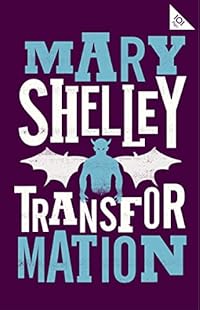
 Transformation cover

This is a reprint of three of Shelley’s short stories originally published in the 1830s in the literary annual The Keepsake. “Spelling and punctuation have been standardized (sic), modernised and made consistent throughout.”

The first and title story, Transformation, is the tale of a prodigal waster, keen to worm himself back into the good books of his sweetheart’s father, offered a body swap by the devil to effect the desired outcome. The writing is obviously of its time but to modern eyes, overwrought.

The unfortunate narrator of The Mortal Immortal seemingly spurned by his beloved, inadvertently drinks an elixir concocted by his employer, the alchemist Cornelius Agrippa, and finds, eventually, he is immortal – or, at least, very long-lived. This is in the now long tradition of unexpected consequences stories.

The final tale, The Evil Eye, is a story of thwarted inheritance, skulduggery, child kidnap and coincidence in the Greece and Albania of Turkish times, apparently influenced by Byron’s Childe Harold’s Pilgrimage, Thomas Hope’s Anastasius and Prosper Mérimée’s La Guzla. It suffers a little through being told rather than shown to us.

Reading these stories in the twenty-first century is an odd experience. What may, when written, have seemed fresh and new is perhaps diminished by the time that has since elapsed and the many authors who have followed in Shelley’s wake.

Pedant’s corner:- a missing comma before a piece of direct speech.

Art Deco in Kendal

Kendal is reasonably out of the way but it nevertheless has some Art Deco buildings.

This one is now a Home Bargains but looks as if it could once have been a Woolworths:-

Art DecoShop, Kendal

There are nice curved swoops below the roofline. It’s a pity the windows’ eyes have been put out, though:-

Art Deco Detail, Kendal

Bodycare has “rule of three” in the windows and the roofline is decoish:-

Another Art Deco Shop, Kendal

It’s not surprising if a Burton’s is deco but in this one the main pointer is the company’s logo just below the roofline. The rest looks older than deco:-

Burton's, Kendal

Card Factory is just about deco. Is it the rendering – sadly now grey rather than white – or the roofline which gives it a deco feel?

Just About Deco, Kendal

Kendal

On the way back up from our Oswestry trip we stopped at Kendal in Cumbria, which lies in the valley of the River Kent.

This rather nice bridge straddles the river towards the town’s southern end:-

Bridge over River Kent, Kendal, Cumbria

Close by and just up from the river is Kendal Parish Church, Church of the Holy Trinity:-

Kendal Parish Church

This angled vie wshows the building off to good effect:-

Kendal Parish Church

Front view with clock tower:-

Kendal Parish Church and Tower

Not Friday on my Mind 56: There’s a Kind of Hush – RIP Les Reed

Songwriter (well, tune writer: he collaborated with lyricists to complete his songs) Les Reed died last week.

Writing for the likes of Tom Jones and Engelbert Humperdinck, Reed was never the most credible with the rock crowd but he helped create a formidable catalogue of notable songs of the 1960s.

It’s Not Unusual, The Last Waltz, I’m Coming Home, Delilah and I Pretend all made No 1 or 2, not a bad achievement for anybody – even if these were mostly bought by Mums and Dads.

Then there’s this song from 1967 (lyric by Geoff Stephens,) and later recorded by The Carpenters.

Herman’s Hermits: There’s a Kind of Hush

Leslie David (Les) Reed: 24/7/1935 – 15/4/2019. So it goes.

The Land the Ravens Found by Naomi Mitchison

Collins, 1968, 190 p. Illustrated by Brian Alleridge.

This is what may nowadays be called a YA novel. In a long-ago Caithness, still forested, Anlaf, the son of Thorstan the Red, himself son of Anlaf the White, longs to become an adult and go on raids with his father against the indigenous Scots. His future is unutterably altered when, perhaps due to information given to a Scot by one of his family’s thralls his father is killed on an expedition. Wise to the possibility of their new-forged vulnerability being exploited they build a boat and set sail for Iceland, the land the ravens found, where Anlaf’s grandmother, Aud, has kin.

Mitchison builds her story well, the obvious research required being well disguised. Reading this would be a relatively painless way for anyone to learn some history of the Dark Age period and the earliest settlement of Iceland. Particularly well-handled are the tensions between those adherents of the Old Faith and the New (Christianity,) the conventions of Viking society and the relative power women held, but the language is tailored to a young audience. Embedded within it is a prophecy that two of the characters are forebears of the first Europeans to have a child born in the Americas.

On the face of it this would seem to be Anlaf’s story but it is really more that of Aud, Cetil’s daughter. It is her family connections that bring the group to Iceland and her influence that pervades the book.

Pedant’s corner:- “‘Doesn’t he knew?’” (know,) prophecying (prophesying,) a missing full stop. In the Postscript; “There are any amount of stories” (There is any amount.)

Evesham War Memorial

Stepped wall with central pillar surmounted by strolling soldier with slung rifle.

From banks of River Avon. Evesham Abbey Belltower behind:-

Evesham War Memorial

Reverse view. River Avon below:-

Evesham War Memorial from Behind

Closer view. Evesham Abbey Belltower again visible.:-

Evesham War Memorial Close-up

Incsription. “To the enduring memory of the Glorious Dead of the Borough of Evesham who gave their lives for their country in the Great War 1914-1920.” That “1920” is unusual.

Evesham War Memorial Inscription

Great War Memorial Plaques:-

Evesham Great War Memorial Plaques

Great War Memorial Plaques, Evesham

Second World War Memorial Plaques:-

Second World War Memorial Plaque, Evesham

Evesham Second Word War Memorial Plaque

free hit counter script