Archives » 2016 » November

Hooge Crater Museum (iii)

German Great War memorabilia in Hooge Crater Museum. In my own Great War collection I have a mug similar to one shown here:-

Hooge Crater Museum 13

Trench Art including inkwells in the shape of Renault tanks:-
Hooge Crater Museum 14

British Great War memorabilia (above) and German (below.) Again I have some of the featured British items in my own collection:-

Hooge Crater Museum 15

More trench art, Renault tank inkwells with poilus’ helmets:-
Hooge Crater Museum 16

Trench art cabinet:-
Hooge Crater Museum 17

More trench art:-
Hooge Crater Museum 18

Mock-up of British dugout:-
Hooge Crater Museum 19

If you are ever in Ypres/Ieper I would recommend a visit to Hooge Crater Museum as well as to In Flanders Fields Museum.

The Three-Body Problem and The Dark Forest by Cixin Liu

The Three-Body Problem, Head of Zeus, 2015, 400 p, translated from the Chinese 三體, Chongqing Publishing Group 2006, by Ken Liu. The Dark Forest, Head of Zeus, 2015, 512 p, translated from the Chinese 黑暗森林, Chongqing Publishing Group 2008, by Joel Martinsen. Reviewed for Interzone 261, Nov-Dec 2015.

 The Three-Body Problem cover

Barring Verne and the genre’s very beginnings, non-Anglophone SF has historically had a low profile in its heartlands. Some Eastern European SF did manage to filter across the language barrier during the Iron Curtain days but was usually a niche commodity. That situation has recently begun to change markedly with SF emanating from outwith the usual source countries. Though not all from non-Anglophone sources, in the past few years I have been able to sample SF originating from Japan, Finland, Israel, South Africa, Nigeria and other former colonial states. Now, aided by Puppygate and its unintended consequence of a best novel Hugo Award for Cixin Liu, his Remembrance of Earth’s Past trilogy looks set to raise the profile of Chinese Science Fiction; which on this evidence comprises hard SF, red in tooth and claw (though arguably not red in political terms.)

The first book, The Three-Body Problem, begins during the Cultural Revolution when Ye Wenjie witnesses the death of her father, a physicist unwilling to bend to the doctrine that the theories which underpin his subject are reactionary, at the hands of Red Guards. Ye herself is sent to a labour camp and further blots her copybook when she reads Rachel Carson’s Silent Spring and pens a letter to the authorities about the environmental depredations resulting from the work of her labour corps but due to her capabilities as a physicist she is assigned to Red Coast Base, an apparently military endeavour.

There is then a jump of forty years in the narrative and we are plunged into a world where nanomaterials researcher Wang Miao is co-opted into a Battle Command Centre – a committee whose members comprise not only Chinese but also NATO generals plus the unorthodox but effective cop Shi Qiang. The world faces a threat (at this point unspecified) related to the fact that physicists are killing themselves as their experimental results are not consistent, leading them to the conclusion that physics varies from place to place and so does not exist. Shi Qiang warns Wang always to look behind the surfaces of things to find the deeper connections.

Strange things begin to happen to Wang; he sees a countdown on his photographs and then on his eyes. This stops when he ceases his research. His wider investigations lead him to an online game at www.3body.net, the playing of which requires a haptic feedback suit, and which is set on a curious world with unreliable sunrises and sunsets, Stable and Chaotic Eras, mysterious flying stars and inhabitants who can dehydrate and rehydrate according to the conditions. Each time he logs into it the game’s history has moved on. He works out the planet has three suns whose orbits form an inherently chaotic configuration. This is Trisolaris. In one of the novel’s structural problems the relevance of this game to the ongoing threat is not revealed till later.

We subsequently find Red Coast was actually a site for SETI investigations and Ye Wenjie had used its antenna – via the sun as a signal amplifier – to send a message to the universe. A reply containing a warning of invasion if Earth responds came from only four light years away and therefore must have originated on Alpha Centauri. The disillusioned Ye, convinced that humanity’s relationship to evil is like the iceberg to the ocean (made of the same material) ignores the warning. Meanwhile a secretive Earth Trisolaran Organisation, ETO, has recruited devotees via 3-body and communicated with the Trisolarans who have developed Project Sophon, the unfolding of protons into different dimensions, to shoot a quantum entangled pair at Earth to completely ruin scientific research and seal off the progress of human science. The Alpha Centauri system of course contains three suns.

The trouble is we are told a lot of this via the medium of 3-body and transcripts of Trisolaran transmissions – most of which content is dry as dust. Human interactions are sidelined, the main instigator of ETO, Mike Evans, advocate of Pan-Species Communism, barely appears in the novel and the chronology of the events is disjointed. While Wang’s nanomaterials background comes in useful in obtaining the Trisolaran transcripts the incident concerned is really the only one which occurs in the novel’s here-and-now.

In his translator’s afterword Ken Liu refers to Chinese fiction having different emphases and preferences “compared to what American readers expect”. Whether this explains the oddness of The Three-Body Problem’s structure the non-Chinese reader cannot tell. And nothing is resolved, the whole is merely a prologue.

 The Dark Forest cover

In The Dark Forest the narrative is much more linear. Earth has 450 years to prepare for the Trisolaran invasion but is now riddled with sophons, making all transactions transparent to Trisolaris. The UN has set up a Planetary Defence Council which initiates the Wallfacer Project whereby four individuals are given more or less absolute power to command resources to further the anti-Trisolaran plans devised in their own minds, (the sophons cannot read thoughts). One character muses, “I wonder whether we could find a form of communication that only humans can comprehend, but which the sophons never will. That way, humanity can be free of sophon monitoring…… A gaze or a smile can transmit so much information!”

The first part of the book follows the progress of the Wallfacers’ plans, the setting up and development of Earth’s space forces and the societal changes which take place under the Trisolaran threat. “Behind them was the Golden Age, the good times that began in the 1980s and ended with the Crisis. Ahead of them, humanity’s arduous years were about to unfold.”

The disparity in force between Earth and Trisolaris is the biggest in human history, defeatism the worst enemy – especially in the space forces. Escapism, the thought of leaving Earth for the wide blue yonder, appeals to some but is soon made illegal as who goes and who remains involves basic human values no matter who gets to leave – elites, the rich, or ordinary people. So long as some will be left behind, it means the collapse of humanity’s ethical value system. One character says, “The fundamental axiom of economics is the human mercenary instinct. Without that assumption, the entire field would collapse. There isn’t any fundamental axiom for sociology yet, but it might be even darker than economics. A small number of people could fly off into space, but if we knew it would come to that, why would we have bothered in the first place?”

There are still occasional forays into 3-body where we find Trisolaris has designated a Wallbreaker to each Wallfacer, to frustrate or reveal their plans.

Curiously – or is this an endemic Chinese habit? – smoking seems to be commonplace in this future even when we have again jumped in time to year 205 of the Crisis Era, after a minor Dark Age called the Great Ravine has more than halved Earth’s population. Most cities are now underground.

The narrative contains a few potential sense of wonder moments. Giant space telescopes, the seeding of space with oil film, “mined” from Neptune’s rings, to reveal the tracks of Trisolaran probes, a space battle which came over eerily like an updated version of E E ‘Doc’ Smith, and other Science Fictional concepts such as the technology to fix beliefs in the human brain. However, there are times when the info dumping can be intrusive and strange interludes such as when Liu allows his characters to discourse on the writing process, “The highest level of literary creation is when the characters in a novel possess life in the mind of the writer. The writer is unable to control them. But today’s practitioners of literature have lost that creativity,” and the nature of the object of love, “not the man or woman of reality, but what he or she is like in their imagination.”

Key to the book are two maxims, “Survival is the primary need of civilization” and, “Civilization continuously grows and expands, but the total matter in the universe remains constant,” plus the related concepts of chains of suspicion and technology explosion.

The Dark Forest bristles with SF ideas while remixing the tropes of First Contact, Generation Starship and disaster tale but these elements sometimes sit uneasily with the stories of the humans involved. Its title’s metaphor encapsulates a bleak explanation for the Fermi Paradox.

Both these novels contain footnotes, mostly to explain specifically Chinese references. Footnotes can be a delight but SF readers are used to neologisms – sometimes unexplained. Their necessity in either book is therefore arguable – and in the cases of Kuiper Belt, Oort Cloud, tokamaks, the strong nuclear interaction and Lagrange point, surely superfluous.

However, together they both suggest Chinese SF has been neglected in the wider world for far too long.

The following did not appear in the published review.

Pedant’s corner:- ahold (a hold,) meet-up (meeting,) to not have heard (not to have heard,) we get tori (correct for the plural of torus) but tetrahedrons instead of tetrahedra, in a 3body argument with “Liebniz”, “Newton” is heard to refer to calculus (Isaac Newton called his system fluxions, calculus was Liebniz’s name for these mathematical functions,) sunken (sunk,) Wallfacers (Wallfacer, singular,) widow (window,) in The Dark Forest the base is called Red Shore (in The Three-Body Problem it was Red Coast,) gasses (gases,) “you only would have” (you would only have,) automatons (automata,) Jupiter is referred to as a liquid planet – it’s a gas giant, impassible (impassable,) shape of sword (shape of a sword,) 120gs (a measurement unit’s abbreviation subsumes its plural so 120g,) miniscule (minuscule,) become (became,) torturous (the context implies tortuous,) off of, use to (used to, x 3.)

Hooge Crater Museum (ii)

More Exhibits.

A canvas carrying pannier:-
Hooge Crater Museum 8

Mannequin of soldier with full canvas carrying pannier. How could he have even moved with all that weighing him down?:-

Hooge Crater Museum 9

Artillery shells of various calibres:-

Hooge Crater Museum 10

Mannequin of a soldier in the uniform of the Liverpool Scottish:-

Hooge Crater Museum 11

Artillery shell fuses and grenades:-

Hooge Crater Museum 12

Machine guns, trench mortars, projectiles, barbed wire roll:-

Hooge Crater Museum 20

Asimov’s Science Fiction Sep 2016

Dell Magazines.

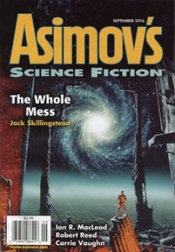
Asimov's Sep 2016 cover

Sheila Williams’s Editorial lists The Thirtieth Annual Readers’ Award Results. Robert Silverberg’s Reflections (“Darn,” He Smiled) remembers the glory days of Science Fiction reviewing by James Blish and Damon Knight including one memorable Blish evisceration of a story that used 89 different expressions for “said” (a practice Silverberg himself thereafter strictly avoided) and laments that the pendulum has now swung so much the other way that would-be writers are positively encouraged to eschew the unintrusive “said”.
Peter Heck On Books1 looks favourably on the latest novels by Charlie Jane Anders, Laura R Gilman, and Fred Chapell, Paul di Filippo’s collection and the non-fiction Breaking the Chains of Gravity: the story of space flight before NASA by Amy Shira Teitel.
In The Mind is its Own Place2 by Carrie Vaughn, Lieutenant Mitchell wakes up in hospital to be told he is suffering from Mand Dementia, an affliction suffered by navigators who intuit the correct coordinates for hyperspace jumps. The story concerns his gradual unravelling of what happened to him.
Dome on the Prairie3 by Robert Reed is an alien invasion story inspired by the works of Laura Ingalls Wilder. Aliens in the form of the Scourge have come to Earth. Our (unnamed) narrator is chosen to try to communicate with a Scourge child dubbed Laura.
In Epitome4 by Tegan Moore, Shelby, a woman given power of attorney by her female lover Vivian (whom for some unexplained reason she cannot acknowledge as such) becomes her carer after a fall causes brain damage. To compensate, Shelby has a hacker friend upload a brain scan of Vivian into the Personify virtual reality programme.
Academic Circles5 by Peter Wood is a time travel story wherein a man uses a time machine to plagiarise academic essays on Philip K Dick and claim precedence. Others have feelings of déjà vu.
In The Whole Mess6 by Jack Skillingstead mathematical genius Professor Dunn is handed an incomplete equation. When he solves it tentacled Masters slip through from a parallel universe and he slides to a third. Only he can undo the change but his abilities are restricted.
All That Robot…7 by Rich Larson sees a man stranded on an island otherwise inhabited by sentient robots sin against their nascent religion.
The best is kept till last – and it’s the best in Asimov’s all year up to now. Ian R MacLeod’s The Visitor From Taured8 tells the tale of Lita, a woman who studies Analogue Literature (old style 2D physical books rather than interactive or non-static narratives,) and her (lack of) relationship with astrophysics adept Rob who is trying to prove the many worlds theory.

Pedant’s corner:- 1Palazo (in a book title! palazzo,) 2“He’d signed in, said good morning to the captain, went to his station” (He’d; therefore [he’d] gone to his station,) “He had to learn to the truth” (learn the truth.) 3a wide range… were scattered (was,) “shifting its aim for a moment that ends when you forcing your attentions to…. (with you forcing? when you force?) 4 freshman (freshmen mad emoe sense) 5Popoov (Popov,) a missing end quote mark. 6 the ‘the Masters’ (only one the needed,) a particularly adept memoirists (memoirist,) I couldn’t breath (breathe.) 7”hoping that the two events to coincide” (the two events coincide.) 8Even in a US publication it is intensely annoying to read in a story by a Briton and set mostly in Leeds and the Outer Hebrides the word “asshole” rather than arsehole, yet there was archaeologist not archaeologist and later maths and “arsed around”. “He fucked about.” (I assume US readers will read this as implying promiscuity – the context leans towards it – but I didn’t. In Britain it means engaging in activities to little purpose, not fulfilling yourself, see “arsed around”,) post-centarian (post-centenarian?) this stuff happen at the atomic level (this stuff happens,) “as if every choice you made in a virtual was mapped out in its entirety” (“world” after virtual?) sung (sang,) span (spun.)

Hooge Crater Museum (i)

Hooge Crater Museum is on the Menin Road just at Bellewaarde, less than a stone’s throw from our hotel. The museum was described in a pamphlet we picked up in In Flanders Fields Museum as the best privately owned museum in Flanders. It’s housed in a former chapel and is utterly jam-packed with exhibits relating to the Great War.

In front of the former doors to the chapel lies this German grave marker:-

Hooge Crater Museum 3

From the Menin Road the path to the museum entrance is lined by stone, shaped as sandbags as if it were a trench:-

Hooge Crater Museum 1

Entrance and door. Again made to simulate a trench:-

Hooge Crater Museum 2

Almost the first thing you encounter in the museum proper is this Fokker DR 1. A Fokker triplane in the scarlet colours as flown by Baron Manfred von Richthofen, the Red Baron:-

Hooge Crater Museum 4

Typical exhibits. (Tank track on left):-
Hooge Crater Museum 5

British Officer mannequin with part of a tank behind:-
Hooge Crater Museum 6

Trench Mortars?:-
Hooge Crater Museum 7

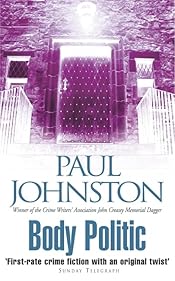
Body Politic by Paul Johnston

NEL, 2003, 349 p

The Body Politic cover

The first publication of this novel was in 1997 when the date in which it is set, 2020, was a considerable time away. That makes it read a bit oddly in 2016.

Edinburgh – like many other parts of the UK – is independent, home to a never-ending tourist drawing festival, from which the city derives most of its income. It is run by the Enlightenment Council of City Guardians, which comes across as a sort of muted cross between a local Council, the Committee of Public Safety and a Kirk Session. The city’s citizens lead a circumscribed existence, unruly beards are obligatory, television, private cars and crime are banned, as is blues music – a problem for former city guardian Quintilian Dalrymple who at the novel’s start is asked by Katharine Kirkwood to find her missing brother. Before long however, a body is discovered whose murder bears remarkable similarities to those of the Ear, Nose and Throat Man from several years before. Dalrymple, as the expert on the previous crimes (and instrumental in their ceasing,) is roped back in to the Enlightenment’s police force (called guardians) to investigate. What follows is the usual tale of corruption, red-herringry and interconnectedness; though carried off with great skill. The crime element is pretty standard fare (as far as my reading of the genre goes) the bureaucratic hassles associated with the policeman’s/policewoman’s lot lent an air of strangeness by the unusual background. Various villains are unmasked, the murderer not whom you might expect. Kirkwood’s brother’s disappearance is peripheral to that aspect of the plot and only really exists to provide Dalrymple with a love interest.

Despite its (altered) future setting this cannot really be considered Science Fiction. In form and content it is more of a crime novel than anything else, there is no speculation involved. Quite why it appeared on the Herald’s list of “100” best Scottish Fiction Books, I’m not sure. I can only think that the Enlightenment might be supposed to be a peculiarly Scottish conception. It has Calvinistic undertones but the things it tolerates – encourages even – have traditionally been frowned upon at best and more usually excoriated.

Somewhat prophetically there is the line, “The USA had reverted to the self-obsession that’s a hallmark of their history.”

Pedant’s corner:- “didn’t use to mind” (didn’t used to,) had lead to (led to,) reponse (response,) “I wanted to sit down badly” (how can anyone sit down badly? – I think Johnston meant “I badly wanted to sit down,”) Mary, Queen of Scots’ (Mary, Queen of Scots is singular so; Mary, Queen of Scots’s,) “The USA had reverted to the self-obsession that’s a hallmark of their history,” (its history; unless you’re talking pre-American Civil War when the United States were referred to in the plural.)

EM-Drive?

This peer reviewed paper seems to be experimental proof of an electromagnetic space drive capable of getting to Mars in 70 days.

At least according to the Daily Galaxy.

It may not turn out that way though (on the face of it it breaks the laws of Physics which of course “You cannae change, Captain,”)* but it still makes me feel like I’m living in the future.

*From this clip Scotty actually said “can’t” rather than “cannae”:-

Art Deco Style Building, Zonnebeeke

I couldn’t help noticing this very deco looking (or possibly Frank Lloyd Wright influenced or maybe it’s just Belgian) building when we passed through Zonnebeeke in Flanders. The tower behind belongs to the Church of our Lady:-

Art Deco Building, Zonnebeeke, Flanders, Belgium

Art Deco Building, Zonnebeeke,

Imagine my surprise when I got round to the front and discovered it houses the Passchendaele Research Centre which seems to be part of the Passchendaele Memorial Museum. Note the “rule of three” in the windows – and even in what looks like a cold frame below them:-

Art Deco Building, Zonnebeeke

Other angle:-
Art Deco Building Zonnebeeke

From rear:-
Art Deco Style Building, Zonnebeeke

Unfortunately I couldn’t get an uninterrupted view of the frontage due to the parked van:-
Art Deco Style Building, Zonnebeeke

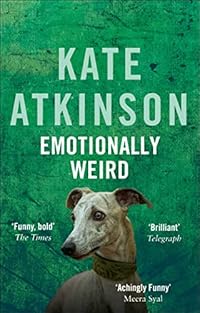
Emotionally Weird by Kate Atkinson

Black Swan, 2015 reprint of a 2000 publication, 489 p

 Emotionally Weird cover

During this, Atkinson’s narrator (by implication Atkinson herself) is at pains to emphasise that it is a comic novel. It is mainly the tale of the student life in 1972 of Effie Stuart-Murray (Effie Andrews as she had thought of herself) ostensibly narrated to, and frequently interrupted by, her mother (who is not her mother) interleaved with said (not)mother’s relation to Effie of her convoluted origins. Extracts from the ongoing novels of some of the characters – including Effie’s own, which Emotionally Weird as a whole is not – appear at odd intervals. All this requires the use of seven or so different fonts (not including italics) to differentiate the various strands.

This is fine as far as it goes – and it is always welcome to find in a novel those fine Scottish words rammy, stushie and stramash (the use of which indicates Atkinson can truly be considered a Scottish writer,) not to mention a Dundee setting – but it is not enough to defuse analysis of a book’s faults by including criticism of it within it. “Too many characters” Effie’s not-mother tells her, and later, “a welcome piece of exposition” to which the reader can only say “indeed.”

Effie’s ongoing failures to deliver essays when they are due is a backdrop to various comings and goings between members of the University staff, students and a private investigator called Chick. There are some wry observations but few if any laugh out loud moments. The intrusion of fantasy elements – possible ghosts, pseudo magic realism, the use of authorial omnipotence to rewind and change events – only adds to the rather unfocused feel. Comic, after all, does not mean anything goes. Curious foreshadowings of Atkinson’s Life After Life and echoes of Behind the Scenes at the Museum exist in her predilection for scenes depicting drowning.

At the sentence level the writing is fine, good even, the characters’ interactions are well observed, their motivations psychologically plausible. The trouble is Effie’s student days are really entirely separate from the circumstances of her birth. While the two story strands are intermingled, sometimes with extremely short jump cuts, they are not really connected except that they both involve Effie. A lampooning of early 1970s campus culture is all very well and might not have been enough to carry the novel on its own – especially when it is elongated beyond its ideal length as it is here – but Effie’s unusual beginnings and relationship with her not-mother do not distract from this. In the end Emotionally Weird just goes on too long to too little effect but within it some seeds of Atkinson’s future triumphs can be discerned.

Pedant’s corner:- still caked in Monro mud (these hills are called Munros,) Cousins’ (Cousins’s,) “and the Hun were” (the Hun was,) “Murdo fell at Mons” (in the previous paragraph he had signed up at age fifteen, three months after his brother “crossed to France”. The battle at Mons was in August of 1914, was followed by a retreat and the British Army did not get back there till November 1918,) “‘if you can’t manage the math’” (the British usage is maths and this USian character had been in Britain long enough to adapt but to be fair to Atkinson I suppose she wouldn’t have,) Descartes’ (Descartes’s; it’s pronounced “day-cart” for goodness’s sake, and its possessive therefore must be “day-cart’s”,) a range of…. farm buildings were (a range was,) primeval (I prefer primaeval,) one of the instances of jumping from strand to strand is a transition which adopts the new font one sentence too early, bouef bourguignonne (bouef bourguignon, or bouef à la Bourguinonne) “‘Jings, crivens and help me Boab’” (jings, crivvens and help ma boab,) Jenners’ carrier bags (Jenners’s,) Scalectrix (it’s spelled Scalextric,) tapsie-teerie (I thought at first this might be a mishearing by Atkinson of the more usual tapselteerie/tapsalteerie but I checked and the Dictionary of the Scots Language has it as a variant,) men-o’-wars (men-o’-war,) Effie Andrews’ (Effie Andrews’s.)

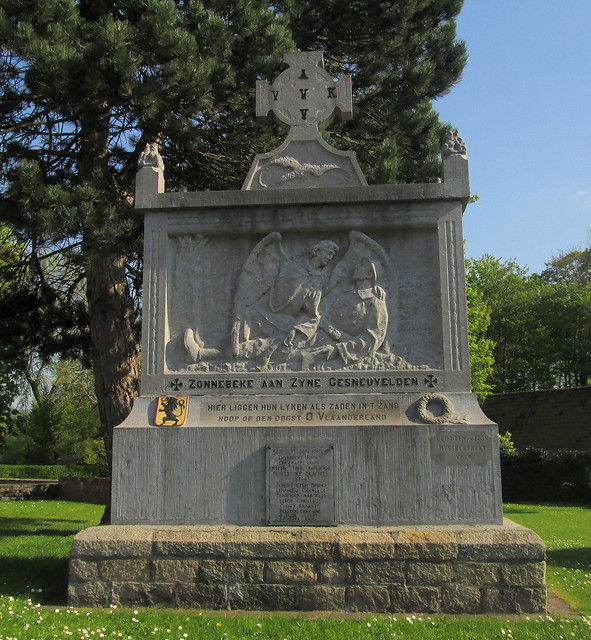
Zonnebeeke War Memorial

Zonnebeeke is in Flanders, Belgium, just west-north-west of Ypres. We passed through it on the way to Tyne Cot and Langemark War Cemeteries.

I had stopped to photgraph a distinctive building in the town (more of which later) and this War Memorial was on the same crossroads.

I could only see the date 1940 on it but Belgian soldiers from Zonnebeeke certainly died in the Great War.

Zonnebeke War Memorial

free hit counter script