Archives » 2016 » November

Wolfhound Century by Peter Higgins

Gollancz, 2014, 307 p

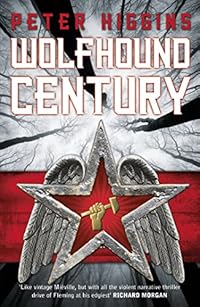
 Wolfhound Century cover

Investigator Vissarion Lom is bobbling along in the regional city of Podchornok seeking out dissidents when he is summoned to the capital city Mirgorod and there tasked with catching a terrorist. The setting is clearly based on Russia, characters have patronymics, the currency is the rouble, distances are measured in versts, the iconography of the cover is Soviet. A secret service head called Lavrentina (Chazia) adds to the impression. But it is a strangely altered Russia, named Vlast, ruled not by a Tsar nor a General Secretary, but by a Novozhd, and perpetually at war with a polity called the Archipelago. Moreover, an Archangel lies imprisoned in the countryside potentially threatening the future but first it has to ensure that the Pollandore, the vestige of an older voice which can undo the Archangel’s vision and is capable of altering reality, is destroyed. Lom has a piece of angel flesh embedded in his forehead “like a blank third eye”, giving him powers to move the air. There are giants.

It is a curious mix. The flavour of the novel is a bit like reading Joseph Conrad, the feel of the society it depicts like late Tsarist era Russia, but there are sub-machine guns. I found the thriller aspect of it to be too conventional, the circles of contact of Lom’s suspects too restricted and their connections too easily uncovered by him but it is an unusual fantasy scenario, all the more welcome for not being based on a mediæval template.

To be sure there is occasional “fine writing” but I’m afraid I lose patience when extra-human powers come into things, although such content may be true to its Russian inspiration. A more major complaint is that the novel didn’t end. An immediate threat was dealt with but the Archangel and the Pollandore were still extant. And quite why it is entitled Wolfhound Century remained obscure. If I see its sequel in one of my local libraries I might pick it up; otherwise, no.

Pedant’s corner:- “He should have waited. Showed his papers.” (Shown,) “his cap pulled down tight down over his forehead (only one down required,) and and (only one and required,) miniscule (minuscule.) “Its not on any map” (It’s,) dikes (USian? dykes,) “broken staithes and groynes” (staithes?) “with the trunk on it back” (its back,) a missing full stop.

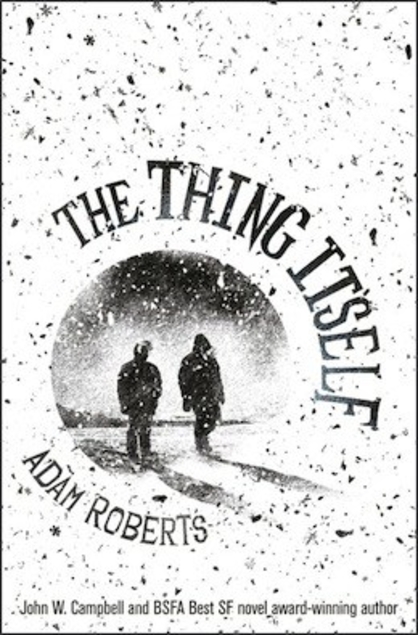
The Thing Itself by Adam Roberts

Gollancz, 2015, 333 p

The Thing Itself cover

I’ve read quite a few novels by Roberts now and there was always – New Model Army perhaps excepted – something lacking about them which nagged a little but what exactly that something was hadn’t crystallised till partway through this one when he alluded to a famous Joseph Conrad phrase. Then it struck me. He was telling the reader what to feel. But, and this is the point, he hadn’t managed to evoke that feeling in me. It was all too distanced, too formalised, not emotionally compelling. Admittedly this novel is one of Roberts’s more abstruse efforts, being an attempt to render Immanuel Kant’s Critique of Pure Reason into fictional form, to speculate on the Dring an sich, the world as it is – as opposed to the one we perceive through our senses.

It may be Roberts has an inkling of this himself as he has posted about the novel’s lack of award nominations or indeed much notice within the SF community and has said he intends in future to produce fiction that is less challenging to the reader. He may be slightly off-beam there. It’s not the challenge that niggled me, it’s the lack of connection. I still haven’t got round to Roberts’s Yellow Blue Tibia from 2009 (which Kim Stanley Ronbinson opined ought to have won the Booker Prize that year.) It’ll be interesting to read it with this thought in mind.

As to the plot here, Charles Gardner and Roy Curtius are on an Antarctic research base in 1986 when something weird happens. The effects of this are to dog Gardner for the rest of his life as he becomes gradually less employable before he is finally embroiled into a (deniable) government attempt to render Curtius and a recently evolved AI named Peta harmless. Breakthrough into the Dring an sich is way too dangerous to allow uncontrolled access. As it is, ripples backward and forward through time from the events of Gardner’s life have already occurred.

Gardner’s story chapters are alternated with others with settings ranging from Mayence (Mainz) in 1900 to a future time war via 19th century Gibraltar (where the rock changes its dimensions every time a couple has sex,) the late 1690s, a list of 89 numbered paragraphs and the days of Kant’s dotage.

With many allusions – the novel’s first sentence, “The beginning was the letter” suggests the first sentence of the Gospel of John, there is a Joycean section, a chapter in Restoration style, that reworking of Kant’s last days – the novel is undeniably dense; but it is not difficult to read. Emotionally, though, it is scanty.

There is a lot to admire in Roberts’s work, it is certainly impressive; but I suspect it is much more difficult to love it.

Pedant’s corner:- “Say what?” (I don’t recall people using this formulation in 1986,) sprung (sprang,) scilla (cilia made more sense,) protruberances (protuberances,) nineties and naughties (noughties, but then again it may have been a sexual pun,) “I was in the verge of something” (on the verge is more usual,) “not eager to say” (to stay.) “And her she held up a single finger,” (And here,) my stomach clenches sharply (all the other verbs here were past tense so; clenched.) “Spaces is,” (Space,) “the torn stitched removed” (stitch,) shuggle (this Scots word is usually spelled shoogle) another Scotticism was “fair” as an amplifier, as in, he fair shrieked. “The sole window right beside the door I had just come in through, and so I took a look outside.” (??) “didn’t phase the clerk” (faze,) Curtus (Curtius,) “who can do as the please” (as they please,) meters (metres, but this was in a future scenario along with the spelling vodka,) Valzha (spelled twice this way, otherwise Valzah,) sphereoids (spheroids,) “in which both paries were male” (parties,) he is sat (seated.,) appeared drunken (appeared drunk, surely?)

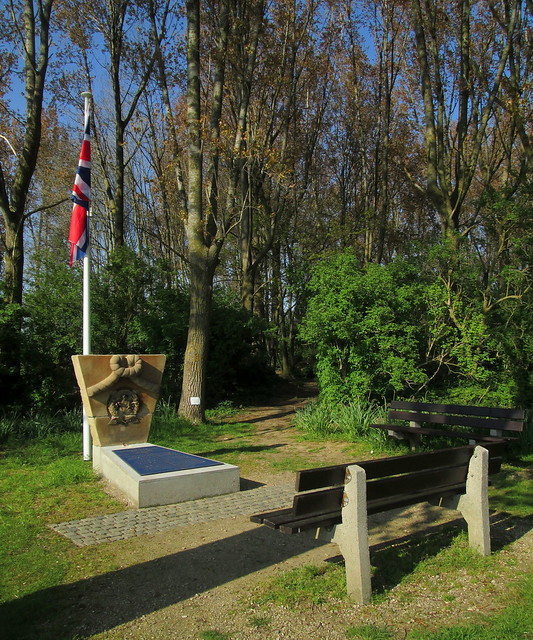
Liverpool Scottish Memorial, Railway Wood, Ypres

The Liverpool Scottish were raised in Liverpool from Scottish stock and wore kilts. They made an attack at Hooge (Bellewaarde) in June 1915 by Railway Wood.

There is a memorial at the edge of Railway Wood.

Liverpool Scottish Memorial near Ypres

Liverpool Scottish Memorial, Railway Wood, Ypres

Friday on my Mind 140: Journey to the Centre of the Mind

I’ve not posted a piece of psychedelia for a while so here are The Amboy Dukes.

The Amboy Dukes: Journey to the Centre of the Mind

Railway Wood, Ypres

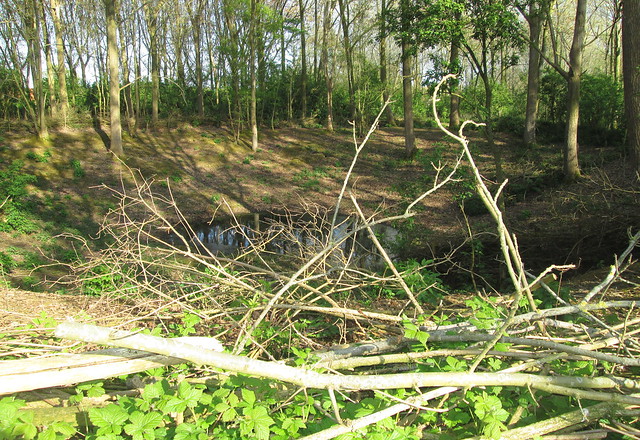
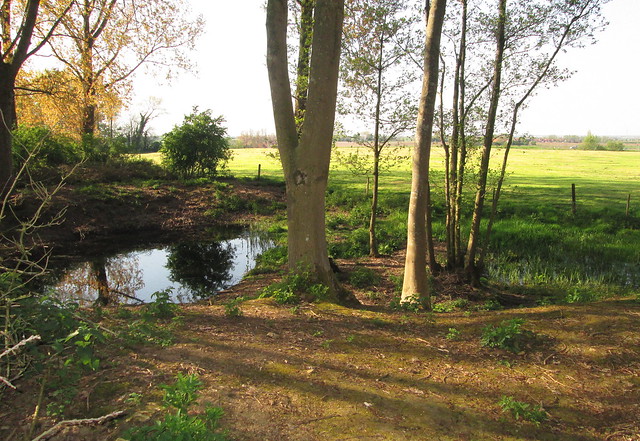
In Railway Wood itself, near the Royal Engineers Memorial, there were several large craters.

Shell Crater , Railway Wood, Ypres

Shell Crater, Railway Wood, Ypres

Shell Crater near Ypres

Shell Crater near Ypres

It was quite spooky walking round the shell shattered ground, the peacefulness contrasting with what it must have been like for the soldiers of both sides, some of whom must lie underneath all this.

Pinned to a tree we found this memorial note for Private John William Ogley:-

Memorial Note for Private John William  Ogley

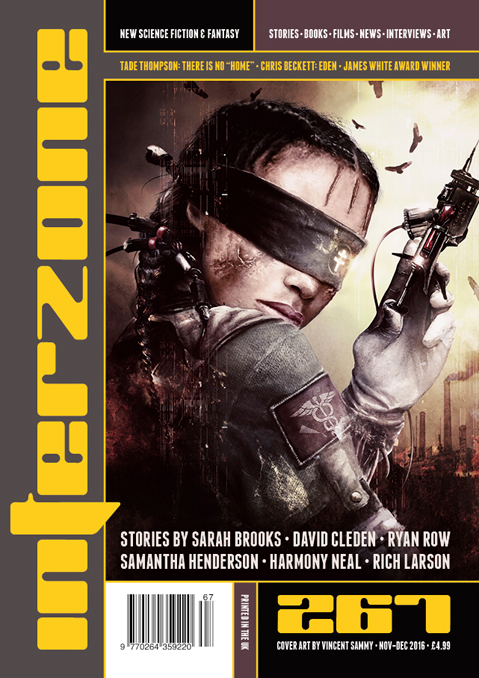
Interzone 267

The latest issue of Interzone, 267 of that ilk, has landed.

Among all the usual stuff this one contains my review of Dave Hutchinson’s Europe in Winter.

Royal Engineers Memorial, Railway Wood, Ypres

From the Menin Road we could see just on the ridge of a hill a Commonwealth War Graves Cross of Sacrifice. A signpost pointed up a very minor road to RE Memorial Railway Wood. We had to make the last bit on foot – past several Remembrance Trees. The line had shifted up a bit from the Menin Road by 1915.

It was now such a peaceful setting with cows grazing hard by the memorial:-

Royal Engineers Grave, Railway Wood, Ypres

Royal Engineers Memorial, Railway Wood, Ypres:-

Royal Engineers Grave, Railway Wood, Ypres, From Access Road

Unless there are at least forty graves a Commonwealth War Cemetery will not have a Cross of Sacrifice. This memorial commemorates only twelve men but the graves are not individually marked, hence the cross.

Royal Engineers Memorial, Railway Wood, Ypres, from Entrance:-

Royal Engineers Grave, Railway Wood, Ypres, From Entrance

Royal Engineers Memorial, Railway Wood, Inscription 1, 177th Tunnelling Company, Royal Engineers:-

Royal Engineers Grave, Railway Wood, Inscription 1

Royal Engineers Memorial, Railway Wood, Inscription 2, six names:-

Royal Engineers Grave, Railway Wood, Inscription 2

Royal Engineers Memorial, Railway Wood, Inscription 3, a further six names:-
Royal Engineers Grave, Railway Wood, Inscription 3

View Towards Ypres from Royal Engineers Memorial, Railway Wood:-

Royal Engineers Memorial, Railway Wood, View Towards Ypres

Crater, Railway Wood, Ypres, Royal Engineers Memorial in background:-

Crater, Railway Wood, Ypres

Sherlock Holmes The Thinking Engine by James Lovegrove

Titan Books, 2015, 304 p. Reviewed for Interzone 261, Nov-Dec 2015.

 Sherlock Holmes The Thinking Engine  cover

After The Stuff of Nightmares and Gods of War this is the third of Lovegrove’s Sherlock Holmes novels for Titan Books. (By other hands there are four more with two forthcoming.) The foreword here, supposedly written in 1927 by a retired Dr Watson, places The Thinking Engine in the interstices between the Holmes stories published in The Strand.

Books which extend a franchise, as it were, potentially have to satisfy more than one constituency; devotees of the originals, those of passing acquaintance, the possibility of attracting new adherents – even the odd reviewer unfamiliar with the oeuvre save, perhaps, as part of the general cultural background. Adherents are catered for here by frequent mentions of previous Holmes cases, a couple of diversions on how often Holmes ever used the word “elementary”, sly references to inconsistencies in the canon, several citings of the Reichenbach Falls and an evocation of the Great Grimpen Mire.

The premise of The Thinking Engine promises a foray into Alternative History, a speculative slant to the proceedings, a steampunk ambience. A certain Balliol Professor, Malcolm Quantock, has constructed the Engine of the title, said to be able to solve crimes merely by providing it with all the data required, and newspaper proprietor Lord Knaresfield has offered a prize to anyone who can disprove its accuracy. How can this fail to interest the Great Detective?

The Engine’s first case is that of the murder of a mother and her two daughters for which the prime suspect, the husband and father, has an apparently cast-iron alibi (involving a dog which did not bark.) Holmes, given access to the crime scene by an unusually helpful policeman, Inspector Tomlinson, solves it in short order. So too does the Thinking Engine, a device of whirring rotors and tickertape print-outs (though it later gains a voice based on phonographic disc recordings.) We have to wait a while for this encounter, though, as in the early chapters we are introduced to a pre-fame Harry Houdini, animating the mummy of an Egyptian pharaoh in the midst of night in order to drum up business for an exhibition of antiquities. Such unlikely meetings with the famous in perhaps unfamiliar roles are one of the small pleasures of Alternative History; but here there are few other instances. We are told Charles Lutwidge Dodgson (aka Lewis Carroll) consults the Thinking Engine on a mathematics problem (and appears crushed by its, evidently correct, solution). Later, Home Secretary H H Asquith and the London Police Commissioner visit to assess the Engine’s suitability to aid in the wider aspects of law enforcement.

The Engine’s second case at first seems more trivial. Student Aubrey Bancroft sends poison pen letters to his tutor but is easily unmasked. This affair takes on more sinister attributes when Bancroft is himself poisoned by strychnine contained in a celebratory bottle of champagne. Another apparent piece of nonsense about the crew kidnapping and replacing the arrogant stroke of a rowing VIII ends in the murder of ringleader Hugh Llewellyn. In both of these Watson is conscience-struck by being unable to save the lives of the victims despite being in attendance.

Holmes’s repeated failures to rebut the Engine delight reporter Archie Slater, who takes great pleasure in lambasting him in print. Yet all the cases bear the hallmarks of the perpetrators being manipulated into their acts. A greater intelligence is at work.
Unlike SF, it is the duty of the detective story, of the detective, to restore order to an errant world. Holmes, naturally, does so, but not before exposing himself to danger and humiliation.

Despite occasional USianisms such as, “it’s down to me,” “So you’ve shown up,” “ruckus,” “fit” used as a past tense and instances of possibly unWatsonian usage like, “Oh pish! Think nothing of it,” plus the surely modern, “You reckon you’ve cracked it?” and, “It fair broke my heart,” it’s all very cleverly done and devotees will (I assume) be pleased enough; but lovers of speculative fiction may be less enthralled. The story sticks closely to the Holmesian template, remains firmly down to earth. Far from being an advance on Babbage’s Analytical Engine, the workings of the Thinking Engine are foreshadowed by the business with the mummy, and resolutely quotidian. Its closest comparator (Spoiler!) is a historical machine known as the Mechanical Turk, which Lovegrove himself acknowledges in the text. After this the revelation of the villain of the piece does not come as too great a surprise.

There are neat authorial touches such as Quantock’s allusion to, “paths laid out before me, following the lead of others,” and Watson’s statement that, “It is possible to have refined tastes and peddle dross,” but this book is one mainly for Holmes aficionados.

These comments did not appear in the published review (but “Americanisms” for “USianisms” did):-
Pedant’s corner:- the book is set in 1895 yet Holmes suggests a criminal would be transported to the colonies. Penal transportation had ended by 1868. There are references to Slater’s bookmaker (but off-course betting wasn’t legalised in Britain till 1960.)
Opuses (the plural of opus is actually opera – though I agree that could be confused with a type of musical entertainment,) medieval (mediaeval.) “Whet my whistle” (a confusion with “whet my appetite”? “Whet” means “sharpen”. The correct phrase is “wet my whistle”.) The chemists (it may be plural I suppose but the context suggests otherwise, so chemist’s,) between him and Quantock (“himself” would be less awkward than “him”,) font of all wisdom (I prefer fount,) “when you have quite so clearly lost” (“quite clearly” or “so clearly” but not “quite so clearly”,) one less villain (fewer,) mostly likely (most likely.)
In Flanders Fields Museum Exhibits (iii)

Italian Field Gun beside horse ambulance in In Flanders Fields Museum, Ypres:-

Italian Field Gun

Machine Gun:-
Machine Gun

Stokes Mortar:-
Stokes Mortar

Trench Mortars:-
Trench Mortars

At the exit there was a list of wars since 1918 – so many I had to take three photographs.

(1):-
List of Wars Since 1918 (1)

(2):-
List of Wars Since 1918 (2)

(3):-
List of Wars Since 1918 (3)

In Flanders Fields Museum Exhibits (ii) Headstones

I didn’t photograph the British headstone as I have posted many of those before.

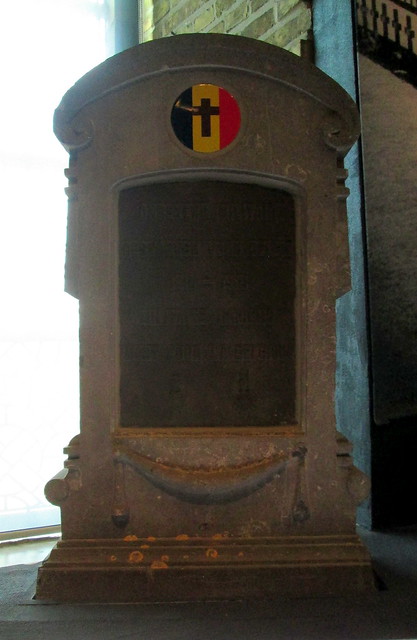
Belgian Headstone:-
Belgian Headstone, In Flanders Fields Museum

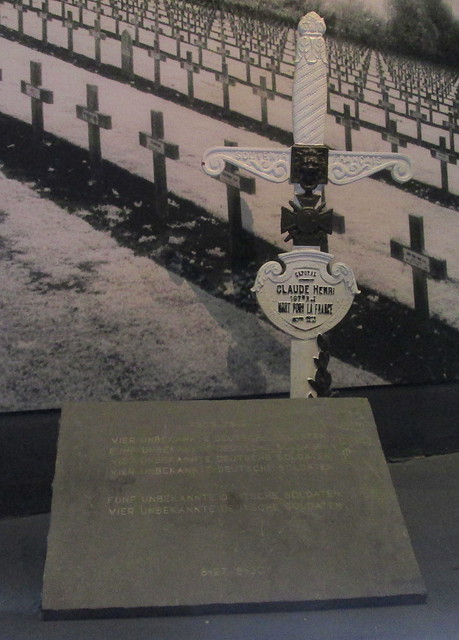
German Grave Marker + French Cross:-
Great War German Headstone + French Cross

German Headstone. Unusual. The German grave markers are usually laid flat. French Cross behind:-
Great War German headstone

Muslim Headstone:-
Muslim Headstone

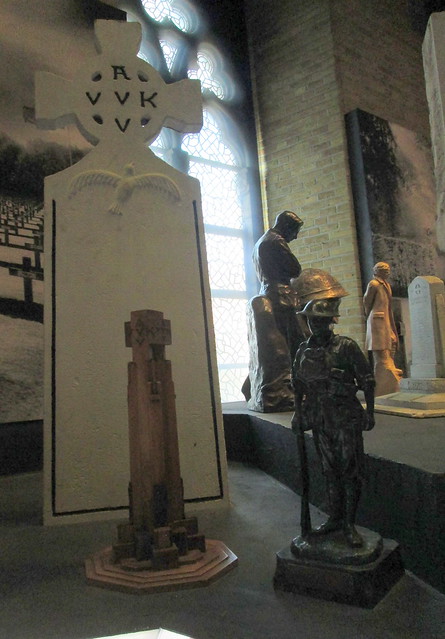
Unattributed Headstone plus various commemorative statuary:-
Unattributed Headstone

free hit counter script