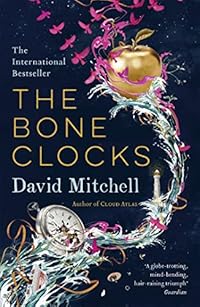
Sceptre, 2015, 620 p, plus 4 p notes on reappearing characters and 4 p author interview.
In The Bone Clocks Mitchell is essaying something similar to his earlier novel Cloud Atlas which also had episodes spanning over time into the future but the six first-person-narrated-in present-tense novellas here are not enleaved within one another nor returned to later as they were in that earlier book but rather follow in chronological sequence; 1984, 1991, 2004, 2015-2020, 2025, 2043. The narratives of Hugo Lamb, Ed Brubeck, Crispin Hershey and Dr Marinus (in the guise of Dr Iris Fenby) are bookended by two from Holly Sykes, who appears in every novella and whose overall life story the book therefore chronicles.
We meet Holly at fifteen years old when she is in the throes of her first love affair, besotted with car salesman Vincent Costello, and at odds with her mother. In her childhood, until treated by Dr Marinus, Holly had heard voices, whom she called the Radio People. Her much younger brother Jacko is also touched by strangeness, old beyond his years. The crisis of this first section is precipitated by Holly’s discovery of Vince’s faithlessness and subsequent running away from home. Classmate Ed Brubeck brings her back with the news that Jacko has disappeared too. Mitchell’s delineation of the teenage Holly and her character is so immersive that the fantastical elements of Holly’s existence feel like intrusions, as if coming from some altogether different story.
Jump to 1991 where “posh boy” Hugo Lamb is holidaying in a Swiss ski resort with his even posher mates. He boasts to them he has never fallen in love (despite having had many lovers) but his meeting with an equally commitment-shy Holly after an accident on a ski-slope changes all that. A happy ending is precluded, though, when Lamb is recruited by the Anchorites of the Chapel of the Dusk of the Blind Cathar of the Thomasite Monastery of Sidelhorn Pass, practitioners of the psychosoterica of the Shaded Way. These fantastical aspects appear almost shoe-horned in so at odds are they with Lamb’s (again brilliantly rendered) persona.
By 2004 Holly has a child, Aoife, fathered by third narrator Ed Brubeck, by now a lauded war journalist. When Aoife disappears from their hotel room at a wedding bash, Holly has a fit of sorts and channels a voice, which resolves the situation. The dynamics of Ed and Holly’s relationship are superbly depicted as are the chaos and exigencies of war-torn Baghdad.
The fourth narrator is Crispin Hershey, once the Wild Man of British Letters but struggling to make a living. He comes across the now single Holly (Ed Brubeck’s luck in bomb-dodging having run out) at writers’ events after she has written a book of memoirs titled The Radio People. Deeply sceptical about her experiences Hershey also witnesses one of Holly’s channelling episodes.
The fifth segment contains the book’s climax as narrated by Dr Iris Fenby Marinus, the latest incarnation of Dr Marinus. She/he is an atemporal, or horologist. When she/he dies he/she will wake up in a new body forty-nine days later, usually with a sex-change. Among horologists’ attributes are telepathy, suasion, hiatusing others, scanning minds and everlasting life (with terms and conditions.) The atemporals are in conflict with the Anchorites of the Blind Cathar who can only achieve immortality by draining the psychosoteric energy of adepts and drinking the Black Wine so produced. Holly aids in the final conflict with the help of a labyrinth in a pendant left to her by Jacko. This is the most fantastical of the six novellas and stands in contrast to the others as its focus lies mainly on action.
The last, 2043, section adds nothing much to the overall story but finds Holly retired to Ireland and looking after her two orphaned grandchildren. It does, though, succeed in portraying a very believable post-oil, globally-warmed, electricity deprived world fallen apart (unless blessed with geothermal power plants as in Iceland.)
The Bone Clocks manages to contain its own critique: at one point Lamb thinks, “‘The Mind-walking Theory, plausible if you live in a fantasy novel.’” Then there is the quote from a review of Crispin Hershey’s come-back novel where Richard Cheeseman says, “the fantasy sub-plot clashes so violently with the book’s State of the World pretensions, I cannot bear to look,” and “what surer sign is there that the creative aquifers are dry than a writer creating a writer-character?” – which is precisely what one could say of Mitchell here except that Mitchell’s writing is superb, mellifluous and engaging – each narrative drags you along – but the gradually uncovered fantastical elements are too in conflict with the realistic treatment, seem too tagged on to be credible. By the time we get to the meat of Marinus’s section disbelief is all but impossible to suspend and the whole begins to seem a bit pointless. I began to wonder if Mitchell was somehow playing a joke on all his mainstream readers who would not knowingly read a fantasy novel. Mitchell’s touch also deserted him with his use of “device” as a verb for texting somebody (or texting’s future equivalent.) Then too there were the intertextual meta-fictional games in the mentions of Black Swan Green and de Zoet and Mitchell’s laying out in a Crispin Hershey lecture of, “The perennial tricks of the writers’ trade dating back to the Icelandic sagas. Psychological complexity, character development, the killer line to end a scene, villains blotched with virtue, heroic characters speckled with villainy, foreshadow and flashback, artful misdirection.” Hershey also observes, “What Cupid gives, Cupid takes away. Men marry women hoping they’ll never change. Women marry men hoping they will. Both parties are disappointed.”
The 2015 narrative mentions ex-President Bashar-al-Azad of Syria and in the 2043 one the nuclear power station at Hinkley Point has been updated by the Chinese but recently suffered a meltdown. The first (and perhaps now both) of these would turn the book into an altered history.
Mitchell can certainly write and creates compelling characters. The Bone Clocks however does not reach the heights that The Thousand Autumns of Jacob de Zoet did.
Pedant’s corner:- must of (must have. OK it was in a character’s voice but even so; authors owe a duty to their readers not to mangle the language unnecessarily,) heat-seeker missile (the term is heat-seeking missile; but again it was in voice,) and and (only one “and” required,) a plethora pass through (passes, but it was in dialogue,) medieval (mediaeval,) Saint Agnès’ (Saint Agnès’s,) “I’ve find I’ve forgotten” (I find,) the the (only one the necessary,) anciliary (ancillary – or was it a confusion with auxiliary?) homeopathy (homoeopathy,) tying ropes around painted steel cleats, “a T-shirt emblazoned with Beckett’s fail better quote I was given in Santa Fe” (reads as if the narrator was given a quote in Santa Fe,) ‘I consider jerking off again’ (the British term is “wanking”,) a Taser (does that need to be capitalised any more?) Hershey narrates his meeting with Hugo Lamb and then Lamb’s redaction of his memory of it; so how could he relate it to us? “A leaf loop-the-loops” (loops-the-loop,) St James’ church (St James’s,) superceded (superseded,) modii (is meant as a plural of modus, so “modi”,) maw (used for mouth, [sigh….]) in the the pram (remove a “the”,) embarass (embarrass,) sailboat (sailing boat.) In the author interview:- “set in Iceland” (it was actually Ireland.)