Archives » 2016 » July

The Persistence of Scott

My previous post’s title was of course a reference to the alternative title of Sir Walter Scott’s first novel Waverley otherwise known as Tis Sixty Years Since.

I am of course reading that author’s The Heart of Mid-Lothian at the moment which means he has been on my mind.

Scott’s influence continued to be felt long after his death. Edinburgh’s main railway station is named Waverley in his honour and there is of course the huge monument to his memory on Princes Street.

Scott Monument

On seeing this Belgian author George Simenon is supposed to have asked, “You mean they erected that for one of us?” then added, “Well, why not. He invented us all.”

Also named after him is the main steamer on Loch Katrine in the Trossachs, the SS Sir Walter Scott, which was built by Denny’s of Dumbarton, dismantled, its pieces numbered, then the whole transported by horse cart to Stronachlachar on Loch Katrine where it was reassembled.

SS Sir Walter Scott
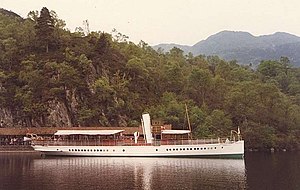
SS Sir Walter Scott

She is by no means the only ship with a Scott connection which I have sailed on.

The Heart of Mid-Lothian‘s main female character is named Jeanie Deans, a name previously familiar to me – at least in her second steamship incarnation – from several of those trips “Doon the Watter” that used to be so much a part of a West of Scotland childhood.

PS Jeanie Deans
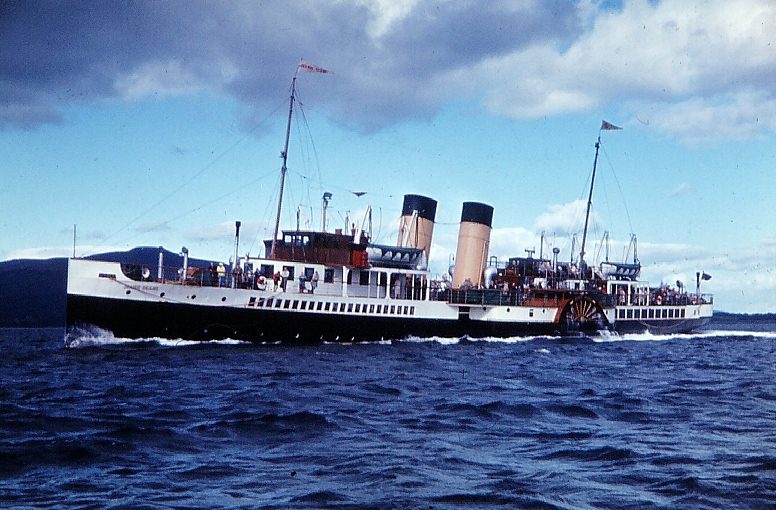
PS Jeanie Deans

There was a short branch line (now long gone) off the main-line station at Craigendoran (about 8 miles from Dumbarton) which took trains right up to a platform on the pier where the ship would be waiting for its passengers to detrain and embark – usually for Rothesay. I believe something similar pertained at Wemyss Bay.

One of the delights of the trip was to descend into the lower parts of the ship to see the engines; mesmerising visions of gleaming, oiled steel and brass, powerful flywheels spinning, pistons thundering, regulators twirling. “Taking a look at the engines” was also used as a euphemism by those suitably aged gentlemen patrons who wished to avail themselves of the licensed facilities on board.

There was also an earlier PS Jeanie Deans. Indeed the North British Packet Steam Company and North British Railway seem to have named their ships almost exclusively after Scott characters. Have a look at this list of their ships, some of which were transferred to later operators.

Only one of these floating mini-palaces still exists. The second PS Waverley (built in 1949) is now the sole ocean-going paddle steamer left in the world and still carries out excursions from its base on the Clyde near Glasgow Science Centre, in the Bristol Channel, from London, the South Coast and Wales under the auspices of the Paddle Steamer Preservation Society.

PS Waverley at Ilfracombe

Waverley at Ilfracombe

If you can avail yourself of the opportunity to take a trip on the Waverley (or indeed the SS Sir Walter Scott, though she is much smaller and does not quite afford the full experience) I would urge you to do so.
‘Tis Fifty Years Since

If you peruse Radio 2’s schedule for today you will find an unusual item at 14.50.

World Cup ’66 Live.

(If you listen to Radio 2 you may also have heard the trailers for this being aired hourly since about the end of April – or does it just seem like that?)

Guys. I know it’s been fifty years and your only major trophy win is not likely to be repeated any time soon. But it’s not as if it hasn’t been mentioned at all in the interim.

Don’t you think it’s maybe time you got over it?

After today might we possibly have a moratorium on the whole business? Please?

What?

Thought not.

Friday on my Mind 135: Excerpt From “A Teenage Opera”

I mentioned this song once before. Its singer Keith West also had an incarnation with the band Tomorrow.

The Teenage Opera from which this was an excerpt did not make its full appearance until thirty years or so later.

As you can imagine being named Jack and at school at a time when a song with the refrain “Grocer Jack” became a hit wasn’t an unalloyed joy.

Keith West: Excerpt From “A Teenage Opera”

Only Six Plots?

My attention has recently been drawn to this website which refers to research in which – albeit limited – data analysis reveals there are only 6 plots (or emotional arcs) into which most works of fiction fit.

Insights of this sort are not entirely new. Others have had similar thoughts.

This clip of Kurt Vonnegut talking about the shapes of different stories is delightful.

Kurt Vonnegut: The Shapes of Stories

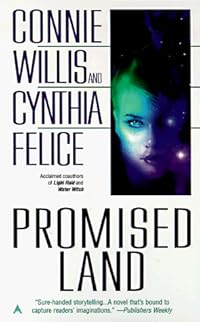
Promised Land by Connie Willis and Cynthia Felice

Ace, 1998, 366 p.

 Promised Land cover

After her mother’s death Delanna Milleflores returns to Keramos, the backwater planet of her birth (from where she was sent years ago to get a decent education) to resolve complications over the inheritance. She wishes to sell up but local laws are strict and do not allow this unless the seller has been in occupation for ten years. In addition her pet scarab Cleo falls foul of the quarantine regulations and she finds that a marriage arranged by her long-dead father between Delanna and Tarleton Tanner (known as Sonny,) the man from the neighbouring farm (on Keramos these are called lanzye) who has been running Milleflores lanzye all these years, became legal. At the space-port she encountered local Lothario, Jay Madog, whose attentions she is plagued by from then on.

The apparent urgency with which her Keramos lawyer, Maggie, says she must take up residence in Milleflores in order to comply with the planet’s inheritance laws, necessitating catching the morning train, is somewhat vitiated by the fact that the terminus is still five thousand miles from Milleflores and it takes weeks to get there. The length of the journey would have disqualified her. The delay of course gives the authors plenty of opportunity to describe Delanna’s lack of knowledge of local customs and conditions and her adaptations to them.

From the start, though, we know where this is going. Delanna’s journey from worldly-wise offworlder (or been-to as they are known on Keramos) to falling in love with her childhood home again – and with Sonny – her accommodations to the idiosyncracies of life on Keramos (including a world-wide radio news and gossiping network where her inadequacies are exposed and everybody’s business discussed mercilessly) has an obvious arc which the authors do not eschew. The traffic is not all one way. She is able to contribute some of her expensively learned been-to computer skills to finding the best routes through dangerous salt-flats.

Promised Land is a very Willis kind of story in which her signature narrative technique of delay by interruption, of not getting to the nub of a situation, which so marred To Say Nothing of the Dog, Blackout and All Clear, is to the fore. At first I thought her co-author Felice had muted this trait but it becomes increasingly irritating as the book progresses. Another quirk is that the main structural building material on Keramos is tile. (Keramos, you see.). Add in a sub-plot about an over-officious vet, Doc Lyle, and his obsession with protecting the wild-life and livestock of Keramos from contamination, particularly the very rare birds called Royal Mandarins, an obsession which threatens to endanger Cleo, and the indigenous animals known as Fire Monkeys (fascinated by Delanna’s red hair) and the elements are present for all the ends to be tied up.

Pedant’s corner:- mowed (mown,) Milleflores’ (Milleflores’s,) Keramos’ (Keramos’s, which did appear once,) solarises (a soralis is a solar powered vehicle: the plural might have been solares but I suppose that could have been misconstrued,) mike as an abbreviation for microphone (still in use in 1998 then) Flaherty’s (this is usually given as Flahertys’ as its plural,) two full stops at the end of one sentence, jerry-rigged (jury-rigged; why do people confuse this with jerry-built?) tamarines (elsewhere always timarines,) species’ (the usage was singular so species’s.)

Glasgow’s Art Deco Heritage 17: Templeton’s Carpet Factory

This should really have been much earlier in this series as it is one of the most striking buildings in Glasgow – and Scotland as a whole.

The former Templeton’s Carpet Factory is by Glasgow Green near the People’s Palace and occupies a sort of square formed by Binnie Place, Templeton Street, Tobago Street and London Road.

This view from the People’s Palace shows the unique combination of eastern and Scottish influences. The West Brewery at extreme left side here:-

Templeton Carpet Factory, Glasgow, from West

This is from a bit further along Templeton Street:-

Templeton Carpet Factory, Glasgow, from Southwest

Strong horizontals and verticals in the moderne style in this Templeton Street view:-

Templeton Carpet Factory, Glasgow East Section

There is fantastic detailing in the upper brickwork:-

Templeton Carpet Factory, Glasgow, Detail

Junction of the “eastern” and “moderne” parts with Scots baronial thrown in to the mix:-
Templeton Carpet Factory, Glasgow

The eastern side of the building, off Tobago Street, has now been converted into flats:-

Templeton Carpet Factory, Glasgow, from East

Further up Tobago Street:-

Templeton Carpet Factory, Glasgow, Northeast section

I had to stitch two photos to get the Tobago Street entrance doorway in. (It appears bent in this; it’s not really.)
Templeton Carpet Factory, Glasgow, East Doorway

The clocktower segment on the corner of Tobago Street and London Road has classic Art Deco lines:-
Templeton Carpet Factory, Glasgow, Clocktower Angle

North side of building – converted into flats. Off London Road:-
Templeton Carpet Factory,Glasgow, North Aspect

Stitch of two photos of west end of London Road aspect. (Again the building isn’t curved.) The West Brewery occupies this portion:-

Templeton Carpet Factory,Glasgow, North Aspect

I’m on the Map!

Literally.

Despite me not having a piece of fiction published for a few years – and only ever one novel – I’ve been included on this map of British SF and Fantasy writers. (If you click on the map it will lead you to its creator’s website, where copies can be purchased):-

Science Fiction and Fantasy Literary Map

I’m humbled by this. Imagine me being on the same map as Alasdair Gray, Iain (M) Banks, Ken MacLeod, Ian McDonald, Eric Brown, Arthur C Clarke, J G Ballard, George Orwell et al. Not to mention J Leslie Mitchell (Lewis Grassic Gibbon.)

Dundee 6-2 Dumbarton

Scottish League Cup*, Dens Park, 23/7/16.

We were impressive in the first half and dominated it apart from a brief interval when they scored a silly free kick to give away at the edge of the box which Mark Brown flapped at.

Robert Thomson held the ball up well and generally looked lively, Ryan Stevenson and Andy Stirling combined well down the left hand side. We played some good stuff. The equaliser followed a cleared corner back out to Ryan Stevenson whose first time cross was headed back across to Robert Thomson (maybe a shade offside) who was under pressure but stooped to head the ball down and Frazer Wright (there’s a novelty; Frazer Wright!) bundled it over the line. The keeper clawed it out and we thought it hadn’t been given at first but the linesman had spotted it as over. The second had parallels a Robert Thomson headed effort had crossed the line – just) before it was cleared. I couldn’t actually see the shot as the guy in front had jumped up to claim the goal and obscured the ball. I just saw it travel into the net. It was soon obvious Gregor Buchanan had hit the shot.

Second half was a totally different story. Dundee looked much sharper and we barely got a kick. Their equaliser was offside though and their third came fom a free-kick that certainly wasn’t a foul – but it was coming. Mark Brown had made a great double save somewhere around there to keep us just about in it but it only delayed things. The last three they just walked through us.

On the first half performance we might just be able to compete this season. On the second we definitely won’t.

*Now the Betfred Cup.

The Devil’s Elixirs by E T A Hoffman

Oneworld Classics, 2011, 287 p including 2p Editor’s Preface, 1 p Notes, iv p Introduction and ii p Chronology. Translated from the German Die Elixiere des Teufels by Ronald Taylor.

The Devil's Elixirs cover

This is not one of the Hoffman stories which Offenbach turned into an opera. It is, though, a very Gothic tale of temptation, mistaken identity, and encounters with the Devil. Francesco, brought up in a monastery with no idea of his ancestry experiences a sexual torment when he glimpses his music teacher’s sister partly dressed. Later he perceives a slight when seen kissing her discarded glove. To resist temptation he resolves to become a monk, taking the name Medardus, and develops a talent for preaching. The reception of his sermons, which bring in a growing audience, boosts his ego. He is, though, plagued by a vision of the painter of the portrait of St Anthony which hangs in the monastery. He is given access to a box which contains bottles left to St Anthony by the Devil. Of course he gives in to the temptation to drink from one, which makes him euphoric. Partly to remove him from the sin of pride but also from temptation, the Prior, Leonardus, sends him on an errand to Rome. There follows a series of fantastical adventures involving the woman Aurelia (who bears a remarkable resemblance to a portrait of Saint Rosalia,) Medardus’s ancestral family, his döppelganger and various deeds of evil on his part in which Hoffman seems to be saying that origins cannot be outrun and we are doomed to repeat the sins of our forebears. (Recognising and resisting the Devil might be an aid in avoiding that, though.) The plot is intricate, the lines of Medardus’s ancestry convoluted, incidents recur in slightly altered form. The story is presented to us at one remove as a found, or, rather, handed over manuscript (the prior who did so thought it should be burnt) written as a penance for Medardus’s sins.

Early on Leonardus tells Medardus that the pleasures of the world, “produce an indescribable disgust, a complete enervation, an insensibility to higher values, which spells the frustration of man’s spiritual life.” Well, maybe to the religious ascetic: but this acts as an indicator of a kind of detachment which Medardus exhibits in his relations with others and the world.

Pedant’s corner:- Cyrillus’ (Cyrillus’s,) Hermogenes’ (Hermogenes’s,) “I threw away the monk’s habit, which still contained the fateful knife, Victor’s dispatch case and the wicker bottle with the remainder of the Devil’s elixir,” (I read this to mean that the habit, knife, case and bottle had all been thrown away; but the last three are still in his possession a few pages later.) ‘“All the floral arrangements,” said my companion, the work of our beloved Princess,’ is missing a start quotation mark before “the work”, louis d’ors (I doubt this is the correct plural of louis d’or. Should it not be louises d’or? Compare “pieces of eight”. [Unless the plural of louis is simply louis in which case the coin’s plural should be louis d’or.]) Descendents (descendants,) imposter (impostor.)

Not Friday on my Mind 41: Paradise Lost

The Herd’s follow-up to From the Underworld kind of carried on from where that one left off but Paradise Lost was still a very odd concoction, with its intro and coda reminiscent of The Stripper but Prog leanings elsewhere.

(By contrast the band’s third single – which I featured in a different context here – was a straightforward bouncy pop song.)

The Herd: Paradise Lost

free hit counter script