Archives » 2016 » July

Langemark German Military Cemetery (ii)

In the first battle of Ypres more than 3,000 not well trained volunteers were thrown into the German attacks and did not leave again so their final resting place is in Langemark. The cemetery is sometimes called the Studentenfriedhof (Student Cemetery) as there was a large number of (school) students among them. A board fills one wall of the entrance building with their names.

Deutsche Studentenschaft Names

Unlike the upright Commonwealth War Graves markers the German ones are rectangular slabs laid flat on the ground. I have seen German war graves before, at Bayeux and Beauvais, so was prepared for that, but those were for World War 2 dead and the feelings engendered by them were more conflicted.

There was something sombre about the arrays in Langemark. The grass was being regenerated after poor weather so at our time of visiting we there was no access to individual graves but from the fence it was possible to take photographs. Langemark War Cemetery, Graves:-

Langemark War Cemetery, Graves

The German practice was to bury 8 men together. These two grave markers name 16 each though. Langemark War Cemetery, Named Graves:-
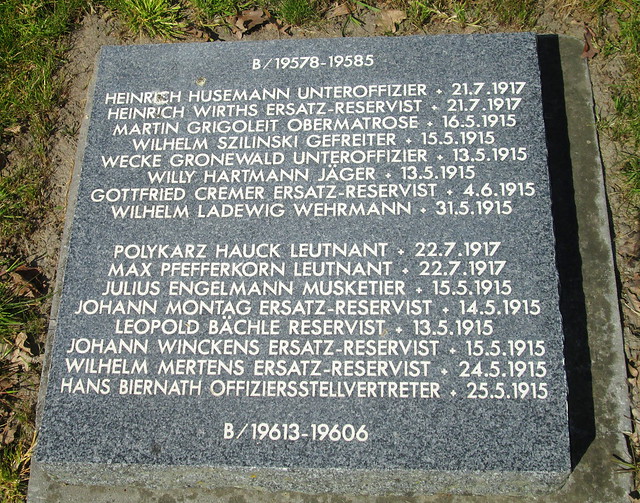
Langemark War Cemetery, Named Grave

Langemark War Cemetery, Grave

Vier Unbekante Deutsche Soldaten (Four Unknown German Soldiers):-

Langemark War Cemetery Grave

Emil Krieger’s Mourning Soldiers Statue from the Kameraden Grab:-

Langemark War Cemetery, Mourning Soldiers

Vier Unbekante Deutsche Soldaten and Nikolaus Jackel musketier, Zehn Unbekante Deutsche Soldaten (Five unknown soldiers, one named rifleman, ten unknown soldiers):-

Langemark War Cemetery, Communal Grave

Langemark War Cemetery, Stone Wreath. The inscription (from Isaiah 43:1) reads “Ich habe dich bei deinem namen gerufen, du bisst mein.” “I have called your name, you are mine.” :-

Langemark War Cemetery, Stone Wreath

Like the cemetery in Beauvais which had few visitors from Germany – few visitors at all (and which I felt bad about not signing the book as I had come across that one by accident and had no pen with me) – not many Germans seem to visit Langemark. (Bayeux was a mainly British/Commonwealth Cemetery with German graves set to one side of it.) I did sign the book at Langemark. However all the tributes surrounding the stone wreath in the picture above seemed to have been laid by British school visitors.

Langemark War Cemetery, Basalt Crosses, Graves:-
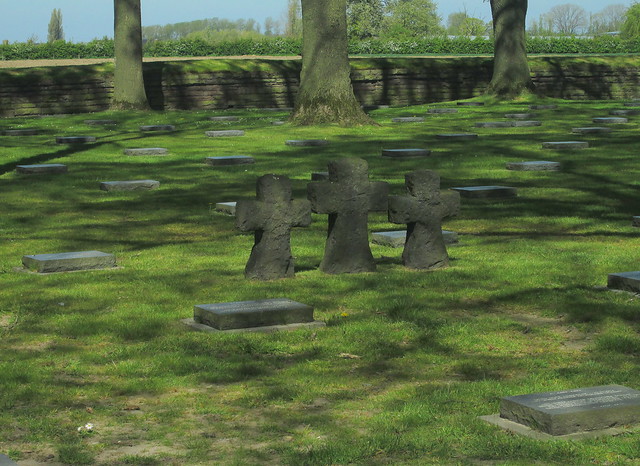
Langemark War Cemetery, Basalt Crosses, Graves

A series of blocks with German words on them snakes through the northern part of the cemetery. These, I think, commemorate the companies of students who were killed here during the first Battle of Ypres. This block says “Rothenburger Verband Schwarzer Schlagender Verbindungen.

Langemark War Cemetery, Inscribed Block

Another, closer, view of Emil Krieger’s statue:-

Mourning Soldiers, Langemark War Cemetery

This Census-Taker by China Miéville

Picador, 2016, 150 p.

 This Census Taker cover

This is a novella from Miéville which is unlike anything of his I’ve read before. A boy sees his father kill his mother – or thinks he does. Knowing his father has previously killed animals (and two people) then thrown them into a chasm in a nearby cave the boy flees downhill to the nearby town and blurts out the news. The locals’ investigations lead to no conclusion as his father says his mother has merely gone away and left a note to say so. The frightened boy – the narrator of this tale written down in recollection many years later – is returned to his father’s care.

In this society there had been a series of disruptions, wars, some time in the past. As a result, people are sent to take stock, to count foreigners, of which the boy’s father is one. One such census taker arrives later to find out the truth of the incident. There is not much more to the story than that but a sense of eeriness pervades the book leading to a feeling that more has been revealed than has actually been said, which is a neat trick for a writer to pull off.

In this regard I was reminded of some of the work of Ursula Le Guin, especially her Chronicles of the Western Shore. The rural setting (though the technology here, even if it is remnant technology, is more advanced than in Le Guin’s stories) and the hint of menace in the surroundings – here more pronounced – are common to both. The sense of oddness, too, of dislocation. There were also some echoes of Emmi Itäranta’s Memory of Water, though I suppose tales of future dystopias will always have elements in common, and, oddly, of Andrew Crumey’s Pfitz.

Pedant’s corner:- no entries. Remarkable in this day and age. (Any day and age?) Congratulations to all concerned.

Langemark German Military Cemetery (i)

Just outside the town of Langemark (formerly Langemarck) in the municipality of Langemark-Poelkapelle, West Flanders, Belgium, lies a German War Cemetery which contains the bodies of more than 44,000 soldiers including the German air ace Werner Voss and two British soldiers who died in 1918. Many of the smaller German war cemeteries in this part of Belgium were consolidated into larger ones such as Langemark in the 1950s.

Langemarck village (as it was then) was the site of the first German gas attack in April 1915.

Stone by Langemark War Cemetery entrance. The five crosses design is the motif of the Volksbund Deutsche Kriegsgräberfürsorge, the German war graves commission:-

Langemark War Cemetery, Stone by Entrance

Langemark War Cemetery Entrance:-

Langemark War Cemetery Entrance

Volksbund plaque inside entrance building:-

Langemark War Cemetery, Volksbund Plaque

This basalt cross is at the cemetery’s corner by the path from the car park to the entrance. Blockhouses can be seen in the cemetery’s interior:-

Langemark War Cemetery, Basalt Cross

Blockhouses and graves from cemetery exterior:-

Langemark War Cemetery, Surround, Blockhouses and Graves

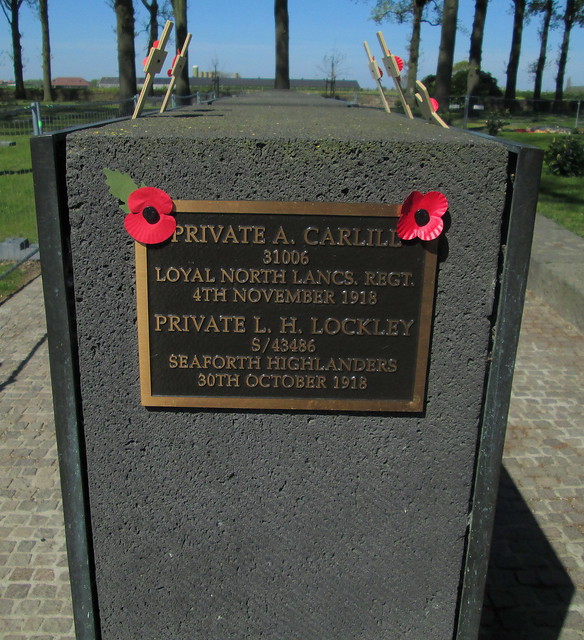
On a series of basalt blocks in the area just behind the cemetery’s entrance are engraved the names of those known soldiers who are buried in the mass grave here, known as the Comrade’s Grave (Kameraden Grab.) The plaque on this first one commemorates British Privates A Carlisle, Loyal North Lancs Regiment and L H Lockley, Seaforth Highlanders:-

Langemark War Cemetery, Basalt Block

Names of some of the known soldiers in the Kameraden Grab. There are 68 bronze panels of these names:-

Langemark War Cemetery, Basalt Block

Langemark War Cemetery, Statues. When we visited this grouping was set behind the entrance building though previously it had been moved from there to the cemetery’s rear boundary. It was designed by Emil Krieger who gained his inspiration from a photograph of mourning German soldiers taken in 1918:-

Langemark War Cemetery, Statues

Life Goes On

In amongst all the stuff going on in the world – a certain referendum result, the resultant resignation by Mr Irresponsible (see posts here,) a constitutional coup d’état in the UK followed by the appointment of a buffoon as Foreign Secretary, an inadequate with mental problems rampaging along a packed, festive promenade in a lorry deliberately targeting families and children, a seeming military coup d’état in Turkey with characteristics that are very odd and which swiftly fell apart, not to mention the ongoing mayhem in Iraq, Syria and so on – people have to get on with things and carry on, marking the milestones in their lives.

So it was that I missed Sons opening game of the season (about which the only thing positive to be said is that we twice came back from a goal down.)

Why did I miss a game so easily travellable for me?

I was at a piss-up in a brewery.

To clarify: it was my younger son’s wedding and the happy couple decided to hold their nuptials at the West Brewery, in part of the former Templeton’s Carpet Factory, near Glasgow Green, (which I now realise I haven’t yet posted my photographs of.)

One of the advantages of holding a wedding in a brewery is …… beer. As well as the usual immediate post ceremony libation of wine the choice of beer was available, great foaming jugs of the stuff (and half-pint glasses – just as well; the beer seemed quite strong.)

Then these two jugs appeared on the table before the meal. The beers were Munich Red and St Mungo, both very palatable:-

Beer

A few minutes later another jug was added. This was a wheat beer of some sort, to the front in this shot. Less to my taste, though:-

More Beer

There was a lot of dad dancing going on – and not just from the older ones like myself. But a good time was had by all.

Asimov’s Science Fiction, March 2016

Dell Magazines, 112 p.

Asimov's Mar 2016 cover

The second issue of the year’s subscription to the magazine my younger son gave me as a Christmas present. Robert Silverberg describes how Walter de la Mare’s story The Three Mulla-Mulgars, read in his youth and many times since, inspired him and fed into his fiction. James Patrick Kelly’s internet overview discusses the pros and cons of reading and writing a series of books.1 In the fiction:-
The Bewilderness of Lions by Ted Kosmatka.2 A data cruncher who can predict scandals goes to work for a politician. Then she is contacted by the people who really run things. Another story which panders to the secret-conspiracy-that-rules-the-world tendency.
The Ship Whisperer by Julie Novakova. An expedition to a black dwarf (which shouldn’t exist) discovers a device that can alter the rate of change of time. The titular character can “talk” to quantum computers, enabling the story’s resolution.
A Partial List of Lists I Have Lost Over Time by Sunil Patel is a series of listicles. I believe it is supposed to be humorous. The author seems to have a particular thing about kale.
Project Empathy by Dominica Phetteplace is about trends, moving elsewhere then finding the norms are different, plus there are Watcher chips inside people’s heads.
Do Not Forget Me by Ray Nayler3 is a story in the Eastern tradition, of tales within the tale – four embedded narratives here – the central one being about a man who doesn’t age. There is nothing really noteworthy here though.
A Little Bigotry by R Neube.4 An ex-soldier down on her uppers is reduced to accepting a contract to be an escort to a former enemy. A fine enough story but reminiscent of Barry B Longyear’s Enemy Mine. Then again, I suppose the point about enemies being worthy of understanding always bears repeating.
New Earth by James Gunn.5 A colony ship from a more-or-less destroyed Erath has reached a new planetary home. Choices and dangers must be faced.
I Married a Monster from Outer Space by Dale Bailey6 is narrated by a woman who takes home an alien who came into the Walmart she works in. This at first unpromising – clichéd even – scenario is, though, only scaffolding over what eventually becomes an affecting tale of love, loss and redemption. I note the references by Bailey – via the narrator’s surname (Sheldon,) her dead daughter Alice and her comment on her status as an invisible woman – to the career of James Tiptree Jr.

Pedant’s corner:- In the editorial; definine (define,) chose (choose,) Lawrence Watt Evans tale (Evans’s,) 1 ambiance (ambience,) 2 she could feel it siding in her fingers (sliding makes more sense,) lobyists (lobbyists,) 3 lay about (lie about.) 4 license (licence,) maw used for mouth (maw means stomach,) accurst (accursed,) 5mentions trees that are not-quite-trees but one of the characters says multi-cellular life hasn’t evolved there. Trees are multi-cellular; the fern-like structures subsequently described would be also. 6Bug-Eyes’ (it’s singular; so Bug-Eyes’s,) Hastings’ (Hastings’s,) laying (lying; plus lay for lie,) breath in (breathe in.) In Paul di Filippo’s book reviews; stefnal to mean science-fictional, a usage I had not come across before, whereas sfnal I was familiar with.

Summer Football

Way back in the dim mists of time the world was a simpler place and football did not dominate the calendar. World Cup finals were 16 teams large and the European Championship only had four qualifiers until it expanded to eight teams in 1980.

In Scotland the football season started on the second Saturday in August and finished on the last Saturday in April.

I thought it was pushing it when the season began edging into July to accommodate the Challenge Cup and altered League Cup format.

Today though is the 16th of July. The schools have barely broken up for the summer. Yet the Sons have a first game of the official season at Station Park, Forfar, in yet another alteration to the League Cup. It barely seemed the old season had ended when pre-season games began.

The squad manager Stevie Aitken has collected seems a little thin. The League Cup looks on paper to be not too daunting but I have no idea how we will fare against the three lower division sides in our group. (I expect to be beaten by Dundee.)

The league is a different matter. Already it looks tough. We’ll be relying on another full-time side to be rubbish (as Livingston were last season) to avoid the relegation play-offs and even then we’d have to finish above Ayr United, by no means a given.

How long we can continue to defy gravity I don’t know. This may be the season we don’t.

Friday on my Mind 134: From the Underworld

When a very young Peter Frampton joined The Herd, the group with whom he made his name, they had just been dropped by Parlophone, but simultaneously brought in composers Ken Howard and Alan Blaikley, who had written a barrowload of hits for Dave Dee, Dozy, Beaky, Mick and Tich and signed up to Fontana. The songs concocted for the Herd were of a different order to those hits though. Elements of psychedelia and glimmerings of prog rock are here.

The Herd: From the Underworld


1610: A Sundial in a Grave by Mary Gentle

BCA, 2003, 603 p.

 1610: A Sundial in a Grave cover

Valentin Raoul Rochefort is a duellist, even though it is illegal, and a spy for the Duc de Sully, who in turn is right hand man to Henri IV of France. In order to protect his patron he is suborned by Henri’s wife Marie de Medici into procuring the King’s assassination. He means to fail by hiring an incompetent to carry out the killing but by chance the assassination succeeds and Rochefort is forced to flee. In attempting to make his escape he encounters a M. Dariole who had previously humiliated him in a duel. As a result of a further defeat (and a sexual humiliation) Rochefort and Dariole end up travelling together. The sparring between Rochefort and Dariole is of the verbal as well as the fencing kind. On a beach in Normandy they rescue a shipwrecked man, Tanaka Saburo, the only survivor of an embassy from the Shogun of the Japans to King James I (of England) and VI of Scotland. Saburo immediately sees M Dariole is in fact a woman. She is Arcadie Fleurimonde Henriette de Montargis de la Roncière, runaway from a premature marriage and much more at home as a sword wielder.

In London the three come under the influence of Robert Fludd – a historical figure here a practitioner of the Nolan Formulae learned from Giordano Bruno who can therefore calculate the future and who wishes (in order to create conditions so that humankind might prevent the impact of a destructive comet in 500 years’ time) to replace King James with his son Henry, Prince of Wales, and asks Rochefort to devise a plan to kill the King. The plan having been deliberately sabotaged with the help of another of Bruno’s disciples and spymaster Robert Cecil many further adventures ensue (including a trip to the Japans) before events are set on a more familiar keel with Prince Henry’s fatal swim in the Thames. We also meet in these pages Armand Jean du Plessis, to whose career our heroes give a boost.

We are presented all this as a found manuscript of Rochefort’s memoirs, partly burned and reconstructed via computer image-enhancement. It is perhaps too convenient that other accounts found in the same box, an extract from the cipher journal of Robert Fludd, two excerpts from Saburo’s report to the Shogun, an account of Roncière’s rape when captive by Fludd, fragments of a play by poet Aemilia Lanier, Roncière’s reflections from old age, so precisely fill in the gaps in Rochefort’s, though the “translator’s note” at the beginning states they are included for that purpose.

For all its glorying in the details of everyday life in the early 17th century (the black mud of Paris, the unwashed state of westerners, the fiddly business of clothing,) the minutiae of sword fighting – and the concomitant outpourings of blood and death – the toying with matters of history, the brushes with hermeticism, in the end this is a love story, peopled with eminently believable characters, replete with human passions, flaws, desires and misunderstandings.

Aside: I find it interesting that since 2000 Gentle has taken to setting her stories in the past (or alternative pasts Ash: A Secret History, Black Opera.) Is there something about the future or the present that she finds inimical to sweeping storytelling?

Pedant’s corner:- de Vernyes’ companion (de Vernyes’s,) laying (lying; also lay for lie, multiple instances,) sunk (sank; ditto,) swum (swam,) “I am not used to be manhandled” (being,) one instance of “amn’t I?” “No woman neither.” (The no is already a negation so “no woman either,”) “ought else” (aught, several instances,) Neopolitan (Neapolitan – which appeared later,) swum (swam,) one instance of Fontainebleu (Fontainebleau occurs elsewhere,) “cowardice on his own behalf” (on his part makes more sense,) Louis Capet (this is usually used to denote Louis XVI after his dethronement in the French Revolution – nearly 200 years after the events of this novel – but since all later French Kings were descended from the first Capetian, known as Hugh Capet, I suppose it may have been a common epithet,) I thought Bedlam might have been another possible anachronism but it seems the word did enter everyday speech in Jacobean times as a synonym for chaos, wernt (went,) Prince of Wales’ (Prince of Wales’s,) “All men do not travel in groups, with firearms” (Not all men travel in groups.)

Theresa May Not

Of course I caught on the news Mr Irresponsible‘s last Prime Minister’s Questions. What a parade of sycophancy that was (with a few exceptions.) The man has been an absolute disaster for the country and he ended up being applauded for walking away from it! [On which note whatever happened to the convention that applause was unparliamentary? They just make it up as they go along.]

And did anyone else notice the journalist’s comment that austerity was forced on him? Forced? FORCED? It was a choice, a political choice that could quite easily have been made otherwise. In all probability it contributed mightily to the situation we find ourselves in. They say journalism is history’s first draft. In this case it was history being rewritten before it was history. David Cameron’s place in history is of course utterly secure – as the worst Prime Minister since the office was instituted, with the possible exception of Neville Chamberlain (though even he managed to delay war with Hitler till the country’s defences, in the shape of the RAF, were just up to the task.)

Then there was the fawning over the new PM, Theresa May. Did nothing else happen in the world today?

I did notice her claim that her government will not be to the favour of the privileged few but for those who are struggling. This reminded me of “where there is discord may we bring harmony” and we know how well that worked out for the less privileged.

And in one of her first acts….. She has appointed Boris Johnson as Foreign Secretary!

Words fail me.

Apart from:- on this evidence, Theresa certainly won’t.

What is Occurring, Terence?

The title of this post is, of course, taken from the TV series Minder, George Cole‘s signature role.

It is however the only appropriate phrase with which to greet the latest news from the soap opera that British politics has become. Yea, verily; Angela Leadsom – it seems only two seconds after anyone first came to hear of her – has abandoned her attempt to become Prime Minister.

So, not only is the architect of the catastrophe, Mr Irreponsible, quitting, his main nemesis been shown up for the buffoon he is and betrayed, his assassin defeated, and one of the last two standing has weaselled out (which is entirely in keeping with the way she weaselled in.)

Who leaned on her? Is Angela Leadsom really so thin-skinned that she cannot take criticism of a statement she made – on tape – to a journalist? Why has she suddenly decided she is no longer the person most suited to run the country? She seemed confident enough about her abilities a week or so ago.

This is the sound of the Tory party closing ranks, partly to presume upon Labour’s disarray, partly because it is just what Tories do. They can be ruthless in cleaving to what they see as their advantage. Its members may feel cheated of their chance to give their input but I suspect the Tory grandees have never been too keen on democracy – even democracy within the party – and may always have been looking for a way to engineer the result they wanted.

But…. To look at it another way it is actually a coup d’état. The Government has been removed and will be replaced with another, another that is liable to propel the UK even further rightwards, make it even more divided, even less fair, even more prepared to kowtow to the barons of the Press and their agenda, even less likely to address the concerns of those whose votes were suborned in order to enable it, even more likely to eviscerate – and even dismantle – the NHS and the BBC.

She may possibly have been the lesser of two evils but if the answer is Theresa May what the hell was the question?

And note, the wider electorate has been totally excluded from all this. I very much doubt there will be a General Election to sanction the change of government and due to the Fixed Parliament Act our new Prime Minister will have four years to do more or less as she wills. Her government’s majority of 12 in the House of Commons will not see serious inroads, unless there are by-elections. Tories, without the bee of the EU in their bonnets, won’t want to upset the apple cart.

On a happier note, congratulations to Andy Murray on winning Wimbledon for a second time. A thoroughly professional, accomplished performance.

free hit counter script