Fly Past of Ceres
Posted in Astronomy at 12:00 on 13 June 2015
Images of dwarf planet Ceres, taken from NASA’s Dawn spacecraft and made into a movie. (Via Astronomy Picture of the Day, 10/6/15.)
Posted in Astronomy at 12:00 on 13 June 2015
Images of dwarf planet Ceres, taken from NASA’s Dawn spacecraft and made into a movie. (Via Astronomy Picture of the Day, 10/6/15.)
Posted in 1960s, Music at 12:00 on 12 June 2015
Firstly, a piece of English whimsy typical of Honeybus, which I have mentioned before.
Like last week’s offering – (Sittin’ On) The Dock of the Bay – Honeybus’s version of this Pete Dello song has brackets in its title.
Honeybus: (Do I Figure) in Your Life?
Joe Cocker reworked it in his own distinctive way – with title slightly amended, and no brackets. In Cocker’s hands the song has a totally different feel.
Joe Cocker: Do I Still Figure in Your Life?
Posted in Football, Reading Reviewed at 12:00 on 11 June 2015
Travels around Italy in search of illusion, national character and …. goals.
Secker and Warburg, 2002, 447 p.

Parks is an English novelist who has lived in Italy for many years. Long fallen under the influence of the Brigate Gialloblù (the Yellow-and-Blue Squad,) “ultras” who throng the Curva Sud of Verona’s Bentegodi stadium for home matches, he conceived of the idea of attending every game of the team’s 1999-2000 season, selling this to his wife on the basis he could write a book about it. The result, though, is not a book only about football and the experience of being a fan, but also an exploration of Italy, the strange divisions, attitudes, enmities and prejudices within that country.
Given that the team Parks is so devoted to is Hellas Verona, not one of Italian football’s superpowers, the book’s subtitle is a bit of a red herring. Goals (at least, Hellas goals) turn out to be in somewhat short supply. This is partly due to the loss of their previous manager, Cesare Prandelli, to a bigger club. His successor is not as accomplished.
As well as the Veronese dialect being derided in the rest of Italy, Hellas fans and Verona itself had at the time (and may still) an unenviable reputation, as racist. (As far as the football club is concerned the nearest British equivalent might be Millwall – “No-one likes us, we don’t care” – but that club’s profile is probably lower than Verona’s, its football history less illustrious. In the miraculous year of 1985, before Parks’s time as a fan, Verona actually won lo scudetto – imagine Millwall winning the English Premiership – but immediately after that incredible outcome the system of appointing referees in Serie A was changed.) A sub-theme throughout the book is the saga of a teacher in Verona who was the subject of an attack because he was a Jew. Most Veronese are solicitous and supportive of him but the national press and media weigh in with stereotyping of all Veronese as racist. The situation becomes ever more complicated when it is revealed that the man did not have the teaching qualifications he claimed, thus putting his job in danger. (But even this is turned against the Veronese.) Neither is any hospital report of the man’s injuries ever produced. The attack may not have occurred at all. However, Parks portrays the fans’ racism as more contrarian and reflexive than real, an assertion of defiance and distinctiveness. An afterword says that a black Colombian made his debut for Hellas two seasons later and was warmly welcomed by the Curva Sud. During the season covered the Verona fans encounters a certain amount of casual violence, both from opposition supporters and the police. (Veronese, being perceived as racist, are seen as fair game.)
The author’s novelistic background shows through at times. The chapters are structured with a fiction writer’s feel and the incidents detailed highlight the points he is making. All but a few chapters are tailed by the Giornata (results) and Classifica (league table) after the fixtures discussed within. Among his more general observations are that, “To do anything in Italy you don’t need to be capable of it. What you do need is a certificate. The document is crucial.” He adds, “There is no people more ready to imagine a conspiracy than the Italians.” Yet “everyone wants their team to win at all costs and everyone earnestly wishes the world to be fair.” Parks concurs with Leopardi who in a book published in 1828 stated that society in Italy is a “school for insult.” The description is even more applicable to football. While not sharing their enmities to local rivals Bergamo, Brescia and Vicenza, when Inter come to town Parks feels the indignation – familiar to fans of wee teams everywhere – of Hellas fans to those Veronese who have turned up to support Inter. “How can they do it?” Mixed in with this is the disparity in resources “the five reserves they” (Inter) “have on the bench are worth more than our whole twenty-five-strong squad put together.” On the iniquities of referees officiating in a match involving a big team at the Bentegodi, Parks says, “The more I think about football, the more I am convinced that injustice is an essential part of it,” adding that the fan of Verona, indeed the fan of a small team anywhere is lucky. “He gets it.” Also, “The truth is that whenever a provincial side come to Turin,” (to play Juventus) “they arrive expecting to be cheated. More than they would anywhere else.” (Welcome to Parkhead and Ibrox!)
The first game is a trial. Away to Bari, eight hundred and fifty kilometres down the Adriatic coast. Not as far as Lecce but bad enough. And held not on the usual Sunday of Serie A matches but as the anticipo at 3 o’clock on Saturday afternoon, and thus the first match of the entire Serie A season. This arrangement is for pay television purposes. A second anticipo is played on a Saturday night and a posticipo on the Sunday evening. I don’t like the concept. Football games ought to be played at the traditional time (football’s soul has long since been sold out, in some cases far too cheaply, for filthy lucre) but I do like the word posticipo. In a circumstance which will be unsurprising to also-rans in other countries only the provinciali, not the big five of Juventus, Inter Milan, A C Milan, Lazio and Roma, are delegated to play on a Saturday afternoon. Parks’s journey to Bari on the Zanzibar bus (the book is dedicated to its denizens, the Zanzibar is the bar from which the supporters bus leaves) is a nightmare full of interruptions and replete with Italian expletives – if you didn’t know what vaffanculo means before reading this book it wouldn’t take you long to work it out – with Parks’s credibility at stake, travelling for hours on a clapped out vehicle stocked with initially suspicious diehards. The game, too, is a trial for the most part but Hellas salvage a draw. For the later game at Lecce Parks uses his projected book as a means to travel with the club. Unable to get there any other way he flies with the team and officials, staying at their hotel. The players turn out to be fairly sad individuals, almost like little boys lost. The game, too, is lost and Parks swears not to travel with the team again.
It is only more than halfway through the book, when the reality of a relegation struggle has become clear, that Parks mentions what he had hoped to avoid, something unthinkable. Verona has another football team, from the suburb of Chievo. Traditionally poorly supported – Parks characterises this as more or less a woman, two men and a dog (I paraphrase) – and habitual denizens of the lower leagues, they have not long been elevated to Serie B, and so are now allowed to play at the Bentegodi but are exemplary, with two black players and fans who don’t invite trouble. Worse still for Hellas fans, Chievo are on course for promotion. Hence Hellas faces the imminent loss both of Serie A status and that of top dog in Verona. It is here that Parks rails at the fact that, without television money – with Serie B and European games added to the schedule it means that there is football on Italian TV every day of the week – Chievo would not be able to afford the players who have brought them success.
While not being beyond personal considerations – he greets the pathetic performances that threaten the club’s status with the thought that “they are destroying my book” – Parks is good on the trials of being a fan. When Bologna score first in the (for Hellas, must-win) third last game of the season he observes, “Then I realised that although I thought I had already abandoned hope before the game, actually I hadn’t. I had pretended to despair, precisely to keep alive the tiniest hidden hope, flickering deep, deep in my breast. Now it was extinguished.” A reaction familiar to all fans who have been in that situation. Then Adailton, “the only Brazilian who can’t play football, as the fans like to say,” (these fans and Parks have obviously never witnessed Rafael Scheidt) scores a beauty. Verona go on to lead the game but almost throw the win away.
The season ends on a triumph of sorts. Five points behind with three games to go was a situation never before retrieved in Serie A. Yet Hellas still ended in a three-way tie for the last relegation place. In the complicated way Italian football approaches these things there can only be one pair of teams to play-off. Lecce came top of the calculation of the relevant results so Hellas had to confront Reggina (to whom they had lost at home in the normal season while drawing away.) That normal away game was played in Sicily, in Catania, as Reggina were being punished for crowd trouble. So after a 1-0 win at home, Parks travels for the first time to Reggia di Calabria for the final game. Only one plane can get him there, the team’s, which of course he had forsworn. Nevertheless he has to go. At 2-0 down an away goal means survival. Its achievement is succeeded by an excruciating period of Reggina pressure and an heroic display by Verona’s goalkeeper, Ferron. An orgy of violence towards the away team, officials and fans follows the final whistle.
I note that Parks describes Luca Toni – playing for the opposition – as spending the game falling over, seeking to win free kicks. I once commented on another blog that the spectacle of said player resembled a tree trying to play football; a comparison that blogger described as inspired.
Pedant’s corner:- having if off (it,) national Italian team (Parks’s sojourn in Italy is perhaps in evidence here, the usual order in English is Italian national team,) for convenience sake (convenience’s,) indignance (indignation,) Seishelles (Seychelles – though the misspelling may have been a reproduction of that of one of Parks’s students of English,) place kick (free kick,) that can effect the timing (affect,) sung (sang.)
Posted in Dumbarton, Dumbarton FC at 12:00 on 10 June 2015
A snow-capped Ben Lomond on 2/5/2015. Photographed from stand of Dumbarton Football Stadium. Ben Lomond is the only Munro I have climbed. (I say climbed. There’s a path. You can walk up it.)

On the same day and from the same location I took this photo of Sons players applauding the fans after the last game of the season vs Raith.

Most of these players have now left the club.
Posted in War Memorials at 20:23 on 9 June 2015
This stone is inlaid into the paving round the Doulton Fountain outside The People’s Palace, Glasgow Green.

It commemorates Henry May, the Cameronians (Scottish Rifles,) 2/10/1914.
Was this the first WW 1 casualty from Glasgow?
Edited to add (13/6/15):- I’ve just noticed the insignia inscribed on the stone is of a Victoria Cross. I presume therefore that Henry May won that medal hence his commemoration.
Posted in Glasgow, War Memorials at 12:00 on 8 June 2015
My pictures of this memorial from last December were taken in the dark.
This was in daylight. Shows the flanking lions off well:-

Obelisk and horizontal sculpture:-

The sculpture resembles the fossil of a creature’s skeleton. The latin word “Pax” (peace) can be seen to its right here:-

Posted in Art Deco, Glasgow at 12:00 on 7 June 2015
This one’s in the east end of the city centre part of Argyle Street. I missed it last December but got a photo early last month. Superstructure and windows. Nice scrolling on the stonework and lovely stained glass but needing cleaned up methinks:-

Pity it’s so dilapidated. Close-up on the windows:-

At the bottom of Buchanan Street and on the corner of Argyle Street and St Enoch Square is what used to be Arnotts department store and is now a branch of Bank of Scotland.
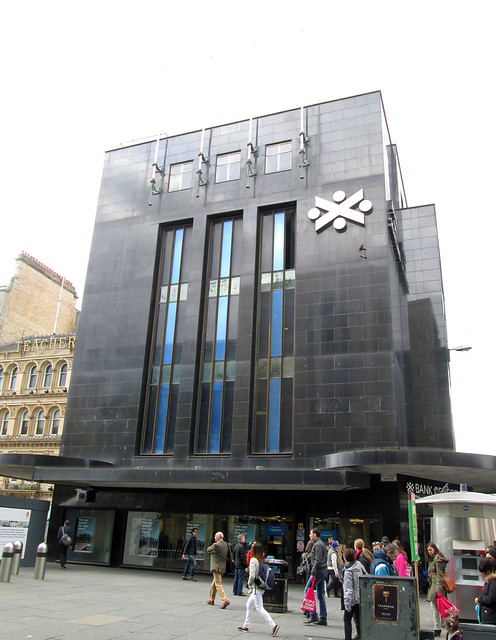
Below is the Argyle Street elevation of HSBC. For Buchanan Street elevations see here.

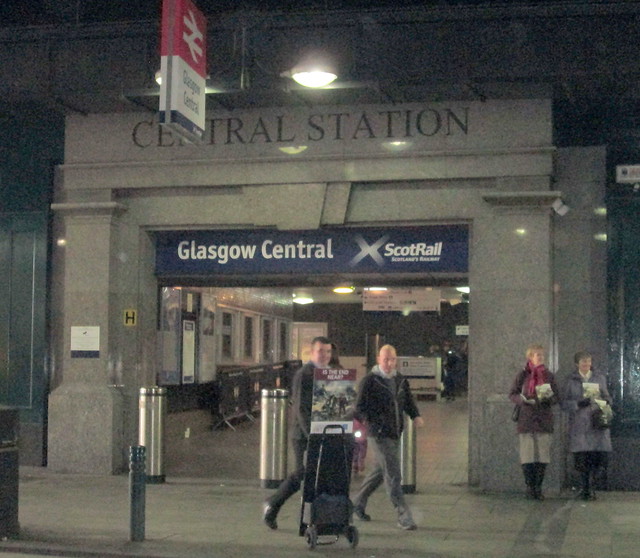
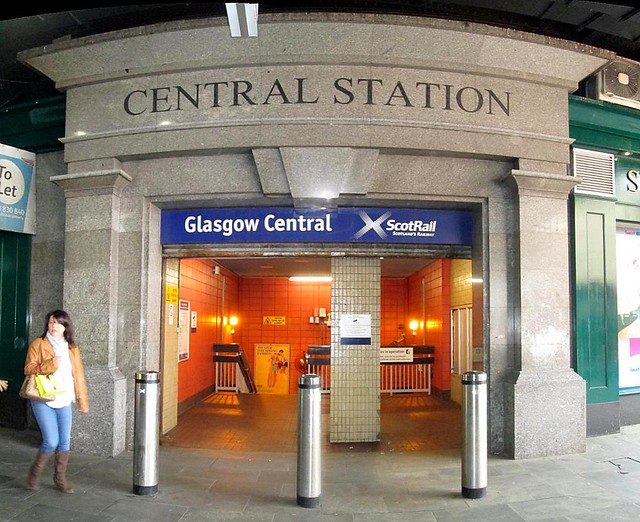
Under the Hielanman’s Umbrella is this entrance to Glasgow Central Station:-
There is a similar entrance on the south side of the street. (Stitch of two photos.)
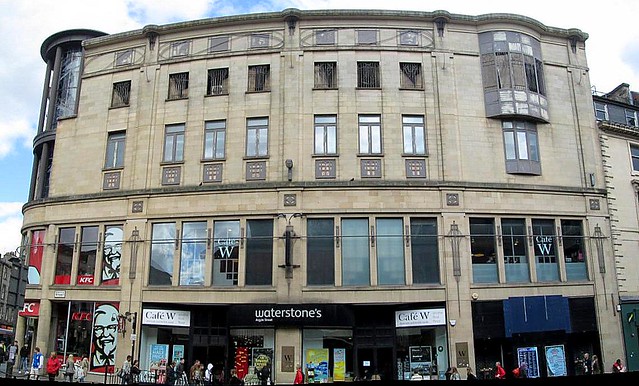
Below is the Argyle Street frontage of the Mackintoshed up building whose Union Street aspect I featured here. Again a stitch of two.
Posted in Orhan Pamuk, Other fiction, Reading Reviewed at 12:00 on 6 June 2015
Vintage International, 1998? 176 p. Translated from the Turkish, Beyaz Kale, by Victoria Holbrook.

Apart from a present day introduction which frames the tale within as a found manuscript, The White Castle, Pamuk’s first novel, is set in the 17th century, narrated by an educated man from Empoli who is captured by the Turks and taken to Istanbul where he is given into the care of someone called Hoja (‘master’) who could be his double. The intention is that his learning will help Hoja in his efforts to produce better fireworks. Hoja also uses his captive’s knowledge to impress the Sultan, eventually gaining the post of royal astrologer. The two become involved in the question of why they are the way they are, the narrator confessing his past faults (which Hoja cannot.) In the process Hoja learns all about the narrator’s past. This makes the narrator increasingly uneasy, imagining Hoja, armed with this knowledge, being able to travel to Italy and take his place there, though of course in the meantime also learning about Hoja. They work for years on an “incredible” weapon – a wheeled, armoured contraption that gets bogged down when attacking the white castle of the title. This failure leads to Hoja vanishing (to Italy?) and the narrator taking his place as court astrologer, even marrying and having children. The subtlety of this is that it is possible that it is either of them who is actually narrating the story, the Italian – or Hoja. Have they really swapped places, or merely pretended to? If someone can give a realistic, convincing, appearance of being someone else, living as that person, do they actually become so? And does it matter if they are not?
Posted in 1960s, Music at 12:00 on 5 June 2015
Like Hard to Handle, Otis Redding’s biggest hit was released after his death. So it goes.
Not typical Redding, it has a more reflective feel.
Otis Redding: (Sittin’ On) The Dock of the Bay
Posted in Events dear boy. Events, Fantasy, Horror, Science Fiction at 22:00 on 4 June 2015
I saw in today’s Guardian Tanith Lee’s obituary.
Despite her prolificity, I don’t recall reading much of her work (SF, Fantasy and Horror in the main) but her name was familiar to me. I may have noticed at the time that she wrote two episodes of Blake’s 7 but it wasn’t something I had at my front of my mind.
She was notable as being the first woman to win the British Fantasy Award for best novel (for her book Death’s Master.)
Tanith Lee: 19/09/1947 – 24/5/2015. So it goes.
