Archives » 2015 » June

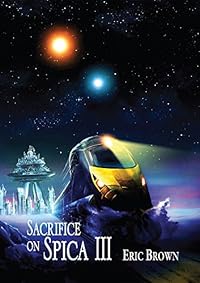
Sacrifice on Spica III by Eric Brown

The Telemass Quartet II, PS Publishing, 2014, 81 p.

 Sacrifice on Spica III cover

Still in search of his wife and daughter, Matt Hendrick has arrived on Kallithea, a planet with an eccentric orbit around its two primaries which leads to a five year long winter, but before he even steps off the Telemass platform Hendrick is sidetracked by a chance meeting with Ed Miller, a former colleague in the Amsterdam Police, into tracking down Katerina Nordstrom, wanted for the murder of her lover back on Earth. Nordstrom just happens to have been Hendrick’s first real love, when he was a tyro detective twenty years ago. Also on the trip are Acolytes of the Ice, members of a bizarre cult inspired by Kallithea’s native culture, whereby devotees give themselves up to death in the freezing wastes.

A weird religion, past traumas, a private life tangled up with the mission at hand, are all typical Brown tropes. Once again it is the changes he rings on the ingredients that provide the impulse to keep reading. The details of the immolation cult are strange and Brown renders them well.

In the context of the Telemass Quartet it is perhaps a drawback that Hendrick’s personal quest is a sideshow to this novella’s plot, though. It causes him to take his eye off the greater ball and so his wife and daughter evade him. No spoiler really as of course this serves Brown’s purposes, as Telemass III and IV are still to come.

Pedant’s corner:- as its swung away (it,) epicentre, “I wouldn’t have through Kat” (thought,) the beneficent gaze His Holiness (gaze of His,) what as right (what was right) and a fair few instances of “time interval” later.

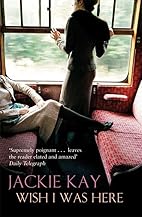
Wish I Was Here by Jackie Kay

Picador, 2007, 202 p.

Wish I Was Here cover

I was impressed by Kay’s novel Trumpet last year. This is her second book of short stories. I have yet to read her first. Wish I Was Here has very wide margins so you’re actually getting fewer words than you might think but all the stories are insightful and magnificently readable. There are only occasional intrusions of Scottishness into the narratives.

You Go When You Can No Longer Stay relates the breakdown of the twenty-five year relationship between Hilary and Ruth; a breakdown premonitored by Hilary quoting from Martin Amis – one example of which provides this story’s title. Another such bon mot (which actually is nonsense) is, “All marriage turns into a sibling relationship.”

In What is Left Behind1 a (heterosexually) married woman who has monthly trips away for assignations with a female lover remembers all the rooms they have (not) slept in. This one is written in USian from a USian’s viewpoint.

Wish I Was Here2 has a woman whose best friend has recently found a New Lover (also a woman) wait for the couple to arrive at their holiday hotel. In this story what is not said, what the narrator does not think – what she dismisses – is what is most important.

In How to Get Away with Suicide3 Malkie spends his day trying to think of a way to commit suicide while making it look accidental. This is because his wife has left him for another man, and taken the kids. Among his observations are, “Glasgow’s changed; it used to be a dark city and now it’s light,” and, “it’s only love that matters in the end.”

Blinds features a woman who has recently split up with her partner having a conversation with the man who comes to measure up for the blinds in the terraced cottage she’s just moved into. She feels exposed. Of the woman who waves and smiles into her kitchen she thinks, “We all want friendly neighbours, of course. But too friendly neighbours fill us with alarm and dread.”

In The Silence a man asked by his wife to, “give me a minute’s peace at my breakfast,” tells her, “I’ll shut up, then.” And does. For ever.

My Daughter the Fox3 is a metaphor about motherhood and the disruption it brings. It tells the story of a woman who gives birth to a fox. She names her offspring Anya.

What Ever5 gives us four snapshots from the life of Ina McEwan, each one featuring an encounter with bird life, respectively quails, a little tern, a robin and a gull.

In Not the Queen6 Margaret Dorothy Lockhart is a Glaswegian woman who is the spitting image of the Queen. She has been since birth. It isn’t a happy thing to be.

Pruning.7 A woman whose female partner of fifteen years is having an affair with another woman finally loses it. The last line here is deliciously ironic.

The longest and most affecting of these tales is Sonata8 in which a woman on an all-night train journey through an unnamed Eastern European country hears the story of another. Contains perceptions such as, “The ugly have no rights. They don’t even feel the right to be loved. They feel grateful for the simplest of kindnesses,” and, “And what does it all matter, those petty jealousies compared to a life, a love, what does it matter.”

In The Mirrored Twins9 two male mountain climbers who have become an item set out one day to see the mirrored twins of Ben More and Stob Binnein. One of them observes, “If people just came out and walked up here every now and again, there would be less wars.”

Pedant’s corner:- 1 The song lyric, “Sonny, once so true, I love you-ooo,” is quoted. I always understood that to be ”Sunny one so true.”
2 Unless the narrator is again USian the use of “New Years” ought to be New Year.
3 Despite Malkie being Glaswegian the word bairns is used for his children. Also Kenny Dalgleish should be Dalglish.
4 medieval
5 When first encountered the family is referred to as the McEwan’s but later on the same page – correctly – as the McEwans. “It was the site she returned to, what ever.” I can’t see the purpose in rendering whatever as two words.
6 I hate the formulation “Queen of England.” In its first appearance here it may be forgivable as it’s that woman herself looking in the mirror – but she surely knows well enough she is Monarch of many other countries besides. But for Maggie’s fellow Glaswegian husband to say, “not a bloody person in the whole of England wid be able to tell the difference!” strikes me as unlikely as he’d be more than aware that he didn’t live in England but still had the same Queen. On a train journey south Maggie knew Scotland changed into England “but she couldn’t see the difference properly.” Really? No difference in the patterns of fields, in the appearance and dimensions of houses?
7 ass (arse.)
8 “you have those kind of looks” (that kind – or those kinds.)
9 “there would be less wars” (fewer.)

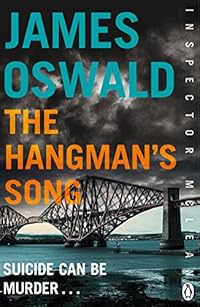
The Hangman’s Song by James Oswald

Penguin, 2014, 321 p.

This is the third of Oswald’s Inspector McLean books. For my reviews of the previous two see here and here.

 The Hangman’s Song cover

Part of the background to The Hangman’s Song is the move from regional Police Forces to an integrated whole Scotland Police Service. Among other factors this produces in complicating a policeman’s lot it has meant McLean’s bête noire, Acting Superintendent Duguid, has been temporarily promoted to commanding officer, and has seconded McLean to work with the Sex Crimes Unit while still having a normal case load. The ongoing chaos to Edinburgh’s traffic caused by the installation of the new tram system mirrors the disorganisation within the force. In the meantime, McLean’s love interest, Emma, has only just recovered from the coma in which she ended the last book and has lost her memory, or at least the recent portion of it.

The novel starts off with an incident engaging the Sex Crimes Unit but the main plot concerns a series of suicides by hanging about which McLean harbours doubts. On this point (possible spoiler) it stretches credulity a little that once again people known to McLean in his personal life are tied up with the crimes. (Clues for this appear very early on.) Another repetition is that hints of the supernatural intrude into the narrative. (I would argue these are always unnecessary in a crime novel, tending to absolve the humans of responsibility for their actions.) McLean of course solves the crimes to his satisfaction – what else is detective fiction for? – but the world isn’t quite set to rights so there is ample scope for further novels

It is very readable stuff, though.

There’s an extract from the fourth Inspector McLean book Dead Men’s Bones making up the last 32 pages of this volume. Is there a point to this naff practice beyond the wasting of paper and shelf space? Anyone who wants more like this will most likely buy that book or read it anyway, anyone who doesn’t, won’t.

Pedant’s corner:- “the top of her piling system” (the context implies filing system, but if it was intended as a portmanteau coinage for “piled high set of files” it’s brilliant.) Otherwise:- shrunk, mementos (mementoes,) tie-died (tie-dyed,) medieval, “there were no franking mark or stamps” (I’d be happier with “was no franking mark” and a comma before the “or”,) “Aren’t I? (the Scottish usage is “Amn’t I?”) “None of the names were repeated” (none is singular, so that verb should be “was”,) sprung (x 2,) rung off (rang off,) “Let it go and move one” (on,) care off (care of,) elevator (lift,) the whole of Lothian and Borders were crawling (again; whole is singular, so “was crawling”,) a team were working (a team is singular so “a team was”,) “sixth form” (in McLean’s case, since he went to a public school in England, this is fine, but the character speaking to him ought to know the Scottish term is “sixth year”,) for you information (your.)

League Fixtures 2015-16

The full list has been posted on the club’s website.

Those first four look awkward; though maybe Queen of the South will not be as good as the past two seasons. But our home record against them is mince. I believe they haven’t ever lost to us at the Rock.

The run-in’s not too bad, the away game at Ibrox perhaps excepted. Will the last game – at Alloa – be crucial?

Reelin’ In the Years 104: Mona Lisas and Mad Hatters

For some reason last week’s featured song always merges into my head into this one by Elton John (from his Honky Chateau LP.)

The mandolin on this is great.

Elton John: Mona Lisas and Mad Hatters

Ensign Ewart and the Scots Greys at Waterloo

200 years ago today the last battle of the Napoleonic Wars was fought at Waterloo. Famously remembered as a “close-run thing” (though the quote is apparently “It has been a damned nice thing — the nearest run thing you ever saw in your life,”) it was a bloody nightmare. A total of around 48,000 men were killed inside 10 hours.

Last month I visited Edinburgh Castle. Among the memorials on its esplanade is this one, erected in 1938, to Ensign Charles Ewart, of the Royal North British Dragoons (more commonly known as the Scots Greys,) who captured the Imperial Eagle of the French 45th infantry regiment during the battle.

Ensign Ewart Memorial Edinburgh Castle Forecourt

The Eagle itself is normally on display in the relevant Regimental Museum in the castle grounds but it wasn’t on the day I visited. I think it’s on loan to the National Museum of Scotland at the moment. I did find, though, this Memorial to the men of the Scots Greys who died in the Great War.

Royal Scots Greys Memorial, Edinburgh Castle

Also, inside the Castle’s Great Hall, there is a painting, executed by Richard Ansdell some thirty years or so after the event, of the moment of the Eagle’s capture. Titled “The Fight for the Standard” the picture is huge – 13 ft by 11 ft. It is somewhat triumphal in tone and perhaps ridiculously sentimental given the likely conditions of the actual battle.

The Fight for the Standard by Richard Ansdell

Picture from Eric Gaba at Wikimedia Commons.

Perhaps a more famous painting of the Battle of Waterloo is “Scotland Forever!” by Elizabeth Thomson, Lady Butler.

Scotland Forever!

The original is in Leeds Art Gallery but a reproduction is in the Regimental Museum.

Henry Bell Memorial, Helensburgh.

The first person to apply steam power to shipping was Henry Bell, in 1812 with his ship, the Comet and I posted about the two hundredth anniversary of the beginnings of steam navigation almost three years ago.

One of the obelisks I referred to in that post is on the front at Helensburgh. I photographed it last month.

Henry Bell Memorial, Helensburgh

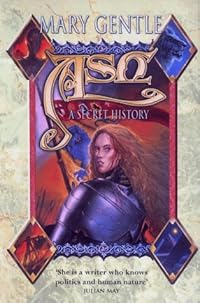
Ash: A Secret History by Mary Gentle

Gollancz, 2000, 1114 p.

 Ash cover

The main parts of this compendious novel are framed as a (complete with footnotes) modern academic translation from mediæval Latin of several “found” manuscripts depicting the life of Ash, the female leader of a company of 15th century mercenaries whose emblem is the Lion Azure. These are presented in the form of “Ash: The Lost History of Burgundy” as by “Pierce Ratcliff, Ph D.” Ash, like Joan of Arc did, hears a voice in her head; in her case it transpires this is of a machina rei militaris (engine of military matters or, to put it in modern terms, a tactics computer.) In Ash’s story Gentle evokes the mediæval world marvellously; the power balances, the camaraderies, the techniques of fighting, the blood and guts, the miseries of a siege, the inconsequentiality of the common people – and there are more technical terms for pieces of armour than you might think could actually fit on a human body.

It is clear from early on that this is not our history, though. When religion is invoked it is the Green Christ, Christus viridianus, who is called upon – this religion is some sort of mash-up between Mithraism and what we would recognise as Christianity – and, while the Turks have indeed taken Constantinople, there are no Moors in North Africa and Carthage is a power in the world, a Visigothic Carthage. The manuscripts also refer to clay men – a term thereafter “translated” as golems – accompanying the forces of Carthage in an invasion of Europe.

Neither is it the history of Ratcliff’s world. Discrepancies exist between details of the manuscripts he is translating and history as he knows it, in particular the existence of a Visigothic Carthage in the 15th century. Moreover, those few copies of the manuscripts held in academic institutions round the world have been mysteriously reclassified from history to fiction even while he has been in the process of translating them, placing at risk his chances of publishing his findings. In search of evidence for the city he has joined an architectural dig in North Africa. The discovery there of a Stone Golem (another name for the machina rei militaris,) initially dated as modern but on second examination to mediæval times, and traces of the city corresponding to the Carthage of the manuscripts (in a deep trench in the Mediterranean sea floor not found on Royal Navy charts from the Second World War – Green Christ notwithstanding, there are overwhelming similarities between Ratcliff’s world and ours) also point to the fluidity of the historical record. This strand to the book is revealed in a series of transcribed emails between Ratcliff and his publisher supposedly interpolated in the printed out pages of the translation. Discussing many worlds and quantum theories these exchanges lend a Science Fictional air to what would otherwise be a straightforward Fantasy. As a coda to Ash’s story, a transcribed interview with a previous translator of the Ash documents and afterwords to successive editions of Ratcliff’s publications continue this strand.

All of this elaborates a tale of deeper powers beyond the Stone Golem, the Ferae Natura Machinae, or Wild Machines, silicon intelligences located inside pyramids in the desert near Carthage, who have not only cast the shadow of night over both Carthage and most of Europe (bar Burgundy) by drawing down the power of the Sun but also threaten to extinguish humans from the world. Through the Wild Machines’ influence on the Stone Golem, Carthage has been breeding for the ability to alter reality. The leader of their invasion of Europe, the Faris, is the first to be able to communicate with the Stone Golem at a distance and will be the instrument of their designs. Thus is the old Roman epithet Delenda est Carthago (Carthage must be destroyed) given enduring relevance. Ash turns out to be a by-product of the Carthaginian breeding programme, rejected at birth, who was taken in on a whim by members of the Griffin-in-Gold mercenary company and survived to adulthood merely by chance. The voice she hears is the machina rei militaris.

So why Burgundy and the “Lost History of Burgundy” (which would actually be better rendered as the “History of Lost Burgundy”)? In the story Burgundy has, inadvertently, perpetuated a bloodline that negates the reality-altering ability.

That women were involved in warfare in the mediæval era – as combatants (and surgeons) as well as camp followers – and would be capable leaders, are points worth making into a novel. To my mind, though, it detracts from the possible resonance of that fact that Ash is imbued with “supernatural” powers.

The character of Ash herself is agreeably complicated; accomplished to be sure, decisive, ruthless at times, but also loyal and liable to human flaws. The portraits of others are equally successful.

I’m not sure about that framing device, though – even if it does give us the delight of footnotes and adds the Science Fictional gloss.

Pedant’s corner:- The text flips indiscriminately between the use of ass and arse, and after the Lion Azure’s surgeon is also revealed to be a woman, her name is given equally indiscriminately given as Floria or Florian. The use in the “translation” of modern phrases such as “listen up,” “you bottled it” and “rag-head”- while conveying the essences well enough – jars a little in the context of mediæval discourse. Then we had 2 counts of lay/laying (lie/lying,) sprung (sprang) and sunk (sank,) a snuck (sneaked,) merchant (merchants,) still born up by the welcome (borne up by,) blue slates roofs (slate,) is there proof of your been born from a slave mother (being,) still held prisoned (prisoner?) no one (no-one,) “His took a slow match” (He,) the edges of her armour cuts the hands of men she helps (cut,) force-marched (the phrase is “forced march” so forced-marched,) towards at the head of (either “towards” or “at” but not both,) auxiliary’s’, paying merry hell (playing,) Richard (Rickard,) outside of (outside,) at your Duchesses’s request (but the request had been made by the Duke, now deceased,) deosil for deasil is an variant of deasil I hadn’t previously seen, E pur si muove is usually rendered as Eppur si muove, “to get the stiffness out her neck” (out of,) hung (hanged.)
Scotland’s Art Deco Heritage 11c. Dumbarton Yet Again

Familiarity must breed not looking. How I missed this building in this sequence up to now I don’t know. Anyway I caught it early in May when I was over for the last game in the season.

It’s the ex-Savings Bank of Glasgow building in Dumbarton, now a TSB.

Dumbarton TSB

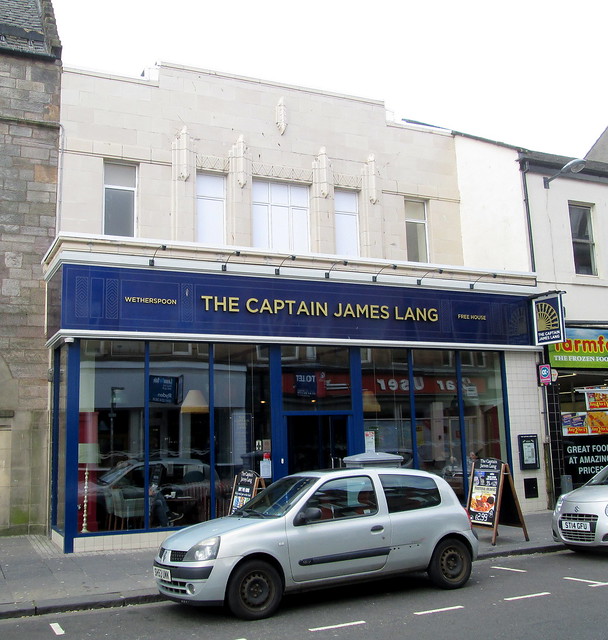
The former Woolworths has been given a makeover and is now a Wotherspoons, The Captain James Lang. The frontage has cleaned up nicely. Compare this to the photo I took in 2009.

Dumbarton Former Woolworths

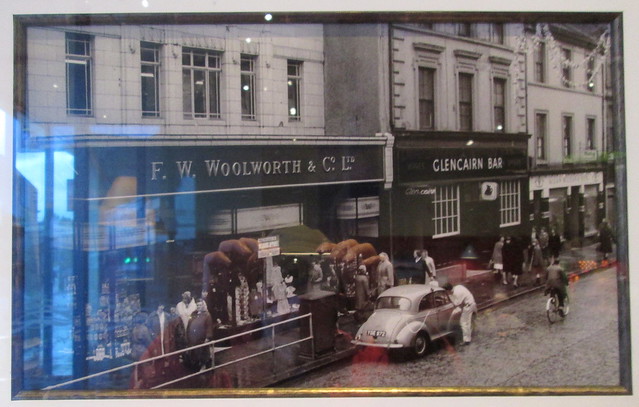
On the wall inside is a photograph of Dumbarton Woolies in its heyday.

Dumbarton Old Woolworths

As a homage to the building’s past this array of old Pic’n’Mix bags and sweets is also on display.

Pic n Mix, Dumbarton

Glasgow’s Art Deco Heritage 16: London Road

This one’s not really worth a number in this sequence all to itself but I’ve nowhere else to put it.

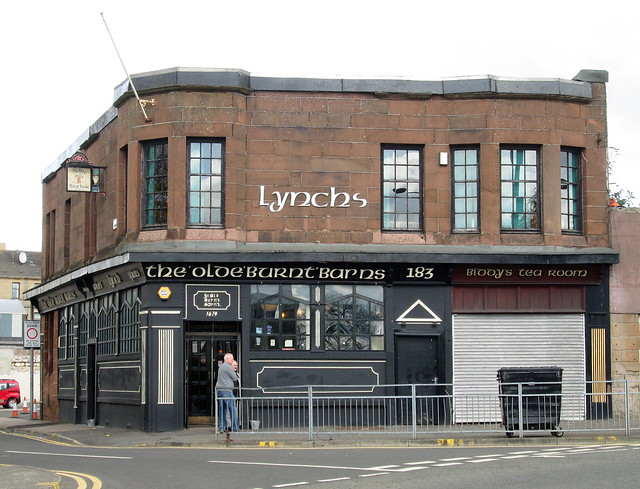
It’s Lynch’s, London Road which has Art Deco influenced upper portions, especially the windows:-

Lynch's, London Road, Glasgow

free hit counter script