Archives » 2013 » September

Iain Banks

For reasons I can’t go into right now I’ll be rereading most of Iain Banks’s novels over the next few weeks. His mainstream novels that is, those of Iain M Banks can wait for another time.

His books will be popping up on the Currently Reading part of my side-bar then (before disappearing later) but while I’ll still be writing my usual reviews of what I’ve read I won’t be posting them on here – at least not for some time.

The People’s Pick and John Henry Lorimer

Kirkcaldy Museum and Art Gallery has a very good collection of paintings, many of them donated by Michael Portillo’s grandfather on his mother’s side, John W Blyth (his father was a Republican refugee from the Spanish Civil War.)

The Gallery’s pictures include quite a few by the Scottish Colourists particularly S J Peploe but also J D Fergusson, the wonderfully named Francis Campbell Boileau Cadell and Leslie Hunter. These counterpart earlier paintings by William MacTaggart and later ones including some by the mysteriously popular Jack Vettriano (sub-Hopper cartoonish efforts though they may be.)

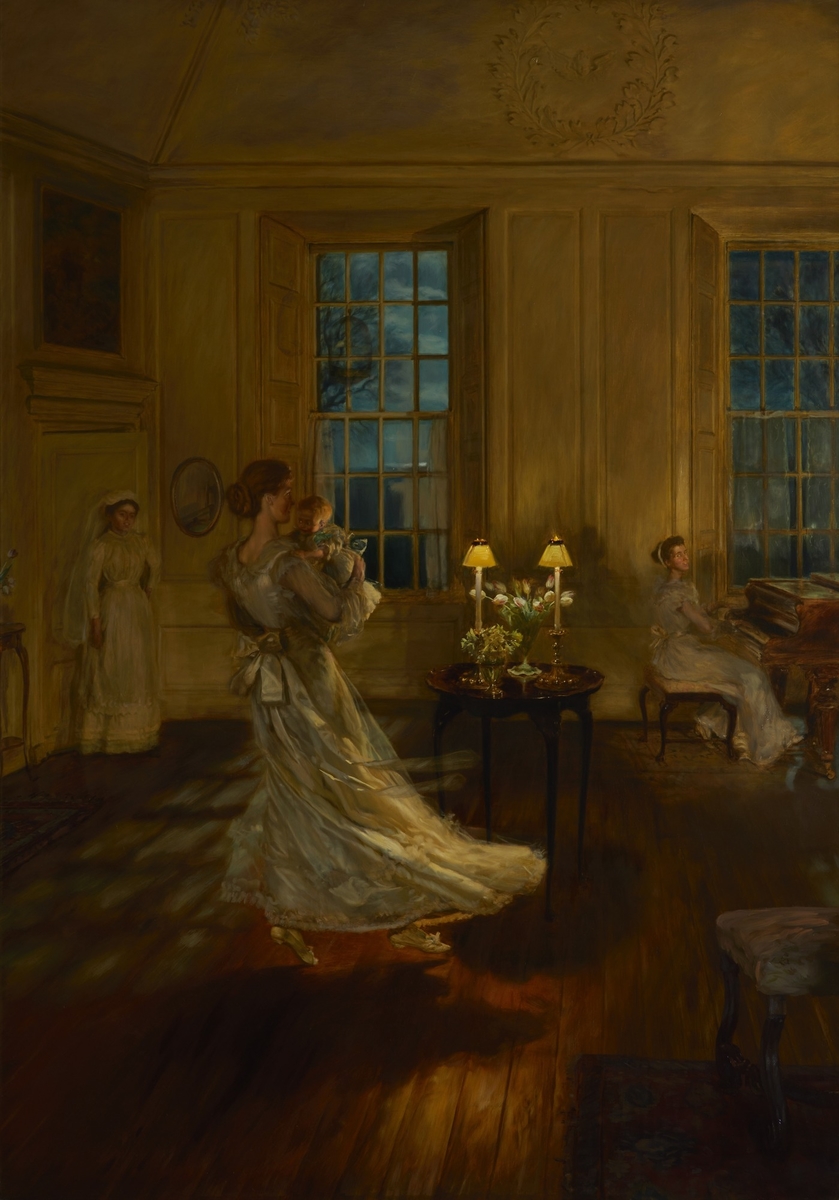
My favourite however has always been Spring Moonlight by John Henry Lorimer, painted in 1896.
Spring Moonlight

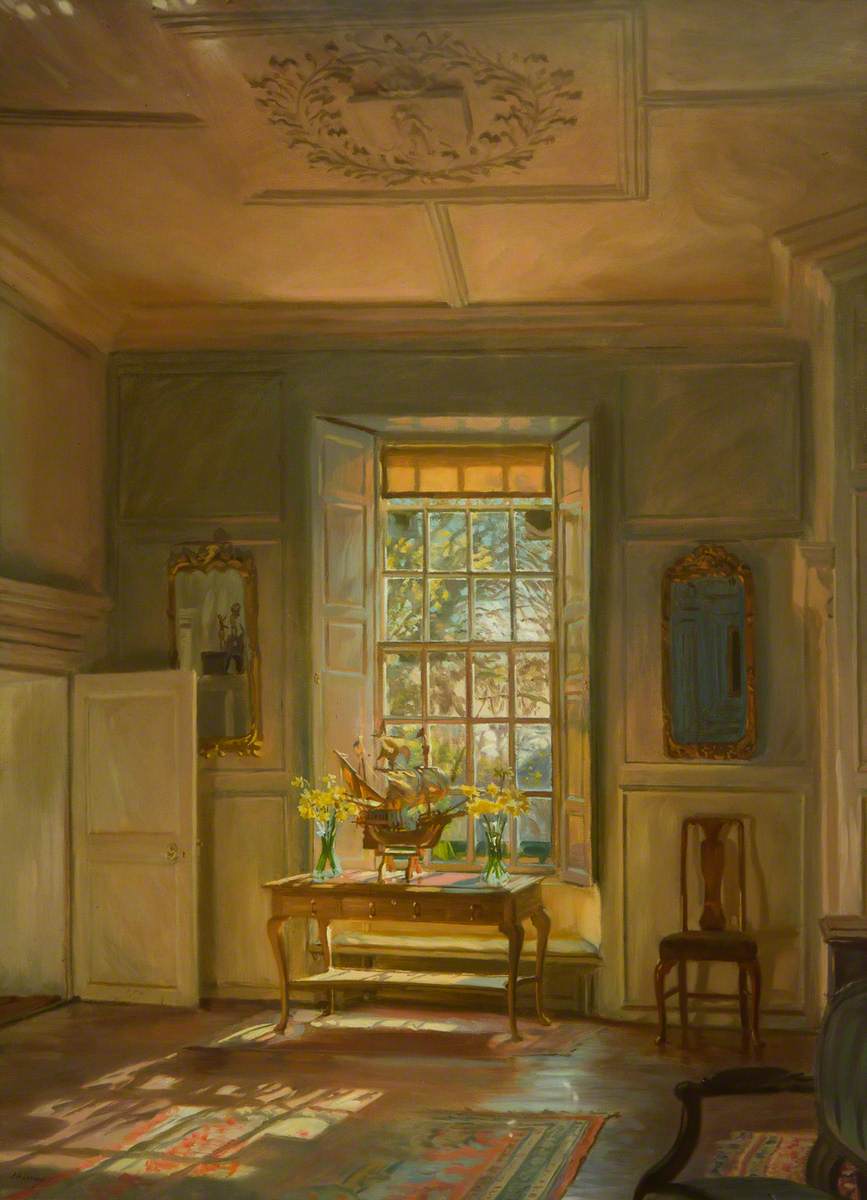
The above is not a very good reproduction; it doesn’t reflect the quality of his depiction of light. Lorimer’s faces aren’t the best but he captures the swirl of the woman’s gown very well and in the flesh so to speak you could swear that the canvas contains two yellow sources of illumination emanating from the table lamps. It is a startling effect and the artist’s style is distinctive – even if it doesn’t come through so strongly in his portraits. On visiting Kellie Castle last summer I immediately recognised the painting below as being by the same hand.

Sunlight in the South Room

Both pictures from BBC Your Paintings

The Museum and Art Gallery reopened in June after refurbishment. Its first exhibition was The People’s Pick – paintings from the collection as voted for by readers of the local newspaper The Fife Free Press.

When I was going round I was dreading the revelation of the most popular painting fearing it might be a Vettriano.

Imagine my surprise when I discovered No. 1. was….

Spring Moonlight by John Henry Lorimer!

My taste in art is obviously less highbrow than I might have hoped.

Kirkcaldy Museum and Art Gallery

The Museum and Art Gallery was gifted to the town by linoleum manufacturer John Nairn as part of the Memorial to the dead of the Great War. The building also houses Kirkcaldy Library.

The building lies behind the memorial here:-

Kirkcaldy Museum and Art Gallery

From right:-
Kirkcaldy Museum and Art Galleryfrom right

The old entrance to the Museum and Art Gallery is to the left of the building. The Great War Memorial cenotaph structure obscures that entrance here:-
ld Entrance to Kirkcaldy Museum and Art Gallery

This entrance (previously the Library entrance only) now serves for both the Library and the Art Gallery and Museum:-

Kirkcaldy Museum and Art Gallery, New Entrance

Dedication inscription on Kirkcaldy Museum and Art Gallery building (between the two entrances):-
Kirkcaldy Museum and Art Gallery Wording

Queen of the South 1-2 Dumbarton

SPFL Tier 2, Palmerston Park, 28/9/13.

Another away win. Great stuff. I’d have taken a draw before kick-off.

How much Queen’s exertions in midweek may have affected them I don’t know but I’m grateful if they did.

We’re only two points off second place! And we’re playing the team which occupies that spot next week at the Rock – but they’re unbeaten in seven league games.

Interesting times.

The Dream Archipelago by Christopher Priest

Earthlight, 1999, 264 p.

This is the first collection of Priest’s stories set in the Dream Archipelago, preceding The Islanders by 12 or so years, though apart from the introductory The Equatorial Moment – describing the strange vortex which affects the planet and presumably written especially for this book – the stories herein are considerably older.

The Negation features an author, Moylita Kaine, who has written a book called The Affirmation. (Priest later reused this title for a novel of his own and Kaine reappears in The Islanders.) Kaine’s book fascinates a border guard, Dik, who visits her in her position as writer in residence in the town where he is on leave.

Whores is a strange tale of another (unnamed) soldier whose visit to one of the whores of the title – forced into that profession by the enemy’s prior occupation of the island – has unexpected consequences.

The Cremation has Graian Sheeld travel to a funeral on an island where the customs are strange to him. His faux-pas lead him to a mistake. In parts this reminded me of the work of Michael G Coney. There is an enigmatic woman, a particularly nasty indigenous lifeform known as a thryme and its unusual life cycle.

The Miraculous Cairn is a tale of narrator Lenden’s sexual awakening combined with an unusual – possibly hallucinatory – encounter, and its ramifications resounding in later life.

The Watched has another of Priest’s confused protagonists. Ordier is fascinated by the mysterious Qataari who have been decanted from their ancestral peninsular home as a result of the war but who are notoriously secretive. A folly on the land he has bought allows him to spy on them.

As a collection this is fine but it doesn’t add up to a whole in the same way The Islanders did. But then it probably wasn’t supposed to.

There are some USian usages presumably because of where some of the stories were first published (though a twice mentioned casket is also once referred to as a coffin.)

Then there was the strange sentence, “You did not make rape my wife?” which badly needed editing and (twice) the common misuse of aureole for areola.

Self-destruct

Speaking of Mission Impossible (previous post) I always hated that catchphrase, “This tape will self-destruct in ten seconds.” What on Earth was “destruct” supposed to mean? The verb is “to destroy,” not “to destruct.” (Fair enough, my dictionary defines destruct in terms of blowing up rockets. Not tape machines you will note, though, but rockets.)

Self-destruct sounds to me the invention of someone with a tin ear. What is wrong with, “This tape will destroy itself in ten seconds?” The worst that really makes sense is, “This tape will self-destroy in ten seconds.”

Friday On My Mind 88: The Man From U.N.C.L.E.

I remember when The Man From U.N.C.L.E. first started it was broadcast in the UK on BBC 1 on a Thursday night at 8 pm. That meant it was a quick rush home from choir practice, which itself followed straight on from my piano lessons. Thursday nights were busy then.

The Man From U.N.C.L.E. theme tune is very hard to recall. It always gets overwhelmed, at least in my head and also in those of other people of my acquaintance, by the one for Mission Impossible – a show which took over that Thursday night slot from The Man From U.N.C.L.E.

The first episode’s opening with explanatory introduction:-

Later colour version, with altered arrangement:-

Bandstand at the Empire Exhibition 1938

This is a sepia postcard showing a general view of the Empire Exhibition, Scotland, 1938 held in Bellahouston Park, Glasgow.

Bandstand and Tower, Empire Exhibition 1938

And this one shows a close-up of the bandstand. Brilliant curve on the shelter part!

Bandstand, Empire Exhibition 1938

Planesrunner by Ian McDonald

Everness Book 1. Jo Fletcher Books, 2013, 373p. Reviewed for Interzone 246, May-Jun 2013.

Tottenham Hotspur supporter, school team goalkeeper and fine Indian cook, Everett Singh witnesses the kidnap of his physicist father, Tejendra, just before they were due to meet on an access visit. He provides the police with mobile phone photos of the kidnap. When his dad’s boss, McCabe, turns up asking if Tejendra had left Everett anything, Everett knows something more profound is afoot. Moreover, when his pictures are returned they have been altered. And he is being followed to school and back. As we are immersed in Everett’s world his mistrust of the police and the strained relationship with Everett’s mother these encounters engender are portrayed well, though like all young protagonists Everett is perhaps just a touch too knowing.

Soon a mysterious folder marked “Infundibulum” and obviously left by his father appears on Dr Quantum, Everett’s laptop. Everett knows infundibulum means “bigger inside than out” – references to Doctor Who follow – and recognises the contents as a representation of the multiverse. His father named him after the creator of many worlds theory and he has always been able to think in up to seven dimensions. This facility allows Everett to tie the Infundibulum topologically into a map of the many worlds. Another of his father’s colleagues has given him clandestine information about the success of the many worlds project and footage of other universes from beyond the Heisenberg Gates. Ours is E10 in the Plenitude of Worlds but none of the others has a map, only Everett. This scenario may have been too much for most writers to pull off but McDonald’s exposition of the arcane details is lucid and he uses all this only as a jumping off point. The necessity for plot to rumble on, though, for action, marks this out as a YA novel. Indeed there are echoes of The Northern Lights – not the least of which is the increasing presence of a powerful villainess, Charlotte Villiers – which, given the target audience, is no bad comparison. Echoes of this kind are almost inevitable when the necessity of holding a young audience’s attention is taken into account. There is plenty to keep the adult reader going too, though.

Armed with his knowledge Everett contacts McCabe and is transported to where the many worlds project has its base near the Channel Tunnel. Diplomats from the Plenitude are present as Everett demonstrates the ability of his map to target contact with other worlds. One of them threatens him with a strange gun and he jumps through an open gate into E3, a world with no oil-based technology, where rugby is the main spectator sport – and where Everett only has himself to rely on. This is one of the (arguably necessary) perennial features of “children’s” fiction: the adventure can only begin if no parents are around to prevent it. The stories are usually the better for it.

Everett finds a library and researches his new environment, quickly working out that the Plenitude is probably keeping his dad in the Tyrone Tower.

Later, on the underground, Everett meets the wielder of a strange tarot deck, a young girl called Sen Sixsmyth, who tries to filch Dr Quantum, but Everett decides to befriend her. Sen turns out to be an Airish – crew of the airships which ply the skies of E3. Her home is the Everness, whose captain is her adoptive mother and whose crew includes a “Southern” gentleman addicted to quotations and a Scottish accented guy in charge of the engines. “Captain, I canna get full power when there’s no engine…” Due to his culinary skills Everett is accepted as a crew member and the real fun starts.

To communicate with each other the Airish use a version of Polari, in our world an argot of gay subculture. (This reference would surely go over the heads of most YA readers were an explanation and glossary not supplied at the end.) The Airish have their own customs and loyalties and not a few colourfully named individuals. Any discrimination Everett experiences on E3 is not due to his skin colour but that he is now Airish.

The details of this other world feel right even if they are a touch old-fashioned but it is a kind of steampunk scenario after all. Moreover it is one which McDonald clearly has enjoyed creating. Set pieces including Sen penetrating the Tyrone Tower, the inevitable pursuit by Charlotte Villiers and a battle between airships for arcane Airish reasons keep things moving nicely.

Being part 1 of the Everness series nothing is truly resolved by the end of Planesrunner but the dénouement and the setting up of the sequel have a logic of their own, consistent with what has led up to them.

Planesrunner is bona stuff. One might even say fantabulosa.
Recreation Park, Alloa

Home of Alloa Athletic FC. Situated on Clackmannan Road (the A 907.)

Home Support Entrance with main stand in grey:-

Recreation Park, Alloa, Home Support Entrance

Boundary wall on Clackmannan Road:-
Recreation  Park, Alloa, Boundary wall

Away support entrance:-
Recreation  Park, Alloa, Away Support Entrance

View from away support entrance, down slope to Railway end, Ochil Hills in background:-
Looking Down Slope Towards Railway End, Recreation  Park

In all my visits to Recreation Park up till a couple of years ago there was no railway behind the ground: it had been Beechinged. However, my elder brother told me of some Dumbarton player in the long ago putting a penalty onto the railway. The modern line from Stirling to Alloa (and beyond for goods trains) opened three or four years ago.

The next photo is shifted right slightly to show the away support area. Note temporary stand halfway down. There used to be a large mound of terracing on this side, with a covered area well back from the pitch. It was taken away a few years ago and replaced with this flatter viewing area. Again a nice view of the Ochil Hills in the background.

Away Support Terracing

Terracing, Clackmannan Road end:-
Recreation  Park, Alloa, Home Terracing

Main stand from away entrance. The artificial turf is obvious here:-
Recreation  Park, Main Stand from Away Entrance

The stand replaced one damaged by fire quite a few years ago now. This is it from the Railway end.

Recreation  Park, Main Stand from Railway End

The Railway end terracing still has the mound of earth type of terrace with some railway sleepers for stability:-
Recreation  Park, Old Terracing Behind Goal

free hit counter script