Hence I was delighted to see this painting of the main building by William J Kennedy of the 1901 Exhibition on display at the Hunterian Art Gallery when we visited:-
Charles Rennie Mackintosh submitted designs for some of that Exhibition’s buildings (as well as for the 1911 one) as noted in this :-
And of course this picture of Dumbarton Rock and the River Clyde was irresistible:-
Then there was this one by my favourite impressionist painter, Alfred Sisley, one of a series he painted of the church at Moret:-
Portrait of a child by Henry Rayburn:-
Not to mention a couple of Old Masters, The Entombment by Rembrandt:-
and the one that stood out from across the room, Head of an Old Man by Rubens. It’s absolutely stunning:-
John Frostbrug in Dutch, this is the famous bridge too far, except it’s a replacement for the original Rhine Bridge fought over in the Second World War during Operation Market Garden. It’s somewhere in The Netherlands I’ve always wanted to visit.
I must say the River Rhine looks not very wide here – not as wide as the Clyde at Dumbarton certainly. Still an obstacle to an army though:-
Eastern guard post. Slight Deco styling. I assume this is original:-
Western guard post. Note groove up the middle of steps, for wheeling bicycles up and down.:-
Reverse view of bridge:-
Roadway:-
Commemorative plaque with inscription to John Frost by roadway on north side of bridge:-
These are the good lady’s photographs. She took them while I was at one of the play-off games at The Rock, in May last year.
River Leven and Dumbarton from Dumbarton Rock:-
River Leven and Dumbarton with Ben Lomond in background:-
Rivers Leven and Clyde at Dumbarton:-
River Leven and Dumbarton From Dumbarton Rock. As a child the good lady used to play on the rocks on the riverside below where this was taken from:-
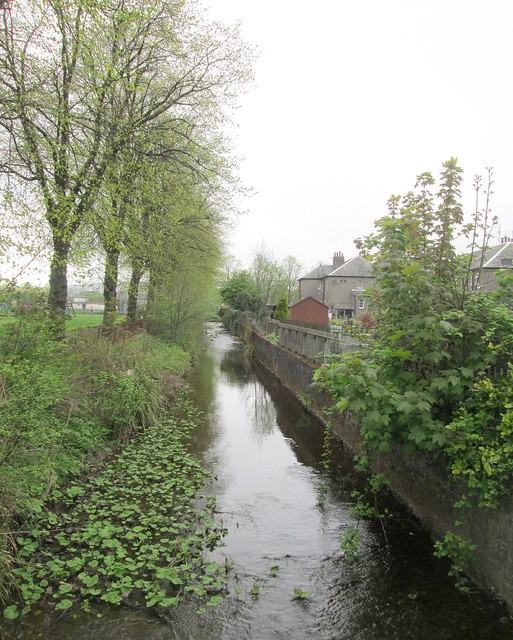
Somewhere else she used to play was in this burn by the Swing Park. Well, that’s what it was always called when I was young. It’s apparently known officially as the East End Park:-
I think my only previous posting about Dumbarton Rock was here. Those photos were taken from across the River Clyde at Langbank in the former Renfrewshire.
There is a more familiar view from the quayside (of the River Leven) at Dumbarton itself:-
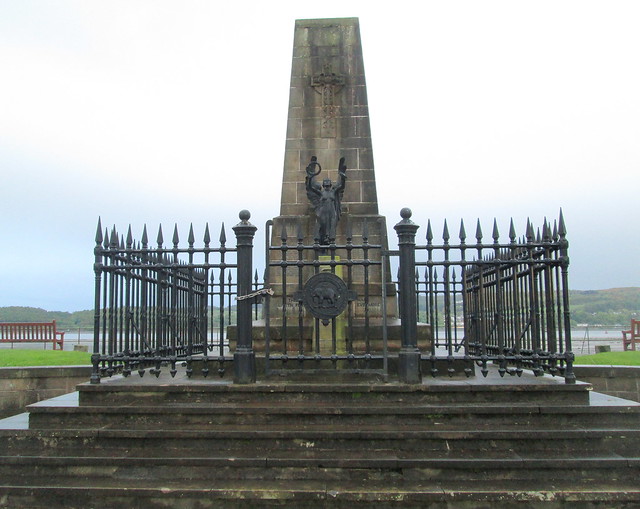
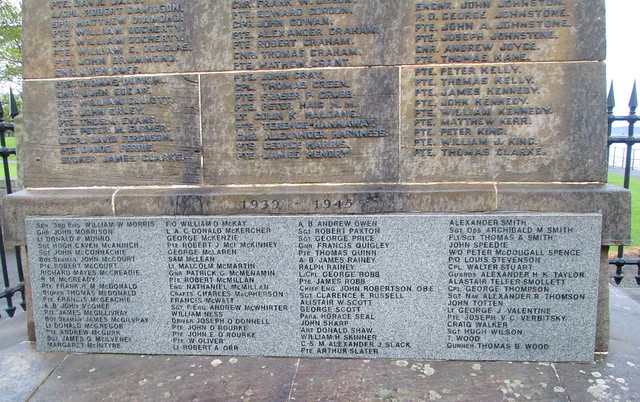
The Memorial is unusually situated some way out of the town centre, in Levengrove Park, on the banks of the River Clyde near its confluence with the River Leven, with a great view of Dumbarton Rock.
This is the view looking from the Park towards the Clyde. It’s the front of the Memorial which as a whole is surrounded by a metal fence and features a bronze angel.* Note the Elephant and Castle crest of Dumbarton on the gate:-
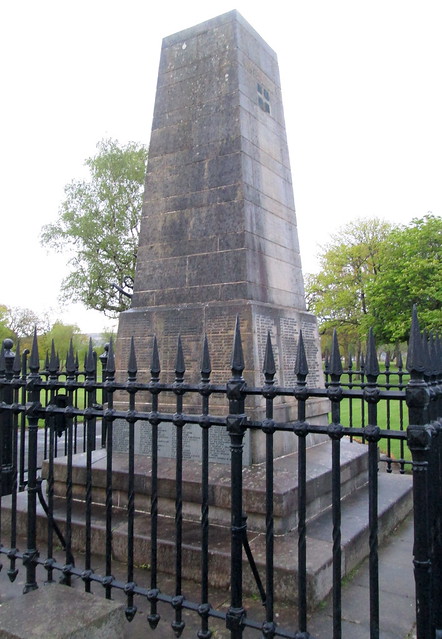
Reverse of the Memorial – the view towards the Park, again with Dumbarton crest on the fence:-
Again looking into Levengrove Park but from an angle:-
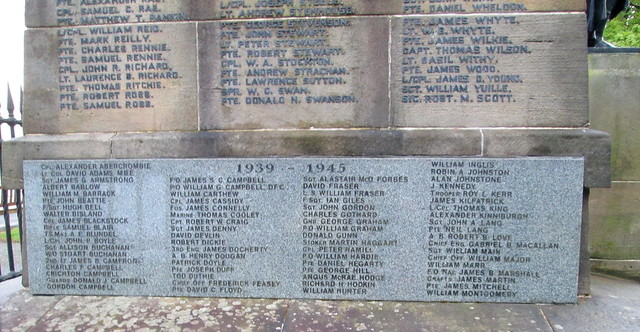
The names of the First World War dead are on each side, above in the original engraving; Second World War ones added below, on two sides only. This is the east side of the Memorial:-
The west side:-
*This may actually be a winged Victory rather than an angel.
Glasgow seems to have a liking for bulbous grey architecture.
This started with the building whose construction saw it immediately dubbed the Armadillo. Its “Sunday” name is the Clyde Auditorium. It sits on the north bank of the Clyde in Finnieston right by the Crowne Plaza Hotel (where Eastercon was held this year) and the SECC and has certain structural similarities to the Sydney Opera House.
On the other side of the River Clyde lie more examples. The nearest to the camera here is Glasgow’s IMAX cinema. The other silvery building is the Glasgow Science Centre of which the tall white tower on the left is also a part.
This is a closer view of the IMAX. It looks like a giant silver slug. The entrance is on the other side.
And here’s the Science Centre closer up.
And the Science Centre from the north bank of the river. The paddle steamer Waverley is at anchor.
Better view of the Waverley, the last remaining ocean-going paddle steamer in the world.
Glasgow’s newest concert venue is the latest addition to the bulbous grey architecture fixation. It’s the Hydro.
The Convention hotel (the Crowne Plaza, formerly the Moat House) was hard by the River Clyde. It’s the tall building. The footbridge is called the Bell’s Bridge.
The bridge is in its swung open position here.
I met quite a lot of old acquaintances and made some new ones. Plus I bought two books.
The two panels I was on went well and I didn’t make a fool of myself (I think.) The one on steampunk had an unexpected extra panellist.
Yes, a steam driven dalek!
Well, a dalek made to look steam driven by fellow panellist Peter Harrow, a fount of information on all things steampunk. It was actually radio-controlled. The chocolate rabbit was a nice touch.
On Sunday I was over in Glasgow. (The good lady was at something called Creative Stitches in the SECC. While she was there I hied myself off to the new Transport Museum called the Riverside Museum. No photos: she had the camera and my mobile is so old it doesn’t do photos. Not that I ever use it anyway.)
The Riverside has a modern architectural design which reminds me of a cardiogram and is full of cars, trains, trams etc with a West of Scotland interest, plus there’s a tall ship moored on the Clyde alongside. Worth a visit.
Anyway afterwards we took in an antique centre/warehouse where I spotted some architectural drawings from the 1930s. They seem to have been produced by a third year student at an architectural college. Very Deco.
By this time the camera was available to me.
This one was for a lakeside restaurant.
The others were for Sports Centres.
I don’t know if any of these buildings were ever erected.
The person selling the drawings wanted £45 for the three Sports Centre drawings; which I thought was a bit steep for bits of paper peeling at the edges. (I couldn’t get close enough to the lakeside restaurant one to see its price.)