Archives » Mario Vargas Llosa

The Time of the Hero by Mario Vargas Llosa 

Grove Press, 1966, 407 p. Translated from the Spanish, La ciudad y los perros, (Editorial Seix Barral, S A, Barcelona, 1962) by Lysander Kemp

(I don’t usually remember exactly where I bought a book but with this one I do. It was in the Netherlands; in a charity shop/warehouse which had a large selection of books, one case of which were publications in English. I think it cost me one Euro, though it might have been €1.50.)


This was Llosa’s first novel and it is set in the Leoncio Prada Military Academy, among the cadets/pupils there, not all of whom are destined to join the army.

It depicts the everyday lives of the inmates, their raggings, joshings and bullying, their constant efforts to evade the rules – such as smoking, gambling, going over the wall at night, or even during the day – and to keep things secret from the officers. Some scenes are set in the surrounding city; illustrating memories of the inmates’ pasts or the intricacies of their love lives.

The plot revolves around the stealing of the text of a Chemistry exam the night before it is due to be taken. The designated cadet, Cava, makes a mistake and a window pane is broken. All passes are cancelled. In order to receive a pass to see his girlfriend a cadet nicknamed the Slave reports Cava to the officers. Later, the Slave is shot during a military exercise. The officers are at pains to insist it was an accident and ignore evidence and testimony to the contrary.

This is almost entirely a male environment; the dialogue often displays the prejudices of its time and place – especially with regard to the casual use of racist terms and to misogyny.

In their encounter the Slave’s father says to Alberto, “‘When you have a son, keep him away from his mother, There’s nothing like a woman to ruin a boy for life.’”

In the main we have here is an examination of the perennial battle of youth against authority, of the pressure to conform and of the constant tendency of institutions to cover up unfortunate happenings so as not to be shown in a bad light.


Pedant’s corner:- Translated into USian. I note La ciudad y los perros actually translates as The City and the Dogs. Otherwise; “tooth paste” (toothpaste,) “brief case” (briefcase,) “girl friend” (girlfriend,) “boy friend (boyfriend,) “on the double” (this military term is usually rendered as ‘at the double’,) “Montes’ bunk” (Montes’s.)

Edith Grossman

I saw in Saturday’s Guardian that Edith Grossman, translator into English of the works of Gabriel García Márquez and Mario Vargas Llosa (among others including Miguel de Cervantes) has died.

I have read at least seven of her translations of novels – four of Márquez’s and three of Llosa’s. Ther are more on my tbr pile.

Translation is an art and Grossman was an advocate of translators far from being all but anonymous ought to be considered as at least equal to th eauthor swhom they translate and their names ought to be on the covers of the books they have translated.

Llosa has said of her work: “It doesn’t seem to be a translation of a novel, but something that gives the impression that it has been written originally in English.” For someone reading in English that, of course, is how it should be.

Edith Marion Grossman: 22/31936 – 4/9/2023. So it goes.

Conversation in the Cathedral by Mario Vargas Llosa

faber and faber, 1993, 605 p. Translated from the Spanish Conversacion en la catedral by Gregory Rabassa.

This is a novel that is at the same time sprawling, covering a time in Peru when it was under the dictatorship of General Odría, yet also intimate, as it revolves round the families and interactions of two of its characters, Santiago Zavala, son of the well-off Don Fermín, and Ambrosio, once a chauffeur to Fermín but later to Cayo Bermúdez, a Minister of Government, Odría’s hardman.

When the novel starts Santiago is staring at the Avenida Tacna and wondering “At what precise moment had Peru fucked itself up?” While the novel does not provide a full account of the country’s dysfunctionality at that time it does go on to illustrate a lot of that fucked-upness. Much to the dislike of his father and mother, Santiago has been working at the newspaper La Crónica for many years. He meets a down on his luck Ambrosio working at the dog pound and they go on to have a conversation (the Cathedral of the book’s title is a bar) during which their life stories unfold.

Through it we meet examples of the highs, Don Fermín, Bermúdez, Santiago’s family, and some of the lows of Peruvian society. Bermúdez keeps a mistress, Hortensia, a former night-club singer with the stage name, the Muse, who spends his money liberally. She is friendly – more than friendly – with Queta, a (relatively) expensive prostitute at Señora Ivonne’s, with whom Ambrosio has a fascination.

Despite the dictatorship there are lingering political tensions between Odríists and Apristas – even more so between that latter group and the Communists (though at one point someone says there are only ten Communists left and they are all secret policemen.) Disturbances occur in the town of Arequipa, which lead to a softening of the regime and the fall of Bermúdez. Hortensia’s life more or less falls apart after his exile. Ambrosio is caught up in all this. Santiago’s job at La Crónica keeps him apart, though he had been arrested early on in his life as a hanger-on of an anti-Odría group known as Cahuide before resolving to stay out of trouble. “‘Capable people like you and me don’t get involved,’ Santiago said. ‘We’re content to criticise the incapable people who do.’”

Much of the text focuses on Ambrosio’s relationship with his wife Amalia, a smaller part relays how Santiago came to marry a nurse (again to his family’s discontent,) while the back-biting, manœuvring and backside-covering of the military during the Arequipa unrest are well-illustrated.

This is not a straightforward read, the narrative often alternates paragraphs from the present of the conversation with the unfolding of past events, which is initially a bit confusing though it settles down more from Part Two onwards, but it encompasses different layers of Peruvian society and illustrates the lack of agency of ordinary people caught up in events outwith their control, their struggles to get by, and contrasts them with the insouciance of the moneyed.

Note to the sensitive: the text contains the word ‘niggers’.

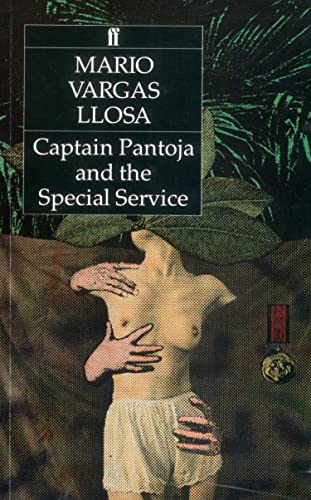
Captain Pantoja and the Special Service by Mario Vargas Llosa

faber and faber, 1987, 252 p. Translated from the Spanish Pantaléon y las visitadoras. No translator named.

Captain Pantoja and the Special Service cover

Llosa may have intended this to be a light-hearted piece of fiction. (Then again perhaps not; there are several deaths in it.) It may have been taken so in the 1970s when it was first published but I doubt the book’s premise would be viewed with much favour were it to be submitted to a publisher nowadays.

Because the soldiers posted (in effect “up the jungle”) to Iquitos, driven to distraction by the heat and conditions, are causing havoc among the local women, raping them left, right and centre – even in the street in full daylight – Army Captain Pantaleón Pantoja is given the unusual task of organising a service to prevent this. This is the SSGFRI, the Special Service for Garrisons, Frontier and Related Installations. In effect he is to procure women to provide for the sexual release of the soldiers on an organised basis. But all this is to be done in secret, he must not wear his uniform; the women, though in reality Army employees, are to be unofficial, without rank, though the service will have an identifying colour scheme, red and green, worn as a badge by the “specialists” and displayed on the trucks, boats and single aeroplane the service will have at its disposal.

Pantoja’s wife, Pochita, is at first delighted by his apparent promotion but her disappointment with their new quarters, not, of course, in the army compound but instead a very old, very ugly, very uncomfortable house in town, not at all comparable to the poorest one on the base, is profound. She is doubtful, too, of the increased sexual interest Pantoja has for her (stimulated by the heat and conditions of their new surroundings) though pleased to become preganant with their first child. Pochita’s ignorance of Pantoja’s true activities, despite his associations with shady characters, is sustained for a while but is eventually lifted when a specialist fired for misconduct writes to her.

Being an Army man, Pantoja of course treats the job with military punctiliousness, engaging surveys into the length of time each “service” will require, hence determining the number of specialists to be recruited, and itemises the amounts to be docked from the pay of the service’s users. Due to his logistical skills he makes a great success of everything; so much so that demand for his specialists increases – to the Navy and beyond.

In the meantime a heretical sect known as The Brotherhood of the Ark, led by a Brother Francisco, whose adherents’ trade-mark practice is the crucifixion of animals and birds, is gaining followers in the region. Despite all the authorities’ efforts to arrest him Brother Francisco remains elusive. The intersection between Francisco’s cult and the activities of the SSGFRI provides th enovel’s turning point.

The story is told through conversations, the texts of military dispatches, letters from and to Pochita, transcripts of local radio broadcasts and extracts from newspaper reports. The “normal” text has an unusual flavour, as different conversations are interleaved with each other on the page, with only a paragraph break to signal any change to and from each discussion. This initially has the efect of obstructing the story’s flow but is soon accustomed to.

Sensitivity warning. One of the characters, an inhabitant of the demi-monde whom Pantoja employs to help him with his mission, is called Porfirio Wong, but is also given the soubriquet the ‘Chink.’

Pedant’s corner:- supervisers (supervisors,) a capital letter on the next word following a colon – but not in every instance of a colon, a line repeated on the next line (x 2,) smoothes (smooths,) “the lay of the land” (the lie of the land,) Collazos’ (Collazos’s,) Manaos (this Brazilian city is usually spelled Manaus,) Iquitos’ (Iquitos’s,) “consults with his adjunct” (that military functionary in English is called an adjutant,) “‘he’d of died of sorrow’” (does this illiterate solecism exist in Spanish? The correct English form is ‘he’d’ve’.)

Bookshelf Travelling for Insane Times – Translated Fiction

Time for Reader in the Wilderness’s meme again.

These shelves contain my paperbacks of fiction translated from languages other than English. Evidence here of my usual suspects – Bohumil Hrabal, Mario Vargas Llosa, Naguib Mahfouz, Diego Marani, Gabriel García Márquez, Irène Némirovsky, Orhan Pamuk, but nearly all of these have been worth reading. In fact I would say there are no real duds here. The English language books on the lower shelf belong to the good lady and are shelved there because they fit into the space:-

Translated Fiction Bookshelves 1

Several really large hardbacks are too big to sit on the above shelves so have to be kept separately. These are not all translations but there is more Orhan Pamuk, more Naguib Mahfouz, more Irène Némirovsky, and then the English language Salman Rushdie. The John Updike omnibus is the good lady’s:-

Large Books Shelf

The Dream of the Celt by Mario Vargas Llosa

faber and faber, 2013, 504 p. Translated from the Spanish El sueño del celta by Edith Grossman.

 The Dream of the Celt cover

On the face of it this seems an unlikely endeavour. A Peruvian novelist focusing on a relatively obscure incident in British – and Irish – history? (Then again the Peruvian Jorge Luis Borges was fascinated by Scotland.) But this novelist’s protagonist, (Sir) Roger Casement, was instrumental in exposing the barbarous practices of colonial exploitation in the Congo and later the Amazon, wherein he made his name and for which he received his title, before he took up the cause of Irish independence and was subsequently arrested for treason after visiting Germany during the Great War to seek its government’s help in that endeavour.

The odd numbered chapters here focus on Casement’s life in prison after his trial, in the run-up to his execution. These are the most novelistic parts of the book, displaying his relationship with the guards and the visitors who come to see him, outlining their efforts to obtain a commutation of his death sentence. The even numbered chapters tend to be longer and cover his career in the years leading up to his arrest – and often read more like a history book than a novel. Llosa discounts a large portion of Casement’s diary entries (which many contend were forged by his captors) relating to his homosexual encounters with various men – which damned him not only in the authorities’ eyes, but more crucially in those of the public – as imagined or else wish fulfilment fantasies, giving a novelistic alternative account of several of these incidents, though he treats others as veracious. As Casement’s priest says to him about the suggestion the stories about him were put in the newspapers to counteract the petition for clemency, ‘Nothing can be excluded in the world of politics. It’s not the cleanest of human activities.’ Yes, indeed.

In what is perhaps a comment on the motives of campaigners, a consul in S America tells Casement, “‘I don’t have much admiration for martyrs, Mr Casement. Or for heroes. People who sacrifice themselves for truth or justice often do more harm than the thing they want to change.’”

It is in the ‘historical’ (in the sense of predating the events in the odd numbered chapters) sections though that it is set out how Casement’s experiences in the Congo and the Amazon led him to the idea that Ireland too was a colonised country, albeit with its inhabitants now less harshly treated.

Despite Casement’s conclusion in South America that, We should not permit colonisation to castrate the spirit of the Irish as it has castrated the spirit of the Amazon Indians. We must act now, once and for all, before it is too late and we turn into automata, Llosa also suggests Casement’s trip to Ireland on a U-boat was to try to forestall the Easter Rising rather than encourage it, or even to bring it weapons, as it would not be supported by German action to neutralise the British Army and Royal Navy. When Joseph Plunkett tells him in Germany the Rising is imminent Casement thinks, “No matter how heroic and intrepid they were, the revolutionaries would be crushed by the machinery of the Empire. It would use the opportunity to carry out an implacable purge. The liberation of Ireland would be delayed for another fifty years.”

Plunkett’s response is that, “‘of course we’re going to lose this battle. It’s a question of enduring. Of resisting. For days, weeks. And dying in such a way that our death and our blood will increase the patriotism of the Irish until it becomes an irresistible force.’” Which it did.

The novel’s title The Dream of the Celt comes from that of a poem Casement wrote in 1906 about Ireland’s mythic past. While as a novel it is a little unbalanced and not, perhaps, Llosa at his best, it does act as a useful primer on Casement’s life and times.

Pedant’s corner:- sheriff (illustrates the drawbacks of translation into USian. There are no sheriffs in British prisons. We have prison officers or, at a push, warders. And it wasn’t the prison Governor, since he appears later in the book.) “In Brixton Prison” (in the context of an earlier mention of Pentonville a British translator would just write ‘In Brixton’ here,) “Dr Livingstone, who never wanted to leave African soil or return to England” (return to the UK? Livingstone was Scottish after all.) “The Irish historian ……. she had been” (even though there are 34 words in between ‘historian’ and ‘she’ that ‘she’ is not needed,) “gave Walla a week to fulfil their quota” (its quota,) “where a formation of African soldiers were marching” (a formation … was marching.) “There were also a good number of” (There was also a good number,) “Perhaps one, some of his colleagues” (one, or some, of his colleagues?) “with the Irish insignia on their visors” (I suspect this refers to cap badges. These do not sit on visors,) Casement refers to the British Army as “the most powerful army in the world” (in 1916 the British Army wasn’t. The German one still was,) “the Court of Appeals” (it’s the Court of Appeal.)

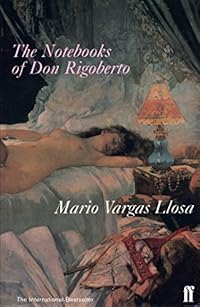
The Notebooks of Don Rigoberto by Mario Vargas Llosa

faber and faber, 1999, 308 p. Translated from the Spanish Los Cuadernos de Don Rigoberto by Edith Grossman

 The Notebooks of Don Rigoberto cover

A very odd piece, this. I’m tempted to add very South American; but it does focus on love and sex (especially the sex) – two of the triumvirate of big novelistic concerns.

Don Rigoberto is a legal director of an insurance company with an interest in collecting books and works of art but he never has more nor less than the same amount of either. Each new purchase must be balanced by the disposal of a previous one. Rigoberto has an extensive set of notebooks where he has inscribed his reflections on all he has seen or read. At the book’s start Rigoberto is estranged from his second wife Doña Lucrecia due to an indiscretion involving Alfonso, Rigoberto’s son from his first marriage, still a schoolboy but one who has an unhealthy fascination with the life and work of the artist Egon Schiele – to the extent he believes he may be a reincarnation.

The novel depicts sessions where Alfonso is visiting Lucrecia with a view to effecting a reconciliation between his father and stepmother, mixed in with Rigoberto’s memories and fantasies of life with Lucrecia and his notebooks’ polemics against aspects of modern life and the timid aspirations and attitudes of the general mass. One of these is a railing against pornographers, who pervert the higher aspects of love and sex, commodify the impulse and therefore desacralize the act of love and make it banal. In the same piece he absolutely nails Margaret Thatcher “not one of whose hairs moved for the entire time she was Prime Minister” (though it has to be said describing her as a delectable source of erotic desire is a perversion far too far.) Another of the Don’s reflections is an aside on the difference between a eunuch and a castrato.He also thinks, “The obligation of a film or book is to entertain me. If … I begin to nod or fall asleep when I watch or read them, they have failed in their duty and they are bad books, bad films.” By this criterion The Notebooks of Don Rigoberto could be a bad book, as I began to nod or fall asleep several times while reading it. Mind you I had been dotting about the country like a blue-arsed fly during the week when I read it and consequently was prone to tiredness. But that’s my fault, the book is still worth reading.

The Notebooks of Don Rigoberto is a consciously literary work, scenes are described from different viewpoints simultaneously, the shifting taking place from sentence to sentence, signalling a certain unreliability in narrative viewpoint (or a touch of magic realism.) Those with a prudish sensibility might want to give it a miss, though.

Pedant’s corner:- maître d’s (surely the plural of maître d’ is maîtres d’?) ambiance (x2, ambience,) a missing full stop before the quote mark at the end of a piece of direct speech x2, depilitated (x3, depilated,) corolla (x2, used in the sense of areola, but corolla is a botanical term,) Saint Vitus’s dance (x2, Vitus’s,) motorcross (motocross.) “They had know each other” ~(known,) “the American Harley-Davidson and Triumph” (implies Triumph is an American marque,) checked flag (the usual term in motor racing is chequered flag,) CD’s (there is no need for that apostrophe, there is no letter missing; CDs,) “the only anthem that can move me to tears are the sounds” (“anthem” is singular; so, is. On the other hand “sounds” is plural and the verb to be implies equivalence; so, are. Better to have something like “expresses the sounds of”,) “a sort of cowl, even, even, the head” (one of those “even”s is extraneous,) a missing end quote mark, “pubises trimmed and dyed” (the pubis is the bone, not the hair of the pubic region. Pubes is the noun to depict the region or its hair, though in English it’s liable to mispronunciation. I assume its plural is “pubes” still, compare the plural of sheep,) offpring (offspring,) a supposed newspaper report has, “A twenty-four year old teacher in New Zealand was sentenced to four years in prison for carnal relations with a ten-year old boy, a friend and classmate of her son’s” (that implies she would have given birth when she was fourteen; possible I suppose, but unlikely,) will-o’-the-wisps (wills-o’-the-wisp.)

Immortality by Milan Kundera

faber and faber, 1991, 391 p. Translated from the Czech Nesmrtelnost by Peter Kussi.

Immortality cover

In the first chapter the narrator tells of seeing a gesture by a woman who was just leaving a swimming pool and which inspired him to write the novel. I was struck by the ageist perspective with which Kundera treats this incident. Be that as it may, gestures and their meanings, their particularity or otherwise, are a feature of the book.

Set mainly in Paris (where Kundera settled after leaving Czechoslovakia) the meat of the book lies in the relationships between Agnes, her husband Paul, and her sister Laura. There are similarities here to the writing of Irène Némirovsky, also an exile in Paris, but at an earlier time. Unlike Némirovsky though, Kundera delves into the deeper past in order to interrogate the means of achieving immortality, in the sense of remaining famous after death, by examining the relationship between Bettina Brentano (later von Arnim) and Goethe, which has mostly been seen through the lens of Brentano’s accounts. Ernest Hemingway too makes appearances – notably in discussions with Goethe in the afterlife – as does Beethoven, and there is a disquisition on Don Quixote. The author himself also features as a character. (Perhaps it was this book which gave Orhan Pamuk that idea.)

The narration comments on itself at various points, and at times does not so much foreshadow as give the later game away. We are told of the death of one character and explore its consequences long before being shown it and that in Part Six a new character will appear and then vanish without trace – as indeed he does; but only to present us with a connection to another that had hitherto not been mentioned (or deliberately hidden.)

The narrator/Kundera notes a historical transition in the toppling of Richard Nixon not by arms nor intrigues but the mere force of questioning, the power of the Eleventh Commandment “Tell the truth.” (Sadly that power no longer seems to work.) He also tells us that nineteenth century writers ended their novels with a marriage not to protect their readers from marital boredom but to save them from intercourse. “All the great European love stories take place in an extra-coital setting…. there was no great love after pre-coital love, and there couldn’t be…. Extra-coital love: a pot on the fire, in which feeling boils to a passion, and makes the lid shake and dance like a soul possessed.” How much of this is an echo of Kundera’s own attitude to intercourse is a matter for conjecture. (Compare “The Unbelievable Prevalence of Bonking” as Iain Banks, in The Crow Road, characterised another of Kundera’s works.)

In amongst all the narrator’s philosophising are sprinkled some bons mots, “A person is nothing but his image” and “I think therefore I am is the statement of an intellectual who underrates toothaches. I feel therefore I am is a truth much more universally valid.”

While at times the prose had the feel of a history book and of the literary work in general – one incident in particular reminded me of Mario Vargas Llosa’s Aunt Julia and the ScriptwriterImmortality was never difficult to read – a tribute to the translator, Peter Kussi, perhaps.

Pedant’s corner:- Saint Vitus’ dance (Vitus’s,) Agnes’ (Agnes’s,) assininity (asininity,) Avenarius’ (Avenarius’s,) Hals’ (Hals’s.)

The War of the End of the World by Maria Vargas Llosa

faber and faber, 2012, 758 p. Translated from the Spanish La guerra del fin del mundo with no translator’s name given, merely a translation copyright notice for the book’s first US publisher. Returned to a threatened library.
 The War of the End of the World cover

An itinerant mystic, Antonio Conselheiro, called the Counsellor, wanders the Brazilian province of Bahia gathering adherents. He preaches against the recently formed Republic of Brazil as the Antichrist, stuffed with Freemasons. In Llosa’s account he has the ability to transform an assortment of unfortunates, misfits, and the misshapen – not to mention the worst of bandits – into followers of the Blessed Jesus (whose every mention among the Counsellor’s adherents is replied to with “Blessed be he”.) Eventually he sets up a community in the town of Canudos against which a succession of ever larger military expeditions is sent by the Republic as the “rebellion” defeats each in turn. All this is based on a historical event, the War of Canudos, the most bloody civil war in Brazil’s history.

The early part of the novel is taken up with sections relating to how some of the Counsellor’s most important followers come to fall under his spell interspersed with the machinations of local politicians in Bahia – both for and against the Republic. Here we also meet a socialist (and red-haired) Scotsman on the run from authorities in Europe – where he had indulged in seditious activities – who goes by the name of Galileo Gall (but whose real name is never given) and has a belief in phrenology. Gall is framed by the editor of the Jornal de Notícias, Epaminondas Gonçalves, to make it look as though Britain, referred to by most characters as England, is involved in gun-running to, and support of, the rebels of Canudos. (“Gall” does put Gonçalves right, though, when he says, “I’m a Scotsman. I hate the English.”) A near-sighted journalist – again nameless – goes along with the third military force to be sent against the rebels and witnesses most of the later fighting; at least until his spectacles get broken.

Entrants to Canudos were made to swear that they were not Republicans, did not accept the expulsion of the Emperor, nor the separation of Church and State, nor civil marriage, nor the new system of weight and measures, nor the census questions. (The devil is obviously in the way you count the spoons.) Mostly though, the Counsellor was playing on the faith of the poor and their fears that slavery would be reintroduced.

Gall thinks of Canudos as, “A libertarian citadel, without money, without masters, without politics, without priests, without bankers, without landowners, a world built with the faith and the blood of the poorest of the poor,” (though part of that is his own idealism projected onto it) and wonders about the – to him – curious code of “Honour, vengeance, that rigorous religion, those punctilious codes of conduct….. a vow, a man’s word, those luxuries and games of rich, or idlers and parasites – how to understand their existence here?” that so prevailed on the husband of a woman he raped that he pursued Gall there.

About a third of the way through the book we find the nameless journalist has survived the war as he talks to the Baron de Canabrava about his experiences. This has the effect of defusing some of the tension as we readers are still to meet them for ourselves.

In Canudos the near-sighted journalist thought to himself, ‘culture, knowledge were lies, dead weight, blindfolds. All that reading – and it had been of no use whatsoever in helping him to escape.’ The baron is disgusted by the journalist finding amid the chaos of Canudos love and pleasure with a peasant girl. “Did those words not call to mind luxury, refinement, sensibility, elegance, the rites and the ripe wisdom of an imagination nourished by wide reading, travels, education?”

Army doctor Teotônio Leal Cavalcanti’s image of humanity abruptly darkened in his weeks seeing to the wounded during the siege, observing of the able-bodied, “‘It is not what is most sublime, but what is most sordid and abject, the hunger for filthy lucre, greed, that is aroused in the presence of death.’”

The novel feels like it has a cast of thousands. There are multiple viewpoint characters and a narrative which shifts from present to past tense and back in section to section. This makes for a dry and slow start as the life stories of the Counsellor’s adherents prior to their falling in with him and those of the politicians of Bahia are told to us rather than shown. But, as the near-sighted journalist tells Baron de Canabrava, “‘Canudos isn’t a story; it’s a tree of stories.’” In telling his tale, Llosa tries to encompass this world of many branches. Some characters return again and again, others only appear in the scene in which we are given their viewpoint. 758 pages are a lot to fill after all. At times it becomes almost too much; but to recount a tree of stories does require length, a length which adds to the impression that this is a very male book. After all, war and revolution attract a certain kind of attention and are accorded an importance that other aspects of human endeavour are not.

Nearly all human life is in The War of the End of the World. Nearly all.

Aside:- In the scenes dealing with military men there are several references to Brazil’s war with Paraguay, which took place in the days of the Brazilian Empire. In Colin Wilson’s history of the goalkeeper, The Outsider, he stated that Brazil had never fought a war. That would be the Brazilian Republic rather than “Brazil” then.

Pedant’s corner:- The translation is into USian but curiously we had “fitted” once and “trousers” twice. Otherwise there were Jesus’ (Jesus’s,) “the Scotsman thought to himself: ‘The Republic has as little strength in Bahia as the King of England beyond the Aberfoyle Pass in the days of Rob Roy Macgregor.’” (The King of England? At that time the King was King of Scotland too. And it’s MacGregor.) “A host of questions were running riot in his head” (a host was,) laughingstock (laughing stock,) rear guard (the military terminology is usually rearguard,) ipso facto is used in the sense of “immediately” (it actually means “as a result of that fact”,) “a group of servants were” (a group was,) dumfounded (I prefer dumbfounded.) “They finally learn a little about what was gone on” (has gone on,) “he’s just dying little little, second by second” (little by little,) sunk (sank,) in a cross fire (crossfire,) chasseurs were mowed down (mowed down appeared at least twice; is this USian? In English it’s mown down.) Quite a few instances of “time interval” later.

Aunt Julia and the Scriptwriter by Mario Vargas Llosa

faber and faber, 2000, 384 p. Translated from the Spanish La tia Julia y el escribidor by Helen R Lane

Aunt Julia and the Scriptwriter cover

Eighteen year old Mario is studying law at San Marcos University but wants to be a writer. To hone his skills he has a job preparing news bulletins for Radio Panamericana in Lima. The events of the novel kick-off when his uncle’s wife’s recently divorced Bolivian sister, the Aunt Julia of the title, comes to Lima to seek a new husband. At the same time another Bolivian, Pedro Camacho (the scriptwriter,) is taken on by Panamericana’s sister radio station, Central, to write soap operas – which are soon highly successful.

Up till chapter 20 the novel consists of alternate chapters; odd numbered ones relating Mario’s dealings with both Aunt Julia and Camacho and even ones the contents of the soap operas. These latter tend to be told to us rather than shown, end with a succession of questions as to what may happen next (think Soap without the “Confused?” after the questions,) become increasingly bizarre and represent a neat way of smuggling a series of more or less unconnected (but see below) short stories into the overall compass of a novel. Chapter 20 is from a time many years later. The contents of the soap operas tend to poke fun at Argentine nationals and their customs. Mario is amazed by Camacho’s devotion to his craft leading him to wonder who is the more worthy of being called a writer, one who thinks deeply about it yet produces only a few works, or one who churns them out but whose whole life is dedicated to nothing else.

Since the family will disapprove, Mario’s relationship with the fourteen years older Julia has to be clandestine. As the complications increase so do those of the soap operas, where characters’ names alter and events from one leech into others. As the crux of Mario’s romance approaches this is mirrored in the even-numbered chapters, prefiguring the mental breakdown of Camacho, There are two ways of looking at this. Either Llosa has admirably illustrated mental breakdown in literary form or he has avoided the need for consistency in his own novel. The latter could be seen as cheating. On the other hand it could be genius at work.

Camacho gives a caution to the young Mario, “Women and art are mutually exclusive,” and in a later writerly interposition Mario realises that everyone, without exception, could be turned into a subject of a short story.

The novel seems to be closely based on Llosa’s own young life. He did marry Julia Urquidi, his maternal uncle’s sister-in-law. Personally I think writers ought to avoid any hint of biography in their fiction – unless it is so disguised as to be all but impenetrable – as it leads some to believe that no fiction is made up. How much of Aunt Julia and the Scriptwriter is actual autobiography I have no idea. Not that it really matters I suppose. The novel can be enjoyed without any knowledge of the author’s life.

The literary canon is full of works which feature doomed, thwarted or inappropriate love affairs. Aunt Julia and the Scriptwriter aspires towards that condition. Chapter 20 may not be the best resolution though. Better maybe to have left the love story at the traditional ending point. I will read more Llosa, though.

The translation is of course into USian and so we have “jumped rope” for skipping, flutist (flautist is more common in the UK but apparently it derives from a derogatory term) and a series of awkward phrases to do with what the text calls soccer; players “butting” the ball with their heads instead of merely heading it, making goals (or points) rather than scoring them, goalkeepers blocking penalties in place of saving them, referees “call fouls or impose penalties” instead of giving fouls and handing out bookings (or sending players off.) Strangely there was also an instance of the Scottish formulation “a wee bit.” In dialogue Camacho implies a tortoise is a marine animal and in one of the serials that a dolphin is a fish but he is supposed not to be well educated. A phrase new to me but whose meaning was immediately obvious was “do things up brown.”

For Pedant’s Corner we had “the hoi polloi,” (hoi already means the,) dumfounded and motived. I was amused by a glossary of “unusual” words in the novel (linked to from its Wiki page.) Fair enough proparoxytones, mimeticosemantic, cyclothymia, oligophrenic, acromegalic, chrematistic, paropsis, apocopes and pignoration; but lugubrious, punctilious, phlegmatic, captious, greenhorn, forensic et al? And huachafo is explained in the text.

free hit counter script