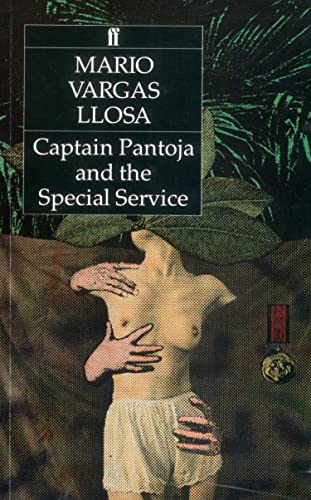
Captain Pantoja and the Special Service by Mario Vargas Llosa
Posted in Other fiction, Reading Reviewed at 12:00 on 16 July 2020
faber and faber, 1987, 252 p. Translated from the Spanish Pantaléon y las visitadoras. No translator named.
Llosa may have intended this to be a light-hearted piece of fiction. (Then again perhaps not; there are several deaths in it.) It may have been taken so in the 1970s when it was first published but I doubt the book’s premise would be viewed with much favour were it to be submitted to a publisher nowadays.
Because the soldiers posted (in effect “up the jungle”) to Iquitos, driven to distraction by the heat and conditions, are causing havoc among the local women, raping them left, right and centre – even in the street in full daylight – Army Captain Pantaleón Pantoja is given the unusual task of organising a service to prevent this. This is the SSGFRI, the Special Service for Garrisons, Frontier and Related Installations. In effect he is to procure women to provide for the sexual release of the soldiers on an organised basis. But all this is to be done in secret, he must not wear his uniform; the women, though in reality Army employees, are to be unofficial, without rank, though the service will have an identifying colour scheme, red and green, worn as a badge by the “specialists” and displayed on the trucks, boats and single aeroplane the service will have at its disposal.
Pantoja’s wife, Pochita, is at first delighted by his apparent promotion but her disappointment with their new quarters, not, of course, in the army compound but instead a very old, very ugly, very uncomfortable house in town, not at all comparable to the poorest one on the base, is profound. She is doubtful, too, of the increased sexual interest Pantoja has for her (stimulated by the heat and conditions of their new surroundings) though pleased to become preganant with their first child. Pochita’s ignorance of Pantoja’s true activities, despite his associations with shady characters, is sustained for a while but is eventually lifted when a specialist fired for misconduct writes to her.
Being an Army man, Pantoja of course treats the job with military punctiliousness, engaging surveys into the length of time each “service” will require, hence determining the number of specialists to be recruited, and itemises the amounts to be docked from the pay of the service’s users. Due to his logistical skills he makes a great success of everything; so much so that demand for his specialists increases – to the Navy and beyond.
In the meantime a heretical sect known as The Brotherhood of the Ark, led by a Brother Francisco, whose adherents’ trade-mark practice is the crucifixion of animals and birds, is gaining followers in the region. Despite all the authorities’ efforts to arrest him Brother Francisco remains elusive. The intersection between Francisco’s cult and the activities of the SSGFRI provides th enovel’s turning point.
The story is told through conversations, the texts of military dispatches, letters from and to Pochita, transcripts of local radio broadcasts and extracts from newspaper reports. The “normal” text has an unusual flavour, as different conversations are interleaved with each other on the page, with only a paragraph break to signal any change to and from each discussion. This initially has the efect of obstructing the story’s flow but is soon accustomed to.
Sensitivity warning. One of the characters, an inhabitant of the demi-monde whom Pantoja employs to help him with his mission, is called Porfirio Wong, but is also given the soubriquet the ‘Chink.’
Pedant’s corner:- supervisers (supervisors,) a capital letter on the next word following a colon – but not in every instance of a colon, a line repeated on the next line (x 2,) smoothes (smooths,) “the lay of the land” (the lie of the land,) Collazos’ (Collazos’s,) Manaos (this Brazilian city is usually spelled Manaus,) Iquitos’ (Iquitos’s,) “consults with his adjunct” (that military functionary in English is called an adjutant,) “‘he’d of died of sorrow’” (does this illiterate solecism exist in Spanish? The correct English form is ‘he’d’ve’.)
Tags: Mario Vargas Llosa, Peruvian fiction, South American Fiction, Translated fiction
