The Dream of the Celt by Mario Vargas Llosa
Posted in Other fiction, Reading Reviewed at 12:00 on 10 October 2019
faber and faber, 2013, 504 p. Translated from the Spanish El sueño del celta by Edith Grossman.
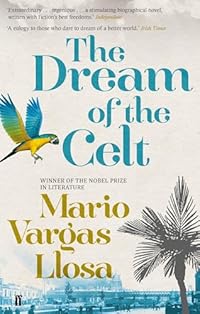
On the face of it this seems an unlikely endeavour. A Peruvian novelist focusing on a relatively obscure incident in British – and Irish – history? (Then again the Peruvian Jorge Luis Borges was fascinated by Scotland.) But this novelist’s protagonist, (Sir) Roger Casement, was instrumental in exposing the barbarous practices of colonial exploitation in the Congo and later the Amazon, wherein he made his name and for which he received his title, before he took up the cause of Irish independence and was subsequently arrested for treason after visiting Germany during the Great War to seek its government’s help in that endeavour.
The odd numbered chapters here focus on Casement’s life in prison after his trial, in the run-up to his execution. These are the most novelistic parts of the book, displaying his relationship with the guards and the visitors who come to see him, outlining their efforts to obtain a commutation of his death sentence. The even numbered chapters tend to be longer and cover his career in the years leading up to his arrest – and often read more like a history book than a novel. Llosa discounts a large portion of Casement’s diary entries (which many contend were forged by his captors) relating to his homosexual encounters with various men – which damned him not only in the authorities’ eyes, but more crucially in those of the public – as imagined or else wish fulfilment fantasies, giving a novelistic alternative account of several of these incidents, though he treats others as veracious. As Casement’s priest says to him about the suggestion the stories about him were put in the newspapers to counteract the petition for clemency, ‘Nothing can be excluded in the world of politics. It’s not the cleanest of human activities.’ Yes, indeed.
In what is perhaps a comment on the motives of campaigners, a consul in S America tells Casement, “‘I don’t have much admiration for martyrs, Mr Casement. Or for heroes. People who sacrifice themselves for truth or justice often do more harm than the thing they want to change.’”
It is in the ‘historical’ (in the sense of predating the events in the odd numbered chapters) sections though that it is set out how Casement’s experiences in the Congo and the Amazon led him to the idea that Ireland too was a colonised country, albeit with its inhabitants now less harshly treated.
Despite Casement’s conclusion in South America that, We should not permit colonisation to castrate the spirit of the Irish as it has castrated the spirit of the Amazon Indians. We must act now, once and for all, before it is too late and we turn into automata, Llosa also suggests Casement’s trip to Ireland on a U-boat was to try to forestall the Easter Rising rather than encourage it, or even to bring it weapons, as it would not be supported by German action to neutralise the British Army and Royal Navy. When Joseph Plunkett tells him in Germany the Rising is imminent Casement thinks, “No matter how heroic and intrepid they were, the revolutionaries would be crushed by the machinery of the Empire. It would use the opportunity to carry out an implacable purge. The liberation of Ireland would be delayed for another fifty years.”
Plunkett’s response is that, “‘of course we’re going to lose this battle. It’s a question of enduring. Of resisting. For days, weeks. And dying in such a way that our death and our blood will increase the patriotism of the Irish until it becomes an irresistible force.’” Which it did.
The novel’s title The Dream of the Celt comes from that of a poem Casement wrote in 1906 about Ireland’s mythic past. While as a novel it is a little unbalanced and not, perhaps, Llosa at his best, it does act as a useful primer on Casement’s life and times.
Pedant’s corner:- sheriff (illustrates the drawbacks of translation into USian. There are no sheriffs in British prisons. We have prison officers or, at a push, warders. And it wasn’t the prison Governor, since he appears later in the book.) “In Brixton Prison” (in the context of an earlier mention of Pentonville a British translator would just write ‘In Brixton’ here,) “Dr Livingstone, who never wanted to leave African soil or return to England” (return to the UK? Livingstone was Scottish after all.) “The Irish historian ……. she had been” (even though there are 34 words in between ‘historian’ and ‘she’ that ‘she’ is not needed,) “gave Walla a week to fulfil their quota” (its quota,) “where a formation of African soldiers were marching” (a formation … was marching.) “There were also a good number of” (There was also a good number,) “Perhaps one, some of his colleagues” (one, or some, of his colleagues?) “with the Irish insignia on their visors” (I suspect this refers to cap badges. These do not sit on visors,) Casement refers to the British Army as “the most powerful army in the world” (in 1916 the British Army wasn’t. The German one still was,) “the Court of Appeals” (it’s the Court of Appeal.)
Tags: Edith Grossman, El sueño del celta, Jorge Luis Borges, Mario Vargas Llosa, Translated fiction
