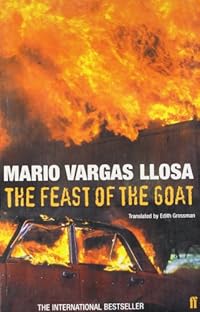
Translated from the Spanish, La Fiesta del Chivo, by Edith Grossman.
faber and faber, 2003, 475p.
After thirty five deliberately estranged years making her way in the world as a lawyer in New York, Urania Cabral returns to Santo Domingo in the Dominican Republic to confront her invalid father, Agustín, once a well-connected member of the brutal regime surrounding the dictator Rafael Leonidas Trujillo Molina, whose times and legacy are the book’s focus.
Apart from Urania’s there are several other narrative viewpoints. Rotating in a strict sequence through the first sixteen chapters are sections detailing Urania’s memories and experiences, Trujillo’s thoughts and actions in his last days and those of the people lying in wait to assassinate him. The latter end of the book focuses more on other co-conspirators and Trujillo’s successor as President, Joaquin Balaguer. The final chapter reveals the extent of Agustín’s betrayal of Urania after he fell into disfavour.
Some of these play tricks with time. The narration of Urania’s memories to her extended family is intercut with third person accounts of what occurred in the past, the time frame jumping back and forward without warning. Trujillo’s thoughts and those of his assassins also mingle reminiscence with the imminent action.
Despite his position Trujillo has insecurities; he feels betrayed by his prostate (its cancerous state can cause him to urinate involuntarily, his manservant always has a change of clothes available just in case) and harbours bitter feelings towards a woman with whom he couldn’t achieve an erection. His almost hypnotic, paralysing, effect on others is emphasised in the sections narrated from others’ viewpoints.
The everyday paranoia, the second guessing, engendered by living close to a dictator is well depicted, the apparatus of state repression and control shown us quite graphically, but the book focuses entirely on the elite in Dominican society. While ordinary Dominicans are mentioned, very little sense is given of their lives.
The Feast of the Goat is, though, clearly a book by a writer who has chosen to grapple with big themes – not just love, sex and death, but man’s inhumanity to man and to woman – and has the ability to handle them.
The translation was into USian, which is understandable given the larger potential readership there, but two thoughts arose. Does Spanish have the same distinction between being hanged and being hung as exists in English? Hung was use twice here in the wrong sense, firstly by a soldier who might perhaps be expected not to know the difference, but the second was in the body of the narrative. Also men’s lower outer garments were sometimes referred to as pants but at other times as trousers.