Posted in Events dear boy. Events at 20:30 on 16 December 2023
I read today the Guardian obituary of West Indies cricketer Joe Solomon, known for his excellent fielding. He it was who threw the ball (with only one stump to aim at) that ensured the runout that secured the first ever tie in Test cricket in a celebrated match against Australia at Brisbane in 1960.
A sufficient claim to fame you would think, but until I read it I had not realised he is the only cricketer (yet) to score a hundred in each of his first three first-class innings.
Joseph Stanislaus (Joe) Solomon: 24/8/1930 – 8/12/2023. So it goes.
No Comments »
Posted in Art Deco, Empire Exhibition, Scotland, 1938 at 12:00 on 24 February 2022
Another Brian Gerald Art-drawn postcard from the Empire Exhibition Scotland 1938. Pavilions for South Africa, New Zealand, Australia and Canada on left with Palace of Engineering at far end:-

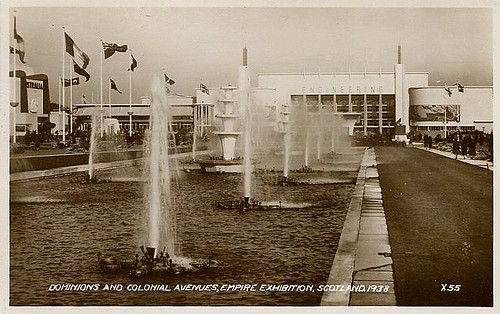
Valentine’s sepia postcard of the Dominions and Colonial Avenues at the Empire Exhibition Scotland 1938 featuring fountains, Australian Pavilion and Palace of Engineering:-
Reverse view. Another Valentine’s postcard. Australia and Canada Pavilions to near right, Palace of Industries at far end:-

Valentine’s sepia postcard of Canada Pavilion plus Palace of Engineering at far end. Tower of Empire in background left:-

No Comments »
Posted in 1960s, Friday On My Mind, Music at 12:00 on 15 February 2019
A piece of typical mid-60s pop. Never a hit (though apparently it still sold 10,000 copies in the UK) but one that nevertheless stuck in the memory.
The Montanas: Ciao Baby
The version below I’d never heard until I researched this post. It was a hit for Lynne Randell in Australia. I think I prefer its faster pace.
Lynne Randell: Ciao Baby
No Comments »
Posted in Architecture, Art Deco, Empire Exhibition, Scotland, 1938 at 08:00 on 17 February 2015
Here are two more of my collection of postcards of the Empire Exhibition, Scotland 1938.
The first shows three of the Colonial Pavilions, part of the South African building on left – one of the few “traditional” structures present (rather than the deco/moderne that dominated the Exhibition) – then New Zealand and finally Canada. As ever Thomas Tait’s Tower of Empire is in the background.

This next one is captioned wrongly. It shows the South African and New Zealand Pavilions and not Australia.
No Comments »
Posted in Altered History, Harry Turtledove, Reading Reviewed, Science Fiction at 12:00 on 28 April 2013
Gollancz, 2008, 321 p.
Unlike the previous volumes in Baxterâs “Timeâs Tapestry” series which were spread over several centuries and as a result had a disjointed feel, the action in this one is spread over only a few years in the late 1930s and early 1940s. The tale is tighter and more cohesive as a consequence.
The prologue features an Irishman called OâMalley who at MIT has invented a machine he calls a âloomâ with which – with the contribution of the dreams of an Austrian Jew called Ben Kamen â he has managed to send a message back to pre-Roman Britain. It isnât long before both the loom and Kamen have been snatched by the Nazis and incorporated into their greater plan of altering history to ensure the triumph of the Reich.
The meat of the book is set in and after the invasion of Southern England by German forces once the BEF had been destroyed on the shore at Dunkirk. A hasty (and to my mind unlikely) deal by Churchill with the US sees them given military bases – US sovereign territory – south of London. As Hitler is seeking to avoid war with the US the German advance halts when they encounter these. This struck me as more of a sop to possible US readers of the book than something that would have occurred in such a scenario. The presence of a female US newspaper correspondent and her son in the cast of characters also points in this direction. A demarcation line cutting off South-East England is where the war situation settles down.
Off-stage Churchill falls as Prime Minister, to be succeeded by Lord Halifax who nevertheless continues the war – which goes on more or less as in our timeline; Barbarossa, Pearl Harbor, Stalingrad, El Alamein all get a mention, Japanâs invasion of Australia is new though. Again it may be more likely that Halifax would have sued for peace, but perhaps that would have been unthinkable with a substantial part of the UK â not just the Channel Islands â under German rule.
While Weaver can be read as a one-off with no detriment to the reading experience there are several nice touches where Baxter has his characters travel to locations which appeared in earlier books in the series; places like Birdoswald on Hadrianâs Wall and Richborough in Kent (Roman Rutupiae.)
This is the sort of thing that Harry Turtledove essays so frequently. Baxterâs characters are more rounded than Turtledoveâs generally are and the extra twist of the loom makes for an added commentary on the contingency of historical events.
No Comments »
Posted in Curiosities, Modern Life Is Rubbish, Nostalgia at 22:33 on 26 April 2013
I was thinking about Cadbury’s Caramello again today and I suddenly remembered that the bar had another name, Caramilk. It had disappeared once before and was brought back under a new name.
I can’t now remember which name came first – possibly Caramilk was the one which was around in my youth and Caramello came later.
I looked up Caramilk and it seems there is a bar of this name sold by Cadbury’s in Canada, and Caramello is found in the US, Australia and New Zealand. The Wiki article doesn’t mention Ireland though.
Here’s a link to the Irish shop and its picture of a Caramello bar which looks more like the non-vending machine size I remember buying back in the day. When I looked there though it said, “Sold Out!”
Some of the images on this page (I see mine has got on there somehow; it’s about halfway down) are of the old packaging.
No Comments »
Posted in Football, Scotland at 20:00 on 16 August 2012
Easter Road, Edinburgh, 15/8/12.
Thankfully I missed any sight of the Florida debacle in June when the USA humped us 5-1.
I only caught the highlights of this, where Scotland looked impressive enough. But I didnât recognize many of the Australians so donât know if it was a strong team or what.
Australiaâs goal was a belter (almost literally.) Mark Bresciano couldnât have hit it any more sweetly.
Jordan Rhodes caught the eye, great movement across the defender for his header from an excellent cross. The poor Aussie defender placed his header for the own goal beautifully. Ross McCormack got behind their defence too easily for the third but took it well.
Danny Foxâs crossing for the first two goals was good but he seems very one-footed. He wonât always have time like that.
Two World Cup qualifiers next month will be more nail-biting, Iâm sure.
No Comments »
Posted in Confederations Cup, Football at 21:44 on 4 December 2009
No sooner had the tedious process finished than Motty was at it again. England willl win it, he said.
At least Alan Shearer and Mark Lawrenson went for Spain and Brazil – though, historically, Spain have an even poorer World Cup record than England. (Not so in European Championships, of course.)
There was a degree of unseemly euphoria at England’s “good” draw and first place in the group was taken for granted. Already it was so-and-so (possibly Germany, though the likely alternatives, Australia – even Serbia and Ghana – could be tough prospects) in the last sixteen and France in the quarter finals.
Let us be clear about this. The USA are no mugs. They could have won the Confederations Cup last summer. If the USA play to form, England will be stretched to beat them. Algeria beat the African Nations champions, Egypt, to qualify and Slovenia may well spring a surprise.
[By the way, judging by how France struggled to qualify, they will only get to the last sixteen if Uruguay and South Africa are mince. I expect at least one of them to be tougher.]
As for the quarter finals, that will be your lot. Overseas it usually is.
No Comments »

