Archives » 2020 » January

Brechin War Memorial

After all those visits to Brechin to see the mighty Sons of the Rock play away against Brechin City last year in August in preparation for yet another visit I finally looked up where Brechin’s War Memorial is located. It turned out it’s very near the football ground in a pleasant park area.

It’s an impressive sandstone column:-

Brechin War Memorial

Side view:-

Brechin War Memorial From Side

World War 2 Dedication. “To the glory of God and in grateful remembrance of those who gave their lives in the Second World War 1939 – 1945.” Below the names, “Greater love hath no man than this.”

World War 2 Dedication, Brechin War Memorial

Great War Dedication, “To the undying memory of the men of the City and Parish of Brechin who gave their lives in the Great War 1914 – 1919. Their name liveth for evermore,” and names Ada – Cla:-

Brechin War Memorial Great War Dedication

Great War names Cob – Hod:-

WW1 Names, Brechin War Memorial 8

Great War names Hoo-Pai:-

Great War Names Brechin War Memorial

Great War names Pet – You:-

Brechin War Memorial Great War Names

Other Conflicts; Kenya, Northern Ireland, Korea, Malaya. Plus additional names for France 1916, Burma 1945, and Mediterranean 1942:-

Brechin War Memorial, Other Conflicts

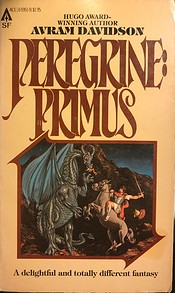
Peregrine: Primus by Avram Davidson

Ace, 1971, 222 p.

Peregrine: Primus cover

The Peregrine of the title is the bastard son of a king, sent out on his own as he approaches manhood. The setting is in the declining years of the Roman Empire, an age of petty kingdoms and the burgeoning of Christianity as a Europe-wide religion. In this respect Peregrine is a heathen still, as was his father.

Davidson adopts a joky, referential, allusive style – with cod Roman numbers (VVVXXXCCCIII) and embedded quotations, “wine-dark sea,” “they looked at each other … with a wild surmise,” “minding the stoa,” “confound their politics, frustrate their knavish tricks,” – as his hero, along with page Dafty and mage Appledorus, goes out into the world partly in search of his elder brother Austin (also one of the King’s by-blows.) Along the way Peregrine falls into the company of Hun Horde Seventeen. You get the drift.

Peregrine, as his name suggests, is a traveller: not only that, but also, when fantasy bleeds into Davidson’s tale, at times a falcon.

This is not a novel to be taken very seriously. It’s a jeu d’esprit on Davidson’s part but passes the time well enough. I note that once again he employs the word wee to mean small. There’s Scots ancestry there somewhere.

Pedant’s corner:- “he had seen nought but” (‘nought’ means ‘zero’, it does not mean ‘nothing’. That would be ‘naught’.) “Gee” (an unlikely expletive for someone from a non-Christian culture, also an anachronism given the setting, but then we also had ‘mom’ and other twentieth century USianisms,) wisant (wisent,) “was still damp and a smelled briny” (no need for the ‘a’,) talley (tally, though always used in the plural so ‘tallies’,) a missing end quotation mark, boney (bony,) Sextuagesima (I’ve heard of Sexagesima and Septuagesima but not Sextuagesima. Davidson may have been signalling the speaker’s ignorance here,) cameleopard (usually camelopard,) coöperation (plus points for that diæresis,) “‘I didn’t use to wonder’” (I didn’t used to wonder,) “several battery of snores” (several batteries,) revery (usually reverie,) “lay of the land” (it’s lie, lie of the land.) “The Hun digested his slowly.” (The Hun digested this slowly,) Philozena (elsewhere always Philoxena,) “‘it’s an ideal was to get conversation started’” (ideal way,) abhore (abhor,) highoffice (high office,) apothegms (apophthegms,) asofoetida (asafoetida or, better, asofœtida,) “the congregation were delighted” (the congregation was delighted,) miniscules (minuscule,) “he had born hither” (borne hither.) “‘And where do you think to do?’” (And where do you think to go?)

Game Off

I was spared the torture of watching today’s game on Sportscene Results for two reasons.

One: Sportscene Results wasn’t on because the Scottish Premiership is having a midwinter break. (This is another example of BBC Scotland’s contempt for lower league football which they tend to ignore as much as possible. Having said that I do though have to commend them on the TV show A View From the Terrace which does give the smaller clubs and their players most of its attention.)

Two: The game was off due to a waterlogged pitch. Not surprising given the weather we’ve been having.

In one sense the postponement was welcome. We’re down below the bare bones in terms of player numbers and a week off yields more time to get injured players fit.

Whether it was a good thing depends on how the game goes on the rearranged date.

As it is, not too much damage was done in terms of the teams below us as Forfar drew and Peterhead lost.

It’s the Cup game against Aberdeen up next. A free hit – except if we get utterly gubbed.

Carmyllie War Memorial

For years on my way up to Brechin to see the mighty Sons of the Rock play at Glebe Park against Brechin City I have been passing this War Memorial – a granite pillar by the side of the B961 seemingly in the middle of nowhere at a junction with an unnumbered minor road (to the left in the first photo below.) There’s not really a place to park but on making that same trip in August 2018 I made sure to stop.

Carmyllie War Memorial

As you can see it’s beautifully kept.

The inscription reads, “In proud and loving memory of men from Carmyllie District who fell in the Great Wars 1914 – 1918. 1939 – 1945.” Great War names are below, plus one for World War 2.

Carmyllie War Memorial Pillar

A memorial bench is set behind the pillar:-

Carmyllie War Memorial Bench

Great War names, plus one for World War 2:-

Carmyllie War Memorial Names

Again Great War names, plus one for World War 2:-

Names Carmyllie War Memorial

The lack of Second World War names on these rural memorials may be due a combination of the loss of men in the Great War and the decline in numbers of men involved in farming which occurred between the two wars as a result of mechanisation.

Interzone 285 Est Arrivé

The latest Interzone (no 285, Jan – Feb 2020) popped onto my doormat this morning.

Interzone 285 cover

 The Menace From Farside cover
Skein Island cover

As well as the usual fiction and features this one contains my reviews of Aliya Whiteley’s Skein Island and Ian McDonald’s The Menace From Farside.

I am expecting a couple of books for review in Interzone 286 through the post any day now.

Reelin’ In the Years 167: The Things I Should Have Said

This is a track from Lindisfarne’s first album Nicely Out of Tune, my favourite track on there, but I’ve not been able to feature it before as I couldn’t previously find an embeddable example.

I have a thing about lyrics. You know this. (Maybe I’m a frustrated song-writer.)

I particularly like the rhyming in this one but the overall lyric has some great lines.

Who hasn’t been in the situation, “So we sat and watched each other through the fading firelight
Each one waiting for the silence to be broken”? Those lines just ache for resolution.

“The spittle from his twisted lips ran down to his bow-tie,” (and bow-tie rhymed with ‘eye’ and ‘deny’) is nothing short of inspired as is also in the last verse, “Teachers from whose hallowed mouths great pearls of wisdom crawl,” where the emphasis provided by the internal rhymes in, “The joke is on the bloke who never spoke a word at all,” hammers the song’s point home.

Add in the fact that the last line of each verse is not just foreshadowed but fore-ordained by the word immediately preceding, “And the things I should have said,” and you have a lyrical masterpiece.

Lindisfarne: The Things I Should Have Said

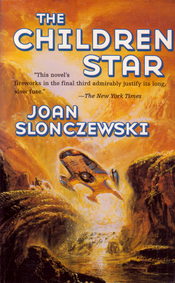
The Children Star by Joan Slonczewski

Tor, 1999, 347 p.

The Children Star cover

This is another of the author’s tales of the Fold, an interstellar polity which we have met before in A Door Into Ocean and Daughter of Elysium.

Here, a prion plague known as the creeping is devastating the human population of the planet L’li. A L’liite child called ’jum G’hana is rescued by Brother Rhodonite and taken to Prokaryon, a planet where the living things all contain ring-shaped structures in their body plans and chromosomes. Zoöids are animal-like, phycoöids resemble plants, phycozoöids display plant and animal traits, while the microzoöids are microbes. The planet is also rich in arsenic. Humans need to be life-shaped to survive there, a process which works better the younger you are. Adults have almost insuperable difficulties in being adapted. ’jum G’hana is on the cusp. She does, however, have a facility for numbers, especially primes which she calls ‘orphans.’ Sarai, a Sharer lifeshaper working on Prokaryon, connects the tale more directly to Slonzcewski’s previous novels of the fold, which were both set on the Sharer’s home planet of Elysium. Sarai’s adoption of ’jum G’hana as a co-worker has ramifications later in the book in whose initial stages the narrative flow is cramped somewhat by the intrusiveness of the author’s information dumping.

While there is a diversion into interstellar politics Slonzcewski’s interest in The Children Star is on the biology of Prokaryon. Tumblerounds have a triplex DNA and reproduce by splitting three ways down the middle. Microzoöids contain a brain’s worth of data in a single cell and are capable of ‘infecting’ humans. This is the main engine of the plot and an explicit threat to Prokaryon. The Fold’s authority debates whether or not to destroy Prokaryon’s indigenous life-forms (by a process known as boiling.) That at least some of these turn out to be intelligent would be their saving.

It’s all readable enough – and more so than Daughter of Elysium. To have such a focus on biology at the microscopic level is an unusual trope in SF, but Slonzcewski is herself a biologist so that isn’t too surprising. The characters tend a bit to the stereotypical, however.

Pedant’s corner:- Sari (elsewhere Sarai,) clear (used as equivalent to colourless. Clear does not mean this, it means transparent. Objects can be both clear and coloured.) “Rod would never has asked” (never have asked.) “Patella came because is a Spirit Caller,” (because he’s a.) “Khral’s voices was softened” (Khral’s voice was softened,) ’jum Ghana (elsewhere always ’jum G’hana,) “or she would not have designed to come” (deigned to come makes more sense,) “he picked her up and folded her in her arms” (in his arms,) kidnaped (kidnapped,) “ten thousand-odd items priorities by her nanoservos” (prioritised makes more sense,) “only a few last long enough to secret toxins” (to secrete toxins,) odiferous (usually spelled odoriferous,) “others such correlations” (other such correlations.) “There … were a group of tumblerounds” (there … was a group.) “And what would the Fold do when they found out?” (And what would the Fold do when it found out?,) “all-to-familiar” (all-too-familiar,) “knew them better, perhaps, even then they knew themselves” (even than they knew themselves,) descendent (descendant.) In the Appendix (a description of the life-forms of Prokaryon): “Rotate as they swims through the water.” (Rotate as they swim through.)

Backhouse Rossie Estate, Fife

The good lady is a keen gardener and also likes to visit large gardens.

One near to us is at Backhouse Rossie Estate but we hadn’t visited it till the summer of 2018 on what turned out to be a good day trip.

One of the exhibits there is a DNA path seen below from the side:-

DNA path

Here you can see the interweaved paving stones representing DNA’s double helix:-

Backhouse Rossie Estate DNA Path

The DNA path from its other end:-

DNA Path, Backhouse Rossie Estate

At the path’s central point is a sculpture on whose sides are carved the C,G,T,A initials of the base pairs which help make up DNA’s structure:-

DNA Sculpture

An information board describes the sculpture’s inspiration. The garden’s creators, Andrew and Caroline Georgina Thomson, have names whose initials are also those of the base pairs:-

DNA Sculpture info board

The garden also contains wooden sculptures illustrating the Goldilocks story:-

Daddy Bear asleep:-

Daddy Bear Asleep, Backhouse Rossie Estate

Mummy Bear:-

Mummy Bear, Backhouse Rossie Estate

There a putting green too (below with the estate house in the background):-

Putting Green and House, Backhouse Rossie Estate

Haig Memorial, Ladybank

Field Marshal Earl Haig‘s family were the proprietors of Haig whisky. Their Ramornie House was near the town of Ladybank (see the two previous posts) and even had their own waiting room at the local Railway Station, though it was built by a previous onwer of the Ramornie Estate.

Their whisky distillery was a few miles away in Markinch.

There are two memorials to the Field Marshal in Ladybank.

Haig Memorial Gates, Ladybank. The inscription reads, “These pillars and chains were erected by the ex-service men of Ladybank and district to the glorious memory of Field-Marshal Earl Haig.” Ladybank War Memorial is in the background:-

Haig Memorial Gates, Ladybank

The Haig Memorial Garden lies behind Ladybank’s War Memorial. This is how the garden looked in 2018:-

Haig Memorial Garden, Ladybank

Information Board, Haig Memorial Garden:-

Information Board Haig Memorial Garden, Ladybank

A plaque on the wall gives the information that the gardens were refurbished in 1993 and re-opened by Menzies Campbell, then the local MP:-

Refurbishment Plaque Haig Memorial Gardens, Ladybank

Ladybank War Memorial

A granite cross on a granite stepped stone base, inscribed “1914 – 1919 and 1939 – 1945” inside a wreath. The names below are for the Great War:-

Ladybank War Memorial Northern Aspect

Additional dedication, “This tablet is placed here by the ex-service men in memory of their comrades who fell in the Great War 1914 – 1919.”

Ladybank War Memorial Additional Dedication

Western aspect. Second World War names. Ladybank Railway Station in background:-

Ladybank War Memorial Western Aspect

Eastern aspect. World War 2 names:-

Ladybank War Memorial Eastern Aspect

free hit counter script