Archives » 2019 » September

World War 2 at Montrose Air Station

Model of Montrose Air Station at Montrose Air Station Heritage Centre:-

Model of Montrose Air Station

Air Transport Auxiliary (ATA) poster. The ATA featured many women pilots:-

Air Transport Auxiliary Panel

Detail:-

ATA Panel Detail, Montrose Air Station

Photos of some women flyers:-

Women Flyers

Civilian casualties:-

Civilian casualties at Montrose Air Station

RAF Sector Clock:-

RAF Sector Clock, Montrose Air Station

RAF Memorial Window, in stained glass. Inscribed, “This window commemorates the pilots of the Royal Air Force who in the Battle of Britain turned the work of our hands into the salvation of our country.”:-

RAF Memorial Window

Models of a Mosquito and Hurricane:-

Mosquito and Hurricane Models

War Savings Campaign Plaque:-

War Savings Campaign Plaque

Something Changed 26: Disco 2000

Another of Pulp’s mid-decade classics from the Different Class album.

Let’s all meet up in the year 2000? It’s 2019 now. How did that happen?

This must be the single version though as the track on the album had a descending guitar line in the chorus that isn’t audible here.

Pulp: Disco 2000

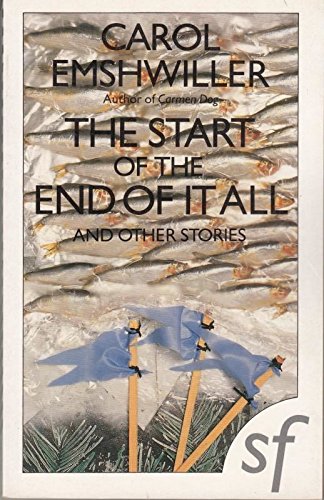
The Start of the End of it All and other stories by Carol Emshwiller

Women’s Press, 1990, 169 p.

 The Start of the End of it All and other stories cover

In these stories Emshwiller’s style tends to the intellectual and reflective, and always told with a female slant on the world. Very few are straightforward narratives but all of them are intriguing – and well written.

The Start of the End of it All is an alien invasion story. “‘Politics,’ they say, ‘begins at home, and most especially in the kitchen’” – a good place for a revolution to start. But first they have to get rid of the cats. The aliens seem to have targeted divorced, post-menopausal women for their infiltration. A tinge of alarm strikes when one of the aliens says, ‘Time to find lots of little dark, wet places.’ But our narrator isn’t keen on giving up cats.
Looking Down is narrated by a sentient bird (or flying creature at least) who allows himself to be captured by humans to function as an oracle and protector.
In Eclipse a woman stumbles into the wrong party and is taken for either a pianist or flautist. She is neither. But a student of Jung gives her confidence.
The Circular Library of Stones is found by our narrator who collects stones and imagines the circle as a library. Her story can be read as if she has lost some marbles though.
In Fledged a winged woman who looks remarkably like the narrator’s ex-wife comes crashing into his house during a storm.
Vilcabamba finds a man displaced from his people but able to remember gestures they made and bits of their language. He sets out to try to find his way back home.
In Acceptance Speech a man abducted from his own world makes his speech on being made Humble-Master-of-the-Poem.
If the Word Was to the Wise is a story about the importance of the word, and its dangers. In the tallest building in the city are two safes. One contains the law, all that keeps the city secure, the other, all the banned books. A young prince of the library (despite the title, really an underling) falls for the chief librarian’s daughter, Josephine. They begin to plan to open the “banned” safe.
The centre of the universe in Living at the Centre is Omphalo, of whose fabulous beached women the mountain men have heard tell. One old woman goes down there to find out if the tales are true.
In Moon Songs a brother and his older sister encounter an unusual insect which when pricked with a pin “sings” for ten minutes. The sister tries to parlay this discovery into a stage career.
But soft, what light… is a variation on the 100 monkeys eventually typing out Shakespeare thing. Uniq-o-fax, (rather quaintly now in 2019) thirty nine typewriters and a word bank, “all those wires and tubes,” and the female narrator fall in love and write poems to each other.
Pelt is set on Jaxa, an ice planet on which a human has landed, with his dog, to hunt for furs. The viewpoint character is the dog, and the hunter finds more – and less – than he bargained for.
Début could be seen as a variation on Snow White. An apparently blind girl is brought before the Queen only for her mask to be removed before she is banished to the hills. There, the story diverges from that template.
The titular organisation of The Institute is the Old Ladies Institute of Higher Learning (the OLI of HL,) the story one that features an embedded drawing and ends with a piece of musical notation for a song. The narrator’s grandmother, an alumna of the OLI of HL, was quite a gal.
Woman Waiting is the stream of consciousness of a woman waiting for her postponed flight, retreating ever into herself.
In Chicken Icarus a man who is a head and torso but little else (but that little – or not so little – is important,) schemes to have himself displayed more widely.
Sex and/or Mr Morrison features a woman looking for the Others amongst us spying on her upstairs neighbour.
In Glory, Glory a woman on holiday with her husband in a country where they don’t know the language is taken by the locals for a goddess.

Pedant’s corner:- six storey (six storeys,) “bit for the tower, I also, would have done” (either no comma after ‘also’ or an extra comma after ‘I’,) “‘the first snows will be coming’ he says. ‘The tower..” (that ‘he says’ is part of a sentence the character is speaking so it should not be outside the quotation marks,) “in order fit my own ears” in order to fit,) “the forsythia were not in bloom” (either ‘forsythias’, or ‘was not in bloom’, largess (USianism for largesse?) stachel (satchel,) contraposto (contrapposto.)

War Memorials, Montrose Air Station Heritage Centre

Part of a Memorial display at Montrose Air Station. A War Memorial rescued from a now disused Church at Logie, near Montrose:-

Church War Memorial

The placard beside the rescued Memorial asks, “Do we really remember them?”

Do We Really Remember Caption

The poppy wall above it commemorates the dead of both World Wars:-

Poppies

Great War Exhibits, Montrose Air Station

BE2 Replica, small model Fokker Triplane behind, plus two other models in photo:-

BE2 Replica, Montrose Air Station

Same BE2 with a small model of a Bristol Fighter to upper left and a Sopwith Camel, I think, to right:-

Replica BE2, Montrose Air Station

Fuselage and Wings of a replica Sopwith Camel under construction. This may now be completed:-

Replica Sopwith Camel Fuselage and Wings

Sopwith Camel wing being worked on:-

Sopwith Camel Wing

Effigy of Lieutenant Ross Robertson:-

Effigy of Lieutenant Ross Robertson

Cross erected at Marquion in France by the Germans at the grave of Lt Ross Robertson inscribed, “Er starb den heldentod – eng Flieger.” “He died the death of a hero – an English Airman.” He was buried there on 17/5/1917:-

The Robertson Cross

Model of a Rumpler? Taube. Plus Bristol Fighter:-

Model Taube and Bristol Fighter

Small Models of Fokker Triplane and Sopwith Camel:-

Small Models of Fokker Triplane and Sopwith Camel

Part of the Fokker Triplane of the famous Red Baron, Manfred von Richthofen. Souvenir hunters apparently got to it very quickly:-

Part of Red Baron's Triplane

Terrance Dicks

A name well-known to fans of Doctor Who, Terrance Dicks has died.

His asssociation with the programme began first as script editor (a position he held from from 1968-1974) and then as writer, starting with the last Patrick Troughton serial The War Games, which introduced the Time Lords, in 1969.

Away from the Doctor he wrote the all-but forgotten (some would say rightly) Sf series Moonbase 3.

Perhaps less commendably he contributed scripts for the ITV soap opera Crossroads, famous for its cardboard sets (and equally cardboard characterisation – none of which could be attributed to him.)

He also wrote many of the Doctor Who novelisations and original stories not derived from TV scripts.

Part of many people’s childhoods, his loss will sadden those who look back upon his work with affection.

Terrance William Dicks: 14/4/1935 – 29/8/2019. So it goes.

Its Colours They Are Fine by Alan Spence

Corgi, 1987, 238 p.

Its Colours They Are Fine cover

Called “A vivid portrayal of Glasgow life” in the title box on its front cover Its Colours They Are Fine is divided onto three sections – each itself made up of five, five and three connected stories respectively.

Section One illustrates the young life of Aleck, growing up in the crowded conditions of Govan before the slum clearances. Tinsel relates the boredom of a pre-Christmas trip to the Steamie and contrasts it with the fulfilment of putting up seasonal decorations. Sheaves finds Aleck at the Harvest Festival at his Sunday School, one of a crop of souls destined for Christ. The Ferry deals with the exoticism and fear of an adventure across the Clyde to Partick. Gypsy tells of the delights and otherwise of the Kelvin Hall carnival and the mutually mistrustful relationship of Govan folk with those they call Gypsies, the people of the travelling shows. Silver in the Lamplight describes life in the back courts and games such as KDRF (Kick Door Run Fast.)

Part Two is more diffuse, featuring episodes from different stages of life. Its Colours They Are Fine recounts the anticipation of and satisfaction from taking part in an Orange Walk. Brilliant repeats this for an evening out, tribalism – of a more parochial sort – being again in evidence. The Rain Dance relates the immediate precursors to and the events on the day of a “mixed” wedding (ie between a Catholic and a Protestant.) Neither family is best pleased. The Palace sees an older man, now jobless but with little prospect of new employment, make a human connection in the Kibble Palace. The chimes of an ice-cream van in Greensleeves lead a retired widow living on the twenty-second floor of a tower block to reflect on her isolation.

Section Three is the most elegiac in tone. In Changes a man returns from a New Year spent in London visiting friends pondering on the fullness and transitoriness of little lives. Auld Lang Syne describes the events of a quiet Hogmanay (for the narrator) but one who is still bound by the traditions attaching to it. All meanings ofBlue, as in the colour of Rangers shirts, and of the Virgin Mary in Art, its associations with sadness and a patch of sky caught between clouds, resonate in the narrator’s memory of the day his mother died.

Glasgow life is here to be sure; working class Glasgow life especially. Its attitudes and habits, its prejudices, the odd casual violence, but also the camaraderie, the fellow feeling. The book in total has become something of a series of snapshots of the past though. Many of the circumstances that led to the sorts of lives portrayed here are gone now – though some will remain – but still Spence has peopled his tales with recognisable characters with full inner lives and descriptions of the Glasgow urban environment to match those of the countryside of other Scottish authors. The prose is written in straightforward English but the dialogue is in an uncompromising Glaswegian.

For those of a sensitive disposition note that the word ‘darkies’ is used twice. (In Glasgow in the days Spence is writing about, though, its use was mainly descriptive and usually not meant derogatorily.)

Pedant’s corner:- Little star of Bethlehem (later given as Little Star of Bethlehem,) a missing end quote, a Roman thumbs up said to mean survival, thumbs down to mean death (this was a common belief at the time these stories are set but I’ve since read that gladiators’ fates were determined the opposite way.) “On the platform were a number” (was a number,) a missing comma before a piece of direct speech (x 3.)

Aberdeen’s Art Deco Heritage 6: Tullos School + A Sports Pavilion

I had a recent comment on my post no 4 in this category to the effect that Tullos Primary School in Aberdeen is Art Deco.

It is.

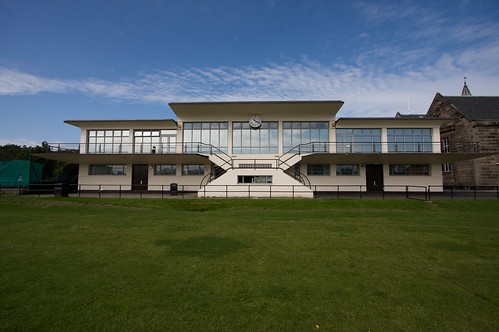
A previous commenter, Kenfitlike, provided a link to this Sports Pavilion in Aberdeen:-

Sports Pavilion in Aberdeen

M27

18th century French astronomer, Charles Messier, famously compiled a list of astronomical apparitions that were neither stars, planets, nor comets and which he called nebulae. These became known as Messier Objects and include star clusters, galaxies and “proper” nebulae.

Astronomy Picture of the Day featured one such on 29/8/19. The picture is copyright to A Bob Franke so i have not reproduced it here.

Is it just me or does that planetary nebula look like a biological cell as seen through a microscope?

External Exhibits, Montrose Air Station

Before you get to the museum entrance at Montrose Air Station Heritage Centre you pass these hangars which date from before the Great War:-

WW1 Air Hangars

Then there’s the obligatory Spitfire. This one’s named Red Lichtie. There is an Arbroath connection, though this one is probably a replica of the original:-

Spitfire Red Lichtie

More up to date (well, 1950s) is this Gloster Meteor:-

Gloster Meteor

This artillery piece, an anti-aircraft gun, is also exposed to the elements:-

WW2 Artillery Piece, Montrose Air Station

Prominent too is this memorial to all those RFC and RAF personnel who served at Montrose Air Station:-

RFC and RAF Memorial

free hit counter script