Archives » Translated fiction

Conversation in the Cathedral by Mario Vargas Llosa

faber and faber, 1993, 605 p. Translated from the Spanish Conversacion en la catedral by Gregory Rabassa.

This is a novel that is at the same time sprawling, covering a time in Peru when it was under the dictatorship of General Odría, yet also intimate, as it revolves round the families and interactions of two of its characters, Santiago Zavala, son of the well-off Don Fermín, and Ambrosio, once a chauffeur to Fermín but later to Cayo Bermúdez, a Minister of Government, Odría’s hardman.

When the novel starts Santiago is staring at the Avenida Tacna and wondering “At what precise moment had Peru fucked itself up?” While the novel does not provide a full account of the country’s dysfunctionality at that time it does go on to illustrate a lot of that fucked-upness. Much to the dislike of his father and mother, Santiago has been working at the newspaper La Crónica for many years. He meets a down on his luck Ambrosio working at the dog pound and they go on to have a conversation (the Cathedral of the book’s title is a bar) during which their life stories unfold.

Through it we meet examples of the highs, Don Fermín, Bermúdez, Santiago’s family, and some of the lows of Peruvian society. Bermúdez keeps a mistress, Hortensia, a former night-club singer with the stage name, the Muse, who spends his money liberally. She is friendly – more than friendly – with Queta, a (relatively) expensive prostitute at Señora Ivonne’s, with whom Ambrosio has a fascination.

Despite the dictatorship there are lingering political tensions between Odríists and Apristas – even more so between that latter group and the Communists (though at one point someone says there are only ten Communists left and they are all secret policemen.) Disturbances occur in the town of Arequipa, which lead to a softening of the regime and the fall of Bermúdez. Hortensia’s life more or less falls apart after his exile. Ambrosio is caught up in all this. Santiago’s job at La Crónica keeps him apart, though he had been arrested early on in his life as a hanger-on of an anti-Odría group known as Cahuide before resolving to stay out of trouble. “‘Capable people like you and me don’t get involved,’ Santiago said. ‘We’re content to criticise the incapable people who do.’”

Much of the text focuses on Ambrosio’s relationship with his wife Amalia, a smaller part relays how Santiago came to marry a nurse (again to his family’s discontent,) while the back-biting, manœuvring and backside-covering of the military during the Arequipa unrest are well-illustrated.

This is not a straightforward read, the narrative often alternates paragraphs from the present of the conversation with the unfolding of past events, which is initially a bit confusing though it settles down more from Part Two onwards, but it encompasses different layers of Peruvian society and illustrates the lack of agency of ordinary people caught up in events outwith their control, their struggles to get by, and contrasts them with the insouciance of the moneyed.

Note to the sensitive: the text contains the word ‘niggers’.

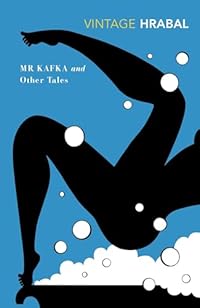
Mr Kafka And Other Tales by Bohumil Hrabal

Vintage Classics, 2019, 150 p, including 6 p Translator’s Afterword. Translated from the Czech by Paul Wilson.

These are stories set in and around Prague in the late 1940s and early 1950s when the city was still recovering from the Second World War. Several of them are situated in a steel works with apparently no safety protocols and with workers culled from various former walks of life. Misogynistic attitudes which in those days would have been unquestioned do not bear much scrutiny to the modern eye.

Concentrating on ordinary encounters and snatches of conversation exhibited in all their bizarrerie Hrabal achieves a kind of heightened realism, emphasising that nothing is truly ordinary, the grimmest of industrial settings assuming a fantastical aspect. In the circumstances that pertained in that time and place, though, the ordinary bordered on the subversive. At bottom, resorting to the ordinary is the only defence against oppression, authoritarian or otherwise.

In Mr Kafka a character named Franz Kafka strolls the streets of Prague describing all the strange encounters he has.
Strange People concerns a labour dispute in the steel works, riffs ironically on the worker’s State and provides a glimpse into the many ways in which people cope with their working environment.
The putative Angel is the overseer of a penal workforce who likes to think of himself as protecting his charges. They themselves perform small acts of human consolation as they get on with their work.
In Ingots a merchant and a doctor of philosophy discuss the times as they load up hoppers with scrap metal while a woman meant to be starting a jail sentence the next day has to succumb to the (lack of) comfort of strangers. The doctor of philosophy says, “And what’ll become of you? The same as all this scrap. The tools of your trade … you’ll be ingots too. This new age is melting you all down.”
A Betrayal of Mirrors presents fragments of a hot summer, boys practising the Czech wall pass, a stonemason repairing a statue of St Jude Thaddeus, submissions to an art exhibition, schoolchildren’s responses to the question of how to make the country an even more beautiful place, the preparations for the demolition of a statue of a figure referred to as the Generalissimo (but in reality Stalin.)
Unusually for this book Breaking Through the Drum is a single-stranded narrative which it is tempting to look on as an allegory of the Cold War. In it, amid some philosophising about the moral nature of ticket collecting, a conscientious ticket collector who has worked himself up to ticket taker for the Prague Municipal Symphony Orchestra in the Waldstein Gardens, which is separated from the St Thomas brewery, where Mr Polata’s Sumava Regional Brass Band plays in the beer garden, by a high wall, the two seemingly in competition, uses a ladder one evening to look over the wall. He sees the beer garden is overlooked by a former monastery now a home for old women and he perceives the patrons there are dancing “for the old women to see, these women who no longer had anyone to touch, who would never again be embraced that way, which was why the old women’s eyes sparkled as they did, why they glowed with longing and envy and resentment; and I saw that there were walls not just dividing symphonic music from brass music, but people from people as well, walls far more real than the one I was sitting on.”
Sharing as narrator the same Kafka as the first story in this collection Beautiful Poldi is Hrabal’s hymn to the steelworks to which he was assigned in the “Putting 77,000 to Work” scheme introduced by the post-war Communist government. Apart from featuring overheard observations on the bus to work and dialogue between Kafka and his colleagues we also see the nightly performance of a woman in the next-door convict barracks, well aware of her male audience peering through the knotholes in the fence. In the end though, “Everything exists in the elasticity of perspective, and life itself is illusion, deformation, perspective ….”

Pedant’s corner:- Translated into USian, organdie (organdie,) “the one who hung himself” (does this confusion between ‘hung’ and ‘hanged’ exist in Czech?) a missing end quotation mark, “reached into to the aquarium” (no ‘to’ needed,) “lay it against his cheek” (past tense, laid it,) “where the part ran through his thick hair” (parting,) “put then into a box” (put them,) “like a aureola” (an aureola.) “Aw shucks” (does not seem to me to be a likely Czech expression,) wolfram (that metal’s modern name in English is tungsten.)

Best of the Year 2021

As usual these books are listed in order of my reading them. 18 this year; 17 fiction, one* not; 10 written by women, 8 by men; 4 could be described as SF or Fantasy; 6 were originally published in a foreign language.

The Old Drift by Namwali Serpell
Light by Margaret Elphinstone
Those Who Leave and Those Who Stay by Elena Ferrante
Snapshot* by Daniel Gray and Alan McCredie
The New Life by Orhan Pamuk
By Force Alone by Lavie Tidhar
Labyrinths by Jorge Luis Borges
Landscape Painted with Tea by Milorad Pavić
The Testaments by Margaret Atwood
Being Emily by Anne Donovan
The Ninth Child by Sally Magnusson
Their Lips Talk of Mischief by Alan Warner
Hamnet by Maggie O’Farrell
Scabby Queen by Kirstin Innes
The Silence of the Girls by Pat Barker
The Sorrow of War by Bảo Ninh
Scandal by Shūsaku Endō
Ru by Kim Thúy

(I normally make the “year’s best” post nearer Hogmanay but I doubt any of the books I ought to have finished by then will make the list.)

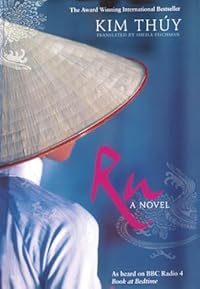
Ru by Kim Thúy

The Clerkenwell Press, 2012, 157 p. Translated from the French Ru (Éditions Libre Expression, Montreal, 2009,) by Sheila Fischman.

It seems from the epigraph page that Thúy chose her title because it is a word in both French and Vietnamese – but with different meanings; respectively a small stream (and figuratively, a flow, a discharge – of tears, of blood, of money,) and a lullaby or to lull.

The story is told in a series of vignettes, jumping about in time from narrator Nguyễn An Tịnh’s cosseted childhood in Saigon before its fall, to the degradations of her time in a refugee camp in Malaysia after a hazardous trip as one of the Boat People, and her eventual life in North America but also taking in her return to Vietnam. There a waiter is surprised she can speak Vietnamese as she “looks too fat.” Nguyễn reflects that it was her Americanised, more confident demeanour to which he was responding. “Once it’s achieved, the American dream never leaves us, like a graft or an excrescence.” But the incident made her realise she “couldn’t have everything,” that she no longer had the right to call herself Vietnamese “because I no longer had their fragility, their uncertainty, their fears.” And that the waiter was right to remind her of this.

A course in History that she took was “a privilege only countries at peace can afford. Elsewhere, people are too preoccupied by their day-to-day survival to take the time to write their collective history.”

She also reflects on the human toll of long wars. “We often forget about the existence of all those women who carried Vietnam on their backs while their husbands and sons carried weapons on theirs.”

It would be tempting to assume that this is all autobiographical, fragments of the author’s real life laid down on the page, but that would be an error. The book is novelistically organised and structured. It is a creation.

Perhaps due to her uprooting from her secure childhood life Nguyễn has a restless adult existence. She never travels except with only one suitcase. She is a woman for whom men are always replaced or replaceable, or, if they are not, her feelings for them are. She prefers relationships with married men because it keeps her “remote, aloof, in the shadows.”

Not that she hasn’t experienced love; but for her the blessing is not unalloyed. “It’s my children, though, who have taught me the verb to love, who have defined it. If I had known what it meant to love, I wouldn’t have had children, because once we love we love for ever.” Which isn’t a bad epitaph when you think of it.

Pedant’s corner:- chilies (chilis.)

The Atom Station by Halldór Laxness

Vintage , 2003, 186 p. Translated from the Icelandic Atómstöðin (Helgafell, Reykjavik, 1948,) by Magnus Magnusson.

It is a time of political dispute in Iceland. The US has proposed to lease some land for what is always referred to in the text as an Atom Station. Opponents of this plan regard the potential base as a possible target for nuclear annihilation and in any case a sellout of Iceland’s seven-hundred-year struggle for independence. Our narrator Ugla is a country girl from the north who has come to Reykjavík to work as a maid in the house of her Member of Parliament, Búi Árland. She finds him, baldness and all, strangely attractive, his voice alone enough to make Ugla weak at the knees, though she does not express this outwardly. His overbearing wife treats her more or less dismissively. (The domestic environment here for some reason reminded me a little of those in the Norwegian TV drama State of Happiness shown on BBC Four in 2020.) Ugla also has ambitions to learn to play the harmonium and so goes to the teacher’s house to do so. There she meets various people with various parts to play later in the novel.

The Atom Station is a satire (mostly on politics) with heightened descriptions and characters named Brilliantine, the unselfconscious policeman, the organist, Cleopatra, and Two Hundred Thousand Pliers. There is also a strand involving a historical character known as the Nation’s Darling and the prospect of the return of his bones from Copenhagen to be re-interred in Iceland. (When they are it is in two crates – either of which may contain the real bones, or not.)

Ugla’s rich employers vilify Communists, but nevertheless she attends cell-meetings and agrees with the desire of the comrades for Day Nurseries for the nation’s poor. These, of course are derided by the moneyed classes who fail to see why they should pay for the education of the poor.

Ugla remembers, “When we children were little we were forbidden to laugh – out loud; that was wicked.” Furthermore “all cheerfulness which went beyond moderation was of the devil.” To talk about feelings would be “idle chatter,” unseemly. Tears were shameful. Yet later, after Búi Árland has procured his fourteen-year-old daughter an abortion, Ugla, while comforting, her notes her weeping and reflects, “Anyone who weeps does not die; weeping is a sign of life; weep and your life is worth something again.” In this respect rural Iceland is very similar to Scotland. Despite her exposure to a more comfortable existence fripperies are still strange to her. “What is the point of making a picture which is meant to be like Nature, when everyone knows that this is the one thing which a picture cannot be and should not and must not be?”

The text is scattered with sly observations on life. In one of Ugla’s conversations with the organist he says, “‘The reason a man talks is to hide his thoughts,’” and she goes on to tell us, “A man who says what he is thinking about is absurd; at least to a woman.” When someone says he has plenty of money, her reply is, “‘Plenty,’ I echoed. ‘If there is plenty, then it has quite certainly not been well come by.’” The organist has many comments to make, among them, “Nations are not very important on the whole.” He goes on to add that the Roman Empire was not a country, and, “China has never been a country, Christendom of the Middle Ages was not a country, Capitalism and Communism are not countries, East and West are not countries. Iceland is a country only in a geographical definition.” He is astringent on societal arrangements and the abuse of power, “If someone wants to steal in a thieves’ community he must steal according to the laws; and he should preferably have taken part in making the laws himself.”

In a campaign called over the question of the Atom Station Ugla is cynical as electioneering politicians swore they would not give part of the country over to foreigners – “they swore it on the country, on the nation and on history, swore it on all the gods and sacred relics they claimed to believe in, swore it on their mothers; but first and foremost they swore it on their honour. And then I knew that now it had been done.”

She is a strikingly free-thinking woman who, even after becoming pregnant by the unselfconscious policeman and a birth for which she had to go back to a more accepting home, wishes to be an independent person, “neither an unpaid bondswoman like the wives of the poor nor a bought madam like the wives of the rich; much less a paid mistress; nor the prisoner of a child which society has disowned.” “I know it’s laughable, comtemptible, disgraceful and revolutionary that a woman should not wish to be some sort of slave or harlot; but that’s the way I’m made.” She rejects the largesse which Búi Árland offers, “I want money which I have earned for myself because I am a person.”

In the end The Atom Station is not really about politics, and not about Iceland. It is about human relationships and their infinite variety.

Pedant’s corner:- In a footnote; calender (calendar.) Otherwise; a missing comma before a piece of direct speech, fifty minks (I have always understood the plural of mink [the animal] to be ‘mink’, minks would be the plural for the stoles made from their fur,) “I had to muster all my strength not lose touch” (not to lose touch,) “it is an an attack” (only one ‘an’ needed.)

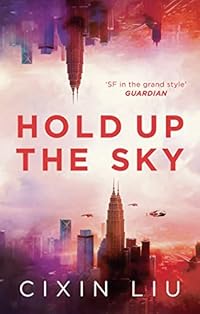
Hold up the Sky by Cixin Liu

Head of Zeus, 2020, 333 p.

撑起天空, variously translated from Chinese by John Chu, Carmen Yiling Yan, Joel Martinsen, and Adam Lamphier. Reviewed for Interzone 289, Nov-Dec 2020.

 Hold up the Sky cover

In his foreword to this collection Liu says that until recently SF had been foreign to China, peripheral to the sweep of its history but the changes in the country have made the future ever more apparent and pressing, thereby creating more interest in the genre. The question he is most asked is what makes Chinese SF Chinese in nature, but he does not consider his writing to be about anything other than humanity as a whole. Which would be, of course, what makes it widely readable.

Liu’s stories here (spanning publication from 1985 to 2014) usually have echoes of Wells and Stapledon in displaying temporal or cosmological grandeur. He has no lack of ambition in his speculative ideas but sometimes that detracts from the capacity for emotional engagement with them. He has a fondness for portraying big (though not necessarily dumb) objects, but also a tendency (see *) to inelegant nomenclature – which may be a problem of translation of course – and a slight awkwardness with structure. Almost without exception, though, his stories deal with mind-expanding concepts.

Still, the leading one, The Village Teacher, (乡村教师,) appears strangely old-fashioned to Anglophone eyes and the contrast between the tale of the dying title character inculcating Newton’s three laws in his pupils and its intersection with a millenia-old galactic war between the forces of the Federation of Carbon-Based Life* and those of the Silicon-Based Empire* is fairly stark.

To alleviate environmental and population pressures The Time Migration, (时间移民,) is carried out using cryogenics. Stops at 120, 620 and 1,000 years hence proving unsuitable for various reasons, sights are set for 11,000.

In 2018-04-01, (2018年4月1日, – a future date when Liu wrote it) Gene Extension – which actually cuts out the bits that cause ageing rather than inserting anything – is possible but expensive. Our narrator is triggered by an April Fool joke involving digital nations to commit the fraud that will ensure he has the means to benefit.

Fire in the Earth, (地火,) is about the first project to gasify coal underground for use as an oil substitute and the disaster attendant on that endeavour. The story would work without its coda but arguably that’s the only thing that makes it SF.

In Contraction, ( 西洋,) Professor Ding Yi has constructed a unified field theory which predicts the imminent moment when the universe’s expansion will stop and its collapse begin, but only he truly understands the implications. The premise is far from new (Philip K Dick’s Counterclock World springs to mind) but the story ends with a neat, if obvious, typographical way to illustrate it.

Mirror, (镜子,) postulates the invention of the superstring computer – of infinite capacity. This has allowed simulations of evolutions of universes from different Big Bangs to take place, including of course our own. Liu lays out the implications of such knowledge for human relationships.

Despite its subtitle (An alternate history of the sophon,) Ode To Joy, (欢乐颂 ,) does not mention that concept, familiar from Liu’s Remembrance of Earth’s Past trilogy, at all. Instead a huge ultra-thin mirror appears in Earth’s sky on the day the UN is to be closed for good: a mirror that can turn radiation from nearby novae into music.

Full-Spectrum Barrage Jamming, (全频带阻塞干扰,) is set during a war between a Russia newly returned to Communism and NATO (a war whose cause seems relatively trifling but has to be accepted for story purposes.) NATO’s electronic warfare capability outmatches the Russians who have to resort to the full-spectrum barrage jamming of the title. Depletion of the jamming network leads to a desperate measure in response.

Sea of Dreams, (梦之海,) is almost emblematic of Liu’s style. An ice-ball dubbed the low-temperature artist* arrives on Earth professing interest only in art and proceeds to convert the planet’s oceans into ice-cubes, which it suspends in a ring surrounding the planet (the titular Sea) before leaving humans to deal with their altered world.

Cloud of Poems, (诗云,) has faint echoes of Clarke’s The Nine Billion Names of God in its account of a human telling what is effectively a god that its poetry will never surpass that of the human Li Bai. Its attempt to do so involves programming every possible permutation of the formal rules of Chinese poetry composition and constructing them in a 100 AU diameter model of the Milky Way.

The last story, The Thinker, (思想者,) is the most successful here at integrating the science and speculation behind it with the experiences of its characters and making the reader feel them. A male brain surgeon and a female astronomer meet by chance at an observatory where she is studying the energy fluctuations from stars. Over the years that follow they, almost by accident, make a discovery about interstellar communication.

The following did not appear in the published review.
Pedant’s corner:- “in a pinch” (at a pinch,) “smoking sulfuric acid,” (the technical term is ‘fuming’ sulphuric acid, Liu also describes the smoke as yellow; that sounds more like fuming nitric acid,) “Order of Victories are worth the most” (should be “Orders of Victory are worth the most” but that was in dialogue,) however ‘Order of Suvorovs’ wasn’t, (Orders of Suvorov,) “gunpowder smoke” (gunpowder? From modern munitions?) “lakes of mercury” (on Mercury the planet. Yet the surface temperature is stated to be 1,800 degrees Celsius. The element mercury evaporates at 0C at 1 atmosphere pressure. In a vacuum – or near vacuum such as exists on the planet Mercury’s surface – and specifically mentioned in the text – that would occur at a much lower temperature,) Comanches (is the helicopter’s name spelled differently to the First Nation tribe’s? Commanche,) “1.0 gees” (1.0 gee, or, better, 1.0 G. It would still be ‘gee’ even if its value was greater than 1, since a measurement’s abbreviation subsumes its plural, eg 6 A, or 20 N or 3 m,) “changing from the dark red to orange” (no need for that ‘the’.)

The Sorrow of War by Bảo Ninh

Secker & Warburg, 1994, 218 p. Translated from the Vietnamese Thân Phân Cua Tinh Yêu, (originally published by Nhà Xuät Ban Hoi Nha Van [Writers’ Association Publishing House], Hanoi, 1991. English version by Frank Palmos based on the translations from the Vietnamese by Vo Bang Thanh and Phan Thanh Hao, with Katherine Pierce.

The vast majority of writing about the Vietnam War published in the West has been from a US perspective. This book acts as a kind of corrective as, here, the US, along with the South Vietnamese ARVN, is the enemy. The novel’s viewpoint character is a North Vietnamese soldier, Kien, whom we first meet in his post-war duty of collecting for burial the remains of corpses left over from the war. This is in an eerie place the soldiers named the Jungle of Screaming Souls. One corpse is discovered in a colourless plastic bag and the body seems immaculate. Then it discolours, something seems to escape, and it deflates. The platoon takes this apparition to be a soul departing. This scene is emblematic as, while the memories of combat are no doubt authentic, so much of what Binh describes here is surreal. Many descriptions of war are.

The novel is disjointed, fragmented, as if reflecting the uncanny nature of such experiences. Ninh tells us the sorrow of war is like the sorrow of love, “a kind of nostalgia,” a “sadness, a missing, a pain which could send one soaring back into the past.” The novel is a patchwork of such pain, of things unforgettable, surfacing unbidden from memory. “His fighting life was being revived in flashbacks, or in slowly unfolding scenes as heart-rending as a funeral march.” War as an experience is perhaps best encapsulated when Kien remembers trying to dissuade his comrade Can from deserting as it would be shameful. Can replied, “‘In all my time as a soldier I’ve yet to see anything honourable.’”

While combat and its horrors – the blood and entrails carried on the tracks of tanks so that they have to be driven through a river to clean them, Kien’s friend killed when his tank is all-but vapourised by a shell, the dreamlike quality of being on the receiving end of a US air-raid, the self-sacrifice of an inexperienced female guide named Hua who distracted a platoon of US soldiers away from a group of wounded NVA personnel whom she had put in danger of discovery – The Sorrow of War is not merely a story of firefights and military life. The story flits between those and his pre-Army life in Hanoi with Kien’s golden memories of his girlfriend Phuong and of life after the war where it is not only Kien who has been changed utterly but also Phuong, forever scarred by her travails when she accompanied him south to his first posting and her subsequent struggles to subsist in Hanoi.

The end of the war brought to the soldiers no soaring, brilliant happiness such as Kien saw later on film, only memories and nightmares. “Those who had died and those who lived on shared a common fate in this war.” As to the future, “Losses can be made good, damage can be repaired and wounds will heal in time. But the psychological scars of the war will remain forever.” The survivors “had lost not only the capacity to live happily with others but also the capacity to be in love.”

Since Kien later sets out to write about his impressions of the war the novel also contains observations on writing. Binh tells us the author wrote “because he had to write, not because he had to publish.” This is of course the way round the process ought to be.

Despite all its gruesome content and incident, its record of man’s inhumanity to man – and woman – The Sorrow of War is not difficult to read, a testament to both Binh and his translators.

Pedant’s corner:- mosquito repellant (repellent,) “his beard was well shaven and tidy” (if it was shaven it wasn’t a beard, well trimmed perhaps?) “Who’s to know.” (is a question; therefore ‘Who’s to know?’) “All that remained of his mother were some photographs.” (‘All’ is singular, hence ‘was,’) a missing comma at the end of a piece of direct speech, “Sue repeated eagerly” (she repeated eagerly,) curriculum vitae (there was more than one; curriculum vitae means ‘course of life’ so its plural – courses of life – is ‘curricula vitae’ in Latin and English – but in English some might say ‘curriculums vitae’. If interpreted as ‘courses of lives’ the Latin plural would be ‘curricula vitarum’, which is a step too far in English.)

Landscape Painted with Tea by Milorad Pavić

Penguin, 1992, 343 p. Translated from the Serbo-Croatian Predeo slikan cajem (Prosveta, Belgrade, 1988) by Christina Pribićević-Zorić.

It is all but impossible to imagine a book like this being written by an anglophone author – not even those of African or Asian heritage. Experimental works are not unknown to the anglophone tradition but I would submit there is nothing to match this. At times it bears a similarity to magical realism – odd things happen and the bodies of some of its characters are subject to even odder anatomical configurations – but it manages to transcend even that. It is all but unsummarisable.

The novel as a whole is separated unevenly into two Books of which the shorter, Book One, A Little Night Novel (whose final passage is rendered entirely in German,) has each of its chapters prefaced by a passage printed in italics relating the history of a group of monks who wind up in the Monastery of Chilandar and are themselves divided into two groups, solidaries (otherwise called cenobites,) and solitaries (aka idiorrhythmics.) More or less failed architect Atanas Svilar (aka Atanas Razin – his origins, like those of many others here, are complicated,) travels to the monastery to try to find out what happened to his father who had fled there to avoid the Germans’ attentions during World War II. Svilar’s beliefs about himself changed by his trip, he takes a new (though old) name, plus his childhood sweetheart, Vitacha Milut, from her husband and daughters and goes to the US where he achieves fame and fortune as a pharmaceutical magnate.

This bears only a prefatory relation to Book Two, A Novel for Crossword Fans, where the monks and the monastery are forgotten but which still follows Svilar, though it focuses more heavily on his wife, and which is decidedly bizarre. This has four Sections of varying lengths denoted 1 ACROSS, 2 ACROSS, 3 ACROSS, 4 ACROSS containing chapters headed 2 DOWN, 1 DOWN, 5 DOWN, █ DOWN, 4 DOWN, 6 DOWN etc. In other words, crossword clues. (The █ DOWN chapters are apparently necessary to the whole book to bind it together, since without them, as in an actual crossword, the crossed words will fly apart.) But instructions on how to actually read this assortment, this new way of reading a book, are only given on pages 187-190, which is to say 88 pages after Book Two begins and so are, for all practical purposes, useless as the reader (unless forewarned) will have already read up to that point linearly. This same chapter at the last informs us that, “All readers of this book are entirely imaginary. Any resemblance to actual readers is coincidental.” Take that fiction fans.

Then, at the whole book’s end, there is an index containing all the words required for the solution but, as in all indexes, it is in alphabetical order and so requires further elucidation. This index is followed by two lined pages for the reader to write in for him- or herself the denouement of the novel or the solution to the crossword, and finally, printed upside down, we have the solution itself.

Not a straightforward read then, but for puzzle solvers an intriguing prospect. But what’s it all got to do with landscape painted with tea?

Svilar had a set of notebooks comtaining details about dwellings, residences, houses and summer houses lived in, worked in or visited by Josip Broz Tito, general secretary of the Communist Party of Yugoslavia, and whose covers were landscapes painted with tints from different types of Camelia sinensis – tea – showing those various buildings and their surroundings.

Throughout we are treated to incident upon incident of a magical realist bent, oddness upon oddness, plus addresses to the reader, but are also supplied with plentiful aphorisms such as, “‘All sexual acts are in some way connected, in some way they interact,” attributed to Svilar, as is, “‘All births are similar, and every death is different,’” which is yet another of those attempts common in literature ever since to echo Tolstoy. “People who are afraid of life leave their families belatedly and reluctantly and are disinclined to start their own,” and “People who are afraid of death stay with their families briefly and go into the world quickly and easily, leaving one another,” are in a similar vein.

A few of Pavić’s sentences are beyond enigmatic, though, “Their road, as all roads, did the thinking for them even while it was empty,” “… only a bird on a branch can understand silence. Man cannot,” though one does reflect life in a country where thoughts have to be circumscribed, “after so many decades, when only the clocks still tell us the truth,” though “Time can harm the truth more than lies,” is more widely applicable. Some are singular, “No undelivered slap should ever be taken to the grave,” but, “October has never come as often as this year….” a saying in the Minut family, is repeated several times.

Then there are the metafictional comments, “Critics are like medical students: they always think a writer is suffering from the very disease they happen to be studying at the time,” … “a writer is like a tailor. Just as the latter, when tailoring a suit, covers up the shortcomings and defects of his customer, so the writer, when tailoring a book, has to cover up the defects and shortcomings of his reader.”

These defects in the reader do not put off Vitacha Milut. We are told, “And so Vitacha Milut, the heroine of this novel, fell in love with the reader of her book.” “‘The heroine of a novel in love with the reader!’” she herself writes. “‘When has that ever happened?’ you will say, and you will not be wrong,” with a few lines later, “ ….isn’t it all the same whether you first fall in love in a book or in life? ….. Why do you think that only you have a right to the book, but the book has no right to you?”

In a comment which could be designed by Pavić to defray criticism he has Atanas reply to the writer of his testimonial (ie part of this book,) “It’s not just one story that’s escaped me from your book, but several,” and adds, “Anyone who reads finds in books what cannot be found elsewhere, not what the writer shoved into the novel,” and goes on to say in effect that you can find any story in the text of a book if you look hard enough.

Sometimes a reader may wish not to have to look hard but the experience is usually better when that requirement is there. As the above all indicates, Landscape Painted with Tea may not be immediately accessible but it is a remarkable work and would certainly bear rereading.

Pedant’s corner:- bureaus (bureaux, please,) the Ukraine (Ukraine, no ‘the’,) “off of” (just ‘off’, no ‘of’ required,) Bosporus (usually Bosphorus,) Skoplje (Skopje.)

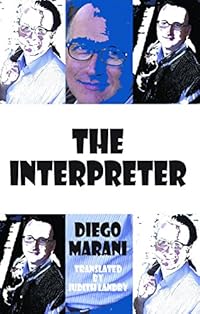
The Interpreter by Diego Marani

Dedalus, 2016, 215 p. Translated from the Italian, L’interprete, by Judith Landry.

This is a very odd book indeed, though dealing, as it does, with language, it can be viewed as a kind of companion piece to Marani’s New Finnish Grammar and The Last of the Vostyachs. The narrator, Felix Bellamy, a Swiss national, is head of an interpretation department who becomes fascinated by one of his staff beginning to exhibit a peculiar kind of glossolalia, making sounds that are effectively unintelligible and which may be those of a primordial language which has long since been forgotten.

Curiously, Bellamy, parachuted into his supervisor’s job with vague promises of further promotion, is unsympathetic to translation, mistrusting his underlings as “circus performers, shifty, dishonest, quick-change artists, mental stuntmen.” Quite how Marani’s translator reacted to his outbursts against the profession is a question. These all may of course be a jest on Marani’s part but he has his narrator go on to tell us, “Languages are like toothbrushes: the only one you should put in your mouth is your own … it’s dangerous to let yourself be contaminated by the germs of another tongue … a foreign language injected into our mind brings with it the taint of unknown sounds, a vision of worlds that are incomprehensible to us – the lure of other truths and a devilish desire to know them.” It is that lure, though, that devilish desire, which makes reading translated fiction so interesting.

The interpreter disappears, leaving a list of names of cities, some of which have been ticked off. Bellamy’s wife leaves him (which may be connected with the interpreter’s disappearance) and he himself begins to suffer from the interpreter’s malaise and goes for treatment to a clinic run by a Dr Barnung. Barnung tells him French and German are similar in the way they view reality, but in essence are profoundly different. “Latin and Germanic languages have something in common … but they cannot mix. In Romanian, all that is rational about Rome, mingled with Mediterranean ebullience, becomes fused with Slav passion and melts into the yearning melancholy of the steppe. German is a bit like aspirin, it’s good for everything: it clarifies thought processes, stiffens resolve and makes feelings bare.” Felix soon perceives something is amiss at the clinic, leaves, and sets out to try to find the interpreter by visiting the cities as yet unticked on his list.

Then things get really weird. The text morphs into a species of thriller when Bellamy is targeted by operatives of Dr Barnung, but escapes. To survive he has to embark on a crime spree, robbing petrol stations, becoming known as ‘the Beast of Bukovina,’ taking up with Magda Kobori, a young woman whose car he stole, with her in it. They stravaig through the back roads of Romania like some sort of Balkan Bonnie and Clyde before Bellamy returns once more to tracking the interpreter.

I’m never sure if something like this is because of the opacities of translation or whether it’s a true indication of foreign sensibilities but, in common with other protagonists of fiction translated into English, Bellamy as a character here presents as incomplete, almost as a kind of absence, though his misanthropy shows in a passage where he reflects, “I was exposing myself to risk by mixing with insane deviants such as interpreters, people with slippery, unformed identities, in whose company sprinklings of the irrational are more likely to insinuate themselves and further crook humanity’s already crooked timber.” His actions are off-kilter, not quite reasonable, nor perhaps justifiable, though it is not impossible – highly likely even – that we are being given a portrait of a madman. Other languages apparently do that sort of thing to you.

The Interpreter was interesting enough but didn’t, for me, reach the same heights that New Finnish Grammar, The Last of the Vostyachs, or even Marani’s immediately preceding novel, God’s Dog, did.

Pedant’s corner:- “the presence of their austere forms in that house were so many pointers” (strictly, the presence … was,) “his voice rising to a crescendo” (sigh. The crescendo is the rise, not its climax,) focussing (focusing,) enthrall (enthral,) hung (hanged, but it was in a letter,) Voivodina (usually spelled Vojvodina,) no quote mark at start of one paragraph where a character’s speech was continued, swum (swam,) “roads which lead” (which led,) Janos’ (x2, Janos’s,) sunk (x3, sank,) “now I could scarcely breath” (breathe,) “I was born aloft” (borne aloft,) “here in Munch” (Munich,) shell-incrusted (shell-encrusted,) “with brass lamps hanging from brightly painted beams and gleaming door handles” (the lamps hung from door handles?) “a cluster of coloured balloons were swaying in the wind” (a cluster was swaying.)

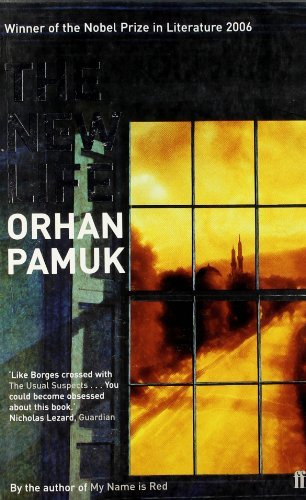
The New Life by Orhan Pamuk

faber and faber, 1998 (according to the publication page but post 2006 as the cover and author blurb both mention Pamuk’s Nobel Prize,) 300 p. Translated from the Turkish Yeni Hayat (Ilepşim Yaymarlı, 1994,) by Güneli Gün.

 The New Life cover

One day narrator Osman Akif read a book and his whole life changed. He had glimpsed the book in the hand of Janan, a girl at the same college as him, stumbled on a copy in a second-hand bookstall that afternoon and immediately bought it. His obsession with the book spilled over into one with the girl, whom he befriended along with her boyfriend Mehmet (later also known as Nahit, and later still Osman – there are reasons for these name shifts.) Mehmet was apparently shot during a student demonstration but Osman knew he survived and walked away so set out to find him, taking Janan along with him. This involved many bus journeys through the heart of Turkey, many videos of films watched while travelling, and several bus crashes. (There is something of that fixation of J G Ballard about this aspect of the book.)

A flavour of the text is given by Osman’s thought that “it was not right for Janan even to imagine the land of perdition, heartbreak and bloodshed because in that twilight land illuminated by the book, Death, Love, and Terror wandered like hapless ghosts in the guise of downtrodden, heartbroken men with frozen faces who packed guns.”

Reading The New Life is an odd experience at times. Osman addresses some sentences to ‘Angel’ but it is never entirely clear (at least, not to me) who Angel is meant to be. Turkish life is illuminated in the margins; the family who moved in across from Osman the day he first read the book, once more in a Pamuk novel the salience of football (sadly always named soccer by the translator,) the statues of Atatürk in seemingly every town square, the endless cafés and bus stations, the past of Osman’s Uncle Rıfkı, a railwayman who wrote children’s stories which starred Turkish children as the heroes of US Western tales, the redolence of New Life brand caramels, defunct in the narrator’s present. Uncle Rıfkı also wrote an adult book, which was banned, with only a few copies surviving in the wild. That book was also titled The New Life and is that same book which obsessed Osman.

In their final meeting Mehmet tells Osman, “‘A good book is something that reminds us of the whole world ….. a piece of writing that implies things that don’t exist, a kind of absence, or death …. But it is futile to look outside the book for a realm that is located beyond the words.’” As if to underline the literary nature of this endeavour, the niceties of its twists and turns, the narrator at one point asks, has the reader “extended enough attention and intellect at every turn of this book?” and describes himself in these terms; “In people like me whose lives have slipped off the track, sorrow presents itself in the form of rage that wants to pass itself off as cleverness. And it’s the desire to be clever that finally spoils everything.”

The New Life may be clever, but it’s not clever clever. And it’s not spoiled by any of this philosophising.

Pedant’s corner:- In the “by the same author” list, Instanbul (Istanbul,) on the publication page, “Orhan Pumuk” (Pamuk.) Otherwise; “the lay of the land” (it’s ‘lie of the land’,) “there were an odd number of bottle caps” (there was an odd number,) maws (a maw is a stomach, not a mouth,) “life’s mystery will become manifested to me” (‘manifest’ would be more forceful,) djins (djinns,) “Andre Maurois’ novel” (Maurois’s. This must be the correct formulation since the final ‘s’ in Maurois is unsounded and so, in order to make a possessive, the extra ‘s’ after the apostrophe must be added,) exploitive (exploitative,) “had really waked me up” (woken.)

free hit counter script