Ru by Kim Thúy
Posted in Other fiction, Reading Reviewed at 12:00 on 9 December 2021
The Clerkenwell Press, 2012, 157 p. Translated from the French Ru (Éditions Libre Expression, Montreal, 2009,) by Sheila Fischman.
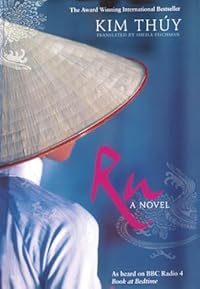
It seems from the epigraph page that Thúy chose her title because it is a word in both French and Vietnamese – but with different meanings; respectively a small stream (and figuratively, a flow, a discharge – of tears, of blood, of money,) and a lullaby or to lull.
The story is told in a series of vignettes, jumping about in time from narrator Nguyễn An Tịnh’s cosseted childhood in Saigon before its fall, to the degradations of her time in a refugee camp in Malaysia after a hazardous trip as one of the Boat People, and her eventual life in North America but also taking in her return to Vietnam. There a waiter is surprised she can speak Vietnamese as she “looks too fat.” Nguyễn reflects that it was her Americanised, more confident demeanour to which he was responding. “Once it’s achieved, the American dream never leaves us, like a graft or an excrescence.” But the incident made her realise she “couldn’t have everything,” that she no longer had the right to call herself Vietnamese “because I no longer had their fragility, their uncertainty, their fears.” And that the waiter was right to remind her of this.
A course in History that she took was “a privilege only countries at peace can afford. Elsewhere, people are too preoccupied by their day-to-day survival to take the time to write their collective history.”
She also reflects on the human toll of long wars. “We often forget about the existence of all those women who carried Vietnam on their backs while their husbands and sons carried weapons on theirs.”
It would be tempting to assume that this is all autobiographical, fragments of the author’s real life laid down on the page, but that would be an error. The book is novelistically organised and structured. It is a creation.
Perhaps due to her uprooting from her secure childhood life Nguyễn has a restless adult existence. She never travels except with only one suitcase. She is a woman for whom men are always replaced or replaceable, or, if they are not, her feelings for them are. She prefers relationships with married men because it keeps her “remote, aloof, in the shadows.”
Not that she hasn’t experienced love; but for her the blessing is not unalloyed. “It’s my children, though, who have taught me the verb to love, who have defined it. If I had known what it meant to love, I wouldn’t have had children, because once we love we love for ever.” Which isn’t a bad epitaph when you think of it.
Pedant’s corner:- chilies (chilis.)
Tags: Kim Thúy, Ru, Translated fiction, Vietnamese Fiction
