Archives » Translated fiction

The Gift by Vladimir Nabokov

Penguin Modern Classics, 2001, 407 p, plus iii p Foreword. Translated from the Russian, Дар (Dar), by Michael Scammell and Dmitri Nabokov in collaboration with Vladimir Nabokov, with a new Addendum translated by Dmitri Nabokov. First published in English in 1952.

This novel is an odd one to try to review. Its structure is not conventional, five – very long -chapters, one of which was not published in The Gift’s first appearance in print (in a Russian émigré journal,) and an addendum labelled here as the second such but in this edition there isn’t a first (unless it is that originally unpublished chapter.) Its narration slides between first and third person with no apparent reason for it (unless our protagonist is merely contemplating or remembering doing things.)

It is the last novel Nabokov wrote in Russian before switching to English and illustrates the author’s passion for poetry. (There is an extensive discussion of the use of different kinds of metrical feet and stresses in lines of verse.) In his foreword Nabokov says his novel’s heroine is Russian literature. The chapters are apparently written in the styles of different Russian literary figures.

What story there is is set among the Russian émigré community in Berlin in the 1920s where Fyodor Konstantinovich Godunov-Cherdyntsev, a poet, is trying to make a name for himself with his first book of poetry. He takes lodgings with fellow émigrés the Shchyogolevs. For Marianna, Mrs Shchyogolev, this is a second marriage, her daughter, Zina Mertz, was the product of her first, to a Jew – a fact which her second husband obviously resents. Shchyogolev throws about the words ‘kike’ and ‘yid’ unthinkingly and is obviously anti-semitic. Zina has no time for him, possibly because he is too interested in her. A friendship develops between Fyodor and Zina but they never converse in the apartment, only in parks and cafés.

The uncertain life of an émigré is illustrated by Fyodor’s thought on boarding a tram that “The Russian conviction that the German is in small numbers vulgar and in large numbers unbearably vulgar was, he knew, a conviction unworthy of an artist but nonetheless he was seized with a trembling.”

Fyodor’s father was a lepidopterist who made several trips to Siberian and Asia before and during the Great War and whose present whereabouts are unknown. The 2nd Addendum I mentioned above is titled Father’s Butterflies, and deals extensively with the subject of butterflies.

After reading an article in a chess magazine about the nineteenth century Russian writer Nikolai Gravilovic Chernyshevski Fyodor proposes to write a biography of him. This book within a book comprises the whole of Chapter Five of The Gift.

A review of Fyodor’s book says, “Everything would have been all right if the author had not found it necessary to equip his account of it with a host of unnecessary details which obscure the sense, and with all sorts of long digressions on the most diversified themes.” (This could be a comment on The Gift itself.) We are also told that “The most enchanting things in nature and art are based on deception.”

In a discussion about the book Fyodor says, “Suppose that I so shuffle, twist, mix, rechew and rebelch everything, add such spices of my own and impregnate things so much with myself that nothing remains of the autobiography but dust….” A review calls it an “incomprehensible essay.”

A measure of the density of the prose here can be assessed from this example; “but of course the main thing is that he had intended, at his leisure, to dedicate a separate study to the question raised here, and at the same time believed that, if the precariousness of human life, and the fog settling on Russia, and the danger of a new hunt far afield projected in such an unpropitious year thwarted it, a maximally accurate exposition of the principles of such a study would still allow minds that at last understood them a chance to consummate the plan outlined by the author.”

All these interpolations and additions make The Gift far from straightforward to read or review. I did not have a similar positive response to it as I had to the same author’s Pale Fire, which I read in 2020. Nabokov’s renderings of relationships between characters are as you might expect from a novel but tend to be sidelined by all the gubbins that surround them.

Pedant’s corner:- Translated into USian; “St Peterburg” (St Petersburg,) “Brockhaus’ Encyclopedia (Brockhaus’s – and, incidentally, Encyclopaedia.) “And in these talks between tamtambles, tamtam my spirit hardly knows” (I have no idea what tamtambles or tamtams are,) mimiking (mimicking,) “what did he use to think about” (what did he used to think about,) “at a Russian small railway station” (at a small Russian railway station,) Mortus’ (Mortus’s,) “a Ukranian” (Ukrainian.)
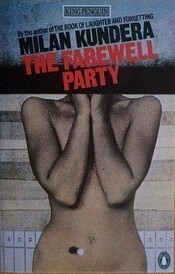
The Farewell Party by Milan Kundera

King Penguin, 1987, 186 p. Translated from the Czech by Peter Kussi. First published as La Valse aux adieux, © Éditions Gallimard, Paris, 1976.

This novel’s story unfolds over five days, the events of each of which make up the book’s sections.

Klima is a jazz trumpeter who has an erotic secret. As he tells his friend Bartleff, a rich American, “I love my wife.” That, however, has not stopped Klima from having sex with other women, one of whom, Ruzena, is a nurse in a fertility clinic in the spa town where Bartleff lives. An earlier phone call from Ruzena to Klima announcing she is pregnant has brought Klima scurrying to the town to try to resolve the situation. Their story is mixed in with that of Dr Skreta who runs the clinic, his friend Jakub, a former political dissident who has just received permission to leave the country and Jakub’s ward, Olga, the daughter of the man who betrayed Jakub to the authorities.

Skreta has had great success in enabling his clients to have babies. He has a sperm bank using his own semen as a result of which many of them have features resembling those of the doctor. “I have cured quite a few women of childlessness by using this approach.”

Klima wishes Ruzena to have an abortion but she refuses, at least initially. Skreta heads the abortion committee before which Ruzena would have to appear. Its two mature women members are generally unsympathetic to those who come before them wishing the procedure, an attitude Skreta interprets by saying women are the greatest misogynists in the world, always doing other women down. Misogyny, though, is a strain which tends to run through the book.

The character of Jakub allows Kundera to comment on the restrictions of a repressive state and the traits that inculcates, “All you have to do to turn people into murderers is to remove them from their peaceful circle of family home and work. Every now and again history exposes humans to certain pressures and traps which nobody can resist.” On people who seek revenge for their plight on the descendants of their persecutors he opines that victims are no better than their oppressors.

Bartleff, too, has observations to make, including that Saint Paul was not only a disciple of Jesus but a falsifier of his teaching. “His somersault from Saul to Paul. Haven’t we seen enough of those passionate fanatics who jump overnight from one faith to another?” (I note here that Christianity’s evolution after Saul’s conversion makes a case for the religion(s) it became to be named Paulinity rather than Christianity.)

The Farewell Party (some translations give the title as The Farewell Waltz) is intricately plotted, the connections between the two main strands woven together in an unexpected but somehow inevitable – albeit harsh – way. The overall feeling though is one of distance, that we see the characters as through frosted glass. They don’t seem to act for themselves so much as take the parts ascribed to them. But that is what living under a repressive regime must be like.

Pedant’s corner:- “surely a more likable being that Raskolnikov’s usurious hag” (than Raskolnikov’s,) missing full stops at the end of two sentences.

Edith Grossman

I saw in Saturday’s Guardian that Edith Grossman, translator into English of the works of Gabriel García Márquez and Mario Vargas Llosa (among others including Miguel de Cervantes) has died.

I have read at least seven of her translations of novels – four of Márquez’s and three of Llosa’s. Ther are more on my tbr pile.

Translation is an art and Grossman was an advocate of translators far from being all but anonymous ought to be considered as at least equal to th eauthor swhom they translate and their names ought to be on the covers of the books they have translated.

Llosa has said of her work: “It doesn’t seem to be a translation of a novel, but something that gives the impression that it has been written originally in English.” For someone reading in English that, of course, is how it should be.

Edith Marion Grossman: 22/31936 – 4/9/2023. So it goes.

Dancing Lessons for the Advanced in Age by Bohumil Hrabal

Harvill, 1998, 107 p. Translated from the Czech Taneční hodiny pro starŝí pokročilé, (published by Československý spisovatel, 1964,) by Michael Henry Heim. Illustrated by Vladimír Suchánek.

This is a seemingly rambling but actually very focused assemblage of scenes and observations from our narrator Jirka’s life as he relates them to a group of ladies. It is all unveiled in a breathless style, moving from one story to another almost without pause, with the whole book comprising a single sentence, jumping hither and yon, occasionally returning to previous musings. Adding to the sense of dislocation, the book just ends, there is no full stop at its sentence’s end, as if terminated mid-flow. A literary conceit, then, like the last part of Gabriel García Márquez’s The Autumn of the Patriarch.
And it is a conceit, for there are elisions in the narrative where punctuation could quite easily have been inserted. But the rush from one incident to the next is undoubtedly the point, the urgency expressing the necessity for the tales to be told – to be heard before it was perhaps too late.

It is Hrabal’s embodiment of the time and place in which it was written, impossible to imagine emanating from a luckier country. The back cover blurb describes it as “an informal history of the indomitable twentieth-century Czech spirit.” It muses on humanity’s foibles and sets great store by “Batista’s book on sexual hygiene,” or “Batista’s book about safeguards of marital bliss, which says that shivers run down a man’s spine whenever he sees a beautiful woman and his first thought is how to get her, as Bondy the poet says from the vertical to the horizontal.” It “warns men against giving in to their passions, no more than three times an afternoon or four times for Catholics, to prevent sinful thoughts from taking shape, you never know where they might lead.”

It does though at times display anti-semitic attitudes.

The illustrations are noteworthy; as eclectic as the prose, like a cross between surrealism and Terry Gilliam’s montages in <em>Monty Python’s Flying Circus</em>.

Pedant’s corner:- “I stood like Montgomery at Tobruk” (This must be an example of metonymy since I don’t think Montgomery was ever personally at Tobruk.)

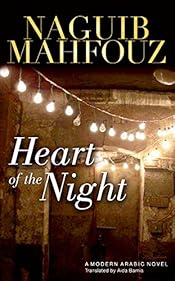
Heart of the Night by Naguib Mahfouz

American University in Cairo Press, 2011, 101 p. First published as Qalb al-layl, 1975.

Jafaar Ibrahim Sayyid al-Rawi lives as a pauper in the ruins of his grandfather’s house. The novel consists in the telling of his life story to our (unnamed) narrator who occasionally interjects comments to or asks questions of him. Jafaar seeks advice on the possibility of breaking his grandfather’s will in which his fortune was left to a charitable cause known as a waqf, thereby disinheriting Jafaar. Our narrator tells him a waqf cannot be set aside.

There is a knotty history here. Jafar’s father too had been disinherited when he married someone his father deemed unsuitable. Jafaar was the offspring of that union. In adolescence Jafaar had been taken in by his grandfather, a religious man who desired Jafaar to follow a religious life. He had been content with this till of course his life too strayed off-course. Again it was an attraction to a woman which caused the rift. In the end, though, she had gone back to her Bedouin family leaving Jafaar to try to rebuild his life via the (somewhat unmanly to Jafaar’s mind) profession of singer – background only, his voice being not good enough for a leading role.

Jafaar also becomes involved in a project to found a political party based on a concocted ideology that was “the logical heir of Islam, the French Revolution, and the communist revolution,” again something unlikely to recommend him to a traditionalist grandfather.

His conversation with our narrator wanders over life, religion and philosophy. Jafaar at one point says, “There is no ‘truth and fiction,’ but different kinds of truths that vary depending on the phases of life and the quality of the system that helps us become aware of them.” A contention which literary fiction is well-suited to examine.

Pedant’s corner:- “an id ea” (idea,) dumpster (seems to me a not very Egyptian type of description of a refuse container,) “the truth of the matter is that that man was and continues to be in a period of transition where the instincts and the mind are both present” (the truth of the matter is that man was and continues to be,) “the abolishment of private property” (abolition.) In the Glossary; “the income generated by ….. are aimed at the needy” (income ….. is aimed at.)


Innocent Eréndira and other stories by Gabriel García Márquez

Penguin, 2004, 173 p. Translated from the Spanish by Gregory Rabassa.

This is a collection of the author’s short stories most published from 1948-1953 but some from the 1960s and one from 1970. His characteristic magical realism is to the fore but so too is an emphasis on death.

Lead story The Incredible and Sad Tale of Innocent Eréndira and Her Heartless Grandmother is the longest in the book. Eréndira starts off as a young teenage girl (prone to falling asleep on her feet while going about her business) whose widowed grandmother blames her for her house burning down. In order for Eréndira to repay her for her loss the grandmother pimps her out. Various travels ensue among which she procures a certificate of purity from a bishop. Eréndira forms a relationship with Ulises, son of a native mother and a Dutch trader who smuggles diamonds grown inside oranges.
The Sea of Lost Time is a prime example of magical realism, mixing a strange smell coming off the sea with the arrival of the richest man in the world who turns up with suitcases bulging with money which he dispense to the locals who nevertheless end up in debt to him and a swim (without artificial breathing aids) to the bottom of the sea where there is a village.
The first sentence of Death Constant Beyond Love, “Senator Onésimo Sánchez had six months and eleven days to go before his death when he found the woman of his life,” (written in 1961) predates that of Márquez’s most famous novel One Hundred Years of Solitude, “Many years later, as he faced the firing squad, Colonel Aureliano Buendía was to remember that distant afternoon when his father took him to discover ice,” which I commented on here. In this story though the character mentioned in the sentence does feature strongly in the tale.
The Third Resignation tells of a child who has seemingly died but is kept alive by intravenous feeding and housed in a coffin-shaped box.
The Other Side of Death gives us the thoughts of a man whose twin brother’s dead body lies embalmed in the next room.
Eva is Inside Her Cat is the tale of a woman insomniac who imagines herself into the body of her cat.
Dialogue with the Mirror contains the thoughts of a man who sees himself in the mirror, shaving. Or is it himself?
The Bitterness for Three Sleepwalkers is that the woman who has occupied the house they sleep in has died.
Eyes of a Blue Dog are the words two people who dream of each other swear they will use in daytime to recognise each other.
The Woman who Came at Six O’Clock relates a conversation, encompassing love and murder, between a restaurant owner and the woman who always comes into his establishment at six o’clock. Except she insists that this day she was early.
Someone Has Been Disarranging These Roses seems to be narrated by a ghost, who waits for the woman who came to live in the room next door to have her Sunday siesta before moving some of the roses she sells to the knoll where his grave lies.
The Night of the Curlews features three men whose eyes have been pecked out by curlews. Though their story had been in the newspapers people don’t believe it.

Pedant’s corner:- Ulises’ mother (Ulises’s,) a bandoleer (bandolier,) martyrized (x 2, martyred,) her virtures (her virtues.)

Friendly Fire: ten tales of today’s Egypt by Alaa Al Aswany

The American University in Cairo Press, 2008, 181 p. Translated from the Arabic, Niuran sadiqa, by Humphrey Davis

I have previously read the author’s most famous novel The Yacoubian Building but this is a collection of Aswamy’s shorter works and preceded by a Preface which apart from that word and its pagination is, curiously, entirely blank.

The first and by far the longest piece here is He Who Drew Close and Saw in which the narrator, Isam, describes at length his relationships with his family – an artist father whose hopes of changing Art history have been dashed, a mother who refuses to accept the death sentence of a cancer diagnosis, her mother with whom she has developed an antipathy and who revenges herself graphically – and at his work at the government Chemicals Department where he has managed to annoy everyone, especially his boss, with his air of superiority. Along the way he reflects on love of country and its spurious nature. He affects to despise the mass of Egyptians equally and tells a German woman whom he meets at a photography exhibition that her impressions of, and so fondness for, Egypt are misguided. The ending, however, casts doubt on all that passed before, or at least on Isam’s views on it.

Izzat Amin Iskander was a schoolmate of the narrator – a schoolmate with an artificial leg and a crutch. Neverthelees he sets off on a ride on the narrator’s new bicycle.

An Old Blue Dress and A Close-fitting Covering for the Head, Brightly Coloured comprises accounts of two contrasting relationships. In the first a woman puts up with the realities of life but her partner is more cynical. In the second the narrator is beguiled by a straight-laced ‘moral’ girl.

Mme Zitta Mendès, A Last Image again has two parts. In the first the narrator recalls his visits to Tante Zitta – whom the reader soon works out is his father’s mistress. The second sees him recognise her in old age at the foreigners’ table in Groppi’s.

Dear Sister Makarim takes the form of a letter, couched in very pious terms, of a worker abroad explaining to his sister in Egypt why he cannot possibly send money back home for their mother’s medical treatment.

Games are what Mohammad el-Dawakhli, an extremely fat schoolboy, tries to avoid at all costs. The gym teacher Miss Souad tacitly accepts this. One day she is replaced by Mr Hamid, who is not so indulgent. Thereafter the story writes itself.

The Kitchen Boy. Hisham is pushed by his mother into training as a doctor. Despite good exam results and practical experience on the wards he still finds his faculty head overly critical, necessitating a change of attitude towards him.

The Society of the Faithful is the remnants of a former political grouping whose dead leader one of their number experiences speaking to him.

The Sorrows of Hagg Ahmad are due to his father dying just as Hagg is starting his predawn Ramadan meal.

A Look into Nagi’s Face is again set in a school environment. Nagi is the new boy who shines academically and eventually even refuses the teacher’s corporal punishment. What happens next isn’t what you might expect from that circumstance.

Pedant’s corner:- Translated into USian, “wasn’t one of those husbands who lay down the law” (laid down,) a missing full stop at the end of one sentence, “he would be compelled to loosened the belt of his pants” (to loosen,) “showing how both sad he is and also how he clings” (showing both how sad he is and also….)

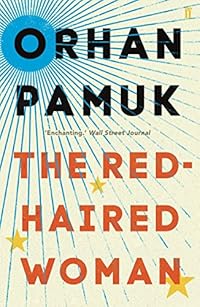
The Red Haired Woman by Orhan Pamuk

Faber and Faber, 2018, 281 p. Translated from the Turkish Kırmızı Saçlı Kadın by Ekin Oklap.

From the outset this reads like the work of an experienced writer, of someone who knows what he is doing, which of course it is. The planks of time and setting are put in place within two paragraphs, the theme the novel will explore, “the enigma of fathers and sons,” alluded to as if in passing. As in many novels a lost past is evoked but the later narrative will recognise that, once gone, an earlier state cannot be returned to. Indeed, our protagonist, Mr Cem, because of the guilt he bears, will spend most of the story resolutely avoiding a return.

Cem’s father had left-wing political sympathies and was arrested for them thus spending spells away from home. Cem’s mother’s bitterness about his later absences, though, hints at a more personal reason for them. Cem sopends most of his childhood fatherless. In 1984 in order to earn money to attend what the translation calls cram school, Cem takes a job as assistant to Master Mahmut, a welldigger of the old style, using only shovel, pickaxe and a windlass as tools. For Cem, Mahmut becomes a substitute father. Mahmut is digging a well near the town of Öngören. In the evening in the town Cem spots the red haired woman of the title. It turns out she is part of a group of travelling players performing there. Despite Mahmut’s disapproval Cem attends one of the shows where he is struck by the portrayal of the Shanameh story of son and father Sohrab and Rostam, the former killing the latter in battle since they could not recognise each other. Its resemblances to the Greek tale of Oedipus are not lost on him.

Besotted with the red haired woman he takes to in effect stalking her. On a night when it seems the well is to be abandoned since no water has been found he and the red haired woman, Gülcihan, take a walk and he makes love to her on a sofa. This is a fateful encounter.

Returning to Istanbul Cem is unable to forget his experiences, the more so as he thinks he may be responsible for Mahmut’s death. He marries a woman named Ayşe but they are not gifted with children however they form a successful business developing land. It is here that Pamuk’s preoccupation with Istanbul forces itself on to the page, where Cem regrets the changes wrought in the city over the years. In particular his much-delayed return to Öngören reveals it to be nothing but a suburb with little recognisable from his earlier days there.

As part of his job he notices on a visit to Iran the similarities that country has to Turkey and reflects “In Turkey, secularism had existed for some time, even if it had to be propped up by the army, and was perceived as a value to be preserved at all costs; but in Iran, secularism seemed not to exist at all, which made it an even more fundamental need.” Later, another character tells him that westernised Turks are too conceited to believe in God, which is to their demerit.

Perhaps as a comment on Pamuk’s reputation in his native Turkey Cem also riffs on the lot of the poet (he had always wanted to be a writer) quoting a saying of his father. “Poets must first be hanged, then mourned at the gallows.”

The emphasis throughout the text on Oedipus and Sohrab and Rostam while necessary to the story do point the way to the ending of Cem’s tale. There is a delightful twist, though, in the book’s final section where we are given the perspective on events of the red haired woman herself.

Pedant’s corner:- “the 110-year old building that composed the campus” (it created the campus? ‘comprised the campus’,) “the Ukraine” (the country’s name is Ukraine, no ‘the’,) “the lay of the land” (the lie of the land,) “something about him had rubbed me the wrong way” (rubbed me up the wrong way.)

Silk by Alessandro Barrico

The Harvill Press, 1998, 106 p. Translated from the Italian, Seta (Rizzoli, Milan, 1966,) by Guido Waldman

Silk cover

This is an odd, intense concoction. Told in spare prose and short chapters, some only a paragraph long, few extending beyond two pages, it is a tale of love, life, deception, envy and devotion.

In 1861, the silk industry in Europe is in crisis, epidemics of pébrine were, it seemed, ravaging the silkworm hatcheries of the whole world. “‘Nearly the whole world,’ quietly observed Baldabiou,” who had brought silk production to the town of Lavilledieu and recognised in Hervé Joncour the man who could help him with the problem. Joncour was to travel to the end of the world, Japan. The Japanese were willing to sell their silk but not the eggs. It was a crime to leave the island with any. “The silk manufacturers of Lavilledieu were all gentlemen, more or less, and it would never have crossed their minds to break any law of their country. The notion of doing so on the other side of the world, however, struck them as entirely reasonable.”

Joncour sets out on the arduous journey, the steps of which are outlined in some detail, no doubt to highlight its arduousness, leaving his beautiful-voiced wife, Hélène, behind, evades an attempt to palm him off with fish-eggs, before meeting with Hara Kei, the most elusive man in Japan.

It is a fateful encounter. On Hara Kei’s lap, eyes closed, is a young girl. Once she opens those eyes, Joncour sees she is not Japanese but Western, and that her gaze had “a disconcerting intensity.” Joncour takes a sip from the tea-cup in front of him. As he tells Hara Kei his life story, the girl slowly picks up Joncour’s cup, rotates it to the position from which he had drunk, and sips from the same spot before laying it down and resting on Kei’s lap again, eyes all the while on Joncour.

The deal done, Joncour undertakes his journey in reverse (again the steps are given in detail,) returning to Lavilledieu in triumph.

For the next season Joncour returns to Japan again (the journey described in almost exactly the same words as before) meets Hara Kei again, and sees the girl again. This time, when he leaves, he bears a message from her in Japanese. After scouring France for a Japanese speaker he discovers it says Come back, or I shall die. The translator, Madam Blanche, tells him to forget about it. Of course he cannot.

By the time of his last visit Japan has descended into civil war. As he sets out Hélène says to him, “‘Promise you’ll come back.’” He does; and he does. Again the journey is described in almost the same words – no doubt to hint at its tedium.

Silk is not simply a history of the importation of Japanese silkworms to France. And it is not one love story. It is two. It is also about how we can fail to know or understand the impulses of those closest to us.

Pedant’s corner:- “Abraham Lincoln was fighting a war of which he was not to see the finish” (Lincoln did see the finish. He was assassinated some days after Robert E Lee had surrendered,) “to leave the island” (Japan consists of more than one inhabited island, but then again, perhaps silk worms occurred on only one.)

Conversation in the Cathedral by Mario Vargas Llosa

faber and faber, 1993, 605 p. Translated from the Spanish Conversacion en la catedral by Gregory Rabassa.

This is a novel that is at the same time sprawling, covering a time in Peru when it was under the dictatorship of General Odría, yet also intimate, as it revolves round the families and interactions of two of its characters, Santiago Zavala, son of the well-off Don Fermín, and Ambrosio, once a chauffeur to Fermín but later to Cayo Bermúdez, a Minister of Government, Odría’s hardman.

When the novel starts Santiago is staring at the Avenida Tacna and wondering “At what precise moment had Peru fucked itself up?” While the novel does not provide a full account of the country’s dysfunctionality at that time it does go on to illustrate a lot of that fucked-upness. Much to the dislike of his father and mother, Santiago has been working at the newspaper La Crónica for many years. He meets a down on his luck Ambrosio working at the dog pound and they go on to have a conversation (the Cathedral of the book’s title is a bar) during which their life stories unfold.

Through it we meet examples of the highs, Don Fermín, Bermúdez, Santiago’s family, and some of the lows of Peruvian society. Bermúdez keeps a mistress, Hortensia, a former night-club singer with the stage name, the Muse, who spends his money liberally. She is friendly – more than friendly – with Queta, a (relatively) expensive prostitute at Señora Ivonne’s, with whom Ambrosio has a fascination.

Despite the dictatorship there are lingering political tensions between Odríists and Apristas – even more so between that latter group and the Communists (though at one point someone says there are only ten Communists left and they are all secret policemen.) Disturbances occur in the town of Arequipa, which lead to a softening of the regime and the fall of Bermúdez. Hortensia’s life more or less falls apart after his exile. Ambrosio is caught up in all this. Santiago’s job at La Crónica keeps him apart, though he had been arrested early on in his life as a hanger-on of an anti-Odría group known as Cahuide before resolving to stay out of trouble. “‘Capable people like you and me don’t get involved,’ Santiago said. ‘We’re content to criticise the incapable people who do.’”

Much of the text focuses on Ambrosio’s relationship with his wife Amalia, a smaller part relays how Santiago came to marry a nurse (again to his family’s discontent,) while the back-biting, manœuvring and backside-covering of the military during the Arequipa unrest are well-illustrated.

This is not a straightforward read, the narrative often alternates paragraphs from the present of the conversation with the unfolding of past events, which is initially a bit confusing though it settles down more from Part Two onwards, but it encompasses different layers of Peruvian society and illustrates the lack of agency of ordinary people caught up in events outwith their control, their struggles to get by, and contrasts them with the insouciance of the moneyed.

Note to the sensitive: the text contains the word ‘niggers’.

free hit counter script