The New Life by Orhan Pamuk
Posted in Orhan Pamuk, Other fiction, Reading Reviewed at 12:00 on 27 February 2021
faber and faber, 1998 (according to the publication page but post 2006 as the cover and author blurb both mention Pamuk’s Nobel Prize,) 300 p. Translated from the Turkish Yeni Hayat (Ilepşim Yaymarlı, 1994,) by Güneli Gün.
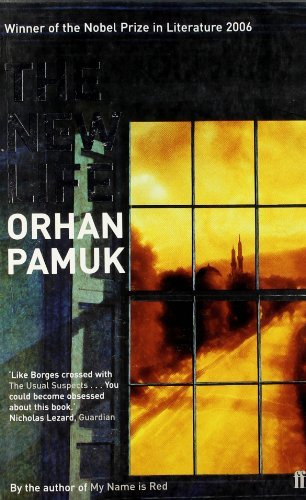
One day narrator Osman Akif read a book and his whole life changed. He had glimpsed the book in the hand of Janan, a girl at the same college as him, stumbled on a copy in a second-hand bookstall that afternoon and immediately bought it. His obsession with the book spilled over into one with the girl, whom he befriended along with her boyfriend Mehmet (later also known as Nahit, and later still Osman – there are reasons for these name shifts.) Mehmet was apparently shot during a student demonstration but Osman knew he survived and walked away so set out to find him, taking Janan along with him. This involved many bus journeys through the heart of Turkey, many videos of films watched while travelling, and several bus crashes. (There is something of that fixation of J G Ballard about this aspect of the book.)
A flavour of the text is given by Osman’s thought that “it was not right for Janan even to imagine the land of perdition, heartbreak and bloodshed because in that twilight land illuminated by the book, Death, Love, and Terror wandered like hapless ghosts in the guise of downtrodden, heartbroken men with frozen faces who packed guns.”
Reading The New Life is an odd experience at times. Osman addresses some sentences to ‘Angel’ but it is never entirely clear (at least, not to me) who Angel is meant to be. Turkish life is illuminated in the margins; the family who moved in across from Osman the day he first read the book, once more in a Pamuk novel the salience of football (sadly always named soccer by the translator,) the statues of Atatürk in seemingly every town square, the endless cafés and bus stations, the past of Osman’s Uncle Rıfkı, a railwayman who wrote children’s stories which starred Turkish children as the heroes of US Western tales, the redolence of New Life brand caramels, defunct in the narrator’s present. Uncle Rıfkı also wrote an adult book, which was banned, with only a few copies surviving in the wild. That book was also titled The New Life and is that same book which obsessed Osman.
In their final meeting Mehmet tells Osman, “‘A good book is something that reminds us of the whole world ….. a piece of writing that implies things that don’t exist, a kind of absence, or death …. But it is futile to look outside the book for a realm that is located beyond the words.’” As if to underline the literary nature of this endeavour, the niceties of its twists and turns, the narrator at one point asks, has the reader “extended enough attention and intellect at every turn of this book?” and describes himself in these terms; “In people like me whose lives have slipped off the track, sorrow presents itself in the form of rage that wants to pass itself off as cleverness. And it’s the desire to be clever that finally spoils everything.”
The New Life may be clever, but it’s not clever clever. And it’s not spoiled by any of this philosophising.
Pedant’s corner:- In the “by the same author” list, Instanbul (Istanbul,) on the publication page, “Orhan Pumuk” (Pamuk.) Otherwise; “the lay of the land” (it’s ‘lie of the land’,) “there were an odd number of bottle caps” (there was an odd number,) maws (a maw is a stomach, not a mouth,) “life’s mystery will become manifested to me” (‘manifest’ would be more forceful,) djins (djinns,) “Andre Maurois’ novel” (Maurois’s. This must be the correct formulation since the final ‘s’ in Maurois is unsounded and so, in order to make a possessive, the extra ‘s’ after the apostrophe must be added,) exploitive (exploitative,) “had really waked me up” (woken.)
Tags: Literary Fiction, Orhan Pamuk, Other fiction, Translated fiction
