Archives » The Guardian

The Stuarts on BBC 2

I watched the first episode of The Stuarts on BBC 2 tonight.

It seemed, like on its first showing on BBC 2 Scotland earlier this year, an odd decision to start with James VI (or James I if you prefer.) There were no less than eight Stuart monarchs before him. In the year of the Scottish Independence Referendum that could be interpreted as a slight, another piece of English ignorance/dismissal of Scottish History.

That the first episode dwelt on James’s desire to unite the two kingdoms as Great Britain might also seem like a dark Better Together plot as the Guardian noted today.

Yet (some, though not all, of) James’s ancestors were spoken of in the programme so the ignorance/dismissal angle can on those grounds be discounted. And the differences between the two countries that then existed (of religion principally,) and in some respects still do, were not glossed over but I was left wondering who on Earth thought broadcasting this was a good idea now. It can only lead to accusations of bias

I had another such disjointed TV experience with the BBC recently. Janina Ramirez in her otherwise excellent Chivalry and Betrayal: The Hundred Years War – on BBC 4 last week, this (and next) but also a programme that has been screened before – kept on emphasising how the events she was describing played a large part in how the country “we” live in now came to be as it is. (Note also the “us” on Dr Ramirez’s web page about the programme.)

Yet that country was/is England. Ramirez seemed totally unaware that her programme was to be broadcast not on an England only channel but one which is UK-wide. Indeed that the country all the BBC’s principal audience lives in is not England, but the UK. [Except for powers devolved to the Scottish Parliament and the Welsh and Northern Irish Assemblies legislation at Westminster is for the whole of the UK. No English elected body oversees the equivalent powers to those devolved elsewhere (arguably there ought to be one;) it is the UK Parliament that performs that function.]

Two parts of the UK share none of the history Dr Ramirez was outlining. Wales (having been incorporated earlier) was involved directly in the Hundred Years War but neither Scotland nor Ireland were. Yet she spoke as if that circumstance didn’t exist.

This sort of thing does contribute to a feeling among many Scots (and I suspect Welsh and Northern Irish viewers too) that the BBC is a broadcaster with a mind for England only and too often forgets the three other constituent parts of the UK.
Jack Vance

I see from Locus and The Guardian that one of SF’s luminaries, Jack Vance, has died.

I can’t say I’ve read a lot of his work – I picked up his Araminta Station on the raffle at the BSFA stall at an Eastercon once and I have the “tribute albumSongs of the Dying Earth on my tbr pile so have that to look forward to.

He was prolific, though.

Jack Vance (John Holbrook Vance.) 28/7/1916 -€“ 26/5/2013. So it goes.

Banks and Israel

Also in Saturday’s Guardian was an article by Iain Banks in which he laid out his reasons for not having his books published in Israel.

His argument boils down to the fact the point that any mistreatment of anyone, anywhere, diminishes us all. Not an argument with which a right-winger is likely to have much truck.

Eton Trifles

This week, talking about the EU budget, our Prime Minister, David Cameron, (aka Mr Irresponsible) used the phrase, “times it by.”

In today’s Guardian, on page 43, in the puzzle section (there doesn’t seem to be a webpage with this content) it claims he said on Newsnight that the Stafford hospital scandal was caused by “a serious failure on behalf of the trust board.”

He’s supposed to have been educated – expensively educated – at one of the best schools in the country. It would claim to be the best, I’m sure.

Yet it has unaccountably failed to teach him to speak English.

So much for Eton as a beacon of excellence.

Modern Art Underground

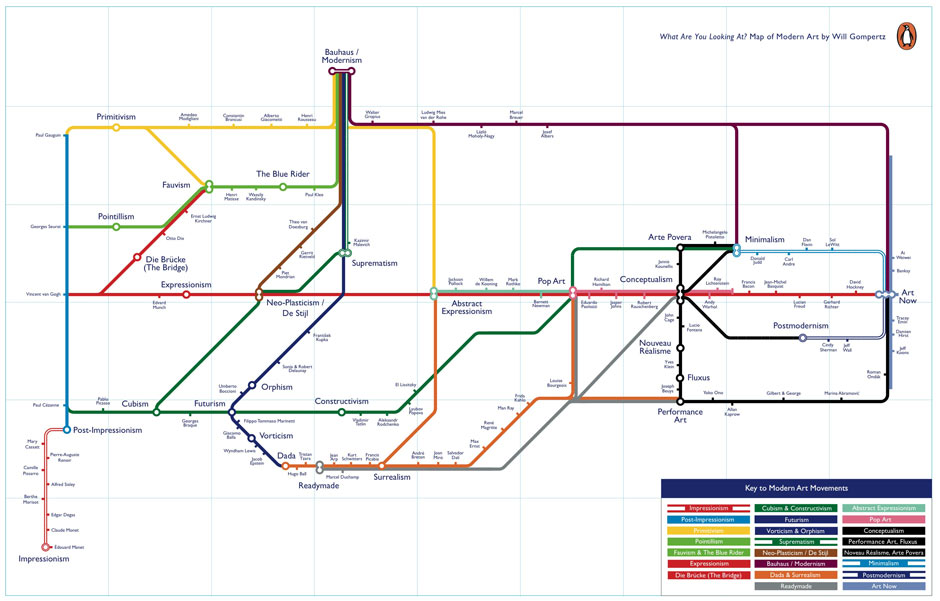
I liked this set of connections between modern art movements laid out as an underground map in Saturday’s Guardian Review.

Modern art movements map

The article the map accompanied is here.

BSFA Awards Result

The BSFA Awards for fiction this year coincided with my views.

Chris Priest’s The Islanders won the best novel.

And Paul Cornell’s The Copenhagen Interpretation the short story award.

John Meaney’s compering of the awards has attracted some criticism.

the guardian* reported only on the novel award, unsurprisingly focusing on Chris Priest’s Clarke Award comments.

*I hate that lower case!

SF Beats Academics To It.

An article by Tom Holland in Saturday’s guardian review about the aftermath of the Roman Empire argued that there was no sudden change from classical to mediæval times, no instant forgetting, but rather a long interregnum in which the rise of Islam was an important feature.

Holland points out that the transition was all a messy business, triggering the evolution of legends of various sorts, which in Britain involved the King Arthur stories plus the evocation of elves and orcs to account for the gigantic ruins of Roman buildings. He sees Tolkien’s endeavours as an attempt to restore these myths to the culture.

The article surprisingly, to my mind, mentions Science Fiction favourably in that Asimov’s Foundation Trilogy and Herbert’s Dune sequence both recognised what Holland sees as the salient aspect of the transformation somewhat before it gained foothold in academe.

When I read the books it was easy to recognise that Asimov’s trilogy was modelled on the fall of the Roman Empire but it is the character of the Mule that Holland finds interesting – a Muhammad like figure with unusual powers. (That the Mule upset the apple cart of the Foundation’s “psychohistory” suggests to me a reflection of Asimov’s world-view.)

The parallels of the Dune sequence with Arab culture were of course unmistakeable even as a very young teenager. Paul Atreides (Muad’Dib) as Muhammad was at that time a step beyond me but is unmissable now. Herbert did seem to be in sympathy with Arab culture if not necessarily the religion it spawned. At the time I took his critique to be of the phenomenon of religion as a whole rather than Islam per se and I see no reason to alter it.

(The article further ponders the historical evidence surrounding the life of Muhammad, a matter on which I am not in a position to judge.)

Historically, the Roman Empire’s fall cannot be seen as anything other than significant. That authors still continue to see it as a template within which to set their stories – Holland mentions Star Wars and Battlestar Galactica as other not so rigorous examples – is testament to the endurance of its legacy.

BSFA Awards Short Stories

Over the past few weeks I have read the short stories nominated for this year’€™s BSFA Awards. I am assuming that, as in the past couple of years, the BSFA will be producing a booklet containing them but since each has been posted on the internet (there is a link from the BSFA’s Awards page to the online versions which is how I managed to read them – though I found off a screen is not the most comfortable of ways to do so) perhaps that might not happen.

The Silver Wind by Nina Allan, from Interzone issue 233, is a kind of time-travel story mixed with parallel worlds. It tells of the encounter of a man from a fascistic future Britain with a genius who makes clocks (which he refers to as time machines.) To begin with there is too much info dumping and throughout a lot is told rather than shown. Perhaps the story needed more space to breathe but I felt the sureness of touch of an accomplished story teller was missing. There is a use of words that is not quite precise -€“ eg ‘hoping one soldier would not see me’ rather than ‘€œhoping none of the soldiers would see me’€ – and twice we are treated to the peculiar phrase, ‘€œIt was growing dusk,’€ but at least Allan knows the use of ‘€œnor’ as in, ‘€œnot for love nor money nor any of these new-fangled gadgets.’

The Copenhagen Interpretation by Paul Cornell, from Asimov’s, July2011, is set in an altered future where European monarchies strive to keep the balance of power throughout the Solar System, souls have weight that is aligned to dark matter and Newton came up with a kind of relativity theory which allows space to be folded – all amenable to a tale of espionage and derring-do admixed with betrayals of various sorts. This stretches suspension of disbelief at times but overflows with ideas and is excellently written.

Afterbirth by Kameron Hurley, from Kameron Hurley’€™s website, is about a woman in a backward-leaning religious society which is engaged in a never-ending war, whose rulers have deliberately cut it off from the stars – originally as an escape from whatever’€™s out there but now to prosecute the war better. In her forbidden astronomical observations she finds God in a torn filter laid across the night sky. Again there is a fair bit of info dumping -€“ perhaps inevitable in stories of short length.

Covehithe by China Miéville, from The Guardian, 20/4/11, features sunken oil-rigs returning to land to drill into the earth and lay – eggs? seeds? – from which smaller rigs later emerge. Atmospheric, but again info-dumpy. The human involvement in Covehithe – a father and his daughter observing one such landing -€“ doesn’€™t really overlap with the SF background. Another scenario where society has suffered extreme breakdown and the military has a strong presence.

Of Dawn by Al Robertson, from Interzone 235, has a woman whose soldier brother has been killed being inspired by his poetry, the music of a long neglected composer, an all but forgotten TV documentary and a figure from Greek myth to produce a synthesis of poetry and music by bringing all those strands together. The final part of the jigsaw is provided by a shadowy figure in a village commandeered by the army long ago, but which had inspired both poet and musician. The story contains echoes of the Green Man myth and illustrates that English fascination with the pastoral. The info dumping here is well embedded.

The futures shown by the five stories are all bleak, having in common repressive regimes of either military or religious stamp. SF is never about the future, though. These stories tell us a lot about where we are now.

As stories though, rounded works of fiction, I found most of them unsatisfying. The only truly successful one was Paul Cornell’s. If these represent the best of last year the SF short story is in a bad way.

A New Iraq?

The lead story on the lunchtime BBC news today (18/2/12) concerned Iran’s pursuit of nuclear weapons. There followed some guy (from the Armed Services Institute?) talking about the ramifications of that on the likes of Saudi Arabia, Turkey, etc as regards proliferation.

The second story on the guardian‘s front page was headlined US believes strike on Iran is inevitable later this year.

Looks like Cowdenbeath are a banker for the Division 2 title this year, then. (With a side order of Armageddon.)

Seriously, though. What are these guys on? Remember Mr Irresponsible during the 2010 General Election campaign? It seems now like that was a prediction rather than an idle slip of the tongue.

How can I put this?

Iran poses no threat whatsoever to the UK. Still less does it pose a threat to the US. I’ll give you it may be a (possible) threat to Israel but its posture there may be rhetorical rather than real. However, there is no way it could invade either the UK or US; nor could it overthrow their governments.

And if it is in the process of acquiring nuclear weapons why might that be?

It has seen its neighbour, Iraq, attacked, on the flimsiest of pretexts, mainly by the US and the UK – and thereafter thoroughly destabilised. It does not want the same happening to it. It knows Israel has nuclear weapons almost certainly targeted on it; it also knows North Korea has such a “deterrent” and is treated more carefully as a result. In its mind developing nuclear weapons might be a rational response to its current circumstances. We (the UK, along with the US) have a history of interfering with the region that goes back a long way. If I were them I wouldn’t trust us either.

The ratcheting up of the Iranian situation reminds me of the run-up to the (second) Iraq war. Drip by drip of increasingly ludicrous assertions. (A much heightened version of this sort of thing was evident in the German press in the summer of 1939.)

I don’t much go for the idea that we could be the bad guys but, in the absence of any attack by Iran on us (or, at a push, Israel) that would be the case here; as it was in Iraq.

Moreover, and again as with Iraq, it would be thoroughly counterproductive.

The ramifications of an attack on Iran would only confirm the idea that the “West” sees Muslims as a whole as targets and though it would take time might make recent terrorist attacks seem like a garden party. Any occupation of Iran would make our involvement in Iraq seem like a picnic and Vietnam a cakewalk.

Do we really want that?

The Iron Lady

I see and hear a film has been made about a certain former Prime Minister of the UK.

I must say at the outset that I shall not be going to see it – not least because the good lady (my good lady) is still too scarred by that woman’s actions that she cannot bear or contemplate anything to do with her.

I gather the film portrays its heroine as frail and dotty. (I suspect this may be a dramatic necessity for the purposes of making the film.) I have heard a speaker on Radio Scotland – a Tory MP – English of course – complain that it went beyond good taste as the person concerned was still alive and it therefore compromised her dignity. Well, that was rich.

Firstly and brutally, if she is frail and dotty she won’t know, will she?

Secondly, did she in her prime give a shit about the human dignity of all those she condemned to hardship and penury, everything she destroyed, as a result of her policies? You could call it karma.

In any case there were signs in her late Premiership that she was unhinged, if not deranged, so it’s not surprising she’s not all there in her dotage.

Yet none of this is to do with the thrust of this post.

Coincidentally I read an article from Tuesday’s Guardian that, as part of the setting up of Sky, Thatcher made the BBC pay £10 million a year to have their channels broadcast on Sky’s platform. Yet one more example of the baleful influence the woman had on British public life. And these payments persist: they are happening now.

Is this circumstance more widely known? Because I was outraged.

Does any other broadcaster – anywhere – have to pay another to have its own programmes shown on that other’s channels? Surely not.

Doesn’t the BBC sell programmes/formats around the world rather than pay others to broadcast them? Don’t the BBC, ITV and Channels 4 and 5 pay to the originator for US (or Australian or whatever) generated programmes? And doesn’t Virgin have to pay Sky to have Sky channels on its (Virgin’s) service? Doesn’t Sky itself pay HBO hefty amounts for their programmes?

We all know the reason why there would not have been much protest from the BBC at such an arrangement. The perceived power of the Murdoch Press. The pusillanimity of politicians of all parties with respect to that power.

That power may now be a busted flush and despite the Tories’ antipathy to anything that smacks of public endeavour surely the BBC ought to be demanding an end to this public subsidy of a private company. For that is what the arrangement amounts to.

As it stands it is – and always has been – a total waste of licence fee payers’ money to throw it away on Sky for no content in return.

The boot should be firmly on the other foot. Sky ought to be paying the BBC – and handsomely – for any access at all to BBC programming. Not to mention providing adequate compensation for all the years in which money has been shamefully drained away from the BBC in this way.

Edited to add:- my good lady says the speaker on the radio was none other than Jeremy (H)unt – her parentheses.

free hit counter script