Posted in Curiosities at 10:00 on 23 September 2015
I’m obviously not the only one who gets nerdy about this sort of thing.
There was a review by Sam Leitch in Saturday’s Guardian of the book Making a Point: The Pernickety Story of English Punctuation by David Crystal. A review which I enjoyed immensely.
I particularly liked the two sentences, “The big four – comma, semicolon, colon and full stop – were for a long time, and insanely, regarded as precise measurements of a pause: a full stop was worth four commas. The book’s full of this sort of curio: interesting on first encounter; illuminating on investigation,” in which Leitch has deployed those marks with great care. The paragraph on Wordsworth and Humphry Davy and the possible punctuation of the parenthesis it coontained was also a delight.
And then there was the bit on defunct and obscure marks:- the asterism, (⁂); the dinkus (***) and the fleuron (stylised forms of flowers or leaves); the austere pilcrow (¶) and the honourable diple (>); the breve (or háček, in which it pleasingly appears) (˘) and the manicule (a pointing hand); or the caret (^).
I’ll not go so far as to read the book itself though. I’ve too much else on.
No Comments »
Posted in Art, Curiosities at 20:19 on 1 September 2015
The Guardian yesterday featured this painting of the first space walk:-
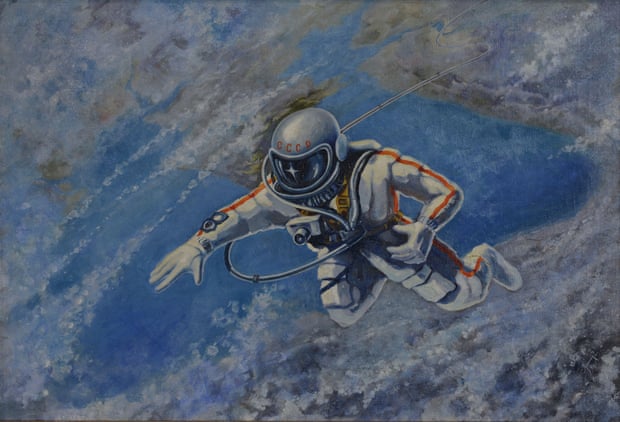
What makes it unusual is the artist. None other than Alexei Leonov, the subject of the painting.
That CCCP on his helmet makes it seem even more of its time.
Leonov also drew the first work of art actually to be created in space, a view of the sunrise as seen from his Voskhod 2 spacecraft. Here it is with the pencils used to draw it:-
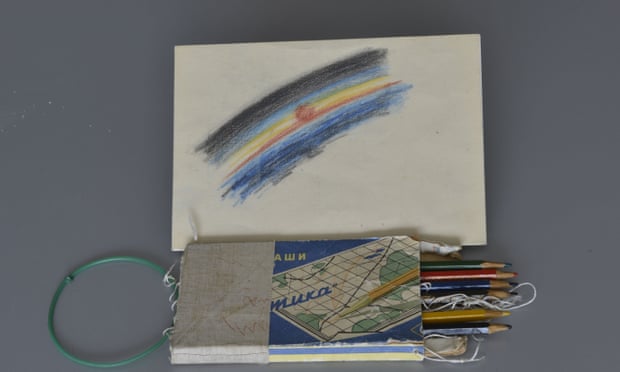
He almost never made it back into the capsule. His suit had expanded and he had to bleed off air to get it to fit. He could have succumbed to “the bends” but thankfully didn’t.
No Comments »
Posted in Architecture, Art Deco at 12:00 on 22 August 2015
The Guardian this week published several pieces about the African country of Eritrea, which is ruled by a repressive regime.
The Guardian briefing about the country is here.
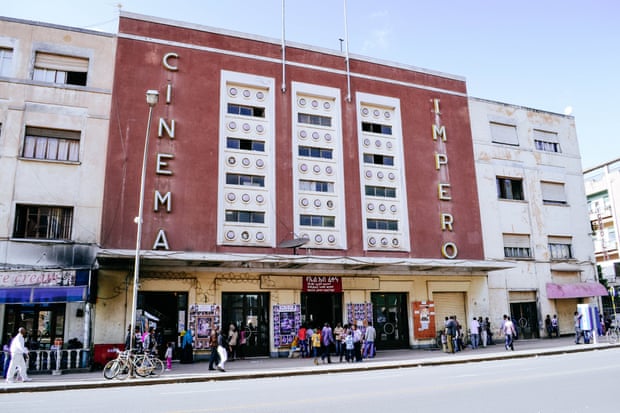
Two of these articles were, however, illustrated by photographs of Art Deco buildings – a relic of Mussolini’s invasion of Abyssinia (Ethiopia) of which Eritrea was then a part.
I couldn’t find all of the photos from the print editions on the Guardian website but the main piece on the Art Deco buildings is here.
The Fiat Building in Eritrea’s capital Asmara is simply stunning:-

This is the Cinema Impero in Asmara:-
And here is a café interior:-
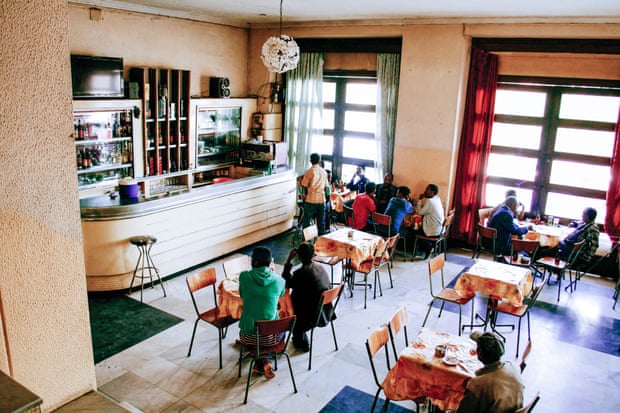
The photographs shown here are credited in the Guardian to Natasha Stallard/Brownbrook.
No Comments »
Posted in Curiosities, Politics at 12:00 on 8 August 2015
This photo (credited to Dominick Reuter/Reuters) – which doesn’t seem to be on the website – appeared in Thursday’s print edition of the Guardian:-

Surely Mr Trump is using the wrong finger to go along with that facial expression.
No Comments »
Posted in Science Fiction at 12:00 on 6 July 2015
In Saturday’s Guardian Review Hari Kunzru had an article – the lead article – reflecting on Frank Herbert’s Dune fifty years on, describing its genesis and continuing relevance.
I’ll slip over the contention in the above the piece strapline that Dune is perhaps the greatest novel in the Science-Fiction canon (on second thoughts I won’t slip over that, it simply isn’t) but it certainly spawned a series of gradually diminishing in return sequels.
Of course I reached it in the wrong way. My first contact with it was via Dumbarton Library when I had graduated to the adult shelves and devoured the yellow jacketed Gollancz hardbacks, the Dobson Science Fiction and Hale SF publications but it was Dune Messiah – the first (and best) sequel I read first as I didn’t realise it was a sequel since Dune wasn’t on the shelves – that day at least. This is perhaps why to this day I prefer Dune Messiah to Dune. I simply think it works better as a novel and indicator of what Herbert was getting at.
That, as Kunzru says, Star Wars was ripping off Dune I suppose I noticed subliminally. But then I never thought the film could be original in any way. I still think that SF works best on the page and not on a screen (of whatever size.) Film and TV images could only ever be a poor imitator of the pictures created inside the brain.
One thing that did occur to me on reading Kunzru’s piece though, was that with its championing of the Arabic/Muslim æsthetic in the culture and religion of the Fremen of Arrakis Dune would not – could not – be published today. (At least not by a traditional publisher. And even if it was, say, self-published, it would not meet with the same appreciation.)
No Comments »
Posted in BBC, Writing at 12:00 on 28 June 2015
In an article in Friday’s Guardian, Nicholas Tucker put forward the thesis that “naughty” words could be got away with in more innocent days.
The trigger for this was the change of name of one of Arthur Ransome’s Swallows and Amazons from Titty to Tatty in a new BBC adaptation of the books, Titty being of course too (err…) tittersome for these days.
He mentions the innocent use in bygone times of “intercourse,” “screw”, “ejaculate” and, in the case of Dr Seuss, “Boners.”
However, the quotation he gives for his next example “cock” – as in a fairground giant cockerel which a maiden aunt of Just William mounts on a merry-go-round – undermines his thesis as the text goes on to say, “It seemed to give her a joy that all her blameless life had so far failed to produce.”
For what is the purpose of that word “blameless”? It seems to me to be present precisely to signal exactly that knowledge which Tucker claims to be absent. Otherwise why include it? If the point was the one Tucker is making then the phrasing, “a joy that all her life so far had failed to produce,” would make it far more effectively, and poignantly.
Tucker then uses the same word to describe Just William’s author, Richmal Crompton, saying she was a blameless ex-classics teacher. But are not the classics – of which she therefore must have had extensive knowledge – full of instances of sexual mayhem? (The Rape of the Sabine Women for one. In case this may be thought to be an egregious example unlikely to be mentioned in school, this incident was one of those encountered by the good lady in her Latin class.)
Tucker says a similar fairground cockerel also appears in an Angela Thirkell story and adduces for her innocence of any double entendre that she was a distinctly snobbish granddaughter of the pre-Raphaelite artist Edward Burne-Jones. As if artists (and particularly the pre-Raphaelites) were entirely free of sexual knowledge and/or shenanigans. Moreover a glance at Thirkell’s life story might suggest rather a lack of innocence.
No Comments »
Posted in Events dear boy. Events at 20:38 on 29 March 2015
…. was an emailed letter of comment in yesterday’s print edition Guardian Review on a piece called A Door into Wonderland which was the lead article in last week’s edition.
Unfortunately my letter doesn’t seem to be on the online version. (Or if it is I couldn’t find it.)
But the text was in my email’s “sent” folder:-
The idea of a “wonder-land” has certainly – as Robert Douglas-Fairhurst said – also attracted English and American authors but his point was perhaps a little undermined by the first example quoted, Thomas Carlyle, not actually being English. Ecclefechan may be near to the border but it’s still on the northern side.
Jack Deighton.
No Comments »
Posted in Curiosities, Politics at 18:00 on 21 August 2014
From yesterday’s Guardian cryptic crossword:
Leading Tory: “I have come last in poll, schooling ultimately a fiasco” (7, 4)
Answer:- Michael Gove
For those of you who have difficulty decoding such things the clues have a definition part – here “Leading Tory” – and another part which guides you towards the answer. Here the word fiasco tells you to make an anagram of previous letters, specifically “I have come”, the last letter of the word poll, “l”, and the ultimate letter of schooling, “g”.
What makes the clue particularly delightful is that its last three words describe the gentleman concerned’s tenure as Secretary of State for Education down south.
No Comments »
Posted in Curiosities at 20:37 on 20 August 2014
There was a brilliant cryptic crossword clue in today’s Guardian.
It read:-
Leading Tory: “I have come last in poll, schooling ultimately a fiasco” (7, 4)
I was flummoxed to begin with; it wasn’t until I got the down clue that connected with the first letter of the seven letter word (M) that I got it.
Answer tomorrow.
No Comments »
Posted in Linguistic Annoyances, Science Fiction, Writing at 12:00 on 20 August 2014
I usually read all the stuff about fiction in the Guardian’s Saturday Review as well as some of the non-fiction reviews.
Last week’s contained three items of particular interest to me.
The cover piece, Steven Pinker’s An Anti-stickler’s Manifesto was about ten “grammar rules” he thinks it’s okay to break sometimes. He says that some of them aren’t actually rules at all and others aren’t rules in English. You may be surprised to read that by and large I agree with him. But I do believe it is important to know what the rules are. This is in order that when you break them it is for a purpose.
Then there was an article about Martin Amis. In this Amis was quoted as saying, “Prose is foremost, and ‘if the prose isn’t there, then you’re reduced to what are merely secondary interests, like story, plot, characterisation, psychological insight and form.'” Secondary interests? Psychological insight is a secondary interest? Story is a secondary interest? Characterisation is a secondary interest? Is this last not what certain purveyors of genre (no names, no pack drill) are pilloried for not providing?
The final piece was an interview with George R R Martin, in London for the Science Fiction Worldcon after first appearing at the Edinburgh Book Festival.
No Comments »

