Archives » Second World War

Roslin War Memorial

The War Memorial in Roslin, Midlothian is situated in a green area by the side of the main road through the town. A restrained Celtic Cross with a wreath on the pedestal.

Roslin War Memorial

It’s dedicated to “Those from Roslin and District.”
1914-1919 names are on the main cross, 1939-1945 names on the projecting slab below.

Roslin War Memorial Close

Commonwealth War Graves, Roslin

There is a cemetery in Roslin, just below Rosslyn Chapel. On its gates I noticed the Commonwealth War Graves sign. Inside I found five graves and two commemorations on other gravestones.

Gunner J Penman, Royal Artillery, 17/10/1941, aged 31:-
Roslin War Grave 1

Private W Baillie, Royal Army Medical Corps, 18/12/1915:-

Roslin War Grave 2

Stoker J N Mackenzie, HMS Raymond, 13/3/1945, aged 34:-
Roslin War Grave 3

Sapper A C Brown, Royal Engineers, 4/1/1919, aged 31:-
Roslin War Grave 4

Serjeant W Barclay, Gordon Highlanders, 27/11/1919, aged 37:-
Roslin War Grave 5

Private John James Noble, RSF, died 24/2/1919, buried in Cologne:-
Roslin Cemetery, War Inscription 2

Brunton Smith, killed in France, 24/3/1918, aged 35:-
Roslin Cemetery, War Gravestone 1

East Linton War Memorial

East Linton is in East Lothian, a few miles from Dunbar.
The Memorial is set in a small park off School Road. Its dedication is to the men of East Linton and Parish of Prestonkirk.

War Memorial, East Linton

Great War Inscription:-

East Linton War Memorial WW1 Inscription

Side View, showing East Linton Primary School in background:-

Reverse View War Memorial East Linton

Side Inscription (WW2):-

Reverse Innscription East Linton War Memorial

Mid-Atholl War Memorial

This is situated by Logierait, just off the A 9 at the A 829 (for Aberfeldy) junction.

World War 1 names in the panel, World War 2 in the shield (a little faded I fear):-

Mid-Atholl War Memorial

From North-west:-

Mid-Atholl War Memorial

From south-west:-

Mid-Atholl War Memorial

Langemark German Military Cemetery (ii)

In the first battle of Ypres more than 3,000 not well trained volunteers were thrown into the German attacks and did not leave again so their final resting place is in Langemark. The cemetery is sometimes called the Studentenfriedhof (Student Cemetery) as there was a large number of (school) students among them. A board fills one wall of the entrance building with their names.

Deutsche Studentenschaft Names

Unlike the upright Commonwealth War Graves markers the German ones are rectangular slabs laid flat on the ground. I have seen German war graves before, at Bayeux and Beauvais, so was prepared for that, but those were for World War 2 dead and the feelings engendered by them were more conflicted.

There was something sombre about the arrays in Langemark. The grass was being regenerated after poor weather so at our time of visiting we there was no access to individual graves but from the fence it was possible to take photographs. Langemark War Cemetery, Graves:-

Langemark War Cemetery, Graves

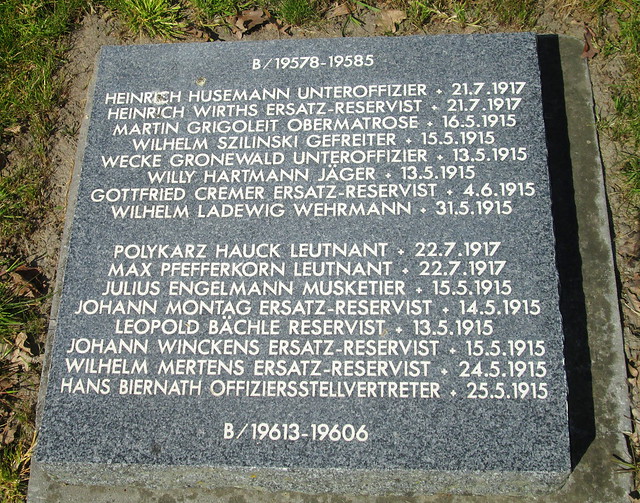
The German practice was to bury 8 men together. These two grave markers name 16 each though. Langemark War Cemetery, Named Graves:-
Langemark War Cemetery, Named Grave

Langemark War Cemetery, Grave

Vier Unbekante Deutsche Soldaten (Four Unknown German Soldiers):-

Langemark War Cemetery Grave

Emil Krieger’s Mourning Soldiers Statue from the Kameraden Grab:-

Langemark War Cemetery, Mourning Soldiers

Vier Unbekante Deutsche Soldaten and Nikolaus Jackel musketier, Zehn Unbekante Deutsche Soldaten (Five unknown soldiers, one named rifleman, ten unknown soldiers):-

Langemark War Cemetery, Communal Grave

Langemark War Cemetery, Stone Wreath. The inscription (from Isaiah 43:1) reads “Ich habe dich bei deinem namen gerufen, du bisst mein.” “I have called your name, you are mine.” :-

Langemark War Cemetery, Stone Wreath

Like the cemetery in Beauvais which had few visitors from Germany – few visitors at all (and which I felt bad about not signing the book as I had come across that one by accident and had no pen with me) – not many Germans seem to visit Langemark. (Bayeux was a mainly British/Commonwealth Cemetery with German graves set to one side of it.) I did sign the book at Langemark. However all the tributes surrounding the stone wreath in the picture above seemed to have been laid by British school visitors.

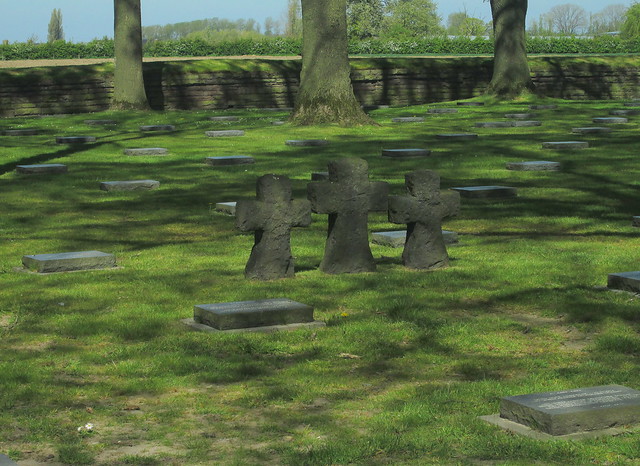
Langemark War Cemetery, Basalt Crosses, Graves:-

Langemark War Cemetery, Basalt Crosses, Graves

A series of blocks with German words on them snakes through the northern part of the cemetery. These, I think, commemorate the companies of students who were killed here during the first Battle of Ypres. This block says “Rothenburger Verband Schwarzer Schlagender Verbindungen.

Langemark War Cemetery, Inscribed Block

Another, closer, view of Emil Krieger’s statue:-

Mourning Soldiers, Langemark War Cemetery

Aberfeldy War Memorial

An unusual memorial in the form of an arch which gives onto a path leading from the town to the local beauty spot the Birks.

Aberfeldy War Memorial

The left hand side of the arch is inscribed “For King and Country” in English. 1939-45 names are on the lower plaque.

Aberfeldy, War Memorial, English

The right hand side of the arch is inscribed in Gaelic “Air Son Righ Us Duthaich.” Again 1939-45 names are on the lower plaque.

Aberfeldy, War Memorial, Gaelic

In Memoriam

The Battle of the Somme began 100 years ago today. That first day saw the British Army suffer 57,470 casualties, its greatest ever one day loss in battle.* 19,240 of these were killed. Overall the battle (really a series of battles) lasted for four and a half months and resulted in 1.120-1.215 million casualties over both sides. Only the Russian Front battles of the Second World War were bloodier.

Like the Ypres Salient, the countryside where the battle(s) took place is dotted with Commonwealth War Cemeteries.

There is a particularly striking memorial at Newfoundland Memorial Park, Beaumont Hamel, in the form of a caribou.

Newfoundland Memorial Park, Beaumont Hamel

Newfoundland Memorial Park, Beaumont Hamel

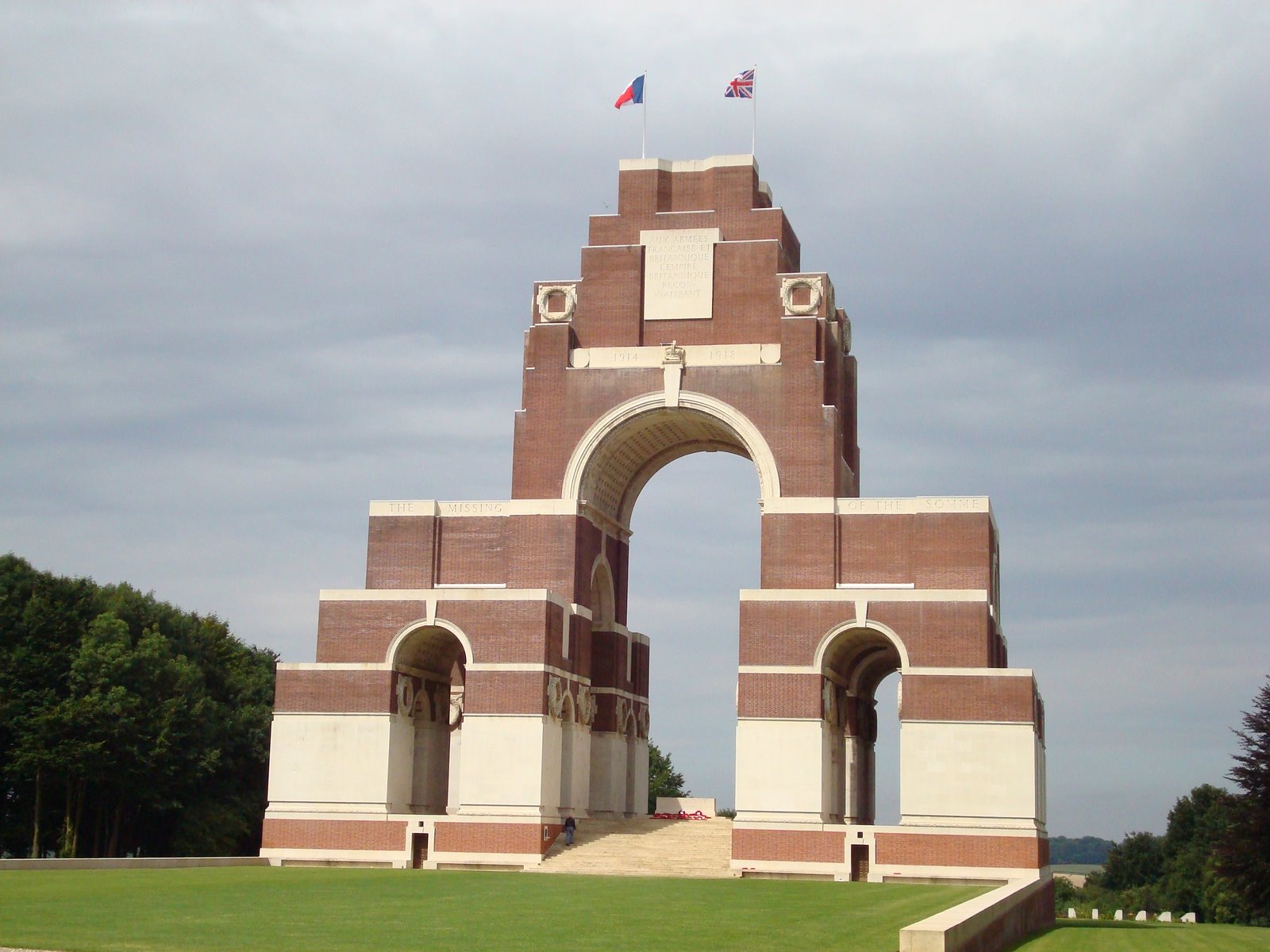
The names of the British army dead who remained missing are engraved on the walls of the towering Memorial at Thiepval.

Thiepval Memorial

Visiting Thiepval is as sobering an experience as the Menin Gate.

The bagpipe tune below was composed by William Laurie who fought at the Somme. He was Pipe Major of the 8th Argyllshire Battalion of the Argyll and Sutherland Higlanders. He became ill as a result of trench conditions and died on Nov 28th 1916.

To all who fought:-

The Battle of the Somme

*More personnel (80,000) were lost by surrender at the Fall of Singapore in 1942.

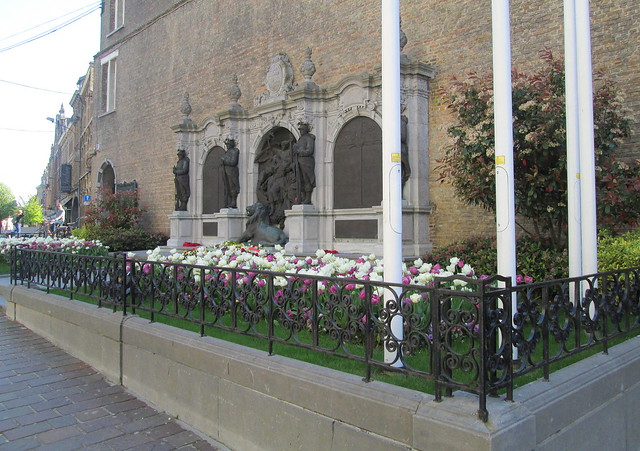
Ypres War Memorial

Is situated on Coomansstraat just beyond the Cloth Hall, the road leading to the square dominated by Saint Martin’s Cathedral.

Ypres War Memorial

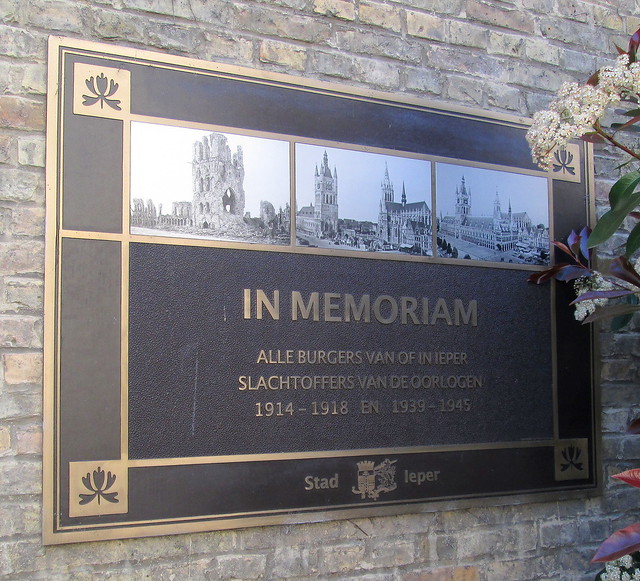
It is dedicated to all citzens of Ypres killed in the World Wars 1914-18 and 1939-45.
Ypres War Memorial Dedication

It lies within a small memorial garden:-

Ypres War Memorial

Just to the left of the main Memorial as you look at it is this one to the members of the Belgian Field Artillery incorporated into the British Army from 17/5/1915 to 17/5/1917 (when the unit was disbanded) who died in the defence of the Ypres Salient:-

Ypres War Memorial Separate Plaque

Iron Fist by Bryan Perrett

Classic Armoured Warfare. Cassell & Co, 1998, 224p.

 Iron Fist cover

As the subtitle suggests in this book Perrett covers the history of armoured warfare from its beginnings in the Great War up to Operation Sabre during the first Gulf War.

In the beginning was the armoured car, whose first flourish in the British forces came in the form of a Royal Naval Air Service armoured car division. With the establishment of the Western Front’s trench system these quickly became unusable but squadrons of cars were subsequently sent to Libya, the Middle East and the Eastern Front and had notable success there.

The origins of the tank were less straightforward than just bolting armour to an existing chassis. An Australian, Mr Lancelot de Mole, in 1911 submitted to the War Office a design for an armed, tracked vehicle capable of crossing trenches. It was ignored; as it was by the Austro-Hungarian General Staff. Again it was the Navy, and the influence of Winston Churchill, a member of the Committee of Imperial Defence, which in 1915 set up a Landships Committee and the development of the tank began. (de Mole received recognition for his invention after the war in the form of an award.)

Perrett illustrates the development of armoured warfare by discussing representative engagements in the Great War, World War 2, the Arab-Israeli Wars, Vietnam and the liberation of Kuwait. He devotes a chapter to Hobo’s Funnies, the tanks adapted under the auspices of Major General P C S Hobart to “swim”, blow up mines, fill in anti-tank ditches etc, which contributed greatly to the success of the British and Canadian landings in Normandy and showed their worth as late as in the battles for Walcheren.

As well as Mr de Mole we find herein the fantastically named Count Hyazinth Strachwitz von Gross-Zauche und Camminetz who was a tactical genius with a seeming ability to read his Soviet enemies’ minds. Sometimes he had his tanks travel with their guns pointing backwards (traversed to the rear as the jargon has it) to fool the enemy into thinking they were friendly. In one such engagement he made his way behind Soviet lines with only four tanks. His tiny unit destroyed 105 Soviet tanks in one hour and made it back out intact.

For those, like myself, with a general interest in the military history of the twentieth century but perhaps lack in depth knowledge, the book illuminates some of its byways as well as giving an overview of its subject.

Pedant’s corner:- the latest generation were (was,) produced in (produced, or resulted in,) not prepared the maintain (to maintain,) handed them over the Senussi (to the Senussi,) Sirelius’ (Sirelius’s,) coped with the mud better the heavier cars (better than,) gild the lily somewhat that by (gild the lily somewhat by,) on 8th January the Soames (no “the”,) set too (set to,) of which were never enough to fill the gaps (there were never enough,) have been in dominant element (a dominant element,) nor aware of (nor was aware of,) the line of German tanks form (forms,) were several of new corps (no “of”,) Kirponos’ (Kirponos’s,) overlaying its rear areas (overlying makes more sense,) the minefields gaps (minefields’) the first of a succession that were to continue (that was to continue,) Volgagrad (Volgograd,) that tide of war had turned (that the tide,) was all but isolated with due course it had to evacuated by sea (all but isolated and in due course,) breath in (breathe in,) an Small Box Girder Bridge (a,) floatation screen (I prefer flotation,) infantry were pinned down (was,) a paragraph break in the middle of a sentence, referred to a Kangaroos (as Kangaroos,) who he invited to surrender (whom,) phosphorous (phosphorus,) the division … and were (and was,) on the eastern sector the British Eighth Army (of the British Eighth Army,) one the best (one of the best,) the cavalry… were (was,) his map told (indicated?) Hollands’ (Hollands’s,) Grossstein (I assume Grosstein,) a variety of ingenious techniques were developed (a variety was,) like that other conventional armies (like that of,) around a arc (an arc.) Perrett describes the Gulf of Tonkin incident as an attack on US warships by North Vietnamese torpedo boats. The USS Maddox fired first. The US authorities described these as warning shots.

The Menin Gate (iii), The Last Post

There is a stairway halfway along each internal wall of the Menin Gate leading to the upper level. Here are laid wreaths brought to the Gate by various organisations.

Menin Gate Wreath Holders

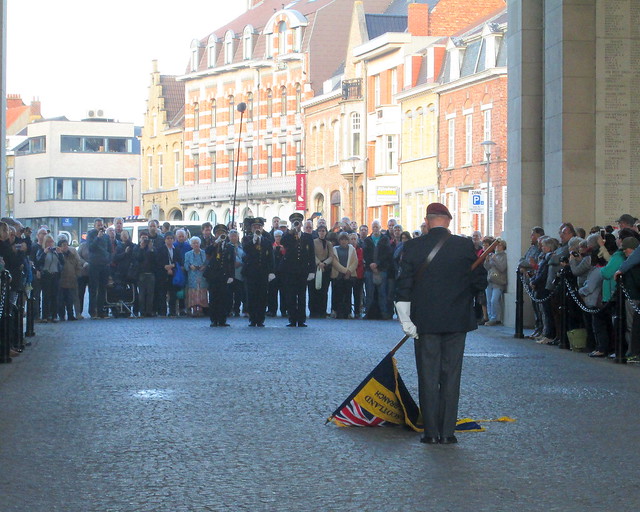
The evening we were there the representatives of several schools performed that duty during the nightly Last Post ceremony to which this flag bearer was the prelude:-

Prelude to Last Post Ceremony, Menin Gate

The Last Post is played every evening at 8pm by members of Ypres Fire Brigade, a ceremony only ever interrupted since its inception by the German Occupation in World War 2 when it was apparently conducted at Brookwood Military Cemetery, in Surrey, England. On the evening of liberation in 1944 the ceremony was resumed despite fighting still taking place elsewhere in the city. A photograph of the ceremony in 1964 in In Flanders Fields Museum had few onlookers in it. The Last Post now attracts large crowds no doubt due to the greater ease of travel to Ypres from Britain and the countries of the British Commonwealth:-

Last Post Ceremony, Menin Gate

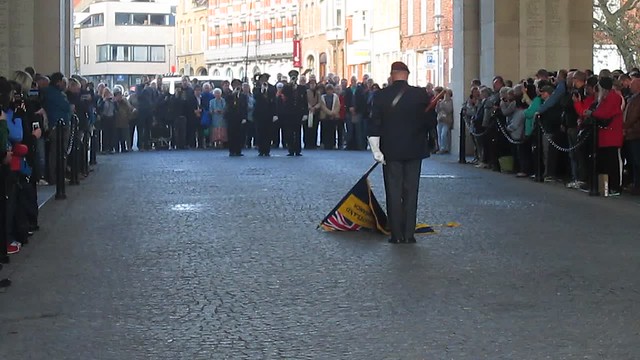
Click on the picture below to go to a short video I shot of part of the ceremony:-
Last Post

free hit counter script