Archives » Napoleon

The Chinese Time Machine by Ian Watson 

NewCon Press, 2023, 269 p. Reviewed for ParSec 7.
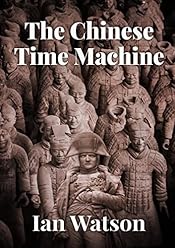
This is the latest collection of stories from Ian Watson, who has been active in the SF field for over fifty years. These were all first published within the last seven.

We start with four stories under the rubric The Chinese Time Machine. Each describes an expedition into the byways of times past. Our travellers, David Mason and Rajit Sharma, set out from a basement lab in Oxford in 2050 on behalf of the Time Institute in Beijing in a Chinese dominated world whose kaleidoscopic and shifting background is elaborated over the four tales. It is obvious that Watson has had huge fun devising and writing these episodes exploring the paradoxes and confusions of timelines in tales where tenses have to be twisted in order to convey the contingencies of “times gone by yet to be.” They are also replete with allusions and jokes. In them there are echoes of John Brunner’s The Society of Time and Connie Willis’s Oxford Time Travel stories. Not the least of their pleasures is that the characters remain blissfully unaware of how their activities change history. Watson’s delight in word-play and allusion also permeates the rest of the collection.

In the 1st Trip: Brave New World by Oscar Wilde, our brave time adventurers, complete with wrist computers and translators worn as necklaces, pluck that author from France in 1897 so that, instead of dying in 1910, he can write his work that will change literature, Brave New World.

The 2nd Trip: The Kidnap of Fibonnaci is made in an attempt to stop that mathematician’s influence inflicting capitalism on the world and makes much of the fact that little is known of Fibonnaci’s life.

3rd Trip: The Emperor’s New Wallpaper is the longest story in the book. Mason and Sharma are accompanied to St Helena by Colonel Maggie Mo, ostensibly to replace the wallpaper made with arsenic dye said to have contributed to Napoleon’s early death so that he will survive for a time. Maggie has ulterior motives and takes them all, Napoleon included, back to the construction of the Terracotta Army as she wishes to establish a world-wide Chinese hegemony well before its time. The tale is somewhat sprawling and even strays to a Lakota Sioux – and Cheyenne – inhabited Mars (which they call Barsoom) before its resolution. Watson’s jocular narration here finds room to comment on the alliteration heavy prose style of these stories.

4th Trip: Sherlock Holmes and the Butterfly Effect (written with Cristina Macía) sees Mason and Sharma travel back to abduct Sherlock Holmes (who claims Dr Watson was an invention by Conan Doyle) so that the United Kingdom of Europe – headquartered in Brussels of course and this future China’s great rival – will not come about. They fail but persuade Maggie Mo to travel back to become Holmes’s chronicler.

The premise of Hot Gates (a literal translation of Thermopylae) is that a process called melting, which erases landscape features – and consequentially kills the people living there – is happening to disputed border regions. Our narrator is a vulcanologist surveying Jerusalem hoping to observe its destruction, which of course occurs – and during which he constructs a hypothesis to explain the phenomenon.

Monkey Business riffs on the monkeys typing Shakespeare trope. Watson makes the most of this chance to include multiple allusions to the bard’s work. The city of Scribe is where thirty-seven robot monkeys (which are more like baboons) are carrying out their task. From the outset it is clear that this world is artificial, or at least not ours. Mixed in with all this is a tale of a pilgrim to the city and a swain she meets on the way, giving the title monkey business added resonance.

When the Aliens Stop to Bottle is an invasion story. Octopus-like aliens calling themselves the Oktagon have appeared on Earth and nullified all the nuclear weapons launched at them. Narrator Jen is on an overcrowded train trying to get home when an alien enters the carriage and asks for her Eye-dentity before displaying an interest in philosophers.

Heinrich Himmler in the Barcelona Hallucination Cell has Himmler on a visit to Spain demand to see the hallucination cell which, to prevent sleep, has a tilted bench and bricks jutting from the floor plus “degenerate art” on its walls when he starts to hear voices from the future in his head. But are they communicating with the real Himmler or one from a different reality?

Clickbeetle is a story regarding an unusual punishment using that tiny insect placed into the ear as an irritant. Its irregular clicks are akin to tinnitus and compared to Chinese water torture (a torment said here to be apocryphal.) The story manages to range widely across the history of such tortures and of Dr Mengele’s experiments.

Journey to the Anomaly explores the differences among the crew of a ship sent out from a star clump containing various sentient races to said anomaly, a solar system whose planets’ orbits are arranged too regularly, in other words our sun’s. Its twenty-one pages contain a plethora of SF ideas.

The Birth of Venus features the coming to awareness of a set of posthuman AIs and their subsequent adventures. It speculates on a universe where Beryllium 8 isn’t unstable and carbon atoms could have formed earlier than they did in ours.

On its own, each one of the above stories is amusing, informative and thought-provoking. Read immediately after each other, with only slight pauses to reflect (as is required for review,) and their cumulative effect can be a touch intense. Take your time, though, and you’ll be fine.

The following did not appear in the published review.

Pedant’s corner:- In the Acknowledgements, The Emperor’s New Clothes (In the Contents and as the story title this was The Emperor’s New Wallpaper. On the contents page “About the Author” is given as starting at page 371 (it’s actually 271.) Otherwise; obsolete (obsolete,) Padddyfields (Paddyfields,) chilis (chillis,) “an annex” (an annexe,) conjouring (conjuring,) times (multiply,) “4 .25” (no space after the 4; ‘4.25’,) “deuxième bureau” (shouldn’t this be capitalised, “Deuxième Bureau”?) schooma’am (schoolma’am,) Sharman (x 1, Sharma,) halfs (as in half-pints of beer. I would have thought it should it be halves,) Surtees’ (Surtees’s,) Porteous’ (Porteous’s,) “as opposed to  surrendering to the Russians” (at Waterloo it was the Prussians who fought alongside Wellington. But this may be – is – an altered history,) “outside of” (x 2, no ‘of’, just outside.) “Clouds are whispy” (wispy.)  “Gracefully Maggie yields les jumelles just a sentry kneels, sights, and fires a crossbow” (seems to be missing either a few words or punctuation.) “A few more arrows follow suite from crossbows” (follow suit,) “the peasant army charge” (charges,) “to be scraped of its hull” (off,) teepees (tepees,) mathematical (mathematical,) mantlepiece (mantelpiece,) Wells’ (Wells’s,) “inside of” (x 2, just inside, no ‘of’,) Holmes’ (Holmes’s – which did appear earlier,) bacterias (bacteria is already plural; one of them is a bacterium,) “isn’t nice even it’s passably pretty” (even it it’s,) “rains never falls” (fall,) ne’re (ne’er.) “type thorough the hours of night” (through,) accommodate (accommodate,) tressle (usually trestle,) glitch/es (usually glitch/es,) “a chamelion’s tongue” (chameleon’s,) Eye-denity” (Eye-dentity,) “barely 5 mills long” (mills is not an abbreviation for millimetres; that is ‘mm’. I have heard people say ‘mils’ as in ‘10 mils’ but the abbreviation is ml, pronounced ‘mil’ however many there are,) “doubles in numbers” (doubles in number,) “voice with chords” (they may communicate musically but ‘cords’ is more likely,) CO2 (x 3, CO2,) “should not be taken refer to” (taken to refer to,) “two a. m. -ish” (two a.m. -ish,) collapsment (should this perhaps be spelled collapsement?) connexions (x 2. But elsewhere – correctly – connection,) “the imagery of … suggest” (the imagery …. suggests,) “none of these are” (none of these is,) dispensably” (dispensibly.)  Syncronisation (Synchronisation.)

Napoleon’s Last Campaign in Germany – 1813 by F Loraine Petrie

Arms and Armour Press, 1977, 406 p, including Index, plus iii p Introduction by David G Chandler, iv p Author’s Preface, four sheets of Maps and Plans, iv p Contents. First published 1912.

 Napoleon’s Last Campaign in Germany cover

The Author’s Preface notes the Napoleonic Wars as an evolution, the time of change from war as involving only the clash of armies to something which involved whole nations instead.

The main body of the book follows the course of the campaign of 1813 from Napoloeon’s initial invasion to its culmination at Liepzig, the largest engagement of the Napoleonic Wars, with a brief description of the minor battle at Hanau in its aftermath. The essence of the tale is that the Russian adventure in 1812 had severely weakened Napoleon (not least in a deficit of cavalry in comparison with before, but also with many new recruits to be assimilated into his armies) if not his personal reputation as a master of war. His aura was still such that during the armistice in mid-1813 the Allies formed a pact not to engage separately the army of which the Emperor was directly in charge unless and until they had united and had a large superiority in numbers. This stricture did not apply to his Marshals who according to Petrie were very well-versed in tactical matters but a failure to train them in strategical considerations meant they were lacking at crucial junctures.

The decline in Napoleon’s abilities from his glory years is illustrated by contrasting his switherings in this campaign with his decisiveness at Jena seven years earlier. There was a fatal conflict of Napoleon’s priorities as Emperor, and dominator of Germany, compared with his military objectives. Here he tended to try to protect the land he held, specifically the city of Dresden, over his previous focus on destroying his enemies’ armies in the field. Petrie also quotes the man himself as saying experience in war does not count for much, that he thought himself as insightful in his youthful campaigns in Italy as he ever was later. His early battles were of course smaller affairs over which he could exercise a large degree of control. Noitwithstanding the fact that armies in 1813 were much more densely concentrated than in later times, by the time of Liepzig this sort of close oversight was perhaps beyond any one person.

It amused me when at one point Petrie wrote, “These extensive expeditions of considerable bodies of cavalry in the French rear are a peculiarity of this campaign which is the only instance of their employment on a large scale in a European War. Similar raids played a considerable part in the American Civil War of fifty years ago. In this case, as in 1813, the raids were generally carried out in a country the inhabitants of which were often sympathisers with the raiders, to whom they supplied food, forage, and information. Moreover, there were few or none of the modern facilities for sending information to the other side. It seems more than doubtful what success such raids could hope for in these days of telegraphs in Europe. (My emphasis.) Petrie notes a like raid by Petrushenko in the then recent Russo-Japanese War which, “can hardly be deemed a great success, and it was only possible to carry it out at all owing to the route being taken through an area devoid of telegraphs.” The thought of such wires being cut in the furtherance of raiding activities does not seem to have occurred to him. And didn’t the Boers in the also recent South African War in effect also use tactics like this? Of course the presence of technologies such as the telegraph, telephone, and radio, did not negate the opportunity for operations behind the lines in later wars.

The language of the text can be a little precious. Petrie uses unnecessary formulations such as “We left Oudinot, at 11 am,” “We now return to Ney,” etc, and there is the usual alphanumeric soup of divisions and Roman-numeralled corps. The four sheets of maps (seventeen diagrams in total) are more or less useless not only since they require awkward folding out but also because they are affixed to pages towards the end of the book, nowhere near the parts of the text they are meant to illuminate. Their appearance is also too cluttered.

Pedant’s corner:- “This broke down one” (broke down once,) England (The United Kingdom,) “6 per cent. on the then population” (of the then,) throu (through,) Friederichs’ (Friederichs’s,) many ionstances of names ending in s being treated this way – Dolffs’ (Dolffs’s,) Reuss’ (Reuss’s,) even one where the final s is not sounded and the possessive therefore positively demands “s’s” – a missing full stop, “unable note Bulöw’s advance” (unable to note,) Probetheida (Probstheida,) “came to nought” (nought = the number zero, ‘came to naught,’)|Naumburg (elsewhere Naumberg.)

Jackboot by John Laffin

The Story of the German Soldier, Cassell, 1965, 241 p, including xii p Index and iv p Sources, preceded by i p Acknowledgements, ii p Contents, ii p List of Illustrations, iv p quotes describing “What the Germans Think About War” and iv p Introduction.

 Jackboot cover

The subtitle of the book is somewhat misleading, this is not, quite, the story of the German soldier. At least not of the individual. Very few instances of soldierly action are described, it is more the history of the Prussian and German states’ relationship to war as a profession and a duty, a guiding principle; their highest calling.

In his Introduction Laffin says the German is a born soldier, aggression and fortitude in his blood, needing to be trained, yes, but the material is there already, not base clay but refined. He contrasts modern national aptitudes for soldiering; none equals the Australian for dash, élan and initiative, but for dogged persistence and obedience to orders no-one can touch the English and Welsh, for fighting fury the Scots, for thoroughness Americans, fanatical courage the Japanese, the capacity to suffer and still keep fighting, the Russians. He claims none of these are complete soldiers, though, they fight only because it is necessary to do so. But Germans are complete soldiers, for them war is holy. “The complete soldier fully realises that his only logical end is death, that this is a soldier’s only privilege. The German knows this.” In modern times, he says, only Napoleon’s soldiers can be compared with them – and then only when Napoleon commanded them. He states that Prussians and Germans never considered themselves beaten in any conflict up to 1918 (later in the book he says not even then.) They had to admit defeat in 1945, bludgeoned by impossible odds, but even in extremis in December 1944 they launched the Battle of the Bulge, which, Laffin claims, “will for ever remain a magnificent feat of arms.” Despite younger Germans saying, “It will never happen again,” Laffin believes a German “can never evade his destiny: he does not really want to evade it. He is a soldier. A soldier fights.”

For how this came about you have to go back to landlocked Prussia, poor and barren, no cities worth the name, little industry and less culture, and to Frederick William (and his obsession with very tall soldiers) who expanded his army by impressing and enrolling men – many of them foreign – but it was his son Frederick the Great who devoted the resources of the state to it and realised that Prussia, surrounded by larger more populous countries, had to depend on organisation and speed and manœuvre in battle.

By Napoleonic times his lessons had largely been forgotten or outmoded. In 1808 crushing defeat at Jena and Auerstadt led to change, Scharnhorst and Gneisenau instituted a war academy and seven years later their influence bore fruit with Napoleon’s defeat at Liepzig. Their adherent Clausewitz formed his principles of war whose beliefs extend down the years since. An inculcation of military virtues via the school system (extended to the whole of Germay after unification in the wake of the Franco-Prussian war in 1870) laid the foundations for the nature of the German soldier and Kaiser Wilhelm introduced badges and awards for proficiency – a system brought to its greatest peak by the Nazis. Through all these years deference to a military uniform (indeed to uniforms of any stamp) was inbuilt in the German state.

In the context of France invading Germanic territory fourteen times between 1675 and 1813 Laffin quotes General Fuller as saying, ‘Few nations have had so bad a neighbour as Germany has had in France.’ (To which I can only reply, you should try being a Scot, mate.)

A piece of information that surprised me was that in the Nineteenth Century homosexuality was apparently rife in the Prussian army and not hidden, was indeed paraded, by those of that persuasion.

The German War Book stated the employment of “uncivilised and barbarous peoples in European wars” was an unlawful instrument of war, since “these troops had no conception of European-Christian culture, of respect for property and for the honour of women.” A footnote adds that this was a source of great bitterness during the Great War, quoting a Private’s letter to his parents (sensitivity warning; use of the ‘n’ word,) “The French have sunk so low as to use niggers against us. They are heathens and quite revolting and cruel. We fight fiercely against them because we know we can expect no mercy from these savages. You can smell them in the night.” (I’d have thought a smell – if any – would more likely have been produced by day than by night, but there you go. I suspect that any such perception was psychological anyway.)

Twice, re 1918 and 1945, Laffin asserts that the Germans were not beaten but overwhelmed – which, he says, is something different. For 1918 he cites a million troops left in the east to keep the conquered territories subdued and how they might have affected things in the west. (In this regard, the undefeated Colonel Paul von Lettow-Vorbeck in Africa does stand out in his four year undefeated campaign of improvisation, holding down 300,000 British and Allied troops with a maximum strength of 20,000 of his own [including bearers,] while managing to inflict 60,000 casualties. After the armistice he for a short time contemplated holding out – much as some Japanese soldiers were to in the wake of 1945 – but in the end decided to honour its terms.) Laffin suggests a suitable counter to this perception might have been that rather than negotiating armistice with the civilian Erzberger, the Allies ought to have forced Hindenburg to the table amd made him surrender his sword; the symbolism of which would have been unmistakable. In 1945 the German soldiers considered themselves brutally crushed, not militarily defeated. Laffin says, “Others,” (I count myself among that number,) “might not be able to see the difference, but this is not important. The Germans know there is a difference.”

The book was published in 1965, only twenty years after the Second World War finished, at which time there were still many Germans who had experienced the upbringing that inculcated such a mindset. Laffin quotes a former soldier telling him that, “‘We are not finished with our jackboots yet,’” and, “‘Germany must triumph. Peace is ignoble.’” It is to be hoped that with the further 55 years since then of peace (however ignoble – yet welcome to those who hope it will never happen again) and of a sustained non-military education system in Germany that that attitude has faded away for good.

Pedant’s corner:- England (at the time covered by this book England no longer existed as a separate state. It was in a United Kingdom with Scotland. Britain, then. A few pages later we have, “The English made him [Count William of Schaumburg-Lippe] Field-Marshal of Portugal, but the role of British mercenary did not suit him.” British is required in both cases, etc, etc,) cameraderie (camaraderie,) sheath (sheathe,) onle (only,) “rend thy Germans” (the Germans.) In the Sources; idealogy (ideology.)

Palace Square and Winter Palace, St Petersburg

Winter Palace stitch. Note Victory Day banners:-

Winter Palace stitch

Video of Winter Palace facade:-

Winter Palace, St Petersburg

Admiralty Building:-

Palace , St Petersburg, Russia

The Alexander Column, a monument to Victory over Napoleon, Palace Square, St Petersburg.:-

victory monument

Victory Monument, St Petersburg

General Staff Building:-

Palace , St Petersburg, Russia

Portico:-

palace , horse statue pediment

Horse-drawn carriages:-

Winter Palace, St Petersburghorse-drawn

Video of horse-drawn carriages, General Staff Building and part of Alexander Column. Again, note Victory Day banners:-

Horse-drawn Carriages, Palace Square, St Petersburg

The Black Jacobins by C L R James

Toussaint L’Ouverture and the San Domingo Revolution

Allison & Busby, 1984, 426 p including 11 p Bibliography and 28 p Appendix plus i p Map of San Domingo, i p Contents, iii p Foreword and iii p Preface to the First Edition. First published in 1938.

 The Black Jacobins cover

C L R James was a Trinidadian historian and journalist whose book on cricket has been described by none other than John Arlott as the finest book written on the game. He was also a Marxist which if you didn’t already know could be divined here from the frequent use of the word bourgeoisie and many mentions of class. Note also, “The rich are only defeated when running for their lives.”

The San Domingo Revolution was the only successful slave revolt in history. It eventually led to the establishment of the state of Haiti. Toussaint L’Ouverture, who changed his name from Toussaint Bréda when he joined the revolt, was its undoubted hero. James says however that “Toussaint did not make the revolution. It was the revolution that made Toussaint.”

San Domingo was a prodigious source of wealth for its white sugar planters and the merchants back in France who traded its product; wealth built on the backs of the slave workers imported from Africa, a slave trade which James says had turned Central Africa from peace and happy civilisation to violence and ferocity, the product of an intolerable pressure on the African peoples. Of those who dispute that statement we have, “Men will say (and accept) anything in order to foster national pride or soothe a troubled conscience.”

Before the revolt San Domingo was riven by differences; between the planters and the bureacracy, big whites, small whites, Mulattoes, blacks. (For some reason I couldn’t fathom James always capitalises the word Mulattoes.) For the small white with not much in the way of property, “race prejudice was more important than even the possession of slaves. The distinction between a white man and a man of colour was for them fundamental.” An illustration of the central importance of colour to San Domingan life was that, “They divided the offspring of white and black and intermediate shades into 128 divisions. The true Mulatto was the child of pure white and pure black, a quarteron was the child of a Mulatto woman and a white man. This went all the way down to the sang-mêlé of 127 parts white and one part black but who was still a person of colour. These distinctions exemplify “the justification of plunder by any obvious differentiation to those holding power.” I note here that James describes pure blacks as negroes. I suppose the usage was common in the 1930s when he was writing but it strikes an odd note now.

Free Mulattoes were able to save, to own property and eventually to lend money. Their threat was such that, “white San Domingo passed a series of laws which for maniacal savagery are unique in the modern world.” But the Mulattoes were too numerous and the colonists had to be satisfied with humiliations such as restrictions on dress, meetings, travel, and so on. Black slaves and Mulattoes hated each other, and those who were more white despised people with blacker ancestry. This internalisation of racial prejudice was still prevalent in the Jamaica of James’s present.

In 1789 San Domingo accounted for 11 of the 17 million pounds of France’s export trade. The beginning of British efforts to abolish slavery was an attempt to undermine this economic powerhouse. “The slave trade and slavery were the economic basis of the French Revolution.” The fortunes made, “gave to the bourgeoisie that pride which needed liberty and contributed to emancipation.” But then came the French Revolution and the ideals of liberté, egalité and fraternité, which took root in the fertile ground of the plantations.

When the uprising finally came James says that the slaves in their vengefulness were surprisingly moderate, far more humane than their masters had been, not maintaining it for long – unlike the systematic and enduring abuse the slaves had suffered. Toussaint himself established early a “great reputation for humanity, a very singular thing in the San Domingo of those days.” The crucial event for the sustenance of the revolt was the abolition of slavery by the Constituent Assembly in Paris, a reason for the slaves to cleave to revolutionary ideals thereafter.

Britain then promptly rowed back on the abolition of slavery and attempted to take over San Domingo. Under Toussaint the former slaves inflicted on Britain “the severest defeat that has befallen a British expeditionary force between the days of Elizabeth and the Great War.” The British lost more men in actual deaths than Wellington did to all causes in the entire Peninsular War, “‘her arm for six fateful years fettered and paralysed.'” Held by Toussaint and his raw levies Britain could not attack the revolution in France.

James has an undiluted admiration for Toussaint (along with Nelson and Napoleon one of the three outstanding personalities of the times) though admits his one fatal flaw. His allegiance to the French Revolution made him what he was; but in the end this ruined him. “His desire to avoid destruction was the very thing that caused it. It is the recurring error of moderates when face to face with a revolutionary struggle.”

The rise of Napoleon is seen by James as the bourgeoisie reasserting itself. Under Bonaparte it was the French intention to restore slavery on the island and their actually doing so in Guadeloupe that led to Haiti’s final independence. Toussaint’s blind spot had seen him acquiesce to the new French Governor, eventual imprisonment, transportation to, and eventual death in, France. It was Toussaint’s more ruthless deputy Dessalines who came to see independence was the revolt’s only hope.

James keeps describing the slaves and their culture as primitive (as he also characterises those of Africa.) Is this as a result of his Marxist view of history and its laws? He notes that slaves brought from Africa were compelled to master European languages, “highly complex products of centuries of civilisation.” There was therefore “a gap between the rudimentary conditions of the life of the slave and the language he used.” (Note also that inclusive – exclusive? – “he”.) It seems to me these sentiments are profoundly condescending – to African and slave alike.

Everything in the book is seen through the prism of Marxism, an approach which seems almost quaint these days as does James’s conclusion that salvation for the West Indies lies in Africa.

Aside:- For a fictional treatment of the slave revolution I would recommend the excellent All Souls’ Rising by Madison Smartt Bell. Having looked that up I discover Bell has published two subsequent books on the subject.

Pedant’s corner:- “All the slaves, however, did not undergo this régime.” (Not all the slaves underwent this régime,) “All of them did not submit to it.” (Not all of them submitted to it,) illtreatment (more usually it’s ill-treatment,) knit (knitted,) “adventurers seeking adventure,” (well, yes,) “72 million pounds’ weight of raw sugar and 51 million pounds of white,” (either use the apostrophe or not, don’t mix them,) the the, “both Hyacinth and another men” (man,) Francois’ (Francois’s,) Laveaux’ (Laveaux’s,) understod (understood,) acutal (actual,) Dessalines’ (Dessalines’s.) “It is a typical example of the cloud of lies which obscure the true history” (the cloud of lies which obscures,) “to neglect the race factor as merely incidental as an error only less grave than to make it fundamental” (as merely incidental is an error,) Maurepas’ (Maurepas’s,) Capois’ (Capois’s,) strewed (strewn,) Clairveaux’ (Clairveaux’s,) wirter (writer,) indpendent (independent,) a missing parenthetical end-comma, tonelle (tonnelle?)

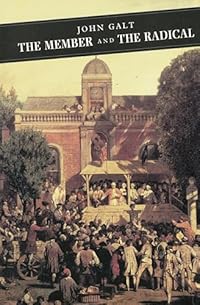
The Member and The Radical by John Galt

Canongate Classics, 1996, 263 p, including 2 p glossary, 6 p notes (The Member) and 4 p notes (The Radical) plus 8 p Introduction.

The Member and The Radical cover

Galt was a Scot born in Ayrshire whose novels mainly dealt with the impact of the industrial revolution and has been called the first political novelist in the English language. The Member was the first example of the Parliamentary political novel, The Radical deals with Parliamentary matters only towards its end. These two works of fiction were first published in 1832 (in January and May respectively) and subsequently in one volume as The Reform that November but apparently not republished till 1975 (The Member) and this edition (The Radical.) The two hundred year old idioms do take some getting used to but it is worth persevering.

The Member: An Autobiography.
This is prefaced by a “Dedication” to one William Holmes, wherein Scot Archibald Jobbry laments the imminent passing of the Great Reform Act and the inevitable depredations which it will bring in its train. Many years before Jobbry had returned from India where he had made his fortune and decided to purchase a seat in the House of Commons despite it being technically illegal to do so. He shows himself a sly and acute bargainer. During this process he opines, “a Tory is but a Whig in office, and a Whig but a Tory in opposition.” Some things don’t change. In this regard Jobbry later says MPs have been, “inveterate to retain the distribution of places and pensions – the natural perquisites of Members of Parliament” and, “The democratical think state salaries always exorbitant, and the aristocratical never think wages low enough.”

The shenanigans accompanying elections in those days are amusingly described. On this point Jobbry tells us, “It is by no means plain why paying for an individual vote should be so much more heinous than paying for a whole borough.” These vices are still with us, if in altered form. To my mind selling off state assets is an even higher category of bribe than either of those Jobbry mentions, promising lower taxes only slightly less so.

Galt often uses the utterly obsolete form “quo’ I” for “I said” when Jobbry is relating his own direct speech.

In talking to fellow Parliamentarian Sir John Bulky, Jobbry – despite being a Tory (even if of a restrained sort) – says, “It is not a time to reduce public appointments when there is a national distress; the proper season is when all is green and flourishing.” (Tell that to the present UK coalition!) Sir John replies, “lessening expenditure during a period of general hardship – is paving the way to revolution.” Fat chance.

We also have, “a wild and growing notion prevails that governments … are of less use than had always been supposed; a doctrine (in) which the most civilised and refined communities will be driven to the wall.”

The Radical: An Autobiography.
The life story of one Nathan Butt (try saying it in a Scottish accent,) an individual poles apart from Alexander Jobbry in outlook and here presented in a much less favourable light than Jobbry was in The Member – though he is much disturbed by his Radical friends indulging in bribery to get him elected. Again there is a dedication, this time to Baron Brougham and Vaux, late Lord High Chancellor. Butt’s enthusiasm for Napoleon turns to a feeling of betrayal by “that very bad man.” The narrator refers to his “friend” John Galt and quotes one of his poems. Metafiction in the 1830s. There is a harsh schoolmaster called Mr Skelper* – no doubt inspired by Mr Thwackum.

Several phrases resonate with the present day. “The age required that men who had large private properties should have resigned what they withdrew from the public purse.” (For this nowadays read Amazon, Google, Starbucks evading tax?) “The newspapers now and then tell us of this gentleman, who on his audit-day remitted so many per cents to his tenantry; but I doubt if the fashion has yet become common.” Quite! “There is something in their” – priests and clerics – “office which leads them to imagine themselves superior to the commonalty of mankind.” One of the characters has “a prophetic vista of the time when the English language, by the American States, and the Oriental colonies, would be universal all over the Earth.”

There is a glossary in the final pages which strangely only goes up to the letter “l” – at least in my copy.

*See skelp in the Dictionary of the Scots Language. Type in “skelp” in the search box and then click “skelp,v”.

Norway 0-1 Scotland

International Friendly, Vasker Stadion, Molde, 19/11/13.

Grand larceny. Norway dominated this.

We were indebted both to David Marshall in goal and to poor Norwegian finishing for the win. It looked as if the team had never met. We survived a few bomb scares in the first half and at least two golden opportunities in the second.

Curiously the goal came after the only series of passes we managed to string together. (Passing! The secret of success at last!)

Napoleon famously asked of potential generals if they were lucky. This criterion may be applicable to managers too.

Black Opera by Mary Gentle

Gollancz, 2012, 680 p.

The book starts atmospherically with a prologue scene set around the eruption of the Indonesian volcano of Tambora in 1815, which provided the loudest sound in recorded history – an explosion so great that 1200 miles away it was thought to be artillery and threw so much ash into the atmosphere it resulted in “the Year without a Summer” in 1816. Perhaps the first sign that this is not a straight historical novel is that a party of “The Prince’s Men” is on hand – on an ocean-going steamboat.

The novel proper focuses on Conrad Scalese, a rationalist atheist who writes libretti for a living. His latest work has had a triumphant premier but lightning has struck the theatre where it was performed. The local (Neapolitan) Inquisition interprets this as a sign of God’s anger at the opera’s blasphemy and arrives to take him in for questioning. He is saved by the local police chief who conveys him to a meeting with the King of the Two Sicilies who assesses Conrad’s suitability to write the libretto for an opera which the King desires in order to counter a Black Opera which The Prince’s Men plan to perform in a few months’ time. The Black Opera is the secular equivalent of a black mass. Not only will it cause the eruption of Vesuvius, Stromboli, Ætna and other volcanic regions in between, thus devastating the Two Sicilies, it will summon up Il Principe, the God whom the creator God left in charge of Earth. Other intrusions of the supernatural into the narrative have Conrad’s father appearing as a ghost and people known as the Returned Dead – not zombies but fully functioning humans except for lacking the need to breathe.

The premise – that volcanic eruptions can be triggered by singing – is of course unremittingly silly but must be accepted for purposes of story. Invocation of gods or devils by incantation is time-honoured in fiction so their summoning by singing is not too much further of a stretch (but still too much for me.)

Gentle’s characterisation and plotting are excellent, though. The web of relationships around Conrad and the betrayals inherent in the set-up – the Prince’s Men are even more dangerous than the Cammora of Naples or the società onorata of Sicily – are finely detailed. Gentle’s knowledge of, or research on, opera seems solidly based to a non-buff. The collaborative nature of a first production, not only composer and librettist but also the singers, was well depicted.

As befits an altered history of the nineteenth century, the victor of Austerlitz and Borodino, the Emperor of the North, also makes two passing appearances.

Conrad’s sweet-bitterness towards his former love is pithily expressed, “It’s as easy to fall in love with a rich man as a poor man,” and the perennial complaint, “why a sister and a sweetheart will invariably combine their forces to persecute the relevant male,” is aired.

Despite any negativity above Black Opera is never less than readable; even the supernatural stuff.

Pedants’ complaints:- “Sung” count: 1. Livestock is a singular noun. Plus we had a who’s for whose, lay for lie, a beaus for beaux and one, “I can’t explained.” Despite her Italian setting and liberal use of Italian phrases, Gentle employed librettos and palazzos as plurals rather than the Italian libretti/palazzi. (Both forms are, though, acceptable in English.)

The Western Front by John Terraine

Hutchinson, 1964. 231p.

This is a book I got at a library sale years ago and have only just got round to reading. Rather than an overview of the Western Front as a whole it turns out to be a series of essays Terraine wrote between 1957 and 1962 which were finally collected in book form in 1964.

In the introduction Terraine is at pains to emphasise that the casualty rate in World War 1 was by no means unprecedented. Starting with Waterloo and taking in the Crimea, The American Civil War and the Boer War he illustrates that, for those with eyes to see, in a time of increasingly industrialised warfare high casualties were inevitable once the fighting started. This was a theme he developed fully in his later book The Smoke And The Fire.

World War 1 was unique, though, in the prolonged timescale of the battles and the static nature of the Western Front. (Other fronts had movement but sustained equally high, or even higher, percentage casualties.) The carnage of the Second World War eclipsed even that of the First, but Britain escaped most of it.

The focus of the book is, however, more on the personalities on the British side than the battles themselves; in particular in the antipathy between Lloyd George and his top commanders. Now, Terraine is a military historian and it is not surprising that his sympathies should lie with the generals but the evidence he presents for Lloyd George’s unhelpfulness is convincing.

His assessment of Douglas Haig as being far from the stolid and hidebound figure of the popular imagination is well argued. His highest praise, though, is reserved for the all but forgotten British general Herbert Plumer.

There is also a discursion into the baneful effect the cult of Napoleon had on the French military mind – and on others. In Terraine’s view Napoleon was anything but the tactical and strategic genius he is usually taken for and, moreover, was exceedingly careless with the lives of his men. The yearning for “something else,” the strategic or tactical genius who might have been able to circumvent the Western Front’s defences was always a chimera. None of the generals, on either side, had a quick and easy solution. In the end, by applying the lessons learned throughout and the integration of new tactics and weapons like the tank, it should not be forgotten that the war was won, and it was won on the Western Front. And that within the three months of late summer and early autumn of 1918.

While Terraine mentions it briefly, the most important assessment of the implications of the war is outwith the scope of this book. Britain was unable to wield sea power effectively (with the launch of the first modern battleship, Dreadnought, and the subsequent naval arms race its dominance had in essence been lost.) The development of the mine and torpedo and the advent of the submarine made a surface fleet almost useless in any case. As a result Britain was sucked in by force of events to becoming a land power; from 1917 onwards – arguably from the Battle of the Somme a year earlier – the major contributor to the Allies; fighting strength and the instrument of final victory.

Had the navy been able to ensure safe passage across the North Sea (rather than keep secure the shorter distance to France) an amphibious landing might have been attempted in Northern Belgium and the Western Front’s flank turned. Whether that would actually have led to an earlier German defeat is another matter.

free hit counter script