Archives » Hannu Rajaniemi

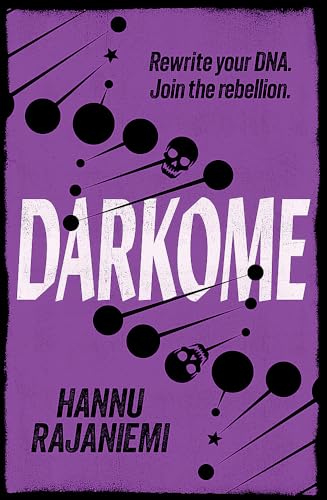
Darkome by Hannu Rajaniemi

Gollancz, 2024, 252 p. Reviewed for ParSec 12.

The book is set in the near future, after a series of disasters known as the Decade of Plagues. Most people now have an ASPIS chip, a miniature mRNA factory capable of immunising against viruses as they appear. The price is your bodily chemistry, and anything that affects it, is known to the authorities. Another apparently universally used technology is a device known as Eyes, a sort of superannuated smart phone, head worn – but can also be hand held – goggles of a sort, allowing internet contact, and blink-activated. These are treated as unremarkable, everyday objects.

Our protagonist Inara has been living in The Harbour, one of a number of Darkome villages, a network of conscientious objectors to the big-tech likes of ASPIS, where people live off-grid and construct their own anti-viruses. Like all women in her extended family Inara has the rare Li-Fraumeni syndrome. Her body lacks the crucial protein named p53, which guards against damage to DNA and kills mutated cells. As a result, she is a tumour hotbed. At seventeen she has fought cancer twice and bears the scars to prove it. Her mother had been trying to find a cure but failed and died of a brain tumour. Inara is trying to carry on the work using her mother’s cells as test subjects.

This youthful not-quite idyll comes to an end when her father manoeuvres her into enrolling in an ASPIS trial called PROSPERITY-A, which can detect pre-cancerous mutations and target them, therefore nullifying her lack of p53. Inara’s decision to comply means she has to leave The Harbour, and boyfriend Jerome.

Some while later, living in rented accommodation which she can’t afford, she discovers a lump in her breast, a lump which ought not to be there if her aspis is working properly. Somewhat unseriously, both on Rajaniemi’s and her parts, this malignancy is referred to as the Heffalump. The replacement aspis she requests also quickly malfunctions and she slowly realises that the Heffalump’s cells have the ability to hypermutate, and may be able to take over the aspis. Not that she knows quite how that works. Nevertheless this is an ability Darkome has been looking for, the capability of an aspis-jailbreak.

Her discovery kicks the story into thriller mode as Inara seeks to alert Darkome and bargain with ASPIS. Stepping into the lion’s den of ASPIS headquarters she finds all sorts of skulduggery occurring and mayhem arising.

The text is full of biochemical terminology which in a story like this is necessary though may be off-putting to some. But if it is, just plough through it. No harm done.

Inara is an amply engaging protagonist in a ‘it’s me against the world’ kind of way – lone hero(in)es have of course long been an SF staple. (Not so much the heroines, to be fair, at least until recently.) However, other characters can at times feel as if they are there only for her to react against. But this is in the end a thriller. The form demands that sort of thing.

Normally the presence at a book’s end of the phrase TO BE CONTINUED (in those capitals) might have felt something of a let-down. Inara’s story and situation are, though, intriguing enough to welcome the thought of being reacquainted.

The following did not appear in the published review.

Pedant’s corner:- “in vitro” (possibly an uncopy-edited authorial instruction to italicise. In the old days before word-processors, underlining took that function. in vitro, then, which did appear later,) “there was no way for two Aspises fail on me in a row” (for two Aspises to fail on me,) “a mRNA drug” (since the letter ‘m’ is pronounced as beginning with a vowel this would more naturally be spoken as ‘an mRNA drug’,) “‘to cover these, ,’ he said” (no need for the extra space and comma.)  “‘Aaaand there is’” (no idea why this is represented as an extended ‘ah’ sound,) “Ca2+ channels” (Ca2+,) zmey (elsewhere zmey,) “drivers’ licences” (driving licences, please.)


Nordic Visions. The best of Nordic speculative fiction, edited by Margrét Helgadóttir

Solaris, 2023, 339 p.   Reviewed for ParSec 12.

This is a collection of fiction of mostly fantasy stories, perhaps in keeping with Nordic traditions but there is a sprinkling of Science Fiction. They are split almost equally between translations and stories which first appeared in English, though they do contain a surprising number of Scottish terms. None of them would appear out of place in any speculative fiction anthology though, in most, character or place names display their provenance.

The book’s contents are ordered by the authors’ countries of origin.

Sweden:

She by John Ajvide Lindqvist, translated by Marlaine Delargy from the Swedish, Hon, has an epigram from Nathan Wahlqvist to the effect that “a haunting is dependent on a series of highly unlikely coincidences,” and so inherently rare. This tale of the haunting of a house newly built on the site of an older one relies on the facts that the owners, a couple trying to embark on parenthood, sourced its materials on the cheap and the grandfather of one of them had done wrong in the past.

Lost and Found by Maria Haskins, translated from the original, Vindspår, by the author tells of the mental disintegration of the survivor of a crashed escape pod from a ship surveying exoplanets for possible terraforming. Or was there really something out there?

Sing by Karen Tidbeck is set on a planet whose human inhabitants are strangely affected by the rising and setting of the system’s moons. Most can sing when a particular moon is up but our narrator can’t. She is also physically impaired and hence not fully part of the society. A visitor finds the planet’s parasitic ecosystem strange and is shocked by the method through which the singing is acquired.

Denmark:

The False Fisherman by Kaspar Colling Nielsen, translated from the Danish Den falske fisher by Olivia Lasky, concerns a man who did not take up fishing till he was over forty but nevertheless gets himself all the correct gear. He never catches anything (apart from one whopper.) This story could quite easily be read as having no speculative content at all – except for perhaps one sentence.

Heather Country by Jakob Drud is set in a world after what is always referred to as the impact, in a Jutland run by the NeuroClan a pair of whose investigators (both mortgaged to the Clan’s system of debt of body parts) stumble across a threat to the production of fuel from the local genetically modified heather.

The Traveller Girl by Lene Kaaberbøl, translated from the original, Rakkerstøsen, by the author, again has only a tangential relationship to the speculative. A man hoping to inherit land by marrying the landowner’s daughter is startled by the humanity he finds in the gypsy girl he encounters one day. Her group comes there so that their horses’ foals may be born on land that confers on them strength, sturdiness and speed.

The Faroe Islands:

The Abyss by Rakel Helmsdahl, translated from the Faroese, Dýpið, by Marita Thomsen, as a story, seems to be a metaphor for Limbo as our narrator climbs up and down and traverses across a never-ending series of iron bars too rigid and close-set to pass through, before deciding to fall into the abyss of the title and further adventures.

Iceland:

The Dreamgiver by Johann Thorsson. A child’s nightmares are relieved by a dreamcatcher hung up by her bedroom door. One night when our narrator, the child’s mother, carries out the daily task of emptying it she is startled by the Dreamgiver, who is not best pleased that his dreams are being discarded.

Hamraborg Babylon by Alexander Dan Vilhjálmson. Translated from the Icelandic Sódóma Hamraborg by Quentin Bates.

This Hamraborg is a tower dominating its city, Kópavogur. A woman penetrates its nightmarish depths in search of her brother. The story doesn’t quite deliver on the promise of its first two pages.

Norway:

As You Wish by Tor Åge Bringsværd. Translated from the Norwegian Som du Vil by Olivia Lasky. Brageson works in Mine-Blue 4 on the planet Nova Thule where the company provides all its workers with an idunn. Created from local crystalline sources these are not-quite-android simulacra of women with a highly developed sense of imitation. Their signature question is, “How do you want me?” –  a question which haunts Brageson as he struggles to accept his idunn’s presence in his life.

The Cormorant by Tone Almhell has more than a few similarities to Scottish Folk Tales. Not surprising really, given the same harsh northern climate, the salience of fishing as a means of earning a living and the overbearing presence of the sea. The story sets its stall out early when the narrator says she is a cormorant and if she spreads out her wings death will follow. She has been brought up without her father, who had mysterious origins anyway, and lives with her secretive mother on an island across a stretch of sea from the town of Grip. The townspeople view both her and her mother with suspicion. Possibly with good reason.

The Day Jonas Shadowed His Dad by Thore Hansen. Translated by Olivia Lasky. Jonas, whose mother has died, is intrigued by the vagueness with which his father describes his work, so decides one day to follow him. In a cottage in the woods he descends into a tunnel which leads to somewhere brighter and, to Jonas, more intriguing. Overall, though, this is a little underwhelming to regular readers of SF and Fantasy.

A Lion Roars in Longyearbyen by Margrét Helgadóttir. Global warming and migration have led to Longyearbyen becoming a destination city for its December light festival. One of the (unheard number of two) lions in its zoo – thought to be the last actually born in the wild – has gone from its cage. In the midwinter darkness a human hunter prepares to stalk it.

Finland:

A Bird Does Not Sing Because It Has an Answer by Johanna Sinisalo. A human monitors an extremely slow moving avatar suit overseeing the nesting site of a pair of (by now incredibly rare) flycatchers while not being supposed to intervene in natural processes. In the meantime, Central’s coordinating AI is decoding the meanings of birdsong. The story’s last word is devastatingly apposite.

Elegy for a Young Elk by Hannu Rajaniemi. In a world where most humans have disappeared into some sort of upload heaven, once and would-be poet Kosonen roams the woods with his talking bear Otso. Both like booze. He is visited by an avatar of his former wife who wants him to retrieve an object which fell into a firewalled city dominated by plague gods. Their lost son also happens to be in there.

The Wings that Slice the Sky by Emmi Itäranta. Translated from the Finnish Taivasta silpovat sivet by the author. Judging by the Author’s Note this seems to be a take on the Finnish epic Kalevala. Louhi, a woman with magical powers, marries into the well to do family which lives in Pohjola in the north. One day she rescues a shipwrecked man from the south and nurses him back to health. In return for a horse to take him back south she asks for a Sampo, a device which will ensure Pohjola will never again want for anything. The bargain is also to include one of her daughters. He sends a blacksmith to forge the Sampo but he in turn spreads the fact of Pohjola’s existence and soon many visitors arrive. Men being men – even (especially?) with magical powers – things don’t end well.

The following did not appear in the published review.

Pedant’s corner:- some of the translations are into USian. Otherwise; Fin (Finn.) “None of these alternatives were appealing” (‘None …. was appealing’ and, strictly, there can be only two alternatives, not three,) “hockey cards” (being set in Sweden these would more likely be ‘ice hockey cards’,) Janosz’ (Janosz’s,) laying (x 2, lying,) “a wee bit of sarcasm” (a wee bit? The author must have spent time in Scotland.) “None of them were armed” (None … was armed.) “The only movement along its streets were those of plastic bags and battered tin cans” (The only movement … was …,) “to such a prophesy” (prophecy,) smothes (smooths,) Douglas’ (Douglas’s,) “the less electromagnetic emissions the better” (the fewer … emissions the better.) “She sat down …and swung its legs” (either, ‘It sat down …and swung its legs’ or, She sat down …and swung her legs’,) sprung (sprang.)

 

More Reviews

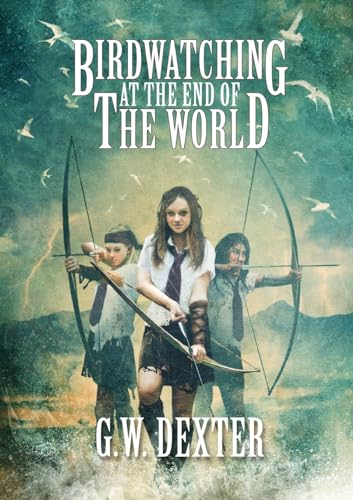
Hot off the presses and to be read for ParSec, come Birdwatching at the End of the World by G W Dexter – a post-apocalypse novel with a twist – and Darkome by Hannu Rajaniemi, seemingly another post-apocalypse novel this time in a world of multiple pandemics where an implantable mRNA vaccine factory will protect you from new viruses.

The twist in Birdwatching at the End of the World is that the survivors are the pupils of a girls’ school located on an island. The pitch writes itself.

Hannu Rajaniemi I know. He used to be part of the same writers’ group as I was before his day job as a microbiological researcher took him to the USA. His expertise in the field will doubtless lend authenticity to his story. I have reviewed several of his books already; here, here, here, and here.


Nordic Visions

I happened to be in my local library the other day. The good lady and myself were looking at the new books section when she said, “What is speculative fiction?”

“SF and Fantasy,” I replied, “Why?” and she pointed out to me a book called Nordic Visions and subtitled The Best in Nordic Speculative Fiction edited by Margrét Helgadóttir.

As well as the editor herself I recognised the names of the three Finns who have contributed, Hannu Rajaniemi, Johanna Sinisalo and Emmi Itäranta (here and here.)

I of course borrowed it on the instant.

Despite its publication date of 2023 and any review of it not going to be timely I offered my review to Ian Whates at ParSec magazine.

He accepted and as a consequence the review will not be appearing on here for some time.


SF Bookshelf Travelling for Insane Times (ii)

Large SF paperbacks this week for Judith’s meme at Reader in the Wilderness.

I keep these in an old music cupboard I inherited from my great-uncle. I’ve got so many of these they have to be double-parked, so you can’t actually see the first and third shelves shown here when the cupboard is opened. Stacking some on their sides gives me an extra 4 cm of space. Click on the photos to enlarge the pictures.

These include a J G Ballard, Iain M Banks, Chris Beckett, Eric Brown, Ursula Le Guin and Ian McDonald:-

Large Science Fiction Paperbacks (i)

Annoyingly, even these large paperbacks do not all come in one size. The upright ones to the right here are smaller than the previous books. More McDonald, Tim Powers, Kim Stanley Robertson, Adam Roberts, Hannu Rajaniemi, a lesser Robert Silverberg, Kurt Vonnegut:-

Large Science Fiction Paperbacks (ii)

More Ballard, Banks, Beckett and Brown. Lavie Tidhar, Neil Williamson and another step down in size:-
Large Science Fiction Paperbacks (iii)

John Crowley, M John Harrison, Dave Hutchinson, Stanisław Lem:-

Large Science Fiction Paperbacks (iv)

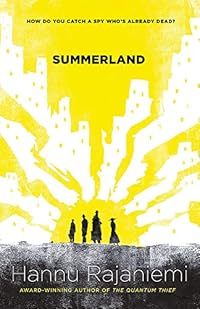
Summerland by Hannu Rajaniemi

Gollancz, 2018, 328 p.

I had scheduled this post to appear when I was away but for some reason only the title appeared. I’ve now binned that one. Here’s the full version.

 Summerland cover

Rajaniemi’s first few novels were fairly dense narratives where not much concession by way of information dumping was made to the reader who in consequence was forced to do a bit of work in following their stories. As an approach this had its merits, as the rich, layered depths revealed themselves slowly and made for a more enriching read. By contrast Summerland has a more common narrative structure with no corresponding demands on the reader beyond suspension of disbelief. Given its timeline it could be classified as an Altered History but the milieu it depicts is really not one for which that description could fully apply being more sui generis.

Sometime towards the turn of the nineteenth and twentieth centuries radio experiments led to contact with the world of the dead. Now a whole system of communications – via ectophone and ectomail – exists between the realms, the Queen rules from what is called Summerland, the Great War was won with the aid of ghastly apparitions like the ectotank, but still a kind of cold war exists between Great Britain and the USSR. Transition between the realms (ie death) is mediated via Tickets which provide a destination for a departed soul. Without a Ticket a dead person is subject to Fading as their soul evaporates away. This will also happen even to those who had a Ticket unless sufficient suffusions of a substance known as vim occur.

The book is set over several months in late 1938 and January 1939. There is no Nazi threat but renegade from the USSR and its own Summerland god engine, Iosef Dzhugashvili, is fomenting trouble in Spain.

Rachel White is an operative of the British security services entrusted with the protection of a Soviet defector. After telling her of the existence of a mole called Peter Bloom, he blows his brains out. Her report of this revelation to her superior is greeted with dismissal, her gender being seen as making her an obvious target for an attempt to foment suspicion and distrust. Bloom, is, however, known to be close to the Prime Minister, Herbert Blanco West (whose mere name is enough to trigger associations in the reader even before we learn of his past as a draper’s apprentice who had dreams of Martian invasions and invisible men.) Similarly Rajaniemi has a bit of fun in slotting in the likes of Guy Burgess, Kim Philby and Anthony Blunt as minor characters in his tale.

The plot then consists of the usual kind of spy story albeit complicated with interferences from the spirit realm whose denizens can take over bodies in the “live” world on a kind of hire basis but also monitor the emotions of the undead, thus making it difficult to lie to them. The tale is however – unusually for a spy story – told from the viewpoint of the spy, Bloom, as well as the would-be spycatcher, Rachel.

The existence in the realm of the dead of shadowy entities called Cullers who will leap on any detected activity in the zone and pounce to ensure its inhabitants will Fade is not made much of in Summerland whose text is mainly Earth-bound and taken up with White’s efforts to prove Bloom is a spy. There is slightly more to Rajaniemi’s story than this but its appeal lies in the idea of a parallel world of the dead and its ability to interact with the ‘real’ world rather than the plot it contains.

Pedant’s corner:- I read an advanced reading copy so many of these may have been changed for final publication. “could really use a person of your calibre” (the British English for this is ‘could really do with’,) “desk a parking lot for memos” (again, ‘parking lot’ is not British English,) “lay low” (lie low,) “none of the security measures were enough” (none … was enough,) “there were a number of small glass vials” (there was a number,) “ we have a bloody mess in our hands” (on our hands,) a missing full stop at a sentence end (x2,) “she lunched with the junior staff with the canteen” (in the canteen,) “more spare time in my hands” (on my hands,) a missing start quotation mark, ”she managed slur the words” (to slur,) “in the in the” (one ‘in the’ too many,) prime minister (x2, Prime Minister,) “reached a crescendo” (a crescendo is a process, not a culmination; ‘reached a climax’, Crookes’ (Crookes’s,) “gift of gab” (gift of the gab,) “‘the benefit of doubt’” (the benefit of the doubt,) “I could use a little flattery’” (I could do with a little flattery,) “‘I just I can’t help you’” (an ‘I’ too many,) “a fearsome, feathered hat” (doesn’t need that comma,) “‘Say, do you see….’” (No English Oxford student would start a question with ‘Say’. ‘I say’, perhaps, but not ‘Say’,) “Peter let go of the drainpipe caught the roof’s edge” (and caught,) “‘you do this it a lot’” (no need for the ‘it’,) “folded his lanky frame into his bench in with great difficulty” (no ‘in’ required,) a missing end quotation mark, “the groans of the old coach” (‘the old couch’ makes more sense,) “times ten” (multiplied by ten,) “‘what are you going ty do next.’” (Is a question so needs a question mark rather than a full stop,) Djugashvili (x3, elsewhere Dzhugashvili,) “Leading up her bar exam” (up to her bar exam,) “‘setting up a meet’” (a meeting,) Symonds’ (Symonds’s,) “rode in their wake of as they pushed their way” (‘in their wake as they pushed’,) dove (dived. Please,) “‘I could, in fact, use some advice’” (I could, in fact, do with some advice,) Rache (elsewhere always Rachel,) “the men’s room” (the gents,) maw (it’s a stomach, not a mouth,) “the car’s hood” (the car’s bonnet,) “on a chair in cell” (in a cell.)

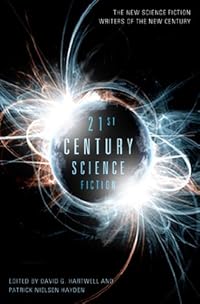
Twenty-First Century Science Fiction edited by David G Hartwell and Patrick Nielsen Hayden

Robinson, 2013, 572 p. Borrowed from a threatened library.

 Twenty-First Century Science Fiction cover

The book cover and spine has 21st Century but the title page Twenty-First Century. The editors choices were made from those writers whose rise to prominence came after 1999 – in a world where they say SF is no longer marginal but a part of the cultural landscape. So to the stories.

In Vandana Singh’s Infinities Abdul Karim is fascinated by mathematics. Visions of beings he calls farishte and sees out of the corners of his eyes lead him to ponder the variety of mathematical infinities and the intersection between transcendental numbers and primes. But life wears him down and his glimpse of the connections does not mesh with the troubles of a divided India. Rogue Farm by Charles Stross is set in a depopulated future and features trees which can store nitrate (effectively making them rockets/bombs) and collective farms composed of several people melded into some sort of tank-like vehicle. I know it was originally published in a US magazine but it’s located in Cumbria yet not only the prose but also the dialogue – with a few exceptions – was written in USian. The exceptions were some unconvincing “ayup”s and a sudden splattering of “Northern” speech in the second last paragraph.

Paolo Bacigalupi’s The Gambler sees an exiled Laotian struggle to get enough click-bait on his news stories, Neal Asher’s Strood features more or less beneficent invading aliens and their pets, which have unusual eating habits. In Eros, Philia, Agape by Rachel Swirsky, Adriana seeks love from and marries a robot called Lucian. Things go wrong when she lets Lucian have free will and their adopted daughter begins to believe she’s a robot. “The Tale of the Wicked” by John Scalzi is an updated version of Asimov’s Three Laws of Robotics stories when the brains of two spaceships in a hot pursuit start to communicate. Bread and Bombs by M Rickert is a post-apocalypse, post twin towers, tale where no-one travels by air, indeed any sighting of an aeroplane is accompanied by fear, and outsiders are treated with suspicion.

Taking its inspiration from a Biblical text and the Uncertainty Principle, Tony Ballantyne’s The Waters of Meribah is set in a universe shrunk to only tens of miles across where a group of scientists is engaged in a bizarre experiment to create an alien in order to break out again. Tk’Tk’Tk by David D Levine features the experiences of a hereditary salesman on a planet inhabited by excessively polite aliens. He comes to an epiphany, as you do. Genevieve Valentine’s The Nearest Thing is the closest to a human an artificial entity can get but the process is neither morally nor emotionally simple for its software designer. In Ian Creasey’s Erosion the comparison evoked by its title is perhaps a touch over-egged in his tale of an augmented human about to leave for the stars out for a last hike along the North Yorkshire coast. Marissa Lingen’s The Calculus Plague tells of the beginnings of transfer of memories by viral infection. One of our Bastards is Missing by Paul Cornell is set in a future where early eighteenth century Great Powers have lasted into the space age, the balance of power is kept steady but they still plot against each other.

A damaged war machine, the last of its platoon, roams the seashore in Elizabeth Bear’s Tideline, collecting material to make memorial necklaces for the fallen. Finistera by David Moles is set on a giant planet with a nitrogen-oxygen atmosphere where floating creatures as large as mountains form homes for people and exploitable resources for the less scrupulous. In Mary Robinette Kowal’s Evil Robot Monkey an augmented chimpanzee wants only to make pottery; but humans – especially schoolchildren – remain humans. The junior of The Education of Junior Number Twelve by Madeline Ashby is the twelfth offspring of a kind of self-replicating android, designed so as not to allow harm to humans. They make perfect lovers though. Even if humans themselves remain as messed up as ever. Toy Planes by Tobias S Buckell sees a Caribbean island join the space-faring nations. Ken Liu’s The Algorithms of Love is curiously reminiscent of Flowers for Algernon in its tale of a designer of truly interactive dolls coming to believe she herself, and all humans, are merely reacting to inbuilt instructions. The Albian Message by Oliver Morton speculates on just exactly what is contained in a pyramid left by aliens in the Trojan Asteroids hundreds of millions of years ago while Karl Schroeder’s To Hie From Far Cilenia supposes layers of “cities” – or at least organised groupings of people – only existing in a kind of online virtual reality parallel to the real world. Brenda Cooper’s Savant Songs is about the search by a brilliant (but socially awkward) female physicist for her counterparts in the multiverse of worlds. Ikiryoh by Liz Williams is reminiscent of Le Guin’s The Ones Who Walk Away from Omelas in that the eponymous child is the repository of all the darkness that would otherwise be present in the goddess who rules. The Prophet of Flores by Ted Kosmatka is set in a world where Darwinism was disproved in the 1950s by dating techniques. Yet on the Indonesian island of Flores unusual bones have been discovered in a cave. The protagonist’s conclusion sticks neatly to the logic of his world.

According to Catherynne M Valente’s How to Become a Mars Overlord each solar system has its own Red Planet and the author provides a stepwise guide to its overlordship but the piece overall is less of a story than a disquisition. In Daryl Gregory’s Second Person, Present Tense Therese has taken an overdose of a drug called Zen, which alters her persona. Her parents don’t accept this. Third Day Lights by Alaya Dawn Johnson features a shape-shifting demon and a human looking for the afterlife of the afterlife. James L Cambias’s Balancing Accounts has a robotic/AI protagonist plying a living for its owners by trading in the Saturn system. An unusual cargo brings problems. A Vector Alphabet of Interstellar Travel by Yoon Ha Lee is another disquisitive story about various different cultures’ star drives. Hannu Rajaniemi’s His Master’s Voice stars a dog (and, yes, it’s called Nipper) seeking the return of its master who has been “condemned to the slow zone for three hundred and fourteen years” for illegally producing copies of himself and, since Rajaniemi sojourned for a while in Edinburgh, could just perhaps have been inspired (a bit) by the tale of Greyfriars Bobby. Plotters and Shooters by Kage Baker is set on a space station dedicated to spotting and destroying Earth threatening asteroids. The station’s hierarchies are disrupted by a new arrival. In The Island by Peter Watts a never-ending mission to seed the universe with jump gates threatens the existence of a millimetre thin organism surrounding its sun like a gossamer Dyson sphere. Escape to Other Worlds With Science Fiction by Jo Walton is set in a world where not only did the New Deal fail but the Second World War did not occur as we know it. By 1960 the US is becoming fascistic. Cory Doctorow’s Chicken Little posits a future where the rich are utterly cut-off from even the wealthy but a drug called Clarity can enable true assessment of risk to take place.

On the whole, strong stuff. There is enough here to suggest that SF is a vigorous culture still.

Pedant’s corner:- “the cluster of competing stories are growing” (the cluster is growing,) metastized (metastasised – I have also substituted s for the USian z,) remittance (remission,) minutia (minutiae,) her sisters’ ability to overcome her fear of their father (their fear?) rung (rang,) “I hate to come out of that jump (I’d hate to,) none of the …. have (none has,) a they as an antecedent to an it, and the killed (and killed,) the architecture of the brains are different (the architecture is different,) a yearning gap (the context suggests yawning gap,) “where his regiment were dining” (his regiment was dining,) a Queen Mother is addressed as “Your Royal Highness,” (I suspect that would still be, “Your Majesty,”) “the Queen Mother’s Office are asking” (is asking,) “the unit are still in the fold” (is still in the fold,) the start quote mark is omitted at a story’s beginning, stripped off (stripped of,) Becqurel Reindeer (they are radioactive, so I presume Becquerel,) borne (born,) Hitchens’ (Hitchens’s – which is used later,) jewelery (the USian is jewelry, in British English it’s jewellery,) the total affect (the noun is effect,) goddess’ (goddess’s, which is used 12 lines later!) equilibriums (equilibria,) Deluvian Flood Theory (Diluvian? – which means flood, so is this Flood Flood Theory?) “Hands were shook” (shaken,) a phenomena (phenomena is plural; one of them is a phenomenon,) “It’s the circulating domain of their receptors that are different” (is different,) sunk (sank,) rarified (rarefied,) talk to the them (no “the”,) none of us get (gets,) aureoles (context suggests areolae,) “that whole series were built” (that series was built,) “a great deal of time to attempting” (no need for the “to”,) “The chained aurora borealis flicker and vanish,” (if its one aurora borealis that should be “flickers and vanishes”; otherwise it’s aurorae boreales.) “We sweeped over the dark waves,” (I think that really ought to be “swept”,) hemi sphere (hemisphere,) the Van Oort belt (a confusion of Oort Cloud with Van Allen Belt?) infered (even USian surely has inferred?) borne of parents (born of; definitely born of.)

New Book: The Fractal Prince

Last Thursday I attended the launch of fellow East Coast Writers’ Group and Writers’ Bloc member Hannu Rajaniemi’s second novel The Fractal Prince. I reviewed his first novel The Quantum Thief for Interzone. Hannu made a reading from the new book and was interviewed by another Group and Bloc member Andrew Ferguson before the floor was opened for questions.

The reading was enthusiastically received and Hannu’s thoughts on translation and the way his Finnish origins are reflected in his writing were interesting. It seems he has a Finnish self – with family and friends back home – and an English (speaking) self in his day to day life in Edinburgh. The Finnish translation of The Quantum Thief, not carried out by him, apparently read like his “English” self.

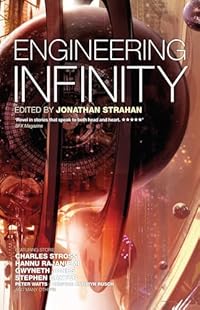
Engineering Infinity edited by Jonathan Strahan. (Solaris, 2010.)

Reviewed for Interzone issue 233, Mar-Apr 2011.

Engineering Infinity cover

According to Strahan’s introduction this anthology is a collection of stories roughly categorisable as hard SF, adding the disclaimer that the term is now a slippery concept hence the stories are inevitably broader in scope than might once have been implied. Whatever his claim that they all invoke the sense of wonder, most exhibit a tendency to be didactic in their narrative styles.

The tone is set early with “Malak” by Peter Watts, the tale of an unmanned airborne war drone that learns from its experiences.

Kristine Kathryn Rusch’s “Watching the Music Dance” deals with the effect of enhanced abilities for children on their dependency and psychological development.

The ghosts of the Soviet space programme are being made real in “Laika’s Ghost” by Karl Schroeder, mainly set in the former cosmodrome in Kazakhstan.

Stephen Baxter’s “The Invasion of Venus” is peculiar in that everything that happens, including the disappearance of the planet Neptune, occurs off stage. Apt, in that humans, and Earth, are of no consequence to the eponymous invaders.

Hannu Rajaniemi’s “The Server and the Dragon” has an intergalactic AI on some inscrutable purpose creating a baby universe as its plaything before being suborned and consumed by a message packet it receives. Extremely dry in the telling, a knowledge of quantum physics and cosmology might be advantageous here.

Charles Stross’s “Bit Rot” is a generation starship type story where the ship is “manned” by cyborgs who are suffering the deleterious aftermath of a gamma and cosmic ray burst. Stross references Tom Godwin’s “The Cold Equations” but overall the story is more reminiscent of John Wyndham’s “Survival.”

In “Creatures with Wings” by Kathleen Ann Goonan the remnants of humanity eke out their lives in what could almost be a zoo which the protagonist leaves to achieve enlightenment. Though Goonan tries to finesse it the story has too large a disjunction when these survivors are taken from Earth by the creatures of wings of the title.

“Walls of Flesh, Bars of Bone” by Damien Broderick & Barbara Lamar is the story from which the collection’s title may have sprung. A man sees himself on a film shot in 1931. The story moves on swiftly to become a concoction of quantum entanglement, self-interference of particles, Bayesian probability, spatial displacements and time travel.

Robert Reed’s “Mantis” concerns the realness (or otherwise) of our experiences and how to tell whether or not we live in stories. The SF gloss involves two way CCTV type screens called infinity windows.

The title of John C Wright’s “Judgement Eve” evokes Edgar Pangborn but unfortunately Wright is no Pangborn. The story, involving angels and Last Judgement, aspires to the condition of myth or Biblicality. As a result the “characters” become cyphers, the prose overblown, the dialogue bombastic and syntactically archaic.

In “A Soldier of the City” by David Moles the eponymous soldier volunteers for the revenge attack on the habitat of the terrorists who attacked his city and killed the goddess whom he loved.

The somewhat loopy protagonist of “Mercies” by Gregory Benford, made rich by inventing a logic for constructing unbreakable codes, invests in and then uses quantum flux technology to “jogg” to nearby timelines in order to execute serial killers before they set out on their sprees; thus becoming himself the object of the same fascination.

In Gwyneth Jones’s ”The Ki-Anna” a man travels to a distant planet to discover the circumstances surrounding his sister’s death and encounters the obligatory strange and disturbing ritual practices.

John Barnes’s “The Birds and the Bees and the Gasoline Trees” features a humaniform who has swum Europa’s oceans and stridden the beds of Titan’s methane seas unravelling the unforeseen consequences of humans trying to offset climate deterioration by seeding Earth’s Southern Ocean with iron from meteorites.

Hard SF? Sense of wonder? In an uneven collection a few stories fail to hit these marks. Enough do, though.

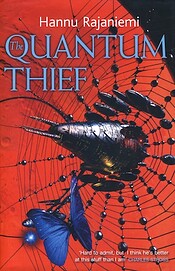
The Quantum Thief by Hannu Rajaniemi.

Gollancz, 2010. Reviewed for Interzone, issue 230, Sep-Oct, 2010.

Rajaniemi’s pacy debut novel is set in a far future where both Jupiter and Phobos have been turned into suns in the aftermath of a war between the godlike Sobornost, who control most of the inner solar system, and the Zoku, now exiled to Mars from their Saturnian home.

On Mars all off-world tech is proscribed. The city called the Oubliette is constantly on the move, built on platforms which change their relative position as it is carried across Hellas Basin on vast articulated legs. Rajaniemi does not fetishise this creation as many another author would. Far from being almost a character in its own right the city is merely an exotic backdrop for his story, not its focus.

In the Oubliette, interactions between people (and buildings) are mediated by technology known as exomemory which captures every thought, dream and action. A filtering system known as gevulot acts as a privacy screen but is opened for speech and donation of information packets called co-memories.

The city’s inhabitants all carry Watches which store the Time they use as money. When your Time runs out, death follows. Resurrection Men decant memories and implant them in a new body in which to serve the city as one of the Quiet till enough credit has been accrued to live normally again. On occasion criminals dubbed gogol pirates deliberately kill in order to steal the deceased’s memories and enslave the minds. This is anathema to anyone from the Oubliette (but philosophically it surely differs from being Quiet only in degree.) Tzadikkim, a vigilante-type group with enhanced powers, act as an informal police.

The narrative is shared between the first person account of Jean le Flambeur, the quantum thief of the title, and the third person viewpoints of an Oortian, Mieli, who kicks the novel off by springing Jean from an unusual prison round Saturn, and the somewhat too intuitive detective Isodore Beautrelet. Both Jean and Mieli have (rarely used) Sobornost enhancements. In addition, several Interludes fill in backstory and -ground.

The text can be dense at times. Rajaniemi deploys technological terminology with a flourish; qdots, ghostguns, qupting, Bose-Einstein Condensate ammunition, quantum entanglement rings, qubits, but these can be allowed to wash over any technophobic reader prepared to follow the flow.

By implication Rajaniemi emphasises the importance of memory, not only in the idea of exomemory or the uploading/decanting of personality but also as a component of individual identity. Jean le Flambeur has hidden his past from himself and has no recall of it until others restore it bit by bit via gevulot exchanges.

Rajaniemi’s Finnish origins are most revealed by some of the names he uses. Mieli’s spidership is called Perhonen – butterfly – and he slips in a Finnish expletive in the guise of an Oortian god. There are also borrowings from Japanese, Hebrew and Russian and a subtle Sherlock Holmes reference.

“The Quantum Thief” is bursting with ideas and there are sufficient action/battle scenes to slake any thirst for vicarious violence but sometimes it seems as if incidents are present in order to fill in background rather than being necessary to the plot. The motivations of some of the characters are obscure and despite the prominence of gevulot in the Oubliette, conversations and interactions seem to be more or less unaltered in comparison to our familiar world, though had Rajaniemi presented them otherwise they may have been unintelligible.

The denouement brings all the threads together satisfyingly while the final Interlude sheds additional light on the proceedings and sets up possible scenarios for sequels – for which there will likely be an avid audience.

free hit counter script