Archives » Lewis Grassic Gibbon

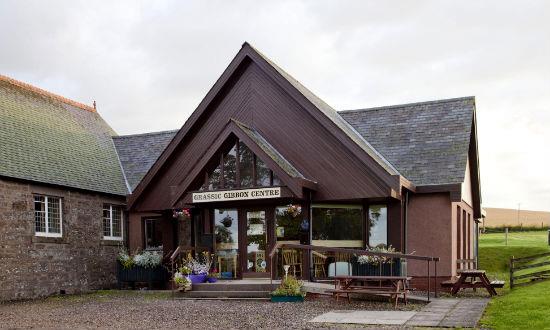
Lewis Grassic Gibbon Centre

The Lewis Grassic Gibbon Centre, dedicated to the memory and dissemination of the works of J Leslie Mitchell – better known as Lewis Grassic Gibbon – lies in the Mearns village of Arbuthnott.

Lewis Grassic Gibbon Centre

We took the good lady’s blog friend Peggy there when she was over from the States. It contains items from Gibbon’s life and memorabilia of the times he lived in.

I picked up several informative brochures, including one with pictures of the covers of the first editions of his books. The one for Stained Radiance might have caused some raised eyebrows when it was published in 1930.

We had a delightful lunch in the café at the front of the Centre before heading off to the churchyard where there is a memorial to Gibbon beside one to members of his family.

Lewis Grassic Gibbon's Memorial, Arbuthnott

War Memorial, Arbuthnott

Arbuthnott is a village in the Mearns, the area south of Aberdeen and north of Montrose.

It is most famous for being the home of writer J Leslie Mitchell (Lewis Grassic Gibbon.) Its War Memorial is on a wall of the local hall.

War Memorial Arbuthnott

In Arbuthnott graveyard there is a memorial to Lt Col Hew Blair Imrie who was killed in Normandy 1944. His name does not appear on the main memorial though.

War Grave, Arbuthnott Churchyard

100 Best Scottish Books (Maybe)

I came across this list a week or so ago. There are some odd choices in it. The Woolf and Orwell are surely pushing it a bit to qualify as in any way Scottish. And The King James Bible? Yes he was primarily a Scottish King but the endeavour was undertaken for reasons to do with his English realm.

Those in bold, I have read. There’s a lot I haven’t. Time to pull my socks up.

(Edited to add:- Those with a *I have now read.
Edited again to add:- I have added even more than these to the “have now read” list.)

John Galt – Annals of the Parish* (1821) I’ve read The Member and The Radical. See my review here.
Aonghas Pàdraig Caimbeul – An Oidhche Mus Do Sheòl Sinn (2003) This is written in Gaelic and hence beyond my competence.
Kate Atkinson – Behind the Scenes at the Museum – (1995) I read this years ago.
Ian Rankin – Black and Blue* (1997) I’ve not read this Rankin but I have Knots and Crosses.
Laura Hird – Born Free* (1999)
Tom Nairn – The Break-Up of Britain: Crisis and Neo-Nationalism (1977) Non-fiction
Frederic Lindsay – Brond (1984)
Naomi Mitchison – The Bull Calves (1947) Not a Mitchison I’ve read but I’ll need to catch up with more of her work. (As of May 2016 on tbr pile.)
Anne Donovan – Buddha Da* (2003)
Matthew Fitt – But n Ben A-Go-Go (2000) Science Fiction in Scots! Brilliant stuff.
Patrick MacGill – Children of the Dead End (1914)
AJ Cronin -The Citadel (1937) Cronin was from Dumbarton. I’ll need to read him sometime.
Frank Kuppner – A Concussed History of Scotland (1990)
Robin Jenkins – The Cone-Gatherers* (1955)
Thomas De Quincey – Confessions of an English Opium-Eater (1822)
Iain Crichton Smith – Consider the Lilies* (1968)
R. M. Ballantyne – The Coral Island (1858) I may have read this as a child but I cannot actually remember doing so.
Louise Welsh – The Cutting Room (2002) (tbr pile)
Robert Alan Jamieson – A Day at the Office (1991)
Archie Hind – The Dear Green Place* (1966)
James Kelman – A Disaffection (1989) I read years ago. Kelman is essential.
RD Laing – The Divided Self (1960) non-fiction
William McIlvanney – Docherty (1975) Again read years ago. Again McIlvanney is essential reading.
David Hume – An Enquiry Concerning Human Understanding (1748) Philosophy. I haven’t read this.
Andrew Greig – Electric Brae (1997) A superb first novel. See my review here.
Tobias Smollett – The Expedition of Humphry Clinker* (1771) Smollet was from Renton, which is 2 miles from Dumbarton.
Violet Jacob – Flemington* (1911)
Agnes Owens – For the Love of Willie (1998) See my review here.
Ian Fleming – From Russia, With Love (1957) Fleming? Scottish? Only by extraction it seems.
Dorothy Dunnett – The Game of Kings (1961) (tbr pile)
Denise Mina – Garnethill (1998) (tbr pile)
James Frazer – The Golden Bough (1890)
Nancy Brysson Morrison – The Gowk Storm* (1933)
Bernard MacLaverty – Grace Notes (1997)
George Mackay Brown – Greenvoe* (1972)
Alistair MacLean – The Guns of Navarone (1957) I read this many years ago. Decent enough wartime thriller.
J.K. Rowling – Harry Potter and the Philosopher’s Stone (1997)
Joseph Conrad – Heart of Darkness (1902) Conrad was the favourite author of the original Jack Deighton (my grandfather.) I’ve read The Secret Agent and always mean to get round to more. But… Wasn’t Conrad Polish?
John Prebble – The Highland Clearances (1963) Non-fiction
Ali Smith – Hotel World (2001) See my review here.
Arthur Conan Doyle – The Hound of the Baskervilles (1902)
George Douglas Brown – The House with the Green Shutters (1901) A Scottish classic; see my review.
Willa Muir – Imagined Corners (1931) (tbr pile)
Luke Sutherland – Jelly Roll (1998)
Chaim Bermant – Jericho Sleep Alone (1964) is on the tbr pile.
James Robertson – Joseph Knight (2003) Robertson is another of those very good present day Scottish authors. My review of Joseph Knight.
Various – King James Bible: Authorised Version (1611) ???? See comments above.
Alasdair Gray – Lanark (1981) Absolutely superb stuff. More essential reading.
Ronald Frame – The Lantern Bearers (1999)
James Boswell – The Life of Samuel Johnson (1791)
Bella Bathurst – The Lighthouse Stevensons* (1999) Non-fiction. I bought this for the good lady and it’s another I keep meaning to read.
George MacDonald – Lilith (1895) The Scottish tradition is to write fantasy rather than SF. I’ll need to catch up with this.
John Burnside – Living Nowhere (2003)
Anne Fine – Madame Doubtfire (1987)
Alan Spence – The Magic Flute (1990) I’ve read his Way to Go.
Des Dillon – Me and Ma Gal* (1995)
Margaret Oliphant – Miss Marjoribanks (1866)
Alan Warner – Morvern Callar (1995) I think Warner’s most recent books The Worms can Carry me to Heaven and The Deadman’s Pedal are more successful.
George Friel – Mr Alfred, MA (1972) (tbr pile)
Neil Munro – The New Road (1914)
William Laughton Lorimer (trans.) – The New Testament in Scots (1983)
George Orwell – Nineteen Eighty-Four (1949) I know it was written on Jura but Orwell? Scottish?
Alexander McArthur and H. Kingsley Long – No Mean City: A Story of the Glasgow Slums* (1935)
Alexander McCall Smith – The No. 1 Ladies’ Detective Agency (1998)
Christopher Brookmyre – One Fine Day in the Middle of the Night 1999) Brookmyre is a fun read – if a little too liberal with the violence. But this isn’t even his best book. See my review here.
Catherine Carswell – Open the Door!* (1920)
Andrew O’Hagan – Our Fathers (1999) I have yet to warm to O’Hagan. My review of this book.
A.L. Kennedy – Paradise (2004) Kennedy’s more recent Day and The Blue Book impressed me more.
Muriel Spark – The Prime of Miss Jean Brodie (1961) My review is here.
James Hogg – The Private Memoirs and Confessions of a Justified Sinner (1824) The quintessential Scots novel. The döppelganger tradition starts here.
Suhayl Saadi – Psychoraag (2004)
Nan Shepherd – The Quarry Wood* (1928)
Walter Scott – Rob Roy* (1818) Scott more or less invented the Scots historical novel but I can only remember reading Ivanhoe.
Thomas Carlyle – Sartor Resartus (1836) Anothe disgraceful omission on my part I fear.
Toni Davidson – Scar Culture (1999)
Margaret Elphinstone – The Sea Road (2000) I’ve read Elphinstone’s A Sparrow’s Flight and The Incomer; but not this. (tbr pile)
Jimmy Boyle – A Sense of Freedom (1977)
George Blake – The Shipbuilders (1935) (tbr pile)
Gordon Williams – The Siege of Trencher’s Farm (1969)
Neil M Gunn – The Silver Darlings* (1941) Of Gunn’s work I recently read The Well at the World’s End.
Ron Butlin – The Sound of My Voice (1987) I’ve not read his poetry but Butlin’s fiction is excellent. My review of The Sound of my Voice.
Robert Louis Stevenson – The Strange Case of Dr Jekyll and Mr Hyde* (1886) Following on the döppelganger tradition from Hogg. Again I can’t remember if I’ve read it or just watched adapatations on TV.
Jeff Torrington – Swing Hammer Swing! (1992)
Lewis Grassic Gibbon – Sunset Song (1932) A brilliant novel. Worth its status as a classic. See my thoughts here.
John Buchan – The Thirty-Nine Steps* (1915)
Virginia Woolf – To the Lighthouse (1927) (tbr pile)
Irvine Welsh – Trainspotting (1993)
Janice Galloway – The Trick is to Keep Breathing (1989) I fear Galloway is an acquired taste. See here.
Jackie Kay – Trumpet (1998) I read this last year.
Christopher Rush – A Twelvemonth and a Day* (1985)
Michel Faber – Under the Skin (2000)
David Lindsay – A Voyage to Arcturus (1920) In the Scots tradition of the fantastical but has a weirdness all its own.
Iain Banks – The Wasp Factory (1984) The much lauded Banks debut. I’ve come to think A Song of Stone may outrank it.
Adam Smith – The Wealth of Nations (1776) The foundation stone of Economics.
Compton Mackenzie – Whisky Galore (1947) (tbr pile)
Jessie Kesson – The White Bird Passes (1958) To be reviewed within the week!
Kenneth Grahame – The Wind in the Willows (1908) I may have read this as a child but can’t honestly remember.
Alexander Trocchi – Young Adam* (1954)
James Kennaway – Tunes of Glory (1956) (tbr pile)
John Gibson Lockhart – Adam Blair (1822) (tbr pile)

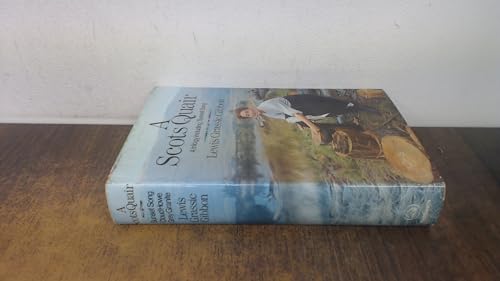
Grey Granite by Lewis Grassic Gibbon

In “A Scots Quair,” Hutchinson, 1966, 156 p. First published 1934.

A Scots Quair cover

After the form of Sunset Song and Cloud Howe, the previous books in Gibbon’s A Scots Quair trio, the text of Grey Granite is divided into four sections, here named after semi-precious stones, Epidote, Sphene, Apatite and Zircon, though unlike its predecessors there is no prelude, proem nor epilude in Grey Granite.

Following the death of her second husband Robert Colquohoun – whose last action to shock his ex-parishioners was to have himself cremated – Chris Guthrie has used what money remains to her to move from Segget and take a half share in a boarding house in the city of Duncairn. [An authorial note at the start informs us this name is amended from the author’s first choice Dundon, since early reviewers in English journals were mistaken in thinking it represents Dundee, nor yet (though it has a Cowgate, a Canongate and a Royal Mile) is it Edinburgh as an American newspaper had it, nor even – notwithstanding its granite buildings – is it Aberdeen (two Scottish sheets) but the city which the inhabitants of the Mearns have hitherto failed to build.]

It is perhaps this setting that makes Grey Granite seem less grounded than the previous two novels in A Scots Quair. While Gibbon’s descriptions of the industrial cityscape are fine they do not have the lyricism of his evocation of rural landscapes. Indeed it is notable that when the story breaks the bounds of the city the writing lifts. But in his defence here Gibbon certainly cannot do without Duncairn. It is absolutely necessary in a novel sequence about modern Scotland (as he was essaying) to encompass the industrial habitat in which most Scots live. And this is only a criticism in the context of Sunset Song and Cloud Howe. Taken on its own Grey Granite would stand as a fine mid-twentieth century Scots novel.

Another factor contributing to Grey Granite’s relative lack of force is the focus moving from Chris to her son Ewan. He is drawn into socialism after taking a job in a metal works which later gains an arms contract. He organises a subsequent strike and is arrested and beaten up by the police. It seems that police accounts of incidents diverging somewhat from what actually happened are never new. In addition, Ake Ogilvie, who had also come from Segget to work in Duncairn, opines, “there was as much graft in the average Scots toun as in any damn place across the Atlantic.”

Once again there is the shifting of narrative viewpoint familiar from Sunset Song and Cloud Howe, by which the Rev MacShilluck for example is well drawn; in a few devastating paragraphs scattered through the book. The text is of its time in some of its references: “psychoanalyst Jewboy chaps” reads shockingly today.

Her business partner, Ma Cleghorn, tells Chris there’s nothing worse than “some old runkle of a woman body living on with no man to tend and no bairns.” As to men, “(they) never live at all. They’re just a squeeze and a cuddle we need to keep our lives going. They’re nothing themselves.” Ewan himself thinks, “A hell of a thing to be History! …. LIVING HISTORY ONESELF.” His treatment of Ellen Johns, a teacher who lodges in the boarding house and helped Ewan along the socialist path is in the end less than gallant. Chris had warned her, though, as we were forewarned in Cloud Howe.

Chris certainly does not have her troubles to seek. Ma Cleghorn dies, Chris contracts a misguided and doomed marriage with Ake Ogilvie, who is instrumental in effecting Ewan’s release from prison. She muses that, “SHE HAD NOTHING AT ALL, she had never had anything, nothing in the world she’d believed in but change… Nothing endured,” and, “We’re all on leading strings out of the past.” She tells Ewan, “The world’s sought faith for thousands of years and found only death or unease in them.” He replies, “It’s the old fight that maybe will never have a finish…. The fight in the end between FREEDOM and GOD.”

On reflection, and after rereading passages, my initial feeling that Grey Granite was not quite at the level of Sunset Song and Cloud Howe may be a touch harsh. It’s a fitting enough conclusion. As Chris comes full circle, “She’d open her eyes and see only the land, enduring, encompassing.”

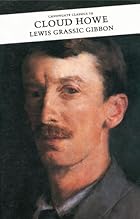
Cloud Howe by Lewis Grassic Gibbon

In “A Scots Quair,” Hutchinson, 1966, 156 p. First published 1933. The cover shown is of a Canongate edition.

Cloud Howe cover

Cloud Howe takes up the story of Chris Guthrie from Sunset Song at the point where her new husband, Minister Robert Colquohoun (strange spelling that, Colquhoun is more usual,) is about to try for the vacant post in the parish of Segget, still in the Mearns and not far away from the Kinraddie of the earlier book. Segget is a divided community, not to mention class ridden and status conscious, with the folks in the old part of town despising the spinners who work in the jute mills. Robert’s self-imposed mission there is to improve Segget. On their first walk in Segget Robert, gassed in the Great War, is horrified by Segget’s War Memorial, an angel set on a block of stone, “like a constipated calf.”

The story unfolds over the 1920s, covering almost incidentally the growth of socialism – and its first betrayal – the (lack of) industrial relations, the grinding poverty, the insensitivity of the rich. The narrative voice is not straightforward, shifting, but not obtrusively, back and forth from a tight focus on Chris – or on occasion someone else – to an unnamed kirkgoer of a conservative bent (small and large C.) Gibbon captures the smugness of that holier than thou voice perfectly, “The English aye needed the Scots at their head, right holy and smart at the same time,” is one of the milder observations. Also well captured is its hypocrisy, “You’d seen it all in the People’s Journal, what the coarse tinks did in Russia with women – man they fair had a time with the women, would you say ‘twould be easy to get a job there?”

Segget is replete with characters and nicknames. Ag Moultrie, prone to outbursts of weeping is known as the Roarer and Greeter, the mayor’s resemblance to a monkey has him dubbed Hairy Hogg. Old Leslie at the Smiddy is prone to reminisce, “I mind when I was a loon in Garvock.”

If Kinraddie thrived on gossip then Segget gloats in it. The morning after the Segget Show a farmer and his wife are delighted to come upon two couples “in such a like way” in their barn. “They’d be able to tell the story about them all the years they lived on Earth; and make it a titbit in Hell forbye.” It doesn’t take long after the Colquohouns’ arrival for tales detrimental to Chris to start to circulate – even before Robert attempts to change Segget for the better. Chris is damned either way. If she speaks in Scots she is common, if in English she is putting on airs.

Cloud Howe also begins to focus on Chris’s son Ewan, who is four times referred to in the text as grey granite. Ewan sees nothing wrong with either nakedness or sex and doesn’t take nonsense from anyone. When confronted by Ag Moultrie with a piece of gossip about himself he replies, “I’m sorry I don’t know what you’ve heard, Miss Moultrie, but no doubt Segget soon will. Good Morning.”

It struck me that when a farmer’s wife says she’s heard of Chris from her son, “he lived in London and wrote horrible books,” might be Gibbon referring to himself. I remember reading somewhere that Chris is intended as a metaphor for Scotland. Gibbon foregrounds this twice; once when the local toff, Mowatt, meets Chris and, “was to say later he felt he was stared at by Scotland herself,” and secondly when Robert refers to her as Chris Caledonia. I’m not quite sure whether the narrative is enough to sustain the metaphor.

As in Sunset Song Gibbon once again asserts that the Scots have never really BELIEVED in God. All that is real is the land. “Only the sky and the seasons endured, slow in their change.” The author’s eye and ear for rural and village life is acute. I have no doubt that this is how it was in the Mearns a hundred years ago.

One curio. The phrase, “leave me to twitter,” reads a little differently nowadays from the way Gibbon intended.

Sunset Song by Lewis Grassic Gibbon

In “A Scots Quair,” Hutchinson, 1966, 180 p. First published 1932. The cover shown is of a Canongate edition.

Sunset Song cover

The Scots Quair trilogy is widely seen as Gibbon’s major work, Sunset Song as one of the most important Scottish novels of the twentieth century. Set in the estate of Kinraddie, in the Mearns area, between Laurencekirk and Stonehaven, where Gibbon lived, the lyrical descriptions of the Mearns countryside speak of a deep attachment to the land.

Sunset Song in the main tells the story of Chris Guthrie, daughter of an overbearing father, John, and a mother, Jean, who is so ground down by childbirth that she kills herself and her young twins when she finds herself pregnant for the sixth time. Kinraddie is said by a new minister of the local kirk, a man called Gibbon, to be “fathered between a kailyard and a bonny brier bush in the lee of a house with green shutters,” despite their being no house with green shutters in the whole of Kinraddie. This of course is the author placing his novel firmly within the ongoing sweep of Scottish literature.

I have read nearly all of Gibbon’s novels – whether originally published pseudonymously as by “Gibbon,” or under his real name of J Leslie Mitchell. Sunset Song and The Speak of the Mearns are the most rooted in his home area, hence liberally sprinkled with Scots words. A prefatory note begs the indulgence of English readers in this regard. (I confess I have only a limited background in Scots – especially of words to do with agriculture – but found a lack of knowledge of precise meanings was not a barrier to comprehension. English or USian readers may beg to differ. However, I understand more modern editions contain a glossary.)

The novel is carefully structured to reflect the phases of Chris’s young life. It has a prelude, “The Unfurrowed Field,” which unfolds the history of and introduces the characters inhabiting the Kinraddie estate, followed by four sections, titled respectively Ploughing, Drilling, Seed-Time and Harvest, then an epilude – a word seemingly coined by Gibbon – also titled “The Unfurrowed Field.”

Kinraddie is depicted as a community that thrives on gossip. That would, in the old Scots phrase, be “minding everybody’s business” (which is in my experience immediately followed by the words “but their own.”) It also thrives on argument. At one point Chris tells her brother, “I don’t believe they were ever religious, the Scots folk. They’ve never really BELIEVED.” The kirk had just been a place to collect and argue, and criticise God.

In Kinraddie people are quick to think the worst of others – and never expect the same will apply to them – but still gather round to help in an emergency. Set in that pre-Great War era when mechanical devices were on the way but a rarity on most farms – though the small size of the holdings in Kinraddie make them more like crofts – life is hard and opportunities for harmless pleasure few, and savoured. The number of pages given over to Chris’s wedding (where everyone musical, and some who are not, give their party pieces or provide accompaniment to the dancing and Chris herself sings that great Scottish lament The Flowers of the Forest) – even though it did coincide with the arrival of a New Year – serves to highlight this. On music Chris reflects, “how strange was the sadness of Scotland’s singing, made for the sadness of the land and sky in dark autumn evenings, the crying of men and women of the land who had seen their lives and loves sink away in the years.”

In Harvest, all is ripped apart by the impact of the Great War. Not only are relationships within the community slowly eroded, the woods which protect the land are cut down to make aeroplanes and the like, and several young men do not come back from France. As its title implies the novel is a eulogy for the lost way of life. In the epilude, at the dedication of the War Memorial, a piper plays the tune of The Flowers of the Forest, the music of which is rendered in the text, a threnody to that now dead past. But the key sentence of the book is perhaps, “Scotland lived, she could never die, the land would outlast them all.” It has, it does, it will.

A couple of phrases appear which are unlikely to feature in a modern novel. After firing the whin bushes Chris’s brother Will is said to be “black as a nigger” and “fit to freeze the chilblains on a brass monkey” is nowadays usually expressed more scatologically. Yes, Sunset Song is a novel of its time – but it is also not of it. The Scotland that Sunset Song depicts may be no more, the people it describes are not.
Projected New Year Reading

Happy New Year everyone.

As I mentioned before the good lady suggested I should take part in her blog friend Peggy Ann’s Read Scotland Challenge. This post is about what I intend to read. (Whether I will actually get around to it all is another matter. There is the small matter of a review for Interzone to be got out of the way as a first priority and other reading to be done.)

When it came up I looked on this project partly as a chance to catch up on Scottish classics I have so far missed. In the frame then is Lewis Grassic Gibbon’s A Scots Quair trilogy – I have read most of his œuvre but not this, his most well-known work. The televison series made of it in the 1970s has been in my memory for a long time, though. I also have his Persian Dawns, Egyptian Nights in my tbr pile and a collection of shorter pieces under the title Smeddum many of which I have already read. I have not managed to source his The Calends of Cairo and doubtless if I did it would be horribly expensive.

Another Scottish classic I haven’t read is J MacDougall Hay’s Gillespie, which lies on my desk as I write this but, according to Alasdair Gray, has the “worst first chapter that ever introduced a novel worth reading.” I consider myself warned.

If I can get hold of a copy then John Galt’s The Member and the Radical will go on the list.

As far as modern stuff is concerned there are multiple novels by Christopher Brookmyre and Allan Massie on my shelves and as yet unread, two by Alan Warner, Andrew Crumey’s Mr Mee and James Robertson’s latest The Professor of Truth.

Plenty to be going on with.

We’ll see how it goes.

The Speak of the Mearns by Lewis Grassic Gibbon

Polygon, 2011, 254p

The Speak of the Mearns cover

The Speak of the Mearns is an unfinished novel first published in 1982, almost 50 years after Gibbon’s death. The book also contains several of his short stories and some essays. The fiction’s setting lies in lands near Stonehaven in North-East Scotland, close to those in Gibbon’€™s most celebrated work, the trilogy A Scots Quair, which I have yet to read. (I saw the BBC Scotland television adaptation many years ago and will get round to reading it some day.) It is an almost elegiac chronicling of a way of life, a way of being, that was all but extinguished even as he wrote about it, though he recognised it as a harsh existence.

Gibbon also wrote under his real name of J Leslie Mitchell, works which included two Science Fiction novels, Three Go Back and Gay Hunter. (You can’€™t imagine anyone naming a novel Gay Hunter nowadays.)

Most of the fiction in the book contained an ingredient I had not previously associated with Gibbon: humour. However the final three stories – after a second introduction – stand in contrast to the others, being set in Egypt – as were several other of Mitchell’€™s novels and stories.

As an unfinished novel The Speak of the Mearns naturally has some infelicities but has an interesting narration, most being in standard third person but with parts in the second person. However the viewpoint can shift from the internal thoughts of one of the characters to another within the same scene. The introduction (which, for safety’€™s sake, I did not read till after the fragment novel) suggests this is a technique Gibbon employed to good effect in A Scots Quair.

One of the essays, Literary Lights, is about Scottish writing. He says that those Scots writing in English felt alien to our southern cousins, as if they had translated themselves. Gibbon takes care to make the distinction between writing by Scots and that in Scots, claiming that none of the practitioners of the time (himself included) wrote in Scots, barring only the poetry of Hugh MacDiarmid and Lewis Spence. That writing in Scots would necessarily restrict your readership and thus was a very valid reason not to (and still is to this day) does not seem to have weighed with him. As far as he himself is concerned he says his technique was to “mould the English language into the rhythms and cadences of Scottish spoken speech*, and to inject into the English vocabulary such minimum number of words from Braid Scots as that remodelling requires.” (*Surely a tautology there.)

Since a fair few of the Scots words he uses were unknown to me (though their sense could be inferred fairly easily) he surely failed in the second part of that mission. In my defence I plead that I am only half-Scots. It has to be said, however, that if their use by English TV presenters is any guide then some Scots words are now more widely spread than when I was young.

Gibbon also claims that Scottish writing was about 20-30 years behind the times, A J Cronin, for example, dragging realism into Scottish letters long after it had appeared in English or foreign writing. That in the 21st century it is English writers -€“ as opposed to Scots or Irish we must suppose – who are now backward was noted in the last paragraph of this review in the Guardian on 4/1/13.

The House With The Green Shutters by George Douglas

The Mercat Press, 1986, 288p

The House With The Green Shutters cover

The House With The Green Shutters has an important place in Scottish literature as when it was originally published in 1901 it represented a break from the sentimentality of the Kailyard School and prefigured the work of Hugh MacDiarmid and Lewis Grassic Gibbon, among others. A warning, though. The book does contain a wheen of Scots words and phrases which may be a barrier to the more general reader.

The eponymous house, an imposing edifice in the town of Barbie, has been built by John Gourlay to reflect his position in the life of the town where he has a monopoly as a carrier. Gourlay has a “€œguid conceit of himself,”€ as we Scots say, and throws his weight about both metaphorically and – as he has a shortish temper – at times literally. His son, also called John, expects to inherit the carriage business and has neither the motivation nor aptitude to shine at school.

All begins to change with the return to Barbie from a sojourn in Aberdeen of James Wilson, whom Gourlay, in true Scottish fashion, at first dismisses due to his origins, (the, “Ah kent his faither,” reflex – see under ‘ken.’) Wilson soon sets himself up as a rival carrier. The opportunity the coming of the railway presents to Wilson gives him the lever to outwit Gourlay and precipitate a slow spiral of descent. Gourlay’€™s determination to outdo Wilson in everything leads him to send his son to University in Edinburgh where his character faults become magnified.

Throughout the book the author illuminates many aspects of the Scottish character as well as more general traits. The “€œbodies” – perhaps “sweetie wives” would be a more modern description – who gossip and scheme on street corners are especially well depicted. However, as perhaps reflects the times in which the book is set, the women characters are little more than cyphers.

The novel is apparently the first book in the English (sic) language read by Jorge Luis Borges (see under ‘criticism’) who thereafter, “€œwanted to be Scotch.”€ Bizarre.

free hit counter script