Archives » Alasdair Gray

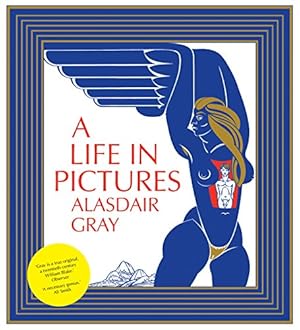
A Life In Pictures Alasdair Gray

Canongate, 2010, 304p

 A Life In Pictures cover

This is not an autobiography but a visual chronology of Alasdair Gray’s life. His earliest days are seen in photographs; after his artistic ability became apparent those paintings, drawings, leaflets, book covers, murals etc of which a record remains have all been reproduced in the book, each annotated with the date it was made and the medium he used. One chapter is devoted to the work of Alan Fletcher, a friend of his from Art School, who died young.

Accompanying the pictures are some explanatory words (which only incidentally add up to a potted biography.) Gray seems always to have been a not strictly representational artist – at school an art teacher told him his shadows were wrong or not present; he adopted multi-perspective views. He did attend the Glasgow School of Art, his peers recognising Charles Rennie Mackintosh’s masterpiece as a wonderful building for their purposes but none of them having been made aware of its designer nor that he had been Scottish until informed by a foreign visitor. That circumstance is almost incomprehensible today. Gray complains of the tutors being hidebound, wedded to the principles of Ruskin, uncaring (ignorant?) of Modern Art, with no mention of the Colourists, as a result of which he and his contemporaries were effectively reinventing earlier modes. There was too an implicit lack of encouragement, no idea of the possibility of making a living as an artist in Scotland. (Arguably there was none at that time.) It was only because Gray was not accepted into the Painting Department for his third year that he took up his signature murals. That seems to me to hang over all his later work as his style is distinctive, even his portraits display that blockiness. So, in a lesser way, do the few landscapes he has painted, which are not as obviously Gray works as the paintings and murals are. Many of his paintings actually remain unfinished since he did not have sufficient time to devote to completing them.

The book is, of course, a feast for the eyes but the text is marred by a few typos. (Proof reading such a complex project cannot have been easy, though.) It does not exist for the text however.

At time of writing Gray is still at work on the huge commission to adorn the walls and ceiling of the Oran Mor Arts and Leisure Centre at the top of Byres Road, Glasgow.

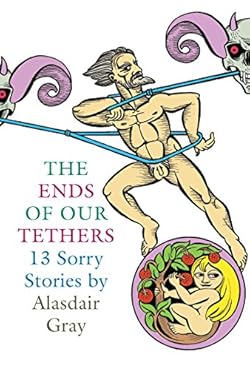
The Ends Of Our Tethers, 13 Sorry Stories by Alasdair Gray.

Canongate, 1985, 181p.

Every Gray book is a visual delight. This is another of those beautifully produced Canongate editions of Gray’€™s works, as usual with wide margins and illustrations by the author, though here there are no footnotes nor marginal annotations. In the main these so-called sorry stories feature, as the book’s title suggests, put-upon protagonists and include more than a few tales of unsatisfactory or failed marriages. They vary in length from two or so to 44 pages.

Gray’€™s narrators tend to have an air of detachment about them and it is unsurprising that their relationships are dysfunctional. Some have especially unfortunate habits. Job’€™s Skin Game‘€™s narrator is so fascinated by his own eczema he subject his scabs to almost Linnaean levels of classification.

Of the other stories that do not focus on marriage Aiblins features the suppression by an academic of a younger poet’€™s works and acts partly as a device to smuggle in some of Gray’€™s own (accomplished) poetry which he nevertheless deconstructs in typical Gray fashion. Wellbeing is about the necessity of not being sane in our crazy world and Big Pockets With Buttoned Flaps is an unusual erotic preference.

15 February 2003 is not so much a story as an account of an anti-Iraq war march. Here Gray mentions that the USSR invaded Czechoslovakia at the time of the Suez crisis in 1956. He is confusing this with the invasion of Hungary in that year. The (crushed) Prague Spring was in 1968.

With its illustrations of disconnection mixed with the odd desultory polemic, as an introduction to Gray’€™s world view this collection couldn’t be bettered.

Edinburgh Again

We took another stroll along the Water of Leith yesterday and there was the heron again. (I assume it’s the same one we saw before.)

<center

It was quite undisturbed while we were going past, standing stock still, making the photo easier. It only moved up on to the bank after we were along the path a bit.

We browsed the book and charity shops in Stockbridge for a while but I came away empty handed. The good lady picked up two books to add to her to be read pile.

This time we came back via the town and so passed the Dene Bridge at the upper level.

There’s no idea from here of how high above the water the roadway is nor of the immensity of the pillars.

Later we dropped into the Scottish National Gallery of Modern Art off Belford Road.

There are sculptures outside; including an unmistakable couple of Henry Moores.

One is at the front.

There is another beside the path which leads down from the car park to the Water of Leith.

Much of modern art leaves me cold but Moore’s sculptures are interesting.

Most of the stuff inside is a bit meh but the figurative paintings by the Scottish Colourists are an exception. (I’m used to these though as the excellent Kirkcaldy Museum and Art Gallery has a fine collection of Peploes as well as some others.)

There were too some pictures by Alasdair Gray on exhibition in the Gallery to tie in with the newly published book of his art work, A Life In Pictures.

Working Legs: a play for people without them by Alasdair Gray

Dog And Bone, 1997, 134p

Gray wrote Working Legs at the request of Birds Of Paradise a Glasgow-based theatre company which stages plays using physically disabled actors.

It is set in a society where to be in a wheelchair is the norm and those who can stand and walk are unusual and frowned upon. The plot concerns the trials and tribulations of Able McMann, who is hypermanic and cannot stop himself using his legs. This is a kind of inversion typical of SF (to which Gray is, of course, no stranger) and while the play is somewhat programmatic at times it does highlight issues surrounding society’€™s treatment of those who are different while incidentally satirising Thatcherite politics of swingeing cuts (now a timely concern again) and the machinations and manipulations of the tabloid press. The resolution could be sentimental were it not undercut by the reappearance of a minor character, but it does round things off satisfactorily.

The book is also copiously illustrated with Gray’s unmistakable idiosyncratic art work.

I don’€™t usually read plays and bought this only as a Gray completist. I did enjoy it, though.

Blooding Mister Naylor by Chris Boyce

Dog And Bone, 1990. 244p

Blooding Mister Naylor cover

Jack Naylor is a solicitor for a Glasgow legal firm (working from their branch in Dumbarton!) He has frequently acted for the activists of a local peace camp located in Glen Douglas. When two of their number are arrested for the murder of a noted and well-liked peace campaigner in Glasgow he is asked to take on the case. It is his first time acting for someone accused of murder; hence the title Blooding Mister Naylor. About halfway through the book as the plot began to complicate and fold back on itself I began to form the suspicion that the title would perhaps become all too literal.

One of the two accused, a woman, is released early on. The usual sorts of complications ensue. Naylor’s bosses do not want him to take the case, there are hints of MI5 and SBS involvement, multi-national corporations lurk in the background, Naylor’s movements are followed, his phone calls tapped and his professional integrity questioned in the press.

This is a work in the comical/thriller style later mined so enthusiastically by Christopher Brookmyre and as such is very readable, but is a shade or two darker.

Unfortunately the book is littered with typos and/or misspellings. Dog And Bone was, I fear, a publishing venture based on less than a shoestring though with a striking set of covers unmistakably designed by Alasdair Gray.

If you like Brookmyre, though, give this one a go.

Sadly there will be no more like this from Chris Boyce as he died in 1999. So it goes.

Consider Phlebas: Towards A Scottish Science Fiction

Throughout the 1950s, the early 1960s, through the late 60s efflorescence of the New Wave and into the 1970s and 80s a stream of English authors came to prominence in the SF field and had novels published in Britain. To my mind there was a clear distinction in the type of books all these authors were producing compared to those emanating from across the Atlantic and that certain characteristics distinguished the work emanating from either of these publication areas. While Bob Shaw was a notable Northern Irish proponent of the form during this period and Christopher Evans flew the flag for Wales from 1980 something kept nagging at me as I felt the compulsion to begin writing. Where, in all of this, were the Scottish writers of SF? And would Scottish authors produce a different kind of SF again?

Until Iain M Banks’s Consider Phlebas, 1987, contemporary Science Fiction by a Scottish author was so scarce as to be invisible. It sometimes seemed that none was being published. As far as Scottish contribution to the field went in this period only Chris Boyce, who was joint winner of a Sunday Times SF competition and released a couple of SF novels on the back of that achievement, Angus McAllister, who produced the misunderstood The Krugg Syndrome and the excellent but not SF The Canongate Strangler plus the much underrated Graham Dunstan Martin offered any profile at all but none of them could be described as prominent. And their works tended to be overlooked by the wider SF world.

There was, certainly, the success of Alasdair Gray’s Lanark in 1981 but that novel was more firmly in the Scottish tradition of fantasy and/or the supernatural rather than SF (cf David Lindsay’s A Voyage To Arcturus, 1920) and was in any case so much of a tour de force that it hardly seemed possible to emulate it; or even touch its foothills.

David Pringle noted the dearth of Scottish SF writers in his introduction to the anthology Nova Scotia where he argued that the seeming absence of Scottish SF authors was effectively an illusion. They were being published, only not in the UK. They (or their parents) had all emigrated to America. Though he has since partly resiled on that argument, it does of course invite the question. Why did this not happen to English SF writers?

It was in this relatively unpromising scenario that I conceived the utterly bizarre notion of writing not just Science Fiction but Scottish Science Fiction and in particular started to construct an SF novel that could only have been written by a Scot. Other novels may have been set in Scotland or displayed Scottish sensibilities but as far as I know I’m the only person who deliberately set out to write a novel of Scottish SF.

It could of course simply be that there was so little SF from Scotland being published because hardly anyone Scottish was writing SF or submitting it to publishers. But there were undoubtedly aspirants; to which this lack of role models might have been an off-putting factor. I myself was dubious about submitting to English publishers as they might not be wholly in tune with SF written from a Scottish perspective. I also thought Scottish publishers, apparently absorbed with urban grittiness, would look on it askance. I may have been completely wrong in these assumptions but I think them understandable given the circumstances. There is still no Scottish publisher of speculative fiction.

With Iain M Banks and Consider Phlebas the game changed. Suddenly there was a high profile Scottish SF writer; suddenly the barrier was not so daunting. And Phlebas was Space Opera, the sort of thing I was used to reading in American SF, albeit Banks had a take on it far removed from right wing puffery of the sort most Americans produced. Phlebas was also distant from most English SF – a significant proportion of which was seemingly fixated with either J G Ballard or Michael Moorcock or else communing with nature, and in general seemed reluctant to cleave the paper light years. Moreover, Banks sold SF books by the bucketload.

There was, though, the caveat that he had been published in the mainstream first and was something of a succès de scandale. (Or hype – they can both work.)

[There is, by the way, an argument to be had that all of Banks’s fiction could be classified as genre: whether the genre be SF, thriller, in the Scottish sentimental tradition, or even all three at once. It is also arguable that Banks made Space Opera viable once more for any British SF writer. Stephen Baxter’s, Peter Hamilton’s and Alastair Reynolds’s novel debuts post-date 1987.]

As luck would have it the inestimable David Garnett soon began to make encouraging noises about the short stories I was sending him, hoping to get into, at first Zenith, and then New Worlds.

I finally fully clicked with him when I sent The Face Of The Waters, whose manuscript he red-penned everywhere. By doing that, though, he nevertheless turned me into a writer overnight and the much longer rewrite was immeasurably improved. (He didn’t need to sound quite so surprised that I’d made a good job of it, though.)

That one was straightforward SF which could have been written by anyone. Next, though, he accepted This Is The Road (even if he asked me to change its title rather than use the one I had chosen) which was thematically Scottish. I also managed to sneak Closing Time into the pages of the David Pringle edited Interzone – after the most grudging acceptance letter I’ve ever had. That one was set in Glasgow though the location was not germane to the plot. The idea was to alternate Scottish SF stories with ones not so specific but that soon petered out.

The novel I had embarked on was of course A Son Of The Rock and it was David Garnett who put me in touch with Orbit. On the basis of the first half of it they showed interest.

Six months on, at the first Glasgow Worldcon,* 1995, Ken MacLeod’s Star Fraction appeared. Another Scottish SF writer. More Space Opera with a non right wing slant. A month or so later I finally finished A Son Of The Rock, sent it off and crossed my fingers. It was published eighteen months afterwards.

I think I succeeded in my aim. The Northern Irish author Ian McDonald (whose first novel Desolation Road appeared in 1988) in any case blurbed it as “a rara avis, a truly Scottish SF novel” and there is a sense in which A Son Of The Rock was actually a State Of Scotland novel disguised as SF.

Unfortunately the editor who accepted it (a man who, while English, bears the impeccably Scottish sounding name of Colin Murray) moved on and his successor wasn’t so sympathetic to my next effort – even if Who Changes Not isn’t Scottish SF in the same uncompromising way. It is only Scottish obliquely.

So; is there now a distinctive beast that can be described as Scottish Science Fiction? With the recent emergence of a wheen of Scottish writers in the speculative field there may at last be a critical mass which allows a judgement.

Banks’s Culture novels can be seen as set in a socialist utopia. Ken MacLeod has explicitly explored left wing perspectives in his SF and, moreover, used Scotland as a setting. Hal Duncan has encompassed – even transcended – all the genres of the fantastic in the two volumes of The Book Of All Hours, Alan Campbell constructed a dark fantastical nightmare of a world in The Deepgate Codex books. Gary Gibson says he writes fiction pure and simple and admits of no national characteristics to his work – but it is Space Opera – while Mike Cobley is no Scot Nat (even if The Seeds Of Earth does have “Scots in Spa-a-a-ce.”)

My answer?

Probably not, even though putative practitioners are more numerous now – especially if we include fantasy. For these are separate writers doing their separate things. I’ll leave it to others to decide whether they have over-arching themes or are in any way comparable.

PS. Curiously, on the Fantastic Fiction website, Stephen Baxter, Peter Hamilton and Alastair Reynolds are flagged as British – as are Bob Shaw, Ian McDonald, Christopher Evans and Mike Cobley – while all the other Scottish authors I’ve mentioned are labelled “Scotland.” I don’t know what this information is trying to tell us.

*For anyone who hasn’t met the term, Science Fiction Conventions are known colloquially as Cons. There are loads of these every year, most pretty small and some quite specialised. The Worldcon is the most important, an annual SF convention with attendees from all over the globe. It’s usually held in the US but has been in Britain thrice (Glasgow 2, Brighton 1) and once in Japan, to my knowledge. The big annual British SF convention is known as Eastercon because it takes place over the Easter weekend.

Edited to add (6/6/2014):- Margaret Elphinstone should be added to the list above of Scottish authors of SF. Her first SF book The Incomer appeared from the Women’s Press in 1987, the same year as Consider Phlebas, but I missed out on it then. My review is here.
See also my Scottish SF update.

Edited again to add (4/4/18) Elphinstone’s sequel to The Incomer is A Sparrow’s Flight which I reviewed here.
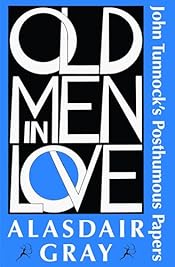
Old Men in Love by Alasdair Gray

John Tunnock’s Posthumous Papers. Edited, decorated by Alasdair Gray
Bloomsbury, 2007, 312p

Lanark‘s publication in 1981 marked not only Alasdair’ Gray’s arrival as a major Scottish novelist but also of his distinctive style. Ever since it has been impossible when sampling his work to escape the fact that you are reading a Gray book.

Old Men In Love is no exception. The usual Gray appurtenances are present; illustrations, marginal notes, typographical excursions. The Bloomsbury edition also comes with a nice internal bookmark.

The book is presented as the literary papers of John Tunnock, a retired primary school teacher, and includes extracts from Tunnock’s diary and from the various writing projects he had started, abandoned, and perhaps restarted. As a result, a couple of (short) chapters of Old Men In Love are set in renaissance Florence, there is an abortive History of Scotland from the Big Bang, a longer section dealing (in two well separated parts) with Socratic Athens, another with the origins of a small nineteenth century English religious cult called the Agapemonites, also known as the Lampeter Brethren. This last becomes a trifle tedious as it meanders on. Aside from the diary extracts the most successful of these is the part featuring Socrates – especially the scenes of his trial.

In the diaries, Tunnock is revealed as a curmudgeonly socialistic Scot, ill at ease with the modern world. But then, he was also uneasy in his youth, being brought up by two aunts and unaware till much later of his illegitimate birth.

All of this is tied up in a metafictional conceit since there is an introduction, as by Lady Sara Sim-Jaegar (an Englishwoman, now living in the US, who is the supposed beneficiary of Tunnock’s will) which mentions Gray himself in less than flattering terms. As does the epilogue, attributed to Sidney Workman – an educator marooned in Fife (I know the feeling) whose address is given as 17 Linoleum Terrace, Kirkcaldy, which, of course, does not exist – wherein the book is said to be a ragbag collection of previously published stories, plays or television transcripts. This is another Gray trope, attempting to defray criticism by anticipating it. The epilogue treats extensively with Lanark (‘Workman”s contribution to which is maintained to have sabotaged his career) as well as the remainder of Gray’s œuvre which ‘Workman’ characterises as derivative and not worthy of the acclaim it has garnered.

Whatever the truth of these criticisms and whether Gray himself believes them or is merely presenting a posture of self-effacement, Lanark did prise open a door through which an array of Scottish SF/Fantasy writers at first trickled (Banks 1984, MacLeod 1995) then breenged (eg Cobley 2001, Gibson 2004, Duncan 2005, Campbell 2007.)

Had it been Old Men In Love which had been published in 1981 that flowering might not have taken place.

Edited to add:-
The Guardian’s Review section had a capsule review of Old Men In Love on Saturday 10/10/09. I can’t find it on their website so I can’t link to it. However, if you caught it, I wouldn’t demur from its assessment one jot.

Not Fifteen Books

Ian Sales on his blog mentioned a while back a meme that is going about, where you list the fifteen books that influenced or affected you most and have stayed with you. I don’t know if I can come up with fifteen off the top of my head but here are some.

Dune Messiah by Frank Herbert
The Man In The Maze by Robert Silverberg
The Left Hand Of Darkness by Ursula K Le Guin
Winter’s Children and Hello Summer Goodbye both by Michael G Coney
Lanark by Alasdair Gray
The Private Memoirs And Confessions Of A Justified Sinner by James Hogg
2001: A Space Odyssey by Arthur C Clarke
Pavane by Keith Roberts

The Herbert is there because it was the first Dune book I read (out of the local Public Library, when I devoured any yellow jacketed book in the SF section.) I didn’t know when I picked it up it was a sequel. It still made sense, and is a better novel than Dune anyway. So is Children Of Dune; but the later ones are increasingly forgettable.
The Man In The Maze made me realise what SF could be and do. Silverberg has written books even more impressive but I was on the verge of stopping reading SF till I read this. So Robert Silverberg is to blame for my continuing involvement with the genre.
The Left Hand Of Darkness just blew me away.
All the Michael G Coneys from around that part of his career are superb as I remember. Lump in Mirror Image, Syzygy, Charisma, The Girl With A Symphony In Her Fingers* (aka The Jaws That Bite, The Claws That Catch) and Brontomek! to that list.
Lanark, while being a masterpiece by anyone’s definition also let me know it was actually possible to be Scottish and still get literature of a speculative bent into print.
Confessions Of A Justified Sinner is the prototypic Scottish novel. Jekyll and Hyde, your inspiration was surely here – also, in many senses, my story “Dusk,” despite the fact that stylistically I was more attempting to echo Silverberg. But if you live in Scotland that streak of fatalistic, Calvinistic gloom just gets to you.
2001. Amazingly, I read this before I saw the film. Sense of wonder plus. (At the time.)
Pavane opened up for me the delights of Altered History.

*This, I read only a few years ago, though.

I see the total comes to eight; fourteen if you count all the Coneys. But then I haven’t enumerated all the Silverbergs, nor the Le Guins. And now I think about it there ought to be a Roger Zelazny in there somewhere; any from He Who Shapes, This Immortal, Isle Of The Dead or Doorways In The Sand.

Now, if there were a meme for books that stayed with you for all the wrong reasons!….

Books I Have Read (And Some I Intend To)

I’ve gone through the Guardian’s list of 1000 novels you must read to find the ones I actually have read. Italicised books await my attention.
I’ve kept them under the Guardian’s groupings.
Titles followed by question marks I believe I read during my schooldays but can’t quite be sure.

What this list says about me I have no idea.

Love (4)

Paul Gallico: The Snow Goose (1941)
Thomas Hardy: Far from the Madding Crowd (1874)
Haruki Murakami: Norwegian Wood (1987)
Boris Pasternak: Doctor Zhivago (1957)

Family And Self (9)

Kate Atkinson: Behind the Scenes at the Museum (1995)
Iain Banks: The Crow Road (1992)
Lynne Reid Banks: The L-Shaped Room (1960)
William Boyd: Any Human Heart (2002)
Jim Crace: Quarantine (1997)
Charles Dickens: Great Expectations (1861)
Shusaku Endo: Silence (1966)
JD Salinger: The Catcher In The Rye (1951)
Alan Warner: Morvern Callar (1995)

Crime (12 + 2)

Wilkie Collins: The Moonstone (1868)
Joseph Conrad: The Secret Agent (1907)
Joseph Conrad: Under Western Eyes (1911)
Len Deighton: The Ipcress File (1962)
Umberto Eco: The Name of the Rose (1980)
Graham Greene: The Third Man (1950) ????
Peter Høeg: Miss Smilla’s Feeling for Snow (1992)
Geoffrey Household: Rogue Male (1939)
John le Carré: Tinker, Tailor, Soldier, Spy (1974)
John le Carré: The Spy Who Came In From The Cold (1963)
Thomas Pynchon: V (1963)
Thomas Pynchon: The Crying of Lot 49 (1966)
Patrick Suskind: Perfume (1985)
Josephine Tey: The Daughter of Time (1951)

Comedy (12)

Julian Barnes: A History of the World in 10½ Chapters (1989)
William Boyd: A Good Man in Africa (1981)
Richmal Crompton: Just William (1922)
Stella Gibbons: Cold Comfort Farm (1932)
Kenneth Grahame: The Wind in the Willows (1908)
Graham Greene: Our Man in Havana (1958)
Nick Hornby: High Fidelity (1995)
Bohumil Hrabal: I Served the King of England (1983)
AG Macdonnell: England, Their England (1933)
Magnus Mills: The Restraint of Beasts (1998)
Philip Roth: Portnoy’s Complaint (1969)
Kurt Vonnegut: Breakfast Of Champions (1973)

State Of The Nation (7)

Alasdair Gray: Lanark (1981)
James Kelman: How Late It Was, How Late (1994)
George Orwell: Animal Farm (1945)
Thomas Pynchon: Vineland (1990)
Salman Rushdie: Midnight’s Children (1981)
Salman Rushdie: Shame (1983)
Mark Twain: The Adventures of Tom Sawyer (1876)

War And Travel (33 + 6)

JG Ballard: Empire of the Sun (1984)
Pat Barker: Regeneration (1991)
William Boyd: An Ice-Cream War (1982)
Joseph Conrad: Heart of Darkness (1902)
Joseph Conrad: Lord Jim (1900)
Joseph Conrad: Nostromo (1904)

Stephen Crane: The Red Badge of Courage (1895)
Daniel Defoe: Robinson Crusoe (1719)
Len Deighton: Bomber (1970)
Alexandre Dumas: The Three Musketeers (1844)
Sebastian Faulks: Birdsong (1993)
William Golding: To the Ends of the Earth trilogy (1980-89)
Anthony Hope: The Prisoner of Zenda (1894) ??
Richard Hughes: A High Wind in Jamaica (1929)
Thomas Keneally: Confederates (1979)
Thomas Keneally: Schindler’s Ark (1982)
AL Kennedy: Day (2007)
Primo Levi: If Not Now, When? (1982)
Alastair Maclean: The Guns of Navarone (1957) ??
Norman Mailer: The Naked and the Dead (1948)
Gabriel Garcia Márquez: One Hundred Years of Solitude (1967)
Frederick Marryat: The Children of the New Forest (1847)
Iréne Nèmirovsky: Suite Française (2004)
Baroness Emmuska Orczy: The Scarlet Pimpernel (1905)
George Orwell: Burmese Days (1934)
Thomas Pynchon: Gravity’s Rainbow (1973)
Erich Maria Remarque: All Quiet on the Western Front (1929)
Walter Scott: Ivanhoe (1819)
Nevil Shute: A Town Like Alice (1950)
Neal Stephenson: Cryptonomicon (1999)
Robert Louis Stevenson: Kidnapped (1886)
Robert Louis Stevenson: Treasure Island (1883)
William Styron: Sophie’s Choice (1979) ??
Mark Twain: The Adventures of Huckleberry Finn (1885)
Leo Tolstoy: War and Peace (1869)
Jules Verne: Around the World in Eighty Days(1873)
Jules Verne: A Journey to the Centre of the Earth (1864) ??
Kurt Vonnegut: Slaughterhouse-Five (1969)
HG Wells: The Island of Dr Moreau (1896)

That makes a non-SF total of 77 (though some of them I would classify as SF.) Add in the 60 from the SF/fantasy list and I’ve read 137 of the thousand. I must be spectacularly ill-read.
The good lady notches up 145 with quite a few in common between our two lists.
I could also add the parts of series and the converted short stories from the SF list but that would only take me to just above 140.

Still a long way to go, then. I won’t have time.

For some of them I’ve seen a film or TV adaptation so feel I perhaps don’t need to read them.

A lot of the rest, however, I have no intention of ever picking up.

Books You Must Read?

The Guardian yesterday (22/1/09) published a list of SF/fantasy works as part of its 1000 books you must read series.

Ian Sales has commented on it on his blog from which I got the list.

Out of the 149 I have read 57 (marked in bold.) There are another five of which I’ve read either part of them or the short story on which they were based (marked in bold and italics.) One is on my to-be-read shelf (italics only.) In addition I’ve seen the TV series of Hitchhiker but not read the books. Ditto for the Disney film of The Sword In The Stone which I suspect had little to do with the TH White book, though Wikipedia says it is based on it. I also watched the TV version of Angus Wilson’s The Old Men at the Zoo.
There are 8 authors on the list of whom I have read other books of theirs (some of them not classifiable as SF or fantasy.) One other of those is to-be-read.

Douglas Adams: The Hitchhiker’s Guide to the Galaxy (1979)
Brian W Aldiss: Non-Stop (1958)
Isaac Asimov: Foundation (1951)
Margaret Atwood: The Handmaid’s Tale (1985)

Margaret Atwood: The Blind Assassin (2000)
Paul Auster: In the Country of Last Things (1987)
JG Ballard: The Drowned World (1962)
JG Ballard: Crash (1973)

JG Ballard: Millennium People (2003)
Iain Banks: The Wasp Factory (1984)
Iain M Banks: Consider Phlebas (1987)

Clive Barker: Weaveworld (1987)
Nicola Barker: Darkmans (2007)
Stephen Baxter: The Time Ships (1995)
Greg Bear: Darwin’s Radio (1999)
William Beckford: Vathek (1786)
Alfred Bester: The Stars My Destination (1956)
Ray Bradbury: Fahrenheit 451 (1953)

Poppy Z Brite: Lost Souls (1992)
Charles Brockden Brown: Wieland (1798)
Algis Budrys: Rogue Moon (1960)
Mikhail Bulgakov: The Master and Margarita (1966)
Edward Bulwer-Lytton: The Coming Race (1871)
Anthony Burgess: A Clockwork Orange (1960)
Anthony Burgess: The End of the World News (1982)
Edgar Rice Burroughs: A Princess of Mars (1912)
William Burroughs: Naked Lunch (1959)
Octavia Butler: Kindred (1979)
Samuel Butler: Erewhon (1872)
Italo Calvino: The Baron in the Trees (1957)
Ramsey Campbell: The Influence (1988)
Lewis Carroll: Alice’s Adventures in Wonderland (1865)
Lewis Carroll: Through the Looking-Glass, and What Alice Found There (1871)

Angela Carter: The Passion of New Eve (1977)
Angela Carter: Nights at the Circus (1984)
Michael Chabon: The Amazing Adventures of Kavalier and Clay (2000)
Arthur C Clarke: Childhood’s End (1953)
GK Chesterton: The Man Who Was Thursday (1908)
Susanna Clarke: Jonathan Strange and Mr Norrell (2004)
Michael G Coney: Hello Summer, Goodbye (1975)

Douglas Coupland: Girlfriend in a Coma (1998)
Mark Danielewski: House of Leaves (2000)
Marie Darrieussecq: Pig Tales (1996)
Samuel R Delaney: The Einstein Intersection (1967)
Philip K Dick: Do Androids Dream of Electric Sheep? (1968)
Philip K Dick: The Man in the High Castle (1962)
Thomas M Disch: Camp Concentration (1968)

Umberto Eco: Foucault’s Pendulum (1988)
Michel Faber: Under the Skin (2000)
John Fowles: The Magus (1966)
Neil Gaiman: American Gods (2001)
Alan Garner: Red Shift (1973)
William Gibson: Neuromancer (1984)

Charlotte Perkins Gilman: Herland (1915)
William Golding: Lord of the Flies (1954)
Joe Haldeman: The Forever War (1974)
M John Harrison: Light (2002)

Nathaniel Hawthorne: The House of the Seven Gables (1851)
Robert A Heinlein: Stranger in a Strange Land (1961)
Frank Herbert: Dune (1965)

Hermann Hesse: The Glass Bead Game (1943)
Russell Hoban: Riddley Walker (1980)
James Hogg: The Private Memoirs and Confessions of a Justified Sinner (1824)

Michel Houellebecq: Atomised (1998)
Aldous Huxley: Brave New World (1932)
Kazuo Ishiguro: The Unconsoled (1995)
Shirley Jackson: The Haunting of Hill House (1959)
Henry James: The Turn of the Screw (1898)
PD James: The Children of Men (1992)
Richard Jefferies: After London; Or, Wild England (1885)
Gwyneth Jones: Bold as Love (2001)
Franz Kafka: The Trial (1925)
Daniel Keyes: Flowers for Algernon (1966)

Stephen King: The Shining (1977)
Marghanita Laski: The Victorian Chaise-longue (1953)
Joseph Sheridan Le Fanu: Uncle Silas (1864)
Ursula K Le Guin: The Left Hand of Darkness (1969)
Ursula K Le Guin: The Earthsea series (1968-1990)
Stanislaw Lem: Solaris (1961)

Doris Lessing: Memoirs of a Survivor (1974)
CS Lewis: The Chronicles of Narnia (1950-56)
MG Lewis: The Monk (1796)
David Lindsay: A Voyage to Arcturus (1920)
Ken MacLeod: The Night Sessions (2008)
Hilary Mantel: Beyond Black (2005)
Michael Marshall Smith: Only Forward (1994)
Richard Matheson: I Am Legend (1954)
Charles Maturin: Melmoth the Wanderer (1820)
Patrick McCabe: The Butcher Boy (1992)
Cormac McCarthy: The Road (2006)
Jed Mercurio: Ascent (2007)
China Miéville: The Scar (2002)
Andrew Miller: Ingenious Pain (1997)
Walter M Miller Jr: A Canticle for Leibowitz (1960)
David Mitchell: Cloud Atlas (2004)
Michael Moorcock: Mother London (1988)
William Morris: News From Nowhere (1890)
Toni Morrison: Beloved (1987)
Haruki Murakami: The Wind-up Bird Chronicle (1995)
Vladimir Nabokov: Ada or Ardor (1969)
Audrey Niffenegger: The Time Traveler’s Wife (2003)
Larry Niven: Ringworld (1970)
Jeff Noon: Vurt (1993)

Flann O’Brien: The Third Policeman (1967)
Ben Okri: The Famished Road (1991)
George Orwell: Nineteen Eighty-four (1949)
Chuck Palahniuk: Fight Club (1996)
Thomas Love Peacock: Nightmare Abbey (1818)
Mervyn Peake: Titus Groan (1946)
Frederik Pohl & CM Kornbluth: The Space Merchants (1953)

John Cowper Powys: A Glastonbury Romance (1932)
Terry Pratchett: The Discworld series (1983- )
Christopher Priest: The Prestige (1995)
Philip Pullman: His Dark Materials (1995-2000)

François Rabelais: Gargantua and Pantagruel (1532-34)
Ann Radcliffe: The Mysteries of Udolpho (1794)
Alastair Reynolds: Revelation Space (2000)
Kim Stanley Robinson: The Years of Rice and Salt (2002)

JK Rowling: Harry Potter and the Philosopher’s Stone (1997)
Salman Rushdie: The Satanic Verses (1988)
Joanna Russ: The Female Man (1975)
Geoff Ryman: Air (2005)
Antoine de Sainte-Exupéry: The Little Prince (1943)
José Saramago: Blindness (1995)
Will Self: How the Dead Live (2000)
Mary Shelley: Frankenstein (1818)
Dan Simmons: Hyperion (1989)
Olaf Stapledon: Star Maker (1937)
Neal Stephenson: Snow Crash (1992)

Robert Louis Stevenson: The Strange Case of Doctor Jekyll and Mr Hyde (1886)
Bram Stoker: Dracula (1897)
Rupert Thomson: The Insult (1996)
JRR Tolkien: The Hobbit (1937)
JRR Tolkien: The Lord of the Rings (1954-55)
Mark Twain: A Connecticut Yankee at King Arthur’s Court (1889)
Kurt Vonnegut: Sirens of Titan (1959)

Horace Walpole: The Castle of Otranto (1764)
Robert Walser: Institute Benjamenta (1909)
Sylvia Townsend Warner: Lolly Willowes (1926)
Sarah Waters: Affinity (1999)
HG Wells: The Time Machine (1895)
HG Wells: The War of the Worlds (1898)

TH White: The Sword in the Stone (1938)
Angus Wilson: The Old Men at the Zoo (1961)
Gene Wolfe: The Book of the New Sun (1980-83)
Virginia Woolf: Orlando (1928)
John Wyndham: Day of the Triffids (1951)
John Wyndham: The Midwich Cuckoos (1957)
Yevgeny Zamyatin: We (1924)

A startling omission (to me) is that of Robert Silverberg. If any one person is responsible for me continuing to read Science Fiction into adulthood it is him. The Man In The Maze showed me what SF could be, what it could aspire to. Yet it is a relatively minor work. So how can there be no Nightwings, no Son Of Man, no A Time Of Changes?

And no Roger Zelazny? Dear, dear.

Not to mention Alasdair Gray’s towering achievement Lanark. (But the list wasn’t compiled by Scots.)

An amusing aspect of this particular list is that before the turn of the millenium The Guardian compiled various bests of the 20th century. The SF book that topped the relevant list (it was an idiosyncratic choice it has to be said) does not appear in this one! Neither does its author.

Edited to add Brave New World to my read list. I somehow missed it on the run through.

Edited again. Up to 59 now. I’ve also read Lord Of The Flies, but it was donkey’s ages ago (so long I’d just about forgotten.)

Make that 60. How did I miss Nineteen Eighty Four? I must be going blind.

free hit counter script