Archives » Science Fiction

The Mother Code by Carole Stivers

Hodder, 2021, 349 p, £8.99. Reviewed for ParSec 1.
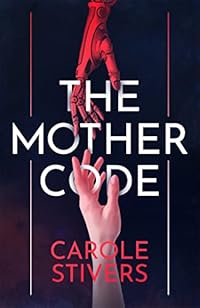
Presumably since for a large part of its history it has been written mainly – though never exclusively – by men, there has not been much of an examination of motherhood in Science Fiction. In The Mother Code Stivers may be trying to redress that a little but if so it is an odd sort of attempt at it. Yes, her mothers are artificial wombs, programmed not only to give birth, but to nurture and teach the resulting children as they grow – yet they are also effectively battle robots, formidably armed and fiercely protective of their charges.

The robot mothers’ deployment has been necessitated as a consequence of the deliberate use by the US military of a supposedly quickly degradable bioagent called IC-NAN to eliminate groups opposed to the presence of US troops in Kandahar. IC-NAN causes lung cells to carry on well past their normal replacement date, growing like a cancer, overpowering good tissue and later invading the body, leading to a slow but certain death. The agent, however, spreads to an archaebacterium and remakes itself to replicate inside that organism’s cells and so begins to diffuse around the world. While the only antidote, C343, is not 100% effective all those working on the project have been supplied with it and the embryos the mothers will carry have been gene-engineered to be resistant to IC-NAN.

The narrative is shared between several viewpoints, one of whom is Kai, a child born inside one of the artificial mothers, and in Part One also jumps in time from when the IC-NAN plague manifests itself in the US and the robots are released, to a period when the children are around eleven years old. This latter reduces any tension around the development of the mothers as we know the initial stages of that project must have worked. In Part Two both strands occur in the same time frame.

James Said is a biologist of Pakistani origin hired to work on the antidote, Rose McBride invents the mother code of the title, computer code meant to embody the very essence of motherhood. To succeed as mothers the bots needed personalities, programmed in from a few human examples (Rose herself being among them as is a Hopi woman, Susquetewa.) Rick Blevins is an army man injured in action whose mistrust of Said’s involvement after a Russian computer hack leads to the mothers being released somewhat prematurely.

In the future sections each child is able to communicate telepathically with his or her mother machine but they have been kept apart by the mothers’ instructions and the limits placed on their wanderings. Interactions with other mothers and children are sought out but they were initially spread out and climate-change induced dust storms are reducing the mothers’ flying capabilities. Over-riding of a source code brings all the mothers together at a base called the Presidio. The mothers’ protective attitudes against the outside world have infected the children who are on constant alert against attack, making the attempts of surviving humans of the project (the Hopi have a natural immunity to IC-NAN) to contact them difficult.

Stivers may have thought her approach is what I believe is now known as woke, but the novel’s stance on prejudice is troubling. OK, she makes one of her viewpoint characters a Muslim by descent but we don’t see it in his daily life, he is effectively irreligious. And what are we to make of, “the London Intifada of 2030 and the suicide bombings at Reagan Airport in 2041 kept alive a healthy suspicion of anyone resembling a Muslim in the West”? Leaving aside the transatlantic misconception of British reality in that London Intifada comment, ponder the use of the word ‘healthy’ in this context. Add in the fact that a black person is considered to be lucky to be employed on the project and the narrative begins to leave a sour taste. Moreover, prejudice becomes a plot point when Blevins authorises release of the mother robots as a direct result of his unwarranted suspicions of James Said.

The Mother Code as a whole is an uneasy mix of techno-thriller and examination of the effects of new technology on human development but has many of the defects of the former, to which it is heavily skewed, and few of the merits of the latter. While it is partly less true of the children the adult characters tend to have attributes rather than rounded personalities. The early pages are also unfortunately crammed with info-dumping. It’s a satisfactory enough read on its own terms but lacks real depth.

Pedant’s corner:- “enormity of the task” (it wasn’t reprehensible, it was big – ‘immensity of the task’,) a capital letter on the first word following a colon.)

BSFA Award Nominees 2022

The nominees for the BSFA Awards for works published in 2021 have been announced.

There is a new award this year for best book for younger readers. Of the novels I have read only one, Skyward Inn by Aliya Whiteley for which my review is here. Neither have I read any of the shorter fiction nominees but I assume the usual BSFA booklet containing them will be forthcoming.

Best Book for Younger Readers

The Raven Heir by Stephanie Burgis, Bloomsbury Children’s Books

A Snake Falls to Earth by Darcie Little Badger, Levine Querido

Iron Widow by Xiran Jay Zhao, Rock the Boat

Redemptor by Jordan Ifueko, Hot Key Books

The Empty Orchestra by Elizabeth Priest, Luna Press Publishing

Utterly Dark and the Face of the Deep by Philip Reeve, David Fickling Books

Best Novel

A Desolation Called Peace by Arkady Martine, Tor

Blackthorn Winter by Liz Williams, NewCon Press

Purgatory Mount by Adam Roberts, Gollancz

Shards of Earth by Adrian Tchaikovsky, Tor

Skyward Inn by Aliya Whiteley, Solaris

Green Man’s Challenge by Juliet E. McKenna, Wizard’s Tower Press

Best Shorter Fiction

‘Fireheart Tiger’ by Aliette de Bodard, Tor.com

‘Light Chaser’ by Peter F. Hamilton, Gareth L. Powell, Tor.com

‘O2 Arena’ by Oghenechovwe Donald Ekpeki, Galaxy Edge Magazine

‘Things Can Only Get Better’ by Fiona Moore, Abyss & Apex

Best Non-Fiction

Cyberpunk Culture and Psychology: Seeing Through the Mirrorshades, by Anna McFarlane, Routledge

Diverse Futures: Science Fiction and Authors of Color, by Joy Sanchez-Taylor, Ohio State Press

The Anthropocene Unconscious: Climate Catastrophe Culture, by Mark Bould, Verso Books

Worlds Apart: Worldbuilding in Fantasy and Science Fiction, ed. Francesca T. Barbini, Luna Publishing

Octothorpe Podcast, by John Coxon, Alison Scott, and Liz Batty, Octothorpe

Science Fiction and the Pathways out of the COVID Crisis, by Val Nolan, The Polyphony

Out of This World 5

First published in 1965, 182 p. In Out of This World Choice (Out of This World 2 & Out of This World 5) edited by Amabel Williams-Ellis and Mably Owen, Blackie, 1972, 369 p in total.

Another set of exercises, as in Out of This World 2, in thoroughly old-fashioned Science Fiction. More problems to be solved or misunderstandings to be overcome. Entertaining enough just the same.

Four in One by Damon Knight. Members of an exploratory expedition to another planet stumble into an alien life-form which absorbs them, leaving only their nervous systems intact. They can still communicate with each other and direct the organism though.

Bottomless Pit by Philip E High. The planet Shrule has been nicknamed the Bottomless Pit since no-one, of whatever species, returns from there. An expedition to exploit its resources finds out exactly why. This is one of the few old style SF stories where humans are bested by their antagonists.

The Hour of Letdown by E B White starts with a man walking into a bar. It’s not a joke though. The machine he carries is a multi-function computer of sorts, which can drink – and cheat at chess.

Colonial by John Christopher. The indigenous animals used to direct Venus’s arbitrary justice system have been replaced by the judgement of the leader of the human colonialists, Max Larkin. An exposé on Earth of the Venusians’ supposed exploitation leads to an investigation by reporters which could threaten the colonials’ extraction business. Larkin’s solution depends on his knowledge of the locals.

Badman by John Brunner. Today is the day that The Badman, upholder of law and order, punisher of all transgressors, and universal object of fear, is making one of his irregular visits to the town. In concert with his pals Niles Boden has concocted a plan to kill him. Niles is the one who draws the short straw and has to attempt the deed. What happens thereafter is different from what he expects.

Pushover Planet by Con Pedersen. A human expedition to another planet is befriended by one of its inhabitants. When they don environment suits it is another matter, though.

The Fiction Machines by Vadim Okhotnikov. A man who thinks his memoirs would make riveting reading finds it’s not so easy to write when you’re faced with a blank page. He invents ever bigger and more elaborate machines to help him with the task but the technology is too good at what it does.

Winthrop Was Stubborn by William Tenn. Four time-travellers to the twenty-fifth century are dismayed when the fifth – Winthrop – says he will not come back with them at the appointed time. Each is sent to the person in this future they could most likely persuade to help change Winthrop’s mind but the social set-up is such that none of them can do anything about it. The situation is resolved in a natural, organic, way.

Pedant’s corner:- In the preface; “Mr James Vance” (Jack Vance.) Otherwise; “his weight was only a little more than twenty kilograms on this planet” (strictly, weight is measured in Newtons, which, on Earth, equates directly to kilograms, the unit of mass. On another planet the relationship would not be so equivalent,) “axones and denerites” (axons and dendrites,) “old wives tales” (old wives’ tales?) “the penalties for indiscriminating killing” (indiscriminate,) “smiled faintly slightly” (either, faintly, or, slightly. Not both,) “oblivious of” (oblivious to.)

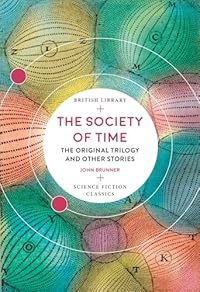
The Society of Time by John Brunner

The Original Trilogy and Other Stories, edited by Mike Ashley. British Library, 2020, 287 p. Reviewed for Interzone 290-291, Summer 2021.

 The Society of Time cover

This British Library reprint, subtitled “The Original Trilogy and Other Stories” contains five novellas first published in 1961 and 1962. The “time” trilogy was collected as Times without Number shortly after then. Its three stories are set around the four-hundredth anniversary of the victory of the Duke of Parma’s Armada over the English fleet when a (Catholic) Spanish Empire – centred on the British Isles – of which our protagonist Don Miguel Navarro, a licentiate of the powerful Society of Time, is a citizen, is at its peak. These are, then, tales of Altered History, with place names such as Jorque and Londres
Curiously we are told Spain itself has been reconquered by “virile” Islam but nothing more is made of this. The Empire’s main rival is instead a Confederacy of Northern European states. The Society of Time controls the time travel machines of the Empire (“Borromeo showed us how we might rotate the dimensions of substances so that the worlds became flat and we could voyage back into time,”) and has rigorous rules to prevent interference with History. A similar organisation in the Confederacy acts likewise. The Islamic powers we must assume to have no time travel capability. All three stories centre round the inevitable (otherwise no story) floutings of these interference protocols. Miguel, a rather correctly behaved individual, is also shocked by other infractions the Society’s members condone, such as pandering.

In the first novella, Spoil of Yesterday, Miguel immediately recognises a work of Art as an illegal import from the past and arrests its owner. The breach is resolved by a trip to the past to replace it immediately after its removal, but the reader does not take this time trip with Miguel, is only told of it. In the second, The Word not Written, Miguel finds that prominent members of the Society actively explore ruptures in time when an argument between them is attempted to be settled by allowing female warriors from a time which would not have occurred bar interference to come to their present, with disastrous results. Again, only a trip back to the past, again unseen, restores the status quo ante. Only Miguel and his confessor retain memories of the infringement. In The Fullness of Time, in retrospect a cunning title, we do finally accompany Miguel to the past. The Empire’s exploitation of the mineral resources of its lands in the New World is protected by the (carefully worded, so as to avoid any possible contravention) Treaty of Prague between it and the Confederacy. Evidence has been found of the Confederacy using its time travel capability to mine in the past where it had no right to. While (in a nod to what actually happened in the reader’s world) recognising that without the Empire the natives of the New World might have been ground between the interests of competing European nations, Miguel’s companion, a Mohawk, resents the Empire’s intrusions on the natives’ ancient lands, despite his tribe becoming a leading light in Empire circles. It is his interference in the past which drives the story and ultimately ensures there will be no more Don Miguel tales.

This is all still very readable, though Brunner’s writing occasionally lapses into cliché, the characterisation is sometimes rudimentary, and there is a rather awkward portrayal of sexual roles and attitudes.

The other two novellas are stand-alones which arguably do not belong with the trilogy though editor Mike Ashley’s introduction says Brunner was at his best at novella length.

In Father of Lies a small area of England is on no maps and technology breaks down when it is entered. Miles Croton is part of a group investigating the phenomenon and penetrates the anomaly on foot after his car will no longer work. He almost straight away sees a dragon from whom he soon has to rescue a naked woman tied to a stake and finds he has entered a world based on mythology (mainly but not exclusively Arthurian.) While this might seem like a fantasy scenario Brunner supplies a rational explanation for them.

The Analysts by contrast is a tale of unusual architecture. Joel Sackstone can visualise from a drawing how a building will be experienced by its inhabitants and as such has been crucial to his firm’s success. A new project baffles him by its design – on which the clients are irrevocably set – seeming to lead people in a direction that isn’t there. In amongst all this oddness Brunner managed to include some asides on sexual and racial politics.

The following did not appear in the published review:- contains the phraseology of the time eg coloured for black.

Pedant’s corner:- “two capital L’s” (strictly speaking the plural is ‘two capitals L’, but that is not how people say it,) focussed (focused,) “if there was anything more undignified than a Licentiate could do” (if there was anything more undignified that a Licentiate could do,) “once for all” (once and for all,) “landing astraddle of the branch” (landing astraddle the branch,) staunch (stanch,) “that all was not well” (that not all was well,) a full stop where there ought to have been a comma, “ten year ago” (years.)

Two More for Parsec

You may have noticed on my sidebar for the past five days a book called The Last ADVENTURE of CONSTANCE VERITY written by US author A Lee Martinez. This will be reviewed for online SF mag ParSec.

I’ve also just received from ParSec a novel titled Braking Day by Adam Oyebanji. This author has Scottish and Nigerian heritage.

Out of This World 2

(First published in 1961, 184 p.) In Out of This World Choice (Out of This World 2 & Out of This World 5) edited by Amabel Williams-Ellis and Mably Owen, Blackie, 1972, 369 p in total.

This contains a collection of Science Fiction stories written in the traditional style. Well, the book was first published in 1961.

The Trouble with Emily by James M White is one of the author’s Sector General stories set in a giant hospital where the ailments of many different types of creature are investigated and – hopefully – cured. This one entails acclimatising a brontosaurus analogue to its new environment with the aid of a telepathic alien.

The title of The Dusty Death by John Kippax is slightly misleading. Its two main characters are on a trip to survey the crater Aristarchus on the Moon when their vehicle tilts over and sinks into the dust. One of them is claustrophobic. The story shows its age by referring to their being no ‘girls’ on the Moon.

Another Word for Man by Robert Presslie is the story of H’Rola, a shape changing alien who speaks in a voice like an organ, hauled up by a fisherman working from a remote island. The local priest, Pierre St Emilion, views the alien as close to the Devil. H’Rola turns out to be a trainee doctor with unusual methods of effecting cures.

The Railways up on Cannis by Colin Kapp is a light-hearted piece. Cannis-four is a planet riddled with volcanoes which makes the building – or, rather, reconstructing since the original system has been destroyed by a war – of railways more than a little problematic. It is obviously a job for the Unorthodox Engineers.

Machine Made by J T Mcintosh is set in a library where the Machine has been put in place to answer problems. The cleaner, Rose, is supposedly dim-witted but assiduous about her job. Despite warnings against interacting with it she acquiesces to one of the Machine’s requests.

But Who Can Replace a Man? by Brian Aldiss is set among a hierarchical group of agricultural robots whose orders one day fail to turn up – because there are no humans left in the city to send them. Some of them set off in search of a new role.

The Gift of Gab by Jack Vance is set on the planet Sabria where humans are extracting minerals from the sea water. Supposedly there are no intelligent indigenous life-forms (harming whom is against the law) but creatures called dekabrachs start killing members of a work crew. They are not the villains of the piece.

The Still Waters by Lester Del Rey features the space ship Midas, the last of the ion-blaster fusion driven ships, whose owner can no longer afford its upkeep and is trying to find a use for her.

Pedant’s corner:- a missing comma before a piece of direct speech, “the air in the lock whipped out into the void” (surely a terrible waste? Air on the Moon would be a precious resource and certainly recycled back into the main body of the base rather than vented out,) “stories of fisherman being lured by the Black One” (fishermen,) “Chablis’ conclusions” (Chablis’s,) Williams’ (Williams’s,) “a fission motor” (a fusion motor. It was being contrasted with fission motors.)

Wild Harbour by Ian Macpherson

British Library, 2019, 220 p, including a v p Introduction by Timothy C Baker, and Wild September a vi p article by MacPherson. First published in 1936. Reviewed for Interzone 290-291, Summer 2021.

 Wild Harbour cover

In the mid- to late twentieth century Science Fiction by Scottish authors was all but invisible. Only four names spring to mind as being much in evidence at the time; J T McIntosh (who did though manage to publish over 20 SF novels,) Angus McVicar – whose output was aimed at YA readers (such books were called juvenile at the time) – and a reprint in the early 1960s of David Lindsay’s 1920 novel A Voyage to Arcturus, which despite its impeccably Science-Fictional title was arguably more of a fantasy than SF as such. Alasdair Gray produced his monumental Lanark in 1981 but that was such a unique novel (or four novels) that it hardly represented a trend or a model practicable to aspire to. And again it leaned towards fantasy, though some of his short stories were more recognisably SF. A tendency towards fantasy and horror in Scottish fiction had always been present – taking in George MacDonald’s Lilith etc and some of Robert Louis Stevenson’s stories (notably of course The Strange Case of Dr Jekyll and Mr Hyde) – as was the tale of the supernatural or, at least, encounters with the devil, whose origins go back even further than Victorian times. Forty to fifty years ago though, of evidence of SF either in that present or from earlier decades, there was barely a trace, neither as reprints nor on library shelves. Not until Polygon’s republishing of the novels of Lewis Grassic Gibbon – some of them published originally under his real name of J Leslie Mitchell – did I become aware that there had indeed been a Scottish tradition of writing SF before the appearance of Iain (M) Banks. Ken Macleod swiftly followed him. That dam having been broken by their success in the field, there are as of now a fair few Scots active in the genre.

With Ian Macpherson’s Wild Harbour, the British Library, whose new editions of British Crime Classics from the 1930s have brightened up bookshop shelves with vibrant Art Deco style covers redolent of the railway posters of that decade, has pulled another long languishing work of Scottish Science Fiction out of obscurity.

The book was written in the shadow of the looming Second World War. In it, something has happened in Europe and war has been declared, exactly what and between whom is unspecified. The novel starts sometime after with protagonist Hugh and his wife Terry being woken up in the middle of the night by the sound (and sight) of gunfire in the distance, towards Inverness. It soon becomes obvious they are taking refuge in a cave – the text goes on to lay out how well they had customised it to the requirements of living in the wild – as an escape and hiding place from the outside world. Hugh had had no inclination to fight in a war, had refused to follow the instructions of his call-up papers and the pair made off into the country to fend for themselves. Despite his aversion to war Hugh nevertheless has to kill animals to survive, hunting deer, fishing, snaring the odd rabbit.

The text takes the form of diary entries by Hugh with chapter titles which usually consist only of dates (from 15 May 1944 – 11 October) except for the final one, Night. Oddly, despite numerous mentions of salting of deer for the winter, when October comes we are told they have run out of meat.

In an observation on modern humans’ capacity to get by unaided that has even more relevance these days Hugh remembers an acquaintance from before the war telling him, “Our senses are blunted. We depend on a multitude of people to make our clothes and food and tools for us. We have noses that can’t smell, ears that are deaf -”

The pair’s struggle to survive and maintain their seclusion is threatened by human intruders into their surroundings, intruders whose shadowy nature and motivations only heighten the sense of threat. In this context Wild Harbour prefigures British SF’s “cosy” catastrophes of the 1950s.

The Introduction tells us, “Place is formative in all Macpherson’s novels, but the human relationship with place is never an easy one.” That is a statement that could be made about the Scottish novel in general. Another Scottish novelistic trait displayed here is a close attention to depiction of the land.

The writing is of its time, though, and the feel very reminiscent of Gibbon’s slightly earlier SF novels Three Go Back and Gay Hunter, both of which involve sojourns in almost deserted countryside, but also of John Buchan’s John Macnab, (plus there is the merest whiff of Geoffrey Household’s Rogue Male.) Macpherson, however, has an absurd overfondness for the phrase “commenced to” and from the perspective of over 80 years after publication it is noticeable that Terry’s contribution to the pair’s survival is confined almost entirely to the domestic sphere, within the cave.

In valediction, Macpherson offers us the thought that, “We are victors over fate when we choose well, though it destroy us.”

A subsequent article by Macpherson, entitled Wild September, which was published in September 1940, rounds off this edition, and in it he reflects on the actual war which started in 1939.

As Science Fiction, though, Wild Harbour on balance falls down. Its background is too sketchy and there is no real necessity for such a story to be placed in a putative future (except for the international situation at the time it was written.) It could as easily have been a present-day narrative with a more mundane reason than dodging conscription for escaping to the hills. However, that might be argued to be an unwarranted criticism as it projects twenty-first century ideas onto an older text and a work of SF is always about the time it was written, never the future. As a historical curiosity and a reminder that SF by Scottish writers has an extended history Wild Harbour is welcome. Modern SF readers, though, might prefer more meat on its bones.

Pedant’s corner:- in the Introduction; “depictions of violence in books bears little relation to” (depictions …. bear little relationship to.) Elsewhere; a lower case letter at the start of a sentence after a question mark at the end of the previous one, ditto after an exclamation mark, digged (dug,) “‘there didn’t use to be’” (used to be,) a switch of tense from past to present then back, “where I sunk his rifle” (where I had sunk his rifle,)

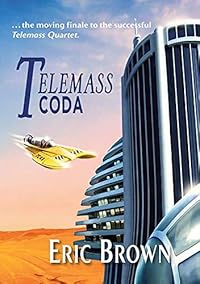
Telemass Coda by Eric Brown

PS Publishing, 2019 , 39 p.

Sixteen years after the events of the last in Brown’s Telemass quartet, Matt Hendrick’s wife Mercury has been ‘lost’ in a telemass transit to Earth from Mars. While she is in limbo – Schrödinger’s Mercury, neither dead nor alive – his daughter Samantha, whom he had chased over the galaxy in the four previous books of the series as his first wife Maatje sought vainly for increasingly outlandish cures for her medical condition, convinces him to still undertake the pilgrimage holiday they had had planned to visit the four main planets of that earlier trek, Fomalhaut IV, Spica III, Reticuli II and Bellatrix I. On each of them Hendrick finds his memories stirred, especially on the third of those, where he had met Mercury. It is on Bealltrix I though where Samantha becomes convinced that its inhabitants, the Vhey, will have saved Mercury from extinction.

Once more here we find some of Brown’s characteristic tropes – enigmatic aliens, artists’ colonies, romantic attachments, a quest of some sort, quasi-mystical experiences, the importance of family – revisited; but it all works and the format is the perfect excuse. If you’ve read the quartet you know what to expect and you would wish nothing less, even if Hendrick’s relationship with Samantha reads as a little cloying and perhaps improbably close since she has a serious boyfriend. Telemass Coda may be short at 37 pages of text but it doesn’t feel so. After all, this is Brown doing what he does best.

Pedant’s corner:- “Time interval” later count – seven. Otherwise; “with a titled tricorne shading her dark Spanish face” (tilted tricorne.) “They can joins two souls into one body (join,) “since she waved goodbye me” (goodbye to me.)

The Highest Frontier by Joan Slonczewski

Tor, 2011, 489 p.

There is not much Science Fiction that deals directly with politics. It’s possibly too contentious a subject. In The Highest Frontier, though, Slonczewski extrapolates from the US situation of the 2000s to present a scenario where a fundamentalist group known as Centrists states baldly that the Sun (and the Firmament) go round the Earth and whose adherents form the core of one of the two main political parties. There has been a sort of balance between those two parties lasting many elections – a statistical tie the last five times – but the results have been accepted, albeit with riots following the count. (Riots apart that is not arguably as grim as things have turned out in the real world where US election results are questioned simply because one side believes that no-one could possibly have voted for the other or else that their opponents’ votes have been inflated nefariously and therefore the elections were fraudulent. No one in Slonczewski’s scenario is claiming election fraud.) A man known as the Creep, due to a medical intervention after an accident leaving only his head and hands as original to him: those hands have a tendency to move away from his body, has been Vice-President for the last several terms. Candidates chose someone else as running-mate but they always got dropped as liabilities just before the vote. Direct taxation seems to have been relinquished – what a USian notion – instead people known as taxplayers have levies placed on their gaming activities.

This is not to say that politics is all that the book concerns itself with, even if Cuba is the fifty-second state of the Union. Global warming has led to Dead zones and migration northwards in the US, a type of plant known as ultraphyte (it ‘feeds’ on uv light) threatens to engulf Earth’s habitat niches and is a further source of political contention.

Jenny Ramos Kennedy is a child from a political family with ancestors and living relatives on both sides of the political fence who have been Presidents. She has been sent to a college on a space habitat known as Frontera to complete her education. Her twin Jordi with whom she was supposed to attend Frontera recently died in an accident and she has been assigned a companĕra roommate called Mary, who is strange. Access to off-world is via a space elevator built from anthrax. Biological engineering is advanced enough to render the material both strong and unharmful. On Frontera, amyloid and carboxyplast are the main structural materials. Resources seem not to be much of a problem at least for the rich. Jenny prints her clothes everyday. Mini versions of Earth creatures provide a simulation of everyday fauna. A political course for some reason leans heavily on Theodore Roosevelt and presumably in his memory the bears on Frontera resemble the toy ones named after him. A version of the internet called Toynet exists. It connects to someone’s personal toybox, is accessed by brainstreaming and usually manifests as an intrusive news service fronted by a reporter called Clive. Frontera’s power source can occasionally be cut off by orbiting debris but does engender the rather pleasing portmanteau word solarray.

There is a ton of such explanation at the beginning of the novel, more often than not clunkily introduced. It slackens off somewhat later on but never entirely disappears.

Jenny’s life is complicated by her family’s political connections. She also is an adept at a game called slanball, a sort of cross between hockey and quidditch only with no magic. The act of slanning instead involves brainstreaming. Her coach is of the strict nothing-must-interfere-with-training type with whom Jenny’s volunteering as a medical first responder and her occasional lack of sleep do not go down well. The game seems to be forgotten about in the latter half of the book, though. Jenny also involves herself with local politics. Voting in these elections includes a ridiculous stipulation that people vote in person, handwriting their choice into the ballot book using a uranium based ink.

Early on in her studies Jenny is told that ultraphyte genes have been found in pileworms. Her tutor leads her into research on plants which can “laugh” due to the introduction of neurons. These are developed into Arabidopsis sapiens and Mary instigates experiments with negative and then reverse controls, which become wisdom plants. Here someone mentions a Greek tag Sophia philai paromen, wisdom is the highest frontier, from which Slonczewski presumably took her title. The plants’ placement onto the stage of a Presidential debate leads to an unusual exchange between the candidates.

Jenny’s attraction to fellow student Tom is par for the course for a tale of an older adolescent – they have the usual misunderstandings and some awkwardness as regards their relative social status – but Slonzcewski’s treatment of such young love and sex is rather coy, in the latter case to the point of blink and you might miss it.

In this future more or less everyone is in effect their own political commentator/extrapolator – a nod to an SF forerunner is provided by a poster of the fictional political predictor Hari Seldon on a classroom wall.

However, the conclusion by some of Slonczewski’s characters that voting is no longer of any utility is a dangerous concept.

Pedant’s corner:- descendents (descendants.) “The faculty were full of expertise” (the faculty was.) “The college ran their own taxplayers rehab” (the college ran its own,) “the amyloid liquified (liquefied.) “The medibot shined a light on his face” (shone.) “A crude pixilated window opened” (pixilated means ‘drunk’, a computer screen window cannot be drunk; ‘pixellated’,) “said Tom said” (either ‘said Tom’ or ‘Tom said’,) sunk (sank.)

Saltflower by Sydney J van Scyoc

Avon, 1971, 174 p.

In the prologue three alien space ships appear over the Puget Sound in 1979 (eight years in the future when the novel was written) then make their way to the Great Salt Desert in Utah where one of them deposits something into the salt, but later investigations fail to reveal anything. Twenty-five years on Marley Greer finds a crystal on the salt bed and lifts it up. It melts in her palm to leave a tiny black seed, which she feels compelled to swallow. That night she tells her husband she is pregnant.

The body of the story unfolds over fourteen days in 2024 when protagonist Hadley Greer (daughter of Marley) undertakes a trip to the Salt Lake Desert where there is a settlement known as New Purification, inhabited by adherents of a cult which effectively worships the aliens. It is led by a Dr Braith (who perhaps surprisingly isn’t the usual money-grasping, sexual predator such leaders commonly are.) In New Purification everyday life is made easier by robotic assistants known as mechs. Over the years of the settlement over twenty people have disappeared in the desert. Braith maintains they have been taken up by the aliens.

Hadley is silver-eyed and has metallic hair which often moves of its own volition. Later we find she is prone to salt hunger. Braith’s associate Jacob has similar attributes to Hadley. Her companion, Richard Brecker, turns out to be a minder, employed by the State Investigation Bureau to keep tabs on her. (His organisation’s initials allow Scyoc to allot them the neat nickname, SIBlings,) Through him she finds there have been other trans-species children but only those close to salty deserts survived.

Unknown to Brecker, Hadley takes trips into the desert at night. There she finds she can see and travel through a strange city, that of the aliens, whose civilisation was dying and so they sought to seed other Earths. In an incidental conversation Brecker and Hadley appear to express themselves as in favour of a return to a system whereby people are imprisoned if they are deemed psychologically capable of a crime rather than actually having committed one. This is an oddly illiberal notion which does not really fill out the background.

The discovery of two murdered bodies in the desert precipitates the novel’s crisis. Brecker finesses the situation by blaming the deaths on rogue mechs but it is Jacob rather than Hadley who is involved with the resolution.

SF is full of linguistic coinages, some more mellifluous than others. Scyoc overdoes the tendency here, where people do not undergo air travel in aeroplanes, they dart in machines called avidarts. Among others we also have a transceiving device named a communipact, food dispensers called autocafs, and the word mecheries where ‘factories’ would be perfectly sensible. But it was her first novel. We can forgive a certain exuberance.

Pedant’s corner:- “the street – and the city itself – were deserted” (those dashes remove what’s inside them from the surrounding phrase so make the verb singular. Either they should be removed themselves or it should be ‘the city was deserted’.) “Besides each work stood a slender pole.” (Beside each work,) nonplussed (nonplussed,) metallicly (metallically.)

free hit counter script