Archives » Science Fiction

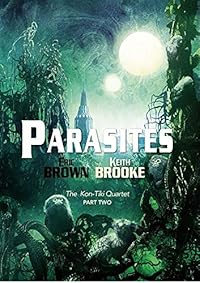
Parasites by Eric Brown and Keith Brooke

The Kon-Tiki Quartet Part Two, PS Publishing, 2018, 79 p.

At the start of this second part of the authors’ quartet the cloned would-be colonists on the starship Kon-Tiki are waking up from their hundred-year suspended animation in preparation for landing on their destination planet Newhaven. A shock awaits them. A city on the planet. A human city. Psychologist Kat Manning now has more on her plate than she had imagined when the voyage began.

In that one hundred years technology has moved on, faster ships have been developed – along with fabrication abilities. Everything humans have created down on the planet has been manufactured from data sent along with the fast ship. That includes the colonists, printed into being once the infrastructure had been built. Two of them, Travis Denholme and Daniel DeVries, are characters familiar from Book One of the quartet. Travis has reason to be excited and apprehensive about meeting Kat again. In the time between the two ships’ departures from Earth the originals of Travis and Kat back home had got married, living well enough together until one day she had been murdered in the bolt-hole she kept in East Anglia. But the data he was printed from is for a Travis in his fifties, balding, and paunchier than in his younger days. The Kat on the ship is still in her subjective thirties and will have no memory of their marriage. The two’s first meeting on Newhaven is profoundly awkward.

The plot revolves around a native Newhaven creature something like a marmoset, which Travis has been studying and which has an unusual ability – hence Parasites being the title of this instalment. It also concerns the triangle between Kat, Travis and Daniel, the latter of whom has too high an opinion of himself and not high enough of the other two. Through this trio we see some of the vagaries of human relationships, their awkwardnesses, jealousies and resentments.

However, the novella’s conclusion seemed like a natural end and I was left wondering how Brooke and Brown would develop their scenario in the next two books.

Pedant’s corner:- “Time interval” later count: five. Otherwise; “None of them were” (None of them was,) “Daniel’s DeVries’ mind-set” (Daniel DeVries’s mind-set.)

ParSec 3

ParSec 3 has become available.

I’ve made lead review!

That’s for my take on Adam Oyebanji’s Braking Day.

Also in ParSec 3’s pages are my reviews of:-

The Last Adventure of Constance Verity by A Lee Martinez

Absynthe by Brendan P Bellecourt,

Only This Once Are You Immaculate by Blessing Murariri

and the first two books of a trilogy by John Birmingham, The Cruel Stars and The Shattered Skies

The Fated Sky by Mary Robinette Kowal

A Lady Astronaut Novel, Tor, 2018, 382 p.

This is the second novel in Kowal’s Lady Astronaut sequence where a 1952 meteorite impact off the Atlantic coast of the US caused not only the inevitable initial devastation (including the deaths of almost all the US government) but, due to the vast quantities of water vapour propelled into Earth’s atmosphere, also a runaway greenhouse effect and an ensuing space programme to colonise Mars as an escape – see The Calculating Stars.

At the start of this book, Elma York, our narrator and said Lady Astronaut, has for some while been part of the lunar base built in preparation for the first Mars trip but is returning to Earth. The craft undergoes a malfunction and crash-lands. The first to reach it are not the expected rescuers but a group of Earth-Firsters (who wish the resources for the space programme to be spent on Earth instead.) This will lead to suspicion that there was sabotage and there are moles within the Mars project. One of the few black astronauts on the craft becomes a focus for this due to the prejudices of a South African, DeBeer, on board.

This is 1961 after all. Racism and sexism are rife in wider society, as they were in our history. Even in this radically altered world, women’s proficiency in technical professions has been accepted only grudgingly, if at all.

Once again Elma is used as a poster girl for the programme (replacing one of the original women chosen for the Mars trip) since she is the publicly acceptable female face of the space effort (as well as an excellent mathematician.) This is a strain as Elma has issues with dealing with groups of people. Her coping strategy, internal recitations of prime numbers, the digits of π or the Fibonacci sequence, is slightly less to the fore here than in the earlier book, though.

Along the way we have an illustration of how difficult and messy the job of unblocking a toilet in weightless conditions would be and also how inherently dangerous an environment space is – not to mention the potential disaster an outbreak of disease on one of the three ships represents.

The situation gives Kowal the opportunity to explore the internal dynamics of a prolonged space flight, complicated in her case by the fact that Mission Commander, Stetson Parker, with whom Elma has a long-standing antipathy, is on her ship. The enforced proximity does, however, allow Parker’s character to be illuminated more closely.

I found there to be a remarkable focus on domestic chores – especially baking. Then again, the women have been allocated such tasks by Mission Control as being eminently more suited to them, a source of ongoing resentment. But the supplies required for baking to be a possible culinary objective on such a flight would be prodigious. Then again, the technology available (teletype machines, for example) is of 1960s vintage. Once more the relationship between Elma and her husband Nathaniel, part of the ground control team, is described in coy terms.

The Fated Sky isn’t great literature, but it isn’t meant to be. It reads easily, does what it presumably set out to do, entertain, and slips in some observations about the nature of humanity forbye.

Pedant’s corner:- “the rachet handle” (x 2, elsewhere ‘ratchet’,) bandanna (bandana,) “A Black man across the aisle with a crooked nose” (why is Black capitalised – and why would an aisle have a crooked nose?)acclimation (acclimatisation.) “Behind this skepticism are a combination of factors” (Behind this scepticism is a combination,) crafts (the plural is craft.) Both these last two were in one of the cod news reports with which Kowal precedes each chapter, O2 (x 3, O2,) ambiance (ambience,) CO2 (CO2.)

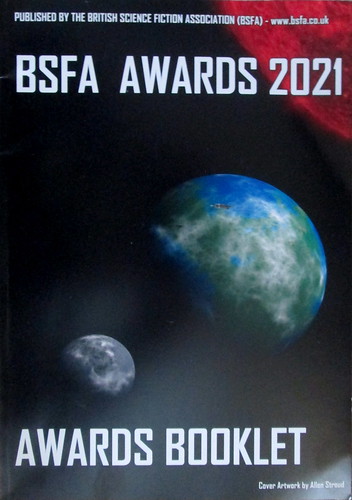
Another BSFA Awards Booklet

BSFA Awards 2021

This year’s BSFA Awards Booklet (for stories published in 2021) arrived on Wednesday.

Unfortunately due to things happening in my life I had no time to read it before voting ended. I’ll get round to it soon.

The awards themselves will be announced tomorrow – as usual at Eastercon.

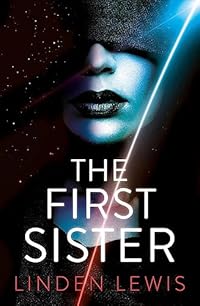
The First Sister by Linden A Lewis

Hodder and Stoughton, 2020, 344 p. Reviewed for ParSec 1.

Sisters are a kind of hybrid of priestess and handmaiden in service to the Goddess. Clad in grey robes, they act as confessors to the soldiers aboard Gean spaceships and are required to submit to their sexual demands without demur. They are literally voiceless, their ability to speak blocked on induction into the Sisterhood. They communicate with others by glance and, between themselves, with hand gestures. Only four sisters per ship are exempt from the sexual role; status as First, Second or Third Sister is denoted by wearing an armband. Adding to this faint echo of the sexual servitude in Margaret Atwood’s The Handmaid’s Tale is the title Aunt(ie), bestowed on that fourth sister, the woman who is the ship’s chief representative of the Goddess.

One of the book’s narrators is the (otherwise unnamed) First Sister of the Gean spaceship Juno, who had been disappointed when her previous captain’s promise to take her with him on his retirement was not fulfilled. She is now looked on with suspicion both by her fellow sisters and Aunt Marshae and has to build a relationship with the new captain, Saito Ren, the Heroine of Ceres, who lost an arm and a leg in the Gean takeover of that minor planet.

As a result of the Dead Century War human society has fractioned into three: the Gean, based upon Earth and Mars; the Icarii, who are settled on Venus and Mercury; and the Asters, gene altered, elongated, thin people who eke out a living from the asteroid belt. Expansion further out into the Solar System is prohibited by the Synthetics, combatant AIs who left for there after that conflict. The Gean and Icarii are in an ongoing state of war. The Gean, though, eschew technology as much as possible, with a particular revulsion to the Icarii use of neural implants and geneassistance. The Icarii’s power is founded on the properties of a substance called hermium, “specific to Mercury,” (whose name was presumably chosen by Lewis on the basis of the more or less magical properties she ascribes to it.)

A second strand is the first person viewpoint of Lito sol Lucius – a somewhat disgraced Icarii, in part blamed for the fall of Ceres. Interspersed with this and the First Sister’s story is a recorded message to Lito passed onto him from his former partner, Hiro. Lito and Hiro were a Rapier-Dagger pair, an Icarii military unit known as duellists. They came together at the Icarii military Academy. Their implants help them bind together telepathically, enhancing their fighting prowess. Lito is recalled from his ostracism to form a new Rapier-Dagger pair with Ofiera von Bain, a much older Academy graduate. Their mission is to infiltrate Ceres to kill both the Mother, head of the Gean Goddess cult, and Hiro, who they are told has turned traitor.

Echoes of other SF inevitably arise. Chapters are headed by extracts from important texts of the various cultures, there is a hint of Ann Leckie in the Gean military set-up, and a glorying in violence for its own sake. Lewis no doubt will argue otherwise but there is more than a fair share of gratuitously spilt blood and chopped heads here, prefaced by a gruesome space execution early on and the emphasis on mercurial blades and neural whips seems odd when their bearers are up against projectile weapons. This may have contributed to the fight/battle scenes being a touch unconvincing.

In a passage which perhaps has somewhat different connotations to a British reader than to others Lito at one point tells us of a superior, “I salute him with two fingers.” On the other hand, Lewis does later mention a two-fingered Icarii gesture of insult.

What at first seems a reflection of the author’s sensitivity via her identification in the book’s blurb as queer (and also a witch. Seriously?) has Hiro’s person always referred to by Lito using plural pronouns. There turns out to be a plot reason for this but when the reader is introduced to Lito’s memories of him Lito does not yet know that reason.

While the recorded message passages were a slightly heavy-handed means of info and back-story dumping Lewis has certainly plotted her story well. However, though conflict is necessary or the reader may not care enough to carry on, The First Sister, readable enough otherwise, leans too much on the violence. And the future of humanity as always at war with itself? Surely SF can do better than that.

Pedant’s corner:- “time interval later”/“within time interval” count, noticeable. Otherwise; “the spherical screen like a port window” (porthole window?) “a family who has” (which has,) Mars’ (Mars’s – which was used later,) “less people” (fewer people,) “I slip between two Aster crafts” (craft.) “The mechanics hiss as the airlock cycles” (The machinery repair workers hiss? ‘The mechanism hisses as the airlock cycles’,) “a pry bar” (a crowbar, or jemmy,) “metal parts for Gean crafts” (craft,) “in perigee to Venus” (perigee is a closest point to Earth, not to Venus; so, ‘perivenera’?) “since the first letter, Ren and I wrote together” (doesn’t need that comma,) smoothes (smooths.) “‘How deep of a hole did she dig?’” (Why that ‘of’?) “‘You’ve grown quite close with Captain Saito’” (quite close to Captain Saito.) On the back cover blurb; Lito val Lucius (sol Lucius.)

Hugo Awards 2022

The list of final nominees for this year’s Hugo Awards has been published.

As far as the novels go the six are:-

A Desolation Called Peace by Arkady Martine (Tor)

The Galaxy, and the Ground Within by Becky Chambers (Harper Voyager / Hodder & Stoughton)

Light From Uncommon Stars by Ryka Aoki (Tor / St Martin’s Press)

A Master of Djinn by P. Djèlí Clark (Tordotcom / Orbit UK)

Project Hail Mary by Andy Weir (Ballantine / Del Rey)

She Who Became the Sun by Shelley Parker-Chan (Tor / Mantle)

Once again, I’ve read none of them. (Ditto for the novellas, novelettes and short stories.)

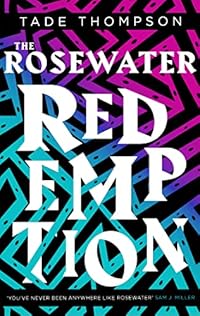
The Rosewater Redemption by Tade Thompson

Orbit, 2019, 380 p.

This finishes off Thompson Rosewater trilogy (I reviewed the previous instalments here and here) and features many of the characters from before – Kaaro, Femi Alaagomeji, Aminat, Jack Jacques, Oyin Da (the Bicycle Girl,) Lora the construct.

There is still antipathy between Rosewater, the city which grew up around the alien dome which had translated itself from London, and Nigeria, from which the city had gained independence. Here the alien city has begun to move slowly towards the sea. Those unfortunates called reanimates, dead humans whose bodies have been revived by the city’s healing powers, are now found to still have residual consciousness, a fact that causes conflict between Jack Jacques, Rosewater’s mayor, and his wife Hannah, a lawyer who represents the reanimates.

A lot of the scenes though again take place in the xenosphere, that mysterious, hallucinatory realm by which the alien Homians remain in contact with their own planet and the individuals waiting there for Earth to be made suitable for their transfer. That contact is cut off and the plot thereafter more or less revolves around the need to make sure Earth is not further invaded.

Thompson’s grasp of human emotions and motivations and his ability to display them are not in doubt but the multiplicity of character viewpoints, as in the two previous books of the trilogy, again renders this concluding volume bitty. As an imaginatory SF/Fantasy vision the Rosewater trilogy is successful in those terms but the tenuous nature of reality in the xenosphere bears the inherent sense of the unsatisfactory of any setting in which the impossible can happen.

Pedant’s corner:- “there are a multitude of footpaths” (there is a multitude,) Nostradamus’ (Nostradamus’s,) Jack Jacques’ (several times, Jaques’s.) “A series of notifications arrive” (A series … arrives,) “the sole benefactor of Mr Tanmola’s estate” (sole beneficiary,) “building to a crescendo” (no. The crescendo is the build, not its climax,) “when I sprung him from jail” (sprang him.) “A small knot of humans follow her” (A small knot … follows her.) “The family seem to have” (The family seems to have.) “None of my actions are part of that” (None … is part,) “a series of graphs appear” (a series … appears,) “will do in a pinch” (will do at a pinch,) “with some of the aliens perpetuating mass shootings” (perpetrating mass shootings,) “the hoi polloi” (I know this is commonly used but ‘hoi’ means ‘the’ so the phrase ought to be rendered as ‘hoi polloi’, or ‘the polloi’,) “begin to rise to a crescendo” (see comment above,) “washeed up” (washed up.)

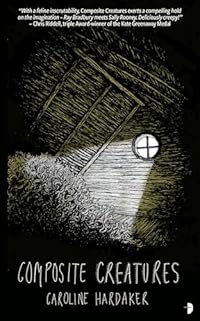
Composite Creatures by Caroline Hardaker

Angry Robot, 2021, 267 p. Reviewed for ParSec 1.

Science Fiction is a broad church, which is arguably at its best when it examines the impact of technology on humans and their relationships. Composite Creatures is such a novel with its speculative background sketched out early on. Among other creatures, birds have vanished – in her youth our narrator’s mother made a collection of feathers in memento. Pollution is rife, even garden soil and plants are contaminated. The NHS is more or less gone, signed up with a private institute to make up for lack of funding; apparently in response to an endemic disease known as the greying. (Reviewer’s note: that institute at present would have to have enormous pockets; but this NHS appears much reduced in scale and ambition.) Technology is being used to synthesise or simulate versions of natural organisms. There are also hints that human fertility has been compromised.

The story is narrated by Norah, a woman in her thirties. She has entered a relationship with Art, a somewhat older writer of forgettable crime novels, who has emigrated from the US to live with her. Theirs is a curiously distanced liaison, little or no passion is displayed, even after Art proposes to her; it is certainly not a conventional romantic relationship. Norah has been in love before, though. There are frequent mentions of Luke, an ex-boyfriend. Her friendships with Aubrey, Eleanor and Rosa are also often in her thoughts. In her office job at Stokers, Norah tells us she is efficient but keeps her head down. (This aspect of the novel was a touch unconvincing. The interpersonal dynamics shown seemed odd.)

Norah and Art have signed up to a mysterious clinic called Easton Grove for which they were subject to a thorough vetting process. Hardaker leaves the terms of their contract vague while implying they can be over-intrusive, but this may be a reflection of Norah’s hypersensitivity. However, the Grove seems to have wider influence in society, as an exchange with Norah’s boss indicates.

The couple’s reward arrives in a cardboard box; a creature like a baby but clearly not one. A “faceless bundle of grey fluff” which is fed on what Norah calls “tinned slush”. This is the Grove’s product, an ovum organi (whose exact function Hardaker leaves unconfirmed until late in the book, leaving the reviewer with a dilemma.) Their interactions with the new arrival, a female, rapidly take on the aspects of parenthood, though the creature is kept in their loft, and later given the run of the house.

Despite cautions against, Art and Norah name their charge Nut, and Norah in particular becomes very attached to her in a series of scenes which could almost have been a depiction of the feelings of a new mother towards her child.

Ova organi are an option available only to the wealthy – or to those who can just afford it, a category Norah and Art fall into but her friends do not. The ova are not entirely acceptable to wider society as a group of protesters against the Grove illustrates on one of the couple’s visits there. This, along with Norah’s increasing fixation with Nut and failure to keep up with the problems in her friends’ lives are two of the contributors which lead to the disintegration of Norah’s friendships and to her descent into self-centredness. Her focus on Nut is entirely comprehensible. Nut is flesh of Norah’s flesh after all – and of Art’s. That self-centredness is the driving force throughout. The ova are a technological solution to both the greying and to an aspect of the human condition to which the society depicted in Larry Niven’s stories of Gil the ARM Hamilton adopted a very different approach.

Novels which hitch themselves to the literary end of the SF genre, which focus on small stories as this one does, sometimes find themselves overlooked in favour of more glittering vistas. Composite Creatures is, though, very well written,* and psychologically believable. It also manages to avoid the pitfalls of excessive information dumping (until it gets a bit more open towards the end.) It’s certainly one for those who prefer SF driven by its characters.

*At one point the text mentions Science Fiction, not generally regarded as a good idea in an SF novel as it tends to break suspension of disbelief.

Pedant’s corner:- innumerable instances of ‘to not’ followed by the required verb rather than ‘not to’, also many uses of focussed or focussing rather then focused or focusing, “Mom or Luke say something new” (the ‘or’ makes it singular; ‘says’.) “The final piece of …. were a pair of socks” (the final piece … was a pair,) bannister (banister,) “along endless roads that lead to” (context and previous tense implies ‘led to’,) sprung (sprang,) sat (sitting,) a semi-colon where a comma would have sufficed (and even that wasn’t necessary,) echo-y (echoey?) gamble (gambol – an odd error, Hardaker had gambolling later in the book,) “the tickling of his fingers on the nape of my neck were far more vivid” (was far more vivid,) “a larger crowd … were crowded around” (was crowded around.) “one of the woman” (women.) “I pressed it back together and returned to the grave before carrying on walking” (no grave had been mentioned, ‘returned it to the ground’ makes more sense,) sneakers (trainers, please,) a missing comma before a piece of direct speech (more than once,) snuck (sneaked,) “the men’s room” (this is set in Britain, it’s ‘The Gent’s’,) outside of (outside, no ‘of’,) inside of (ditto, just ‘inside’,) fit (fitted,) Markus’ (Markus’s,) “estate agents’ office” (estate agent’s office,) “to diffuse the situation” (x2, defuse,) “his trousers hug loosely” (hung loosely.) “Either me or Eleanor was” (Either Eleanor or I was,) stood (standing,) “that I’d already drank too much” (drunk,) “‘It’s New Year’s’” (New Year; no apostrophe,) piece de resistance (pièce de resistance.) In the Acknowledgements; beˋing (being.)
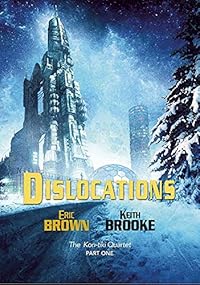
Dislocations by Eric Brown and Keith Brooke

The Kon-Tiki Quartet Part One, PS Publishing, 2018, 100 p

Dislocations cover

The Kon-Tiki is an interstellar colony ship weeks from lift-off with its cargo of cloned humans, soon to be imprinted with their originals’ personalities, originals whose expertise is held to be too valuable to send away from Earth themselves. Our two viewpoint characters Travis Denholme and Kat Manning are part of the crew readying the mission. In this eco-catastrophe-threatened world a group called the Allianz, vehemently opposed to this use of resources which it sees as a waste, pickets the base’s entrance while its foreign associates perpetrate worse actions.

Denholme is attracted to Manning but her affections lean more towards his friend and fellow worker Daniel DeVries. In the eyes of the authorities a past relationship with Ute, now an Allianz activist, hovers over Denholme’s reliability.

Anyone familiar with the work of co-author Brown will recognise aspects of this. There is a certain style to it which bears his stamp. This is not to deny fellow writer Brooke’s input. I could not say for sure which parts were written by Brown and which by Brooke as it reads seamlessly. It is possible they undertook alternate chapters.

After the onset of the imprinting Manning is kidnapped, seemingly by the Allianz. Denholme is questioned about his association with Ute but his lack of involvement is accepted grudgingly. He and DeVries are instrumental in discovering her whereabouts and also what is the real threat to the mission.

The immediate story is satisfactorily resolved within the book’s 100 pages leaving us to wonder what is to come in the succeeding volumes of this quartet.

“Time interval” later count: 10.
Pedant’s corner:- in the blurb; “one of the eighteen specialist” (specialists.) Otherwise; “conduct with last woman he’d dated” (with the last woman,) “was it sooner that that” (sooner than that,) “Richards’” (Richards’s.) “Graphs sprung up” (sprang up,) “until he realised that that” (only one ‘that’ needed,) “‘Don’t looked so surprised’” (‘Don’t look so surprised’,) iced-covered (ice-covered,) “‘Tyres tracks’” (Tyre tracks,) “tyres marks” (tyre marks. I suppose this could be tyres plural but then it should be tyres’ marks.) “‘What if Lauren and Danvers planning to sabotage’” (‘What if Lauren and Danvers are planning to sabotage’,) “but he seems as surprised” (the rest of the story is in past tense; ‘seemed’.)

ParSec Again

You may have noticed on my side bar that I have been reading a book titled The Space Between Worlds written by Micaiah Johnson.

It’s the latest book I have received to review for ParSec online SF magazine.

This is a parallel worlds story by another author new to me.

The copy I have received is the paperback issue from Hodder. A hardback came out in 2020.

free hit counter script