Archives » History

Wideford Hill Chambered Cairn, Orkney (ii)

Cairn’s entrance ladder:-

Wideford Chambered Cairn Ladder

Entrance from inside. You can see it’s quite restricted. The woman in the picture was our travelling companion:-

Entrance to Wideford Chambered Cairn, Orkney, from Inside

There is some graffiti on the walls.

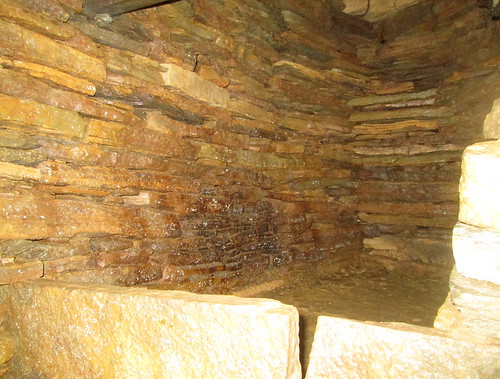
Interior side wall (i):-

Wideford Chambered Cairn, Orkney, Wall

Interior side wall (ii):-

Wall, Wideford Chambered Cairn, Orkney

Close up on graffiti:-

Graffiti, Wideford Chambered Cairn, Orkney

Original entrance from inside:-

Original Entrance, Wideford Chambered Cairn, Orkney

Chambers:-

Inside Wideford Chambered Cairn, Orkney

Inside Cairn , Wideford, Orkney

Inside  Wideford Cairn, Orkney

The side of Wideford Hill where the chamber sits overlooks an inlet of the NorthSea/Atlantic called the Bay of Firth. The settlement of Finstown lies to the far left of the Firth, beyond the islands as seen in this photo stitch:-

From Wideford stitch, Orkney

Wideford Hill Chambered Cairn, Orkney (i)

Wideford Hill Chambered Cairn, Orkney was one of the ancient sites in the Orkney Islands we didn’t visit in 2017. We tyook it in in June last year.

The approach is up a very steep – and winding – farm road till you reach the car park (grandiose description for two parking spaces) from which you can look down to Kirkwall. The photo also shows some of the road:-

Kirkwall From Wideford Hill

There is a view of Scapa Flow from there too:-

Scapa Flow from Wideford Hill

A notice at the car park said the chambered cairn was about half a mile away on a path round the hill. It was much longer than that.

You can see me walking the path here in a photo taken by the good lady. As you can see the cairn is nowhere in sight and we had been walking for about twenty minutes by this time:-

Bay of Firth from Wideford Hill, Orkney

Cairn from path. To the left you can see the box in which the key to the entrance is kept and the information board:-

Wideford Chambered Cairn, Orkney, neolithic

Information board:-

Wideford Hill Chambered Cairn, Orkney, neolithic

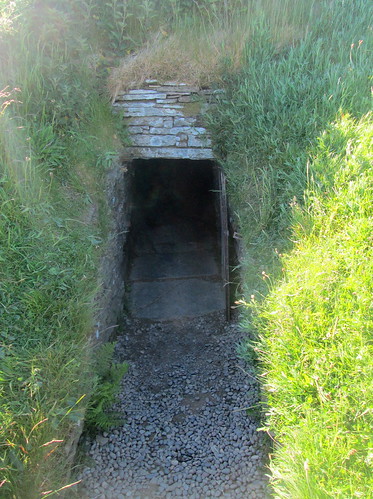
Original entrance (now gridded off):-

Wideford Chambered Cairn Original Entrance

Cairn from above. The modern entrance is the blue square on its top

Wideford Chambered Cairn, Orkney

OVERLORD: D-Day and the Battle for Normandy 1944 by Max Hastings

BCA, 1984, 366 p.

This is an overview of the Normandy campaign from its planning through D-Day itself and on to the breakout from the beachheads to the closing of the Falaise pocket. The author’s stance on the campaign is that the Germans had the better resolve, equipment and better trained soldiers, but the Allies an overwhelming superiority in matériel and supplies. Not that that necessarily meant victory was a foregone conclusion. Much hard fighting was required. Casualty rates – on both sides – were prodigious, in some units 100%.

After the landings there was a belief among the Allies that firepower alone would suffice to beat the Germans but events proved this to be misplaced and progress did not depend on leadership. Hastings says that “few American infantry units arrived in Normandy with a grasp of basic tactics,” though their airborne troops did. There were some less than effective commanders but replacing them tended to have little effect. Even the better generals (Patton included) could not improve the performance of poor quality divisions. Problems – in both Allied armies – often lay at regimental and battalion level. German soldiers, however, adapted at once to the need for infiltration in the bocage, “their junior leadership was much superior to that of the Americans, perhaps also to that of the British.” Hastings does note that Bradley’s response to the Mortain counter-attack was, being calm and unflustered, a better command achievement than Patton’s haring around north-western France.

One thing I hadn’t realised till reading this was that even in the run-up to D-Day both Allied Air Forces were still reluctant to carry out the softening up bombing required in Northern France as they were of the opinion that they could win the war by themselves by attacking German industry and so no ground invasion would be required. Quite how this belief held on is odd since it ought to have been obvious that the German bombing Blitz on British cities had not greatly damaged the morale of the British people. Certainly not so far as to make the Government sue for peace with Germany. However, the bombing campaign over Germany in early 1944, while not really limiting aircraft production, had led to the defeat of the Luftwaffe due to the Mustang P-51 fighter’s effectiveness in inflicting losses on the Germans, whose aeroplanes and more crucially pilots consequently were not available to contest control of the skies over the invasion force. Another contributor was the Allies’ denial to the Germans of weather recording stations in the North Atlantic so hampering their forecasting. And of course there was FORTITUDE, the deception plan which had many Germans believing the Normandy invasion was a feint and another attack would take place on the Pas de Calais. As a result the Germans were unprepared for the attack when it came. Rommel of course was famously at home for his wife’s birthday and Hastings seems so tickled by the tit-bit that the German general Feuchtinger was apparently closeted away with a female friend on the night of June 5th – 6th that he tells us this twice.

Since the area round Caen was the hinge of the Allied force (and closest to Germany if a breakout were to take place) the Germans of course sent their best forces there. This meant the British and Canadians always faced the cream of the German troops in Normandy. The pressure was nevertheless such that Rommel was forced to use his tanks to shore up his defensive line and consequently could not concentrate them for a counter-attack. Montgomery was always conscious that British manpower was limited and the need to minimise losses resulted in overuse of what the Allies had a lot of – armour – as against a mix of armour and infantry. However, he did his reputation no good by continually misrepresenting the situation and his intentions both at the time and afterwards. In the end it was massed fire-power, particularly artillery, which wore down the Germans. In this context it is noteworthy that the historian Basil Liddell Hart later said that OVERLORD was “An operation that went according to plan but not according to timetable.”

Pedant’s corner:- focussed (many times: focused,) ditto “focussing” (focusing.) “One of the greatest throngs of commanders ever assembled … were gathered” (One … was gathered,) “Canaris’ loyalties” (Canaris’s,) “Brigadier Williams’ worst fears” (Williams’s,) “reached a crescendo” (reached a climax,) “the infantry were deployed” (was deployed,) “less weapons” (fewer weapons,) “Sepp Dietrich’s I SS Panzer Corps were quite unable” (was quite unable,) “the sheer enormity of the forces” (not enormity, they were not monstrous except in so far as any army is; ‘extent’.) “The SS were increasingly obsessed” (this is the SS as a whole, therefore ‘The SS was’,) Hodges’ (Hodges’s.)

Barnhouse Stone and Maeshowe Again

The arrangements for accessing Maeshowe in Orkney had changed since the first time we visited. Now you have to take a bus from the visitor centre a few hundred yards along the road. As a result we heard of the Barnhouse Stone which sits in a field a bit west of Maeshowe and lines up with it and one of the solstices.

I later stopped to photograph it:-

Barnhouse Stone, Orkney

Maeshowe from Barnhouse Stone:-

Maeshowe From Distance

Maeshowe entrance:-

Outside Maeshowe

Ness of Brodgar from Maeshowe. The Ness of Brodgar is the spit of land between the two lochs you can see in the photo. Just below the lowest rightmost hill in the background you can make out the Ring of Brodgar:-

Ness of Brodgar

View southwest from Maeshowe:-

View from Maeshowe

View from Maeshowe towards Hoy:-

View towards Hoy from Maeshowe
er>

Sons Are 150 Years Old

Today is the 150th anniversary of the founding of Dumbarton FC, first football Champions of Scotland and one of only seven teams whose names can be found on the Scottish Cup (as opposed to plinths below it.)

I obviously haven’t supported the Sons for that length of time. (It just feels like it.)

I wasn’t around for the glory days of those two League Championships in 1891 and 1892, nor the Scottish Cup (1883) and Festival of Britain St Mungo Quaich (1951) wins but I have witnessed seven promotions including three divisional championships, a Scottish Cup semi-final and a Challenge Cup final. Not bad for a diddy team.

Tomorrow’s home game against East Fife will be a special celebration day.

Congratulations to DFC on its anniversary.

Skara Brae, Orkney (iv)

I featured three posts about Skara Brae the https://jackdeighton.co.uk/2017/07/23/skara-brae-orkney-i/ (in 2017.)

This time we were with a friend who hadn’t been there so it was on the list again:-

An Information Board at Skara Brae Board

Ruins at Skara Brae

Skara Brae, Orkney, neolithic dwelling, Scotland

Skara Brae House Interior

House Remains, Skara Brae

Skara Brae, neolithic dwelling, Scotland

Skara Brae, neolithic dwelling, Orkney, Scotland

Skara Brae, Orkney, neolithic dwelling, Scotland

Aberlemno Symbol Stones

Aberlemno in Angus is a village notable for three large Pictish Symbol Stones located just north of the village.

Aberlemno, Board Pictish stones

Aberlemno Stone , standing stone, Pictish, Aberdeenshire

Aberlemno Stone, Pictish, standing stone, Aberdeenshire

Aberlemno Stone, standing stone, Pictish, Aberdeenshire

These are respectively, the Serpent Stone:-

Information Board, the Serpent Stone, Aberlemno

The Crescent Stone:-

Aberlemno Stone , the Crescent Stone, standing stone, Aberdeenshire

And the Roadside Cross:-

Aberlemno Stones, The Roadside Cross Information Board

Reverse of the Roadside Cross:-

Aberlemno Stone  reverse, Aberdeenshire, Pictish stone, standing stone

There’s also a Pictish Stone in the churchyard at Aberlemno:-

Aberlemno Churchyard Cross

Reverse of churchyard stone:-

Churchyard Cross, Aberlemno, Aberdeenshire, Pictish cross

Information Board:-

Info Board Churchyard Cross

This replica of the churchyard cross is situated at the edge of the car park for the stones:-

Aberlemno, Replica of Churchyard Cross

Midwinter by John Buchan

Certain Travellers in Old England

B&W Publishing, 265 p, plus iv p Introduction by Alan Massie.

Here is another Scottish novel which scratches the 1745 Rebellion itch but unusually this one is set entirely in England. Presented as a partially incomplete found manuscript it tells the story of Alastair Maclean who had lately been in the service of the King of France but had returned to British shores in order to facilitate the rising of Charles Edward Stuart’s supporters in Wales and the West of England.

Maclean’s mission is a dangerous one; a traveller on the byways in those days was always apt to come under suspicion. With the help of the Naked Men and their leader – the Midwinter of the book’s title – he escapes from apprehension by a man charged with taking any who can not give a good account of themselves to the local magistrate, and arrives at the house of Lord Cornbury, a known Jacobite sympathiser but also one who recognises the folly of the Prince’s enterprise. From then on Midwinter’s group pop in and out of the narrative.

The company at Lord Cornbury’s is supposed to be mainly Jacobite but later it transpires there is a traitor to the cause amongst them, one who thereafter continually dogs and frustrates – given the outcome of History how could he not? – Maclean’s efforts to get to Derby with supposedly good news. Lady Mary Conbury has an unusual take on Mary Queen of Scots. “‘Her frailties were not Stuart but Tudor. Consider Harry the Eighth. He had passions like other monarchs, but instead of keeping mistresses he must marry each successive love, and as a consequence cut off the head of the last one. His craze was not for amours but for matrimony. So, too, with his sister Margaret. So, too, with his great niece Mary. …. What ruined the fortunes of my kinsfolk was not the Stuart blood but the Tudor – the itch for lawful wedlock which came in with the Welsh bourgeoisie.”

A surprise visitor arrives in the form of a tutor to a seventeen-year old girl, Claudia Grevel. This ill-clad worthy is none other than Samuel Johnson, disturbed that Claudia has run off with a Mr Norreys and seeking help to catch the pair before they can be married, a task in which he is doomed to fail. Johnson and Maclean become friendly and travel together for the latter half of the book. Johnson’s appearance in the novel allows Buchan to insert into the text some of that gentleman’s aphorisms.

At a later point the pair fall into the hands of troops loyal to King George. Their commander is a General Oglethorpe whom they met at Cornbury. He berates Maclean on why Charles will not succeed. A new breed of belief, the Methodists, had arisen in the south – “with them is the key of the new England, for they bring healing to the souls of the people. What can your fairy Prince say to the poor and hungry?”

Maclean thinks both Midwinter and Oglethorpe spoke of England like a lover to his mistress and that the country was akin to a spell on sober minds. He tells Midwinter, “You in England must keep strictly to the high road, or flee to the woods – one or the other, for there is no third way. We of the Highlands carry the woods with us to the high roads of life. We are natives of both worlds, wherefore we need renounce neither,” and indeed Midwinter spends most of his time in that mystical realm, the greenwood.

This is a tale packed with adventure, incident, betrayal and peril, but also insight. And it displays an eye for landscape which, though in this case is the English countryside, is a hallmark of Scottish writing.

Pedant’s corner:- King Louis’ service (Louis is pronounced as if it had no ‘s’ at the end; therefore Louis’ will also be so and hence to make its meaning clear its possessive must have ’s at its end: Louis’s,) bourgeoisie (was this word in use in the late eighteenth century?) “Jack Norreys’ neck” (Norreys’s,) ditto Lady Norreys’, “The forest had woke up” (woken,) “came the gypsies crazy cackle” (gypsy’s.)

Vindolanda Roman Fort, Northumberland (iii)

Taking the path at Vindolanda down the (actually pretty steep) hill on the way to the museum you come to a memorial dedicated to the legionnaries who served there from AD (aka CE) 85-400:-

In Memoriam To Roman Soldiery, Vindolanda

At the bottom of the hill is a steam crossed by a lovely stone bridge (though as I recall the path over to the museum is by a more modern bridge lower to the water):-

Stream and Bridge at Vindolanda Roman Fort, Hadrian's Wall

The view in the other direction shows a reconstructed temple. The inscription reads Nymphis Sacrum Vicani Vindolandes (The Nymphs of the Sacred Village of Vindoland):-

Vindolanda Roman Fort, Reconstructed Temple

And slightly further up the bank there there is a globe sculpture:-

Reconstructed Temple at Vindolanda Roman Fort, Hadrian's Wall

Replica Temple, Vindolanda

Behind the viewpoint of the previous picture are these replica carved stones:-

Replica Stones at Vindolanda

Vindolanda Roman Fort, Northumberland (ii)

Ruins at Vindolanda:-

Remains of Fort, Vindolanda

Ruins at Vindolanda

Vindolanda Ruins

The heart of the fort:-

Heart of Fort, Vindolanda

A hypocaust:-

A Hypocaust at Vindolanda

A corner tower:-

Corner Tower, Vindolanda

Information board about the temple to Jupiter Dolichenus:-

Information Board, Vindolanda Roman Fort, Hadrian's Wall

Information board for Prefect’s House:-

Information Board for Prefect's House, Vindolanda

Ongoing excavations. Note the blue buckets:-

Excavations at Vindolanda,Vindolanda Roman Fort, Hadrian's Wall

free hit counter script