Archives » Science Fiction

Dawn by Octavia E Butler 

Headline, 2022, 287 p. First published 1987.
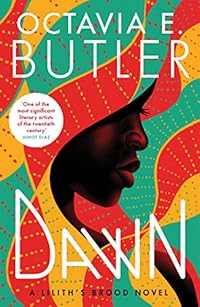
When originally published the trilogy of which this is the first instalment was titled Xenogenesis. It now seems to be called Lilith’s Brood.

Lilith Iyapo wakes up in what appears to be a prison cell, provided with bland food. She has memories of this happening previously and also of her life on Earth when her husband and child had died in a traffic accident. This was shortly before a nuclear war left the planet uninhabitable (to humans at least.) She soon learns that a few humans were rescued from the apocalypse by an alien race, the Oankali; a species for which genetic engineering is essential.

The first appearance to her of an Oankali shocks her: they are covered in small tentacles acting as sensory organs, and which are attracted by movement. The Oankali have three sexes; male, female and ooloi. All have the ability to sense the biochemistry of genetics but the ooloi can manipulate it and build offspring from their mates’ genes.

Lilith is told a cancer has been removed from inside her and that the spaceship she is being held on is alive. The Oankali find cancer to be an attractive trait for their genetic manipulation purposes. They want to blend their own and human genetics, in part as their biological imperative but also to eradicate hierarchical tendencies from humans. They envisage Lilith’s part in this as to Awaken other humans and prepare them for this gene trade and a return to Earth. Lilith and the subsequent Awakened find the prospect repugnant.

When a sufficient number of people have been Awakened there are problems within the group. Specifically, some are wary of Lilith not only as a black woman but of her closeness to the Oankali and of the capabilities to manipulate the structure of the ship with which the they have endowed her, abilities naturally seen as suspicious by those not so treated.

In Dawn there are early similarities to other works of SF where people have been kept in captivity. The whole, though, depends on the credibility of the aliens and their motivations. I wasn’t entirely convinced.

Pedant’s corner:- “Where had all this been, Lilith wondered” (needs a question mark,) a missing end quotation mark after a piece of direct speech, “gasses” (gases,) “had come on to the bed with her and lay down” (and lain down,) “clean shaved” (clean shaven,) “Paul Titus’ wall” (Titus’s. Titus’ appeared again later,) “their own betrayal: No trip to Earth” (colons are not usually followed by a capital letter; ‘betrayal: no trip…’) A paragraph beginning with a piece of direct speech without having an opening quotation mark (I know this is a publishing convention but to me it feels wrong,) repellant (repellent.) “She froze where she stood and had all she could to keep from turning and running away” (is expressed awkwardly.) “It said nothing more, made no sound of its own pain” (ditto,) “she recognised Ahajas, Nikanj’s female mate as the owner” (she recognised Ahajas, Nikanj’s female mate, as the owner.) “She waited almost eager for the darkness” (needs a comma after waited,) Ahajas’ (Ahajas’s.)
Ian Watson

I have just seen from various sources that SF writer Ian Watson has died. I’m so sad to hear about this.

I knew he had been ill recently but had been under the impression he was recovering.

I have thirty of his books on my shelves, the most recent of which was The Chinese Time Machine which I reviewed for ParSec in 2023.

The first time I met him was when I attended the signing event for my first short story publication, The Face of the Waters, in New Worlds 2 way back in 1992.

He was a gentleman and had a particularly sharp wit.

Ian Watson: 20/4/1943 – 13/4/2026. So it goes.

Not by Bread Alone by Naomi Mitchison

Marion Boyars, 1983, 163 p.

A company called PAX has been developing various projects to improve crop types and yields over the world. This culminates in a product known as freefood, which promises to make human existence easier. It is widely welcomed nearly everywhere – a notable holdout is the indigenous Australian community of Murngin in Arnhem Land, North Australia, which has achieved a kind of independence.

Like in Mitchison’s other Science Fiction forays there is in the narration a high degree of telling not showing. Most of the story concerns itself with the scientists involved and interactions among the people running PAX and the reading experience is somewhat dry. Very little of what would be the social ramifications of such an innovation as freefood is explored. War has apparently ended because, as one character says, it was fought for food.

(Well, to a point: water too, and resources, but let’s not forget in these troubled times personal aggrandisement.)

The ‘future that never was’ that bedevils older Science Fiction stories is illustrated by Mitchison’s characters’ long distance communication methods (video calls) anticipating Skype or Zoom but not, of course, the internet or email.

There is an implicit racism – reflecting the times of 1983 but perhaps not Mitchison herself? – in one character referring to ‘Abos’ saying, “‘They could be a no-good mob,’” but admitting, “they got treated in a no-good way in Queensland,’” plus another use of ‘Abos’ in an unflattering context.

The promised paradise of hunger being banished from the world is disturbed when deaths start to occur among some of those using freefood. This is due to a compound called dioscorin which is found in yams and usually removed by the processes of preparing and cooking. Freefood production has omitted these steps.

Mitchison’s writing is usually perfectly agreeable. Her other (ie non-SF) fiction does not suffer from the flaws I have noted above and before here and here – even though some of it is set in such alien (to us) societies as Ancient Greece or Rome. That tendency to didacticism apparent here is missing from those.


Pedant’s corner:- In the inside cover blurb “polictical” (political,) skillfully (skilfully.) Elsewhere; a missing comma before a piece of direct speech embedded within a sentence (x 3, one without a capital letter at the beginning of the dialogue,) “fresh lime, nimbupani” (fresh lime nimbupani,) a switch into a different font size and back again (x 2,) an end quotation mark in the middle of a piece of dialogue, Bangla Desh (nowadays spelled Bangladesh,) Campuchea (nowadays spelled Kampuchea,) Quazulu (nowadays spelled Kwazulu,) grand-parents (nowadays spelled grandparents,) “none of them were any longer newsworthy” (none of them was …,) “nobody would be allowed to turn in into money” (to turn it into money,) Djuvalji (elsewhere always Djiuvalji,) “a dangerous precendent” (precedent,) peole (people.) “‘Still and on’” (isn’t the phrase ‘Still and all’?)

A Calculated Life by Anne Charnock

47 North, 2013, 199 p, plus ii p Acknowledgements and i p about the Author.

Jayna has an affinity with numbers and is employed as a researcher into trends for a firm called Mayhew McCline. But she is also a simulant, a type of clone developed to carry out high grade tasks for the corporations who dominate this future society.

Most humans, known as organics, are immunised against violence, addiction and over-indulgence and – except for a few allowed to do more menial tasks – spend their time in enclaves. So-called bionics (humans deemed suitable) have been given implants to enhance their capabilities, are relatively freer and better employed.

Simulants spend their out of work hours in rest stations, where their food and even sleeping times are controlled. As a result, Jayna’s life tends to be repetitive. Normal human interactions, such as sexual liaisons and it seems empathy, have been edited out of their make-up. However, Jayna keeps stick insects as pets of a sort. Simulants who show themselves to be unsatisfactory in some way are subject to recall and reinitiation – taken back to the Constructor.

Jayna begins to doubt herself when some of her predictions turn out to be off the mark and begins to wonder if she needs more contact with organics. Earlier simulants have been withdrawn from use but Jayna’s cohort has been endowed with better olfactory senses which she believes are tied up with emotions and ability to empathise.

The novel is a slow unfolding of Jayna’s development and – as she mixes more with bionics and organics – of her questioning her role and treatment.

The prose in A Calculated Life is stilted at times but this is a reflection of Jayna’s thought processes as a simulant. In all, the novel is an understated examination of a dystopia. Let’s hope it’s treated as a warning and not a blueprint.

Pedant’s corner:- Published in USian. “‘Pigeons are not animals. They’re birds.’” (Birds are animals; like humans, they belong to the class of vertebrates,) “rinsed it and lay in gently on the wooden board” (and laid it gently.) “‘That’s funny we were chatting the other night’” (needs a comma after ‘funny’,) “asked a women” (woman,) luck-luster (lack-luster; or in British English ‘lack-lustre’.)


Here We Are Again

Book cover for Green City Wars

Another title to be reviewed for ParSec has duly arrived.


This time it’s the latest from Adrian Tchaikovsky.


It’s called Green City Wars. I’ll get on to it soon.

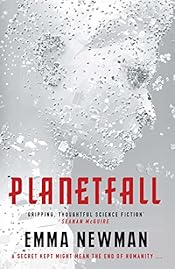
Planetfall by Emma Newman

Gollancz, 2018, 324 p, plus ii p Acknowledgements.

That I have read Newman’s Planetfall sequence in the wrong order (3,4,2,1 to be precise) doesn’t really matter that much as they can all be read as stand alone titles. Here, we are in the years after an expedition to another planet under the guidance of a woman called The Pathfinder in search of God. On landing the expedition’s members found what is now called God’s city. This is an “organic citadel” like a “huge forest of baobab trees tangled round one another,” and, when hot, grows tendrils to manage the heat.

The story is narrated by expedition member Renata Ghali (Ren,) the settlement’s 3D printer engineer, whose later revelation to be a hoarder whose home pod is piled with rubbish stolen from the settlement’s recycling machine, the Masher, is an indication of possible unreliability. She is troubled by fellow expedition member Cillian Mackenzie (Mack,) whose resolve held the community together after the Pathfinder did not return from a foray inside God’s City, saying she was “communing with the creator,” and telling them all to await her return. What has evolved in the colony in the years since is in effect a cult.

Some time after The Pathfinder’s disappearance, other members of the original expedition were lost elsewhere on the planet. Plot kicks in when a lone outsider called Lee Sung-Soo, a survivor of those lost colonists, who is also The Pathfinder’s grandson, turns up at the city.

Ren’s obligations to Mack take her inside God’s city, a strange unsettling place where perspectives shift and passageways can suddenly change orientation. Her explorations lead her to wonder whether the colonists are the first or if there have been previous visitors to the planet; visitors who could only have been alien.

As things unfold we discover what actually happened to The Pathfinder inside God’s city, the revelation of which to the colony has ramifications for Ren, Mack and the settlement as whole.

Newman’s writing is not in question. She is particularly good on Ren’s mental disintegration.

The integration of religious elements with an SF setting is a little awkward though.

Pedant’s corner:- Printed in USian, bacteria (the word is treated as if it’s singular – but that would be bacterium,) outside of (x 2: just ‘outside’; no ‘of’,) “none of them satisfy me” (none of them satisfies me,) “in the opposite direction of God’s city” (it’s ‘opposite direction to’ not ‘opposite direction of’.) “None of them were looking at me” (None of them was looking at me.) “None of them are good” (None of them is good.) “None of them are paying attention” (None of them is paying attention,) “neither of them say anything” (neither of them says anything.) “None of them are listening” (None of them is listening,) “our species’ capacity” (species here is singular; so ‘the capacity of our species would be better.) “None of them are familiar” (None of them is familiar.)

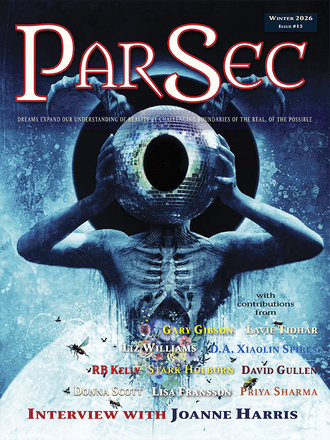
ParSec 15 Update

ParSec 15 is indeed live and I now have my copy.

I found it does contain my reviews of City of All Seasons by Oliver K Langmead and Aliya Whiteley along with The History of the World by Simon Morden but not that of Project Hanuman by Stewart Hotston.

I have four other reviews there though:-

The Measurement Problem by David Whitmarsh,

Halcyon Years by Alastair Reynolds,

Exiles by Mason Coile,

plus Solstice by Ruth Aylett and Greg Michaelson.

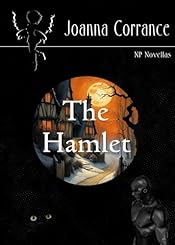
The Hamlet by Joanna Corrance

NewCon Press, 2025, 115 p. Reviewed for ParSec 14.

This was published as a novella but reads more like an assemblage of short stories with characters which cross over from one to the next, though outwith their own tale, usually only in brief appearances. Its background premise – something strange (but unspecified) has happened and people have been advised to remain indoors – may be a literary response to Covid. The setting is a small village in Scotland – locals call it a clachan but incomers have used the description hamlet (which I note is actually a particularly English designation) for so long that it has become more common. The village ‘spinsters,’ however, still frown upon it. Apart from the first, very short, chapter which introduces the strange event, each section is given over to the experiences of different characters, Beth, Polly, Helen, Eve, Robyn and Jeanie, with the novella ending with a sort of epilogue from the point of view someone called the Spaceman.

The stories’ time scales are not always immediately apparent as some chapters start before the strange event or more or less ignore it happening. However, there’s enough oddness going on even without it.

Responding to a voice calling to her, Beth, who has inherited her home from her mother and not improved it in any way, instead letting it run to squalor, manages to move through the pipes in her plumbing, whether by her shrinking or the pipes expanding is moot. Eventually she is drawn down to an underground chamber to chat with the spinsters about the end of the world. The chapters which follow may represent different ways in which that end happens.

Thanks to the green-suited spaceman who appears at her window one night, schoolgirl Polly travels the universe and becomes both a witch and a princess.

Helen begins to produce videos which attract internet followers but increasingly show her lack of control of her life.

To escape the locked down city Eve has come to the cottage she rents out to Matthew (known locally as the Pest.) Not a good choice.

At Helen’s request Robyn builds a doll’s house as an exact replica of Helen’s home but realizes it also needs a doll’s house inside it and then another inside that and so on down.

Jeanie begins to act strangely and eventually locks herself away from everyone. She is however revealed to be a figment, a skin the narrator wore to make her life more amenable. The implication is that all the viewpoint characters are such skins. (But this is the essence of fiction. The reader temporarily becomes – or at least empathises with – a book’s characters.)

The Spaceman is from another world.

The Hamlet has aspects of a fairy tale (but there do not seem to be any happy ever afters, except perhaps for Polly,) has some of the heightened sensibility of magic realism (with a faint echo of John Burnside’s Glister,) moments of horror, and makes a foray into Science Fiction. Whether the disparate elements necessarily cohere into a unified whole is a matter for the individual reader. Corrance can write though.

The following did not appear in the published review.

Pedant’s corner:- “The McIvor’s lived in” (the McIvors lived in,) sat (x 2, sitting, or, seated,) “Mums washing machine” (Mum’s,) “paper mâché” (paper mache:  if its ‘mâché’ then it’s papier mâché,) “it sloped passed me” (past me,) airplane (aeroplane,) “the High-lands” (the Highlands,) curb (kerb.) “‘So where did you learn to cook?’ She asked.” (‘So where did you learn to cook?’ she asked,) “when they played drafts” (draughts,) dollhouse (doll’s house,) “most Saturday’s” (most Saturdays,) “and come pick me up” (come to pick me up,) miniscule (minuscule,) “the little girls’ eyes” (it was only one girl; ‘little girl’s eyes’.)

ParSec 15 is Live

Or at least it ought to be.

The publication date was yesterday.

I’ve not accessed my copy yet but this one should contain my reviews of:-

City of All Seasons by Oliver K Langmead and Aliya Whiteley

The History of the World by Simon Morden

Project Hanuman by Stewart Hotston

Those reviews will appear here in due course.

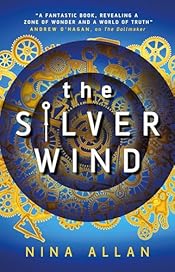
The Silver Wind by Nina Allan

Titan, 2019, 363 p, including 5 p Author’s Foreword and 1 p Acknowledgements.

“Time doesn’t give a damn about the laws of physics. It does what it wants.”

So goes a line in one of the stories in this book, which is made up of a series of connected narratives of varied length, many featuring characters with the same name but whose circumstances are subtly different. Time here – place too sometimes – is slippy. There is a contingency to the narratives, some in third person, others in first, somewhat (though not fully) reminiscent of the œuvre of Allan’s late partner Christopher Priest. Frequently, the characters themselves are not entirely sure of what is going on.

In the first tale, The Hurricane, there is a sense of distance to the telling, an opacity, which I have noticed in Allan’s work before. By the time I reached the last two, Darkroom and Ten Days (both published here under the heading out-takes) either I had got used to it or that opacity had disappeared.

The settings often have the feel of our universe but others quite clearly are not, or not yet anyway.

At least one is set in the aftermath of an unspecified war (possibly World War Two as Hitler gets a mention – though not in a war context – yet the social arrangements feel earlier.) This is (these are?) an England like, yet not identical to, our historical one. One future/present (temporal location in these stories is fluid) is an authoritarian one – under the Billings Government.

Much of the focus is on timepieces and play is made of the fact that a watch, or a clock, is a time machine of sorts. The tourbillon regulator, which stabilises a timepiece’s mechanism, counteracting the effect of gravity, making a watch or clock more accurate. Its inventor, Louis Breguet is here said to have discovered a way of making time stand still.

“The Silver Wind,” a military project to utilise this is “a quantum time-stabiliser that certain military scientists had subverted to their own purposes.” Ghosts are the living products of unsuccessful experiments with a TimeStasis, conducted from a time stream parallel with ours, manifestations of seepage between universes.

With this technology the possibility of time-bridges is asserted, but such time travel is subject to rules. “Time is an amorphous mass, … a ragbag of history. Time Stasis might give you access to what you think of as the past, but it wouldn’t be the past that you remember. The pivotal events in history still occur, even if the cause and effect are subtly different.” Hence the slippage between the stories, the air of unfamiliar familiarity. In several of them appears what at first seems a slightly sinister figure, the Circus Man, parading up and down a beach, but who in one tale administers aid to Martin Newland, one of the main recurring characters. The Circus Man is revealed elsewhere (in another timestream?) to be an accomplished watchmaker called Owen Andrews.

Don’t expect unequivocal rationales when reading any of the stories in The Silver Wind. This is not straightforward Science Fiction, but an examination of contingency.

Pedant’s corner:-  “members of parliament” (Members of Parliament,) “rarer than the both of them put together” (no need for that ‘the’; ‘rarer than both of them put together’,) unfocussed (unfocused,) “it was beginning to grow dusk” (an odd construction; ‘it was beginning to grow dark’ is fine but usually the appropriate phrase would be something like ‘dusk was drawing in’,) “I had spent a half an hour at least talking to….” (no need for that ‘a’; ‘I had spent half an hour at least talking to…’, or ‘I had spent at least half an hour talking…’) “the engine-stoker” (this was of a worker on the footplate of a steam locomotive. He – they were always male back in the day – was called a fireman,) focussing (focusing.)


free hit counter script