The Silver Wind by Nina Allan
Posted in Reading Reviewed, Science Fiction at 12:00 on 8 January 2026
Titan, 2019, 363 p, including 5 p Author’s Foreword and 1 p Acknowledgements.
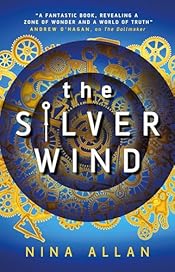
“Time doesn’t give a damn about the laws of physics. It does what it wants.”
So goes a line in one of the stories in this book, which is made up of a series of connected narratives of varied length, many featuring characters with the same name but whose circumstances are subtly different. Time here – place too sometimes – is slippy. There is a contingency to the narratives, some in third person, others in first, somewhat (though not fully) reminiscent of the œuvre of Allan’s late partner Christopher Priest. Frequently, the characters themselves are not entirely sure of what is going on.
In the first tale, The Hurricane, there is a sense of distance to the telling, an opacity, which I have noticed in Allan’s work before. By the time I reached the last two, Darkroom and Ten Days (both published here under the heading out-takes) either I had got used to it or that opacity had disappeared.
The settings often have the feel of our universe but others quite clearly are not, or not yet anyway.
At least one is set in the aftermath of an unspecified war (possibly World War Two as Hitler gets a mention – though not in a war context – yet the social arrangements feel earlier.) This is (these are?) an England like, yet not identical to, our historical one. One future/present (temporal location in these stories is fluid) is an authoritarian one – under the Billings Government.
Much of the focus is on timepieces and play is made of the fact that a watch, or a clock, is a time machine of sorts. The tourbillon regulator, which stabilises a timepiece’s mechanism, counteracting the effect of gravity, making a watch or clock more accurate. Its inventor, Louis Breguet is here said to have discovered a way of making time stand still.
“The Silver Wind,” a military project to utilise this is “a quantum time-stabiliser that certain military scientists had subverted to their own purposes.” Ghosts are the living products of unsuccessful experiments with a TimeStasis, conducted from a time stream parallel with ours, manifestations of seepage between universes.
With this technology the possibility of time-bridges is asserted, but such time travel is subject to rules. “Time is an amorphous mass, … a ragbag of history. Time Stasis might give you access to what you think of as the past, but it wouldn’t be the past that you remember. The pivotal events in history still occur, even if the cause and effect are subtly different.” Hence the slippage between the stories, the air of unfamiliar familiarity. In several of them appears what at first seems a slightly sinister figure, the Circus Man, parading up and down a beach, but who in one tale administers aid to Martin Newland, one of the main recurring characters. The Circus Man is revealed elsewhere (in another timestream?) to be an accomplished watchmaker called Owen Andrews.
Don’t expect unequivocal rationales when reading any of the stories in The Silver Wind. This is not straightforward Science Fiction, but an examination of contingency.
Pedant’s corner:- “members of parliament” (Members of Parliament,) “rarer than the both of them put together” (no need for that ‘the’; ‘rarer than both of them put together’,) unfocussed (unfocused,) “it was beginning to grow dusk” (an odd construction; ‘it was beginning to grow dark’ is fine but usually the appropriate phrase would be something like ‘dusk was drawing in’,) “I had spent a half an hour at least talking to….” (no need for that ‘a’; ‘I had spent half an hour at least talking to…’, or ‘I had spent at least half an hour talking…’) “the engine-stoker” (this was of a worker on the footplate of a steam locomotive. He – they were always male back in the day – was called a fireman,) focussing (focusing.)
Tags: Nina Allan, Science Fiction, The Silver Wind
