Not by Bread Alone by Naomi Mitchison
Posted in Reading Reviewed, Science Fiction, Scottish Fiction at 12:00 on 6 April 2026
Marion Boyars, 1983, 163 p.
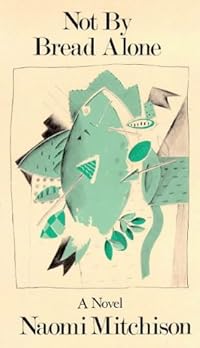
A company called PAX has been developing various projects to improve crop types and yields over the world. This culminates in a product known as freefood, which promises to make human existence easier. It is widely welcomed nearly everywhere – a notable holdout is the indigenous Australian community of Murngin in Arnhem Land, North Australia, which has achieved a kind of independence.
Like in Mitchison’s other Science Fiction forays there is in the narration a high degree of telling not showing. Most of the story concerns itself with the scientists involved and interactions among the people running PAX and the reading experience is somewhat dry. Very little of what would be the social ramifications of such an innovation as freefood is explored. War has apparently ended because, as one character says, it was fought for food.
(Well, to a point: water too, and resources, but let’s not forget in these troubled times personal aggrandisement.)
The ‘future that never was’ that bedevils older Science Fiction stories is illustrated by Mitchison’s characters’ long distance communication methods (video calls) anticipating Skype or Zoom but not, of course, the internet or email.
There is an implicit racism – reflecting the times of 1983 but perhaps not Mitchison herself? – in one character referring to ‘Abos’ saying, “‘They could be a no-good mob,’” but admitting, “they got treated in a no-good way in Queensland,’” plus another use of ‘Abos’ in an unflattering context.
The promised paradise of hunger being banished from the world is disturbed when deaths start to occur among some of those using freefood. This is due to a compound called dioscorin which is found in yams and usually removed by the processes of preparing and cooking. Freefood production has omitted these steps.
Mitchison’s writing is usually perfectly agreeable. Her other (ie non-SF) fiction does not suffer from the flaws I have noted above and before here and here – even though some of it is set in such alien (to us) societies as Ancient Greece or Rome. That tendency to didacticism apparent here is missing from those.
Pedant’s corner:- In the inside cover blurb “polictical” (political,) skillfully (skilfully.) Elsewhere; a missing comma before a piece of direct speech embedded within a sentence (x 3, one without a capital letter at the beginning of the dialogue,) “fresh lime, nimbupani” (fresh lime nimbupani,) a switch into a different font size and back again (x 2,) an end quotation mark in the middle of a piece of dialogue, Bangla Desh (nowadays spelled Bangladesh,) Campuchea (nowadays spelled Kampuchea,) Quazulu (nowadays spelled Kwazulu,) grand-parents (nowadays spelled grandparents,) “none of them were any longer newsworthy” (none of them was …,) “nobody would be allowed to turn in into money” (to turn it into money,) Djuvalji (elsewhere always Djiuvalji,) “a dangerous precendent” (precedent,) peole (people.) “‘Still and on’” (isn’t the phrase ‘Still and all’?)
Tags: Naomi Mitchison, Not by Bread Alone, Science Fiction, Scottish Fiction
