Archives » 2026 » January

Bedrooms and Fittings, Blackwell

Blackwell‘s Arts & Crafts designs extend all over the house.

A bedroom:-

Bedroom, Blackwell

Close-up on bedroom light ftting:-

aBedroom Light Fitting, Blackwell

Another of the beds:-

Blackwell, Bed

Bedroom chair:-

Bedroom Chair, Blackwell

Chest of Drawers and bookcase:-

Bedroom Furniture Blackwell

Chest:-

Bedroom Chest, Blackwell

Live It Up 138: Cloudbusting

I realised last week that I haven’t featured any Kate Bush tracks beyond Wuthering Heights.

So let’s make up for that. This one only reached no 20 (in 1985.)

Kate Bush: Cloudbusting

Dark Crescent by Lyndsey Croal 

Luna Press, 2025, 176 p including Author’s note on Finding Inspiration in Scottish Folklore. Reviewed for ParSec 14.
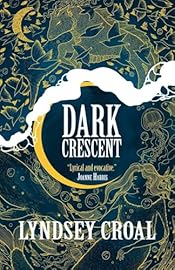
This is a collection of one novella and 22 short stories – some very short; the title story is barely three pages long, a couple are only two, with the longest, The Frittening, just twelve – all taking inspiration from Scotland’s folklore, superstitions, or landscape.

The short pieces are loosely bunched under headings for the four seasons with each section’s stories prefaced with a wood- (or lino-)cut engraving of one of the Moon’s principal phases and a scene illustrative of a story within it. A ‘Bonus Section’ at the end outlines those particular tales and legends which sparked Croal’s imagination.

An individual story here can contain relatively familiar apparitions or hauntings – selkies, kelpies, hagstones, seer stones, magpies, omens and shape shifting, Will-o’-the-Wisp, the Otherworld, Changelings – but others like the Sluagh, the Frittening or the Boneless, the Cat-Sith, the Ghillie-Dhugh, Baobhan Sith and the Fiddlers of Tomnahurich Hill, the Cailleach, the Nuckelavee, the Marool, the Ceasg, Bee-telling, the Sea-Mither, Each Uisge, the Wulver, the Bride and Angus, may be less so. Some are set in depopulated post-disaster worlds and border on Science Fiction; others touch on gothic, weird horror, dark fantasy, and solarpunk. Many draw stimulus from nature, climate, and the environment, with feminist and eco themes prominent. Croal’s Author’s Note informs us three of her tales do not have a specific derivation but are original to her.

Hence, among others, we have omens in the sky, tappings on windows, a strange puddle emerging on a doorstep, pebbles appearing in a nest in the night, a will-o’-the-wisp manifesting more strongly each day, a fiddler finding his muse in a painting whose scene gradually changes, the green man as a malevolent influence, the thoughts of the last surviving whale as it roams the deserted seas. Except for a common thread of the sea there is little beyond the Gaelic names of the various phantasms to mark these stories out as specifically Scottish.

The novella, Daughter of Fire and Water, with its intermingling of gods/goddesses and mortals in fact reads more like a Greek, or perhaps Norse, myth – except for the prince in it being named Angus.

Taken individually the stories here are perfectly fine but the cumulative effect of Croal’s general style tends to the dry. She has a fondness for italicized paragraphs, especially in throat-clearing beginnings, and there is the occasional odd choice of verb, which can be jarring. There tends to be a kind of distance between the tale and the reader and the stories are too often told rather than shown while some are not really given enough room to breathe fully. There is not much emotion evoked in these tales but then stories of weird creatures and the whole apparatus of fairy tale have always been admonitory in intent.

This is a collection to be sipped rather than quaffed. (Not really an option available to a reviewer.)

Curiously, a few lines on Content Notes and Warnings come dead last in the book though a signal to them does lie on the publishing information page. Surely if such warnings are needed they ought to be more prominently placed?

The following did not appear in the published review.

Pedant’s corner:- focussing (focusing,) maw (more than once. A maw is not a mouth,) several USianisms (cookies, snuck, dove [for dive,] inside of, etc,) sunk (several times; sank.) “The only muscle the woman moved was her mouth” (a mouth is not a muscle,) razor—sharp (razor-sharp,) sung (x 2, sang.) “She lay the Seer’s map on the table” (She laid the Seer’s map on the table.) “She was his only companion, his confidant” (she; therefore ‘confidante’,) “Then she said with sharp cruelty, ‘no. Not if you…’” (she said with sharp cruelty, ‘No. Not if you…’,) “Everyone knelt and lay the offerings at her feet” (and laid the offerings,) “all that kept me company were layers of clouds” (all that kept me company was ….) “If I wanted so bad not to be alone” (If I wanted so badly not to be alone,) “and lay it over my chest as a pendant” (and laid it over my chest,) “and lay her in blankets” (and laid her in.) “When the sea witch, turned away and disappeared” (doesn’t need the comma, which in fact detracts from the sense,)  “that I’d wove so carefully” (woven,) “mouth scrunched up into an eclipse” (only makes sense if ‘ellipse’ was meant,) a new paragraph that was not indented, a missing full stop, “span” (spun,) “as if expecting me turn into” (to turn into.) “‘Your association with them isn’t exactly customary’” (sense expects, ‘Your association with them isn’t exactly exemplary’,) sat (seated; or; sitting.) “The fall made the landscape blur, and then a screech” (needs clarification,) “there were no sign of burns or marks” (there was no sign.) “then he swept out the room” (as written this means he cleaned the room with a brush; what was intended was ‘he swept out of the room’,) “the hot water stung into my legs” (the hot water stung my legs,) focussed (focused, annoyingly used two pages earlier.) “They looked between one another” (looked at one another,) galivanted (gallivanted.) “Much of these stories are inspired by” (Many of these stories are.) “I became fascinated in the dark, strange, and rich folklore” (became fascinated by,) “rife with unexplained phenomenon” phenomena makes more sense.) “Hagstones are stones with natural holes bored in centre are thought to be,” (the holes can’t have been bored; plus the sentence needs an ‘and’ before ‘are thought’.)


Blackwell, The Dining Room

Blackwell‘s dining room is off the hall and has similar dark colours:-

Dining table:-

Dining Table, Blackwell

Sideboard. Typical Arts & Crafts styling:-

Blackwell Dining Room Furniture

Dresser:-

Dining Room Furniture, Blackwell

Tapestry. Much faded now:-

Blackwell, Tapestry in Dining Room

Chair:-

Blackwell, Chair in Dining Room


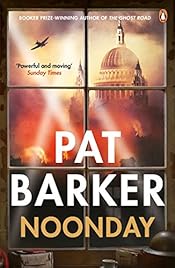
Noonday by Pat Barker 

Penguin, 2016, 263 p.

This is the final book in Barker’s Brooke family trilogy which started with Life Class and continued in Toby’s Room. In this one we have moved on to World War 2, Elinor Brooke and Paul Tarrant are long married and volunteering during the London Blitz; she as an ambulance driver, he as an ARP warden. Their lives are still entwined with that of Kit Neville who is also a volunteer. All three still paint whenever they can.

Paul wishes Elinor to remain in the country in her childhood home where the family has taken in an evacuee called Kenny who keeps getting let down by his mother’s failures to visit. Elinor’s mother is on her death bed but still has enough recall to reveal she knew how close Elinor and brother Toby had been. Kenny eventually disappears off back to London where his family is bombed out and finds shelter in a school, which is later the scene of a tragedy underreported for morale reasons. Paul bears a residual guilt about guiding them there.

The scenes of danger during bombing raids in London and their aftermaths of damage and destruction are well described, if a little familiar from documentaries and histories. Throughout we track the gradual erosion of Elinor and Paul’s marriage.

A curious interpolation is that of a medium (I nearly typed fraudulent medium; as if there were any other kind) – named somewhat oddly as Bertha Mason and who, like the first Mrs Rochester, lives in an attic – but who doesn’t seem to fulfil any narrative purpose apart from to discomfit Paul.

Elinor is asked by Kenneth Clark, head of the War Artists’ Advisory Committee, to contribute to its collection, but only with portrayals of women and children. Elinor has other ideas but suspects they won’t be accepted.

As a conclusion to the trilogy this lacks the impact which the Great War had on the characters’ lives in the previous books and stands in contrast to it. It is, though, a reminder that in the midst of war people’s lives still carry on, with all their imperfections and resiliences. Plus it ends on a slightly hopeful note.

Pedant’s corner:- “just now give her” (just now gave her,) “stood there” (standing there.) “She was sat” (she was sitting,) fetid (foetid; even better fœtid,) “a plastic bag” (plastic? In 1940?) “twenty foot deep” (‘twenty feet deep’ please,) “‘His majesty’s ship Repulse is at the bottom of the sea’” (Repulse was sunk in December 1941, well after the blitz waned,) an extraneous quotation mark, “hadn’t showed up” (hadn’t shown up,) a missing full stop.

Blackwell, The White Room

The entrance corridor at Blackwell is fairly dark. Looking back to shop area:-

Corridor, Blackwell

The corridor was designed to lead from darkness to light – onto a bright white painted room with a view to Lake Windermere:-

White room from corridor, Blackwell, Lake District

View to Windermere:-

Blackwell, White room windows

This room immediately reminded us of the designs of Charles Rennie Mackintosh. Fireplace in white room:-

Blackwell, White room fireplace

This chair especially. We were told it’s not original to the house but was brought in as being in keeping with the original furnishings:-

Blackwell, Chair in White Room

This corner cupboard  is flanked by two stylised trees, natural motifs are all around the house in the decor, particularly rowan berries, and apparently when the house was taken over after a long period of neglect there was a rowan sapling growing inside this cupboard:-

White room  corner cupboard

View from side window:-

Blackwell, View from White Room

This dark piece of furniture is out of keeping with the room but is contemporaneous:-

Blackwell White Room Furniture

The Hall, Blackwell Arts & Crafts House

The entrance to Blackwell is now from the side where the shop and ticket office is and leads along a fairly dark corridor which passes the original entrance into which you can go and see these two stained glass windows:-

Stained Glass Window, Blackwell

Blackwell, Stained Glass Window

Across from this is another set of stained glass windows and a door which gives onto the hall:-

Stained Glass Corridor Window, Blackwell

The same window from the other side – nice clock too:-

Clock + Stained Glass, Blackwell

The hall itself is impressive:-

Hall, Blackwell Arts & Crafts Hosue

Reverse view showing bench, fireplace and minstrel’s gallery above:-

Blackwell, Arts & Crafts House, Minstrel's Gallery from Hall

Side view of the bench:-

Bench in Hall, Blackwell

Hall ceiling:-

Blackwell, Arts & Crafts House, Hall Ceiling

Settle on corridor wall:-

Settle in Hall, Blackwell, Arts & Crafts House

Peacock wallpaper:-

Peacock Wallpaper, Blackwell, Arts & Crafts House

Hall from minstrel’s gallery:-

Blackwell, Hall, from Minstrel's Gallery

Something Changed 97: Out of Space

The refrain of this is very unProdigy-like (in my opinion.)  Not that lyrically there’s much to the whole thing. But reggae?

The Prodigy: Out of Space

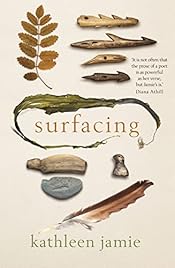
surfacing by Kathleen Jamie

Sort of Books, 2019, 253 p.

Jamie is known as a poet. She is, of course a former Scottish Makar.

This, though, is a prose work or, rather, twelve essays variously about her encounters with the natural world, the two architectural digs of which she has been part, and a trip to as near Tibet she could get. (Getting into Tibet itself would have been difficult at any time but as this coincided with the Tiananmen Square events, reaching Tibet was impossible. It also meant she and her companions were arrested for a short time.)

Her writing about the natural world shows a keen eye for detail; as you would expect from a poet. The account of her trip to China reads almost like a novella.

The first dig she visited was on the Pacific coast of Alaska at Quinhagak village, the dig site was called Nunallaq. The finds were shown to the community where the elders were (usually) able to recall their significance to their Yup’ik culture, giving the younger inhabitants a way to rediscover their traditions, which they were in danger of losing. Jamie’s sympathy with the locals and appreciation of the efforts of the archaeologists is evident.

The other dig was at the Links of Noltland in Orkney and had been ongoing for about ten years. However, time pressure was building as the funding from Historic Scotland (as was) was running out and unlikely to be renewed. And this on a site whose significance is seemingly as great or greater even than Skara Brae.

Curiously the locals weren’t too interested in the ancient remains since apparently Orcadians and Shetlanders identify with the Vikings rather than their much longer ago neolithic ancestors. Jamie quotes one of the archaeologists, “‘The Vikings “won”,’ said Hazel.’ …. ‘After the Vikings arrived, all traces of the older culture ceased. That’s what the archaeology is suggesting.’”

This is an engaging and informative work showing Jamie’s prose is as worth paying attention to as her poetry.

Pedant’s corner:- I have no idea why the title is not capitalised on the book’s cover and spine – nor indeed why the author’s name isn’t either. On the title page both are. Otherwise “Quanset hut” (I’ve previously only ever seen this spelled as ‘quonset’,) “‘kids from his village’” (‘kids from this village’ makes more sense.) “Posters went up the school and store” (Posters went in up the school and store,) “a wintery atmosphere” (wintry,) “and begin to speak” (the earlier part of the sentence was in the past tense so ‘began to speak’.) “Sat right there on their village wall” (Sitting, or Seated,) “sat on seats” (again: sitting; or seated,) “sprung up” (sprang up.) “He was laid on his bed” (he was lying on his bed,) “they were all glad for the diversion” (glad of the diversion.)

Blackwell Arts & Crafts House, near Bowness-on-Windermere

Blackwell is a house built in the Arts & Crafts style near Bowness-on-Wndermere in the Lake District. It was designed by Baillie Scott and erected between 1898 and 1900 as a holiday home for Manchetser brewer Edward Holt.

Being of that era it is not perhaps surprising that the house and some of its contents bear a similarity to the work of Charles Rennie Mackintosh who was a contemporary.

House from car park:-

Blackwell Arts & Crafts House, Cumbria, From Car Park

Outhouse (to right above):-

Outhouse at Blackwell Arts & Crafts House

House from terrace, a stitch of two photos:-

Blackwell Arts & Crafts House From Terrace

Detail of roan pipe:-

Detail of Blackwell Arts & Crafts House

free hit counter script