Archives » 2025 » June

Another Review

Yes, they come thick and fast. This one will be for ParSec 15.


It’s The History of the World by Simon Morden. I can’t find a cover for it at the moment, though.


Amazingly it’s actually Science Fiction. Sometimes recently  it has seemed as if the publishing of SF had dried up.

Alyth War Memorial

Alyth‘s War Memorial stands  quite a way out of the town at the junction of Meigle Road and Airlie Street:-

Alyth War Memorial

The Great War Memorial takes the form of a figure of Britannia on top of a tapering stone column. The Second World War Memorial lies on the wall behind:-

War Memorial, Alyth

Side view of Britannia:-

Britannia, Alyth War Memorial

Great War Dedication with Great War names:-

Alyth War Memorial Great War Dedication

Other Great War names are on panels on the other sides:-

War Memorial, Alyth, Names

Great War Names, War Memorial, Alyth

Alyth War Memorial, Great War Names

Off to the left as you look at the Memorial from the road is this commemoration of Alfred Anderson, the oldest surviving Scottish veteran of the Great War till his death in 2005:-

Alyth, Memorial to Alfred Anderson

Second World War Memorial. The wall  bears a plaque containing names and two others stating “Your supreme sacrifice we will remember” and “Service not self.”

Alyth Second World War Memorial

A closer view reveals one name for the Falklands conflict of 1982:-

Second World War Names, Alyth War Memorial


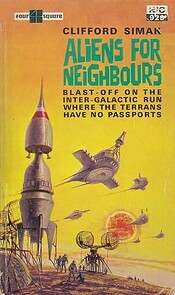
Aliens for Neighbours by Clifford Simak

Four Square, 1963, 157 p.

This is a collection of Simak’s stories from the 1950s, with one from 1960, and they show their age. The connecting thread of the book is that each story features aliens of one sort or another.

In Dusty Zebra things start disappearing from narrator Joe’s desk and other things appear. Joe ends up trading with the unknown entity on the other side of what it seems is an interdimensional portal. All goes well; until it doesn’t.

Honourable Opponent sees a military delegation from Earth’s Galactic Confederacy awaiting the arrival of their counterparts from a species known as the Fivers, whose weapons have been overwhelmingly devastating, to oversee a prisoner exchange. There is a twist to the meeting when it comes.

Idiot’s Crusade has a village idiot suddenly comprehending things he had not until his mind was infiltrated by an alien; but the alien finds the experience less than congenial.

Operation Stinky occurs in the aftermath of a skunk-like animal (later dubbed Stinky) befriending a farmer whose life has been disrupted by the building of a nearby air-force base. When the air-force colonel discovers Stinky has the ability to improve machinery the secret operation of the title is started up. Stinky has its own agenda, however.

A group of interstellar scavengers searches for the Jackpot of the second last story’s title and finds it in a comprehensive library with an immersive access experience. The process changes them. One of the group justifies their activities by citing historical precedent for exploitation, “They didn’t worry much about the law or ethics of it and no-one blamed them for it. They found it and they took it and that was the end of it.”

In Neighbour a newcomer arrives in a small farming area and has sustained success on the farm he and his family have taken over. His machines work by themselves and he has rain and sun when required. His benign influence gradually extends to the neighbourhood as a whole. It is eventually noticed elsewhere. The text displays that mistrust of government embedded in much of US society – especially the rural US.


Pedant’s corner:- swop (swap,) “Alf Adams’ place” (Adams’s,) “and and could find none” (only one ‘and’ needed,) “how I’d lay awake at night (how I’d lie awake,) “when one of the new ones up and moves away (ups and moves away.)

Live It Up 131: Raintown. RIP James Prime

Last week, James Prime the keyboardist of Deacon Blue, died.

He was integral to the band’s sound, adding depth and colour with his playing and there is that wonderful piano instrumental break in the middle eight of the band’s anthem Dignity.

This is Raintown, the title track from the band’s first album.

Deacon Blue: Raintown


Jim was co-writer of this one, a song dear to my heart. (“This is my country. These are my reasons.”)

Deacon Blue: Fergus Sings the Blues

James (Jim) Jim PrimePrime: 3/11/1960 – 19/6/2025. So it goes.

Birdwatching at the End of the World by G W Dexter

NewCon Press, 2024, 213 p. Reviewed for ParSec 12.

The pitch for this post-apocalypse novel must have written itself. “Lord of the Flies – with girls.” Job done. Don’t you want to read it now? (No matter what I say.)

Nevertheless, a reviewer must review.

The story is set in an alternative 1975 on the largest of the Near Islands, an entirely fictional small archipelago located fifteen miles from Aberdeen. The girls are survivors of a nuclear attack on that city in what becomes obvious must have been a world-wide war. Most of the school’s pupils and teachers were away on a trip when the bombs fell.

The tale is narrated in retrospect (of a few years later) by the only boy, Stephen Ballantyne, son of the headmistress who took advantage of the convention that such children attend their parent’s school. All but one of the girls plus Stephen survive but his mother dies in the second blast.

A classic children’s story arrangement, then, with the parents out of the way and no other adults at hand. But these are not youngsters. They are fourteen- or fifteen-year-olds on the cusp of adulthood forced to rely on their own resources, albeit with a well-stocked library at hand. It helps the island is well-endowed with rabbits and sea-birds – not all of them palatable though.

The writing style is more irreverent than you might expect, with stabs at levity (one running joke in particular) and occasional addresses to the reader. It is at times consciously alliterative. In Dexter’s outlining of his scenario he has narrator Stephen tell us one girl’s name evokes “the milky mystery of midnight mosques.” And he eschews describing foul-mouthed language, “This is, after all, an adventure story set on a desert island.” Stephen also claims his greatest fault is self-effacement.

Step forward Pearl Wyss, “the smallest and mousiest-looking of the girls,” who had previously shown her mettle on a trip to a farm on the mainland for a demonstration of artificial insemination and, invited to repeat the farmer’s no doubt spitefully given information, does so flawlessly. Pearl becomes the driving force behind the rump school’s efforts to ensure survival, steering their debates and swaying (most of) the girls with her arguments.

Her awareness of the treatment of women by men down the ages colours her approach: watches to be set for any encroachment from the mainland, the building of a stockade and later a wall, the reconstruction of the curriculum to be more useful in their straitened circumstances, the manufacture of bows and training in shooting arrows.

The first man to arrive – on a rowing boat – only confirms her fears when he attempts to rape one of the girls. He is thereafter caged and ostracised.

Not all the girls agree with her. Some of their worries, such as wanting to get married in due course, a future Pearl’s prescriptions would seem to deny them, exemplify attitudes of the time where it is set. But her answer to that problem of course lies in front of them all the time. She is willing to be ruthless in defending the school against incursion by men no matter how inoffensive they may appear to be or even if they’re accompanied by women. Towards the book’s climax she says, “We make war because we hate war.” Turning into her enemy? All through the book Stephen acquiesces in her designs but in the final paragraphs he lets his air of self-effacement slip.

In an enterprise such as this it does not do to become bogged down on the details, the scenario is all. But two A-bombs dropped on Aberdeen? One would surely be enough. And how likely was it that a single mother in the 1970s would have become a headmistress; particularly of a girls’ school? Plus radiation sickness would most likely have been more prevalent than is presented here.

These are nit-picking, though. This may be no Lord of the Flies but it is still a well written, solid piece of work. In its essence it is not concerned about girls or women or whether they behave better or worse in any given situation. It is really about the nature of men and whether that nature will ever change.

The following did not appear in the published review.

Pedant’s corner:- H2O (H2O,) knit (knitted,) rowboat (several times; rowing boat,) E=mc2 (E = mc2,) focussed/unfocussed (x 2 each; focused/unfocussed,) airplanes (aeroplanes,) Benn Gunn (Ben Gunn,) “a saree” (a sari,) a sentence framed as a question but lacking its question mark, row-boat (x 2; elsewhere rowboat but in any case ‘rowing boat’,) “‘any who disagree this choice’” (who disagree with this choice.)


Administration Over

Dumbarton Football Club yesterday announced that the takeover of the club by Canadian businessman Mario Lapointe has been confirmed by the administrators.

The club is therefore out of administration, much to the relief of Sons fans everywhere, who can now look forward to the new season with a degree of optimism.

There is still the matter of the five point deduction in the second season following administration to be overcome, though.


Alyth

Alyth is a town in Perth and Kinross which we went on to visit after we had left Meigle.

It’s a lovely wee place with a burn running through the town centre with several bridges over it, of which the one in this photo is the most scenic:-

Alyth Burn, Alyth, Perth and Kinross

I found two minor Art Deco buildings.

The Scotmid Coop:-

Art Deco Coop, Alyth, Perth and Kinross

And this one, a hair salon:-

Minor Art Deco, Alyth, Perth and Kinross

Right by the town square is a Boer War Memorial:-

Boer War Memorial, Alyth

Its dedication plaque commemorates three individuals. David Stanley Williams, ninth Earl of Airlie, Noel Neils Ramsay and Charles James Wedderburn Ogilvy:-

Dedication Plaque on Boer War Memorial, Alyth


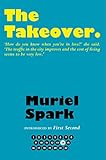
The Takeover by Muriel Spark

Polygon, 2018, 241 p, plus vii p Introduction by Brian Morton and iv p Foreword. First published 1976.

Some people swear by Spark. For myself I struggle to see what the fuss is about. There is just something about her writing that strikes me as off.

I suspect this one was meant to be a comedic novel. Its tone would certainly suggest that. However, its bittiness and lack of characters with whom the reader can be sympathetic – the book is peopled with an assortment of chancers, frauds, swindlers and charlatans – make it something of a chore to read.

Hubert Mallindaine claims to be a descendant of the union between the Roman Emperor Caligula and the goddess Diana. He is renting a villa at Nemi from Maggie Ratcliffe, fairly recently the new Marchesa di Tullio Friole, who also has a house in the vicinity as well as residences elsewhere. Maggie is much exercised by her collections of jewellery and valuables – paintings, Louis XV chairs etc. The local Italians are not too pleased about these foreigners having houses in the town.

Maggie wishes to evict Hubert but he has various ploys to avoid this, among them setting up a religion based on his claim to be descended from Diana. He treats his secretary Pauline contemptuously and is also systematically replacing Maggie’s paintings and chairs with copies/reproductions.

Maggie meanwhile is having sex with her factotum, Lauro, who is, Brian Morton’s Introduction tells us, “a priapic opportunist” (for which read ‘all-but rapist’) “and kleptomaniac.” In addition, Lauro has fathered a child on a local girl (but blames her as a calculating bitch) and without warning jumps on Maggie’s daughter-in-law Mary, giving her little choice but to succumb to his advance. He tells her that next time she should relax. Not one to brook dissent.

That Introduction describes the motley crew of thieves and conmen surrounding Maggie as, “All as respectably dressed and gentlemanly as the Devil must be in a Scottish narrative.”

Things get murkier as the narrative proceeds; it seems there are other claims on the land the houses are built on, while a dodgy financial adviser worms his way into Maggie’s affairs.

There was a review and article – one each – in The Guardian Weekend supplement on both Sat 07/06/25 and 14/06/25 about the latest biography of Spark (Frances Wilson’s Electric Spark – The Enigma of Muriel Spark. Personally I find her the complete opposite of electric.) The review comments on her elision, “Spark knew what to leave out.” Perhaps it is those “odd gaps” which I find so problematic about her œuvre.


Pedant’s corner:- More than a few USian usages, vide infra.

Inter alia pantyhose (tights,) “a vodka-tonic” (vodka and tonic,) boy-friend/girl-friend (several times: both all one word; boyfriend/girlfriend,) station-wagon (estate car.)

Otherwise; “as if treading a mined field” (why not ‘minefield’?) “set at nought” (set at naught. Nought is the number, zero; naught has the meaning of ‘nothing’,) a missing comma before a piece of direct speech (x 2.)

Newtyle, Angus

Newtyle is a village in Angus, Scotland. We visited it the same day we went to Meigle.

Newtyle was the railhead for the first railway in North-east Scotland, the Dundee and Newtyle Railway, which used rope-hauled inclines, horses and sails to pull the carriages, before finally steam locomotives. This plaque commemorates it:-

Railway Plaque, Newtyle

Newtyle’s War Memorial is a segmented stone column at a crossroads to the northeast of the village:-

Newtyle War Memorial

Nowadays the names are on two plaques and are mixed for the two World Wars originally they were carved into the stone. 20 of the 28 are for the Great War:-

War Memorial , Newtyle, Names

Newtyle War Memorial, Names


The Time of the Hero by Mario Vargas Llosa 

Grove Press, 1966, 407 p. Translated from the Spanish, La ciudad y los perros, (Editorial Seix Barral, S A, Barcelona, 1962) by Lysander Kemp

(I don’t usually remember exactly where I bought a book but with this one I do. It was in the Netherlands; in a charity shop/warehouse which had a large selection of books, one case of which were publications in English. I think it cost me one Euro, though it might have been €1.50.)


This was Llosa’s first novel and it is set in the Leoncio Prada Military Academy, among the cadets/pupils there, not all of whom are destined to join the army.

It depicts the everyday lives of the inmates, their raggings, joshings and bullying, their constant efforts to evade the rules – such as smoking, gambling, going over the wall at night, or even during the day – and to keep things secret from the officers. Some scenes are set in the surrounding city; illustrating memories of the inmates’ pasts or the intricacies of their love lives.

The plot revolves around the stealing of the text of a Chemistry exam the night before it is due to be taken. The designated cadet, Cava, makes a mistake and a window pane is broken. All passes are cancelled. In order to receive a pass to see his girlfriend a cadet nicknamed the Slave reports Cava to the officers. Later, the Slave is shot during a military exercise. The officers are at pains to insist it was an accident and ignore evidence and testimony to the contrary.

This is almost entirely a male environment; the dialogue often displays the prejudices of its time and place – especially with regard to the casual use of racist terms and to misogyny.

In their encounter the Slave’s father says to Alberto, “‘When you have a son, keep him away from his mother, There’s nothing like a woman to ruin a boy for life.’”

In the main we have here is an examination of the perennial battle of youth against authority, of the pressure to conform and of the constant tendency of institutions to cover up unfortunate happenings so as not to be shown in a bad light.


Pedant’s corner:- Translated into USian. I note La ciudad y los perros actually translates as The City and the Dogs. Otherwise; “tooth paste” (toothpaste,) “brief case” (briefcase,) “girl friend” (girlfriend,) “boy friend (boyfriend,) “on the double” (this military term is usually rendered as ‘at the double’,) “Montes’ bunk” (Montes’s.)

free hit counter script