Archives » 2023 » May

Reelin’ in the Years 221: Me and Bobby McGee. RIP Gordon Lightfoot

And so now Gordon Lightfoot has gone.

I noted his song If you Could Read My Mind here.

His first single was Me and Bobby McGee which subsequently had a substantial after life. The many artists to have recorded it include its writer Kris Kristofferson, Roger Miller, Kenny Rogers and The First Edition, Janis Joplin, Charley Pride and Jerry Lee Lewis. Janis Joplin’s version has had over 1,000,000 sales/streams.

Gordon Lightfoot: Me and Bobby McGee


Janis Joplin: Me and Bobbie McGee


Gordon Meredith Lightfoot:17/11/1938 – May 1/5/2023. So it goes.

Beautiful Spiral Galaxy NGC 1566

From Astronomy Picture of the Day for 8/5/23.

A magnificent view of spiral galaxy NGC 1566.

The image has been constructed from the Hubble Legacy Archive by Detlev Odenthal.

Annan Athletic 6-0 Dumbarton

SPFL Tier 3 Play-off, Galabank, 9/5/23.

Well. What do you say about a shambles like this?

Except: so much for a record number of clean sheets.

That’s not any good when your defence falls apart in the games that matter.

It was bad enough being two goals down in 24 minutes but Kalvin Orsi’s sending-off only made it worse.

A season that had seemed a relative success (when did we last end up with a positive goal difference?) has ended in embarrassment.

Saturday’s second leg is now the deadest of dead rubbers.

Good luck to Annan in the play-off final.

Lumsden War Memorial

This War Memorial in Lumsden, a village in Aberdeenshire, is for the Parish of Auchindoir.

It’s in the form of a wheel cross which has draped on it a sword in a scabbard.

It’s inscribed “Sacred to the memory of the men of Auchindoir Parish who made the ultimate sacrifice in the Great War” with, below 1914-1918:-

Lumsden War Memorial

Lumsden War Memorial Great War Dedication

Great War Names:-

Lumsden War Memorial, Great War Names


Lumsden War Memorial, Great War Names

The Second World War dedication “They died in war that we in peace might live” and names are on the reverse:-

World War 2 Dedication and Names, Lumsden War Memorial

Dumbarton 1-1 Stranraer

SPFL Tier 4, The Rock, 06/05/23.

So, the final league game of the season.

Like last week at Elgin it was a turgid affair. Both sides had nothing to play for and our players looked like they were not exerting themselves too much; saving themselves for the play-offs.

That concern was reflected in the line-up, with an unusual look to the back line, Aron Lynas alongside Peter Grant at centre half, Harry Broun again in goal and Luca Vata given his first start in midfield. He stayed on for the whole game, didn’t disgrace himself but probably needs to bulk up a bit before becoming anything like a regular.

Neither side created much early on but Finlay Grey had two strong drives which the keeper had to beat away.

Their goal was a joke. Aron Lynas just got his head to a cross but miscued it against the post and the rebound bounced in off Peter Grant.

A few minutes later Edin Lynch got up at the back post from a corner and powered it home for the equaliser.

In the second half Ally Love had two decent attempts at goal, an attempted flick over the keeper just caught his fingertips but the ball was going in until a defender swept it off the line. Then Love’s header from a great Martin McNiff cross beat the keeper but was headed over the bar by a defender. (Love’s header may have been missing the goal though.)

It’s on to the serious end of season stuff now. Away to Annan on Tuesday night, before the return at the Rock on Saturday.

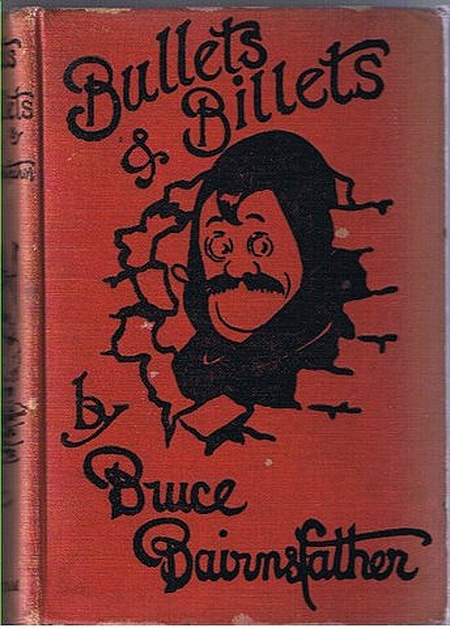
Bullets and Billets by Bruce Bairnsfather

Grant Richards Ltd, 1916, 304 p.

 Bullets and Billets cover

The book is a memoir of the Great War experiences of the author, famous for creating the character of Old Bill in his cartoons for the magazine The Bystander and later collected in various Fragments from France booklets, from late 1914 till he is wounded during the Second Battle of Ypres in 1915.

In this early stage of the war the trenches were rudimentary to say the least, with men waist deep in water, and what dugouts there were also sodden. Not far behind the front line a few farm buildings not yet destroyed by shellfire gave some cover from the Germans provided no movement whatever could be seen in them.

Bairnsfather was in charge of a machine gun company but seems to have had a lot of time to be able to wander about just behind the line exploring the local area. I assume his sergeant looked after things in his absences. His company was also rotated in and out of the line on a regular basis.

He describes these early days of the war as “delightfully precarious and primitive. Amateurish trenches and rough and ready life,” which he says to his mind gave the war what it sadly needed – a touch of romance. Later, though, “much of the romance had left the trenches.” He says he “wouldn’t have missed that time for anything” and claims “our soldiers” even though living “in a vast bog without being able to utilize modern contrivances for making the fight against adverse circumstances anything like an equal contest” wouldn’t have either.

It was during this time he began his artistic career, drawing on the farmhouse walls and making sketches for fellow officers and then deciding to sending off his first cartoon to The Bystander. The book has some of the author’s sketches scattered throughout and also photographic plates of cartoons which appeared in The Bystander bound in and counting towards the pagination.

As an insight into how a British officer felt in that first year of the war this is probably as good as it gets.

Sensitivity warning: contains the word “gollywog.”

Pedant’s corner:- focussed (focused,) “form part of a slack heap” (since these were now ruined farm walls the author may have meant ‘part of a slag heap’, but no matter,) “gulley”, two lines later followed by “gully”.

Friday on my Mind 229: Throw Down a Line

Another one from Cliff. He recorded some good stuff at times. Like The Day I Met Marie this was written by Hank Marvin.

I saw this cited in a list of 1960s psychedelia. At the time of its release, because of its performers, I did not consider it as such.

The drum pattern in this prefigures the one in Neanderthal Man by Hotlegs, the group that was the precursor to 10cc.

Cliff Richard and Hank Marvin: Throw Down a Line


Here’s a version from 1970 as credited to Marvin, Welch and Farrar.

Marvin, Welch and Farrar: Throw Down a Line

Rhynie War Memorial

Rhynie is a village in Aberdeeenshire, south of Huntly. We travelled through it on our way back home from our trip up north in August.

Its War Memorial lies in a wide green space in the middle of the village:-

Rhynie War Memorial

It depicts a soldier in a great coat, in mourning pose with rifle reversed, surmounting a square pillar and base. There’s a good looking church at the end of the green:-

Rhynie War Memorial Closer View

Dedications and World War 2 Names. “Erected in memory of the men from the parishes of Rhynie and Kearns who served the cause of freedom and right in the Great War 1914-1918 and in grateful memory of those hereon who fell in the great conflict. Their name liveth for evermore.” Below “1939-1945.” Note; Miss Helen D Grant Civilian (Student.)

Rhynie War Memorial Dedication

Great War Names:-

Rhynie War Memorial, More Great War Names

Great War Names Rhynie War Memorial

Rhynie War Memorial Great War Names

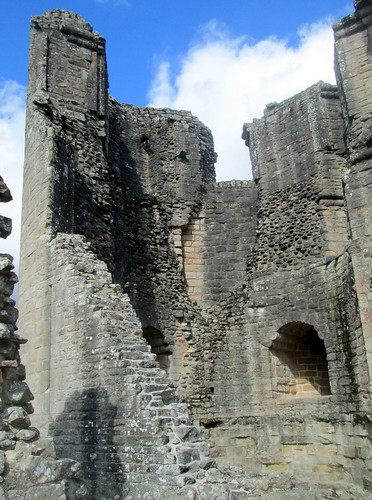
Kildrummy Castle

The ruins of Kildrummy Castle lie about 7 miles west of Alford in Aberdeenshire. On our trip there in August we tried to visit it on the first day but it was late by that time and the castle was closed. I was able to duck into the car park and take a photo though.

Kildrummy Castle from car park:-

Kildrummy Castle from Car Park

We altered our plans slightly for the day we came home so as to try to see the castle properly.

Castle ruins fom the path up from the car park:-

Kildrummy Castle, Aberdeenshire

<a href="Kildrummy Castle Ruins

Judging by this illustration on the information board the castle would have been seriously impressive in its day:-

Kildrummy Castle, info board

Model of castle in the shop:-

Kildrummy Castle model, Aberdeenshire

Interior of castle:-

Kildrummy Castle Interior of Site

To right of above:-

Kildrummy Castle, Aberdeenshire

To left:-

Kildrummy Castle, Aberdeenshire

The area the castle covered was extensive:-

Kildrummy Castle Information Board

Remains of towers:-

Kildrummy Castle, Aberdeenshire

Kildrummy Castle, Aberdeenshire

Cut-away illustration of the Snow Tower (most of which has long since collapsed):-

Kildrummy Castle, info board, Aberdeenshire

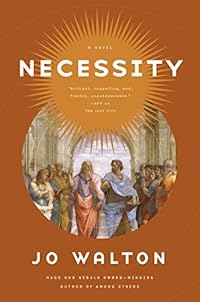
Necessity by Jo Walton

Tor, 2016, 332 p, including ii p Thanks.

This is the last of Walton’s “Thessaly” trilogy in which the author examines the ramifications of implementing Plato’s philosophy in a restricted setting. This is also a scenario in which the ancient Greek Gods are real and can interfere in human affairs. I reviewed the first volume, The Just City, here and the second The Philosopher Kings here.

Necessity takes place in the 26th century on the planet Plato to where Zeus removed the people of the Just City at the end of The Philosopher Kings. As in that second book there are twelve cities in all to cater for people’s various preferences. The climate on Plato is colder than the Greece from which most of the humans now living there were derived. Nevertheless their habitual attire is the kiton. As well as humans, the planet is home to some aliens known as Saeli who have immigrated there and are accepted as full members of society. Contact has also occurred with another set of aliens known as Amarathi. Many tasks on Plato, as in the Just City, are carried out by Workers, sentient robots accorded human rights. One of these, Crocus, has narration duties, as do the humans Jason and Marsilia and the god Apollo. Jason is a fisherman whose crew includes the Saeli, Hilfa, and the present consul Marsilia. He has an unrequited yen for Marsilia’s sister Thetis.

The book starts on the day when Pytheas, the human incarnation of Apollo and grandfather of one of our narrators, Marsilia, dies and a spaceship containing humans (from the planet Marhaba) arrives in orbit round Plato. This last, the reader might have thought, would provide the main thrust of the intrigue/plot but in fact not much is made of it. Instead the thread that is followed is a search for Apollo’s sister Athene who has ventured outside time, to study Necessity, and what Chaos is, and how time began. Necessity is later referred to as a great force that binds all thinking beings. Zeus, the father of both Apollo and Athene, would apparently be displeased if he knew Athene had done this – at least once his attention had been drawn to it – but despite him knowing everything no consequences will ensue if she can be brought back before it comes to his attention.

The human interactions are something of a sub-plot. Marsilia has an eight-year-old child, Alkippe, whom she had conceived with someone calling himself Panodorus. He appears at a gathering but does not recognise her and everyone else sees he is Apollo’s brother Hermes. (Yet even this is another disguise as he is in fact the Saeli god, Jathery.) His failure to recognise Marsilia is because in his time he has not yet met her. This is a potentially disastrous situation since if he does not step outside time then Alkippe may not ever have existed. Again, not as much is made of this situation as might be expected.

Walton it seems is more interested in philosophical speculation than interpersonal (or god to human) conflict. Her writing is fine, though – she can pull you along – and she brings out her characters’ attributes well, but in the end Necessity is a touch disappointing.

Pedant’s corner:- kiton (the spelling chiton displays its Greek origin more clearly,) “we were back on in the peaceful glade” (no need for the ‘on’,) “on a women’s body” (a woman’s.)

free hit counter script