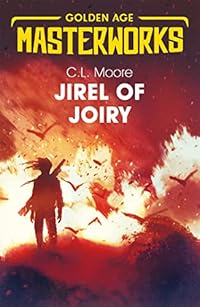
Gollancz Golden Age Masterworks, 2019, 205 p. First published in Weird Tales between 1934 and 1939.
This is a book containing six novellas from one of the early pioneers of women’s writing in the field of SF and Fantasy, in this case from before the Second World War. Viewpoint character Jirel is a fierce red-haired warrior woman who rules the territory of Joiry, which seems to be a fiefdom somewhere in France in mediæval times. Post Roman times certainly, since she wears the leg armour of a long-dead Roman legionary.
Black God’s Kiss starts with Jirel’s forces having been overcome and herself captured by the soldiers of Guillaume the conqueror who subjects her to a savage kiss before imprisoning her in a dungeon. Jirel escapes and travels to an underworld where she eventually meets the stone image of the black god, kisses it and absorbs its energy. After an arduous journey back home she bestows that fatal kiss on Guillaume. Black God’s Shadow sees Jirel suffering what seemed to me an unlikely remorse for her killing of Guillaume, but she is haunted by the sounds of him in torment in the afterlife. She again travels to the underworld in order to seek to release Guillaume from his purgatory. Jirel Meets Magic in another passage through another fantasy world following Giraud, a man whose castle she has taken, through a window into where the sorceress Jarisme holds power.
In The Dark Land a wounded Jirel is abducted from her death-bed and quickly restored to health by Pav, King of Romne, who wants her for his wife. Jirel isn’t keen on this. Queen of the Starstone was written along with Moore’s husband Henry Kuttner. It is an SF/fantasy crossover wherein two men from the Mars of the future are brought back to Jirel’s time by a wizard who wishes them to recover from her the Starstone of the title. Hellsgarde is a place of foreboding. To redeem twenty of her men whom he had captured, Guy of Garlot has sent Jirel there to uncover the treasure someone called Andred had hidden in the castle. She meets dread and ugliness but also a redeeming power. Attitudes of the time this was written are perhaps indicated by the sentence, “God in his wisdom does not for nothing mark a whole and healthy man with a cripple’s face.” And sinful Guy has a dark beauty for a fleshly garment that is “no design of the good god.” The story’s resolution is satisfying though.
Overall Moore has an irritating tendency to repeat a word within a line or two of text and we do not see Jirel perform many feats of swordswomanship or military prowess, we have to take it on trust she is accomplished militarily.
These stories are of their time but are significant for who wrote them and the nature of their protagonist rather than any intrinsic merit.
Pedant’s corner:- sorceress’ (sorceress’s,) swarm (rest of passage in past tense; swarmed,) “Pav’s smiled face” (smiled? Smiling surely,) “before Pav could come near enough to prevent” (to prevent it,) “as through on a giant axis” (as though.)
I see from The Guardian that drummer and song-writer of The Crickets (best known as Buddy Holly’s backing band) has died.
Many of Holly’s best known songs were co-written with Allison – Peggy Sue, Well …. All Right, That’ll Be the Day – though he is not credited for Not Fade Away which he claimed to have co-written.
Though all of these are from before my time they are utterly familiar as being from the pioneering age of rock and roll.
Buddy Holly and the Crickets: That’ll Be the Day
Jerry Ivan Allison: 31/8/1939 – August 22/8/2022. So it goes.
In March we were wandering down the Back Burn quite near to our house and I spotted a small bridge which I had previously never noticed. Mind you it was almost totally concealed by greenery and in summer it will be much more so.
View of burn from bridge:-
Other side of bridge:-
A bit downstream there is this sluice gate which I may have posted before (but it’s not evident on a quick search):-
Never before have we won our first five league games in a row.
Being a Dumbarton supporter of long-standing this is a very unusual circumstance to behold. We have won five games in a row mid-season but I still wonder if I’m dreaming.
We’ve yet to play three of the top five though.
I just don’t know what to think about it.
It’s almost incidental who actually scored but it was Ally Love with two penalties within minutes of each other. (Not Carsy on penalty duty I note.)
It’s East Fife away next week in what, since I live in Fife, amounts to a home game for me.
But since I’ve not seen us live this season I have a quandary. Do I keep doing the same thing as I’ve done every Saturday so far or go to the game and risk being a jinx?
Like Highland River, this is a tale steeped in Gunn’s experience of growing up in the coastal village of Dunbeath in Caithness. The viewpoint character is Hugh MacBeth, youngest son of the family but old enough to be tasked with collecting mussels with which to bait his father’s fishing nets. Part One is a slow unfolding of the realities of living slightly away from the small community but nevertheless enmeshed in it and displays a deep knowledge of the fishing life and empathy for a child on the cusp of early manhood. Hugh’s sister Grace has been away working in a city but recently returned home. He is mildly disturbed by meeting her walking along the road one evening with Charlie Chisholm, with whom his other sister, Kirsty, apparently has an understanding. His father is an accomplished seaman but his mother is opposed to any venturing out in boats by his elder brother Alan, since the McHughs’ other son, Finlay, had drowned several years before. The dramatic climax comes when Alan has offered to take a place in another man’s boat due to a crewman’s indisposition. A storm brews up shortly after the boats are out and a magnificently described passage shows us the perils of trying to make safe harbour in a raging sea and the fears of the women – and men – on the shore. Alan’s boat grounds just outside the harbour mouth but lines cast out from the shore help all to safety. In the meantime Hugh’s father’s boat appears doomed to all the observers when it materialises out of the rolling swells. Yet he times the approach and angle to the small harbour entrance to catch a wave surging into its shelter.
Part Two sees Hugh’s initiation into the company of older men and involvement in a ploy to poach salmon from the upper reaches of the local river, on the return from which he overhears Kirsty and Charlie Chisholm having a serious conversation about their relationship. By this time Alan has resolved to make a life for himself in Australia, an outcome which his mother much prefers to a life on the boats even though she is unlikely ever to see him again.
Hugh’s interactions with his peers and elders and theirs with him and each other are all firmly rooted. Understated love, minor betrayals, low-key heroism, the exigencies of a hard life (when doctors are only available by calling at their houses and even then may be out on a call) are all implied rather than underlined. This is a fine novel.
Pedant’s corner:- Magus (elsewhere Magnus.) “Bows rained on his own face” (Blows rained,) page 40 refers twice to Sandy – this is the name given to another character not in the scene. It is Hugh who is, and Hugh who is meant. “Icredible” (Incredible,) “a light in Morags” (Morag’s,) “tears navigating he zigzag furrows” (the zigzag furrows,) a missing full stop. “Ner’er” (Ne’er,) “a breat of snow” (a breath.) His conused mind” (confused,) “thrust two half-crowns into this pocket” (his pocket.) “He seemed to playing a game” (to be playing a game,) “he grilse rolled in his jersey” (the grilse.) “Cast they bread upon the waters” (Cast thy bread) not yet riches (nor yet riches.)
This classic song is yet another Lamont Dozier composition with the Holland brothers this time with Ron Dunbar. However, the credit on the label is to Edythe Wayne and Ron Dunbar. At the time the trio were in dispute with Motown (and had just set up their own record label Invictus) so required a pseudonym.
Hearing this always takes me back to the League Cup semi-final of 1970 when Dumbarton played Celtic at Hampden (twice.) At the first game – or the replay, I forget which – this came over the tannoy.
Freda Payne: Band of Gold
(There’s a clip of Payne singing this on a US TV show here but it’s followed by an extensive advert.)