Archives » 2020 » November

The Sin of Father Amaro by Eça de Queiroz

Black Swan, 1985, 430 p. Translated from the Portuguese, O Crime do Padre Amaro, by Nan Flanagan.

 The Sin of Father Amaro  cover

Like The Sealwoman’s Gift this is a story about the conflict between duty and conscience on the one hand and human urges on the other. As I noted before, the cover of this book is something of a spoiler, leaving little doubt as to the nature of Father Amaro’s fall from grace. And the title is inaccurate in that, though it is rather skated over and only mentioned in two short passages, he had already fallen in his previous parish, Feirão, before he met the Amelia Joanneira who is the other focus of the novel – and there is a further crime to add to his debit account by the story’s end. Set in the middle of the Nineteenth Century, The Sin of Father Amaro is, however, about more than a single priest’s misdeeds, dealing as it also does with the privileged position the Portuguese Roman Catholic clergy enjoyed and the hypocrisy it encouraged.

The titular sinner is Amaro Vieira, a junior priest (paroco,) more or less forced into the priesthood by circumstance, who comes to the parish of Lieira after finding existence in Feirão too spartan for him. The senior priest, Canon Dias, arranges for him to lodge with Senhora Joanneira (a woman with whom we find later he himself is having relations) and whose daughter Amelia is profoundly religious. Nevertheless, the proximity between the paroco and her will tend to its natural conclusion. No matter how religions attempt them (usually by blaming women) efforts to curb human sexuality will always founder, as is true in any other societal arrangement.

The pair’s attachment grows despite Amelia also being subject to the attentions of a young clerk, João Eduardo. He is a potential firebrand who finds the strictures of religion claustrophobic and is agitated by the connection between Amaro and Amelia. To try to allay suspicion she agrees to marry Eduardo (a temporary rift between Amaro and Amelia ensues) but a tract he writes anonymously for a periodical called The District excoriating the cosy hypocrisy of clerical impunity and hinting heavily at Amaro’s failings, causes a minor scandal. On being exposed and confronted he strikes Amaro and is excommunicated. As a religious woman cannot be associated with an excommunicant Amelia withdraws her consent to marriage and Eduardo leaves the town. The coast is then clear for the liaison between Amaro and Amelia to come to fruition.

The newpaper editor, Dr Godinho, tells Eduardo when he bemoans his fate, “a good Catholic; his thoughts, his ideas, his feelings, his conversations, the employment of his days and nights, his relations towards his family and his neighbours, the food he eats, the clothes he wears, his diversions – all is regulated by the ecclesiastical authority (abbot, bishop or canon) approved or censured by his confessor, counselled and ordered by him as the director of his conscience. The good Catholic, such as your little girl, doesn’t belong to herself; she has no judgement, no wishes, no free will, nor individual feeling; her priest thinks, wishes, determines, feels for her. Her only work in this world is to accept this direction; accept it without discussion, obey it, no matter what its demands.” When Eduardo argues that’s all very well except when love is devouring someone, Godinho says, “Love is one of the greatest forces of civilisation,” but adds a warning, “the heart is a term which usually serves us, for decency’s sake, to designate another organ. It is precisely this other organ which is the only one interested, in the majority of cases, in affairs of sentiment. In those cases the grief doesn’t last.”

Whether it truly reflects de Queiroz’s attitudes or only those of the time (and of later it must be said) there is a strong course of misogyny running through the book. The master of moral at Amaro’s seminary had “explained the anathema of the saints against women, who were, according to the expressions of the Church, Serpents, Darts, Children of Lies, Doors of Hell, Sources of Crime, Scorpions ….. Paths of Iniquity, iniquitas via.” This leads Amaro to ruminate on the conflict between this and the fact that one of these pariahs was enthroned over the altar as Queen of Grace. In another instance Abbot Ferrão opines to Canon Dias that being possessed by the devil only happens to women, never to respectable notaries nor dignified judges. A character called Pinheiro compares a woman to a shadow, “if we run after her she runs away from us; if we run away from her she runs after us.”

In situations such as occur in this book it was always of course, the woman who paid the price of sin, in novels, as in life. In his depiction of Amaro, de Queiroz does not let him off the hook of culpability, but his position ensures he does not incur a penalty for it.

Pedant’s corner:- “‘Make you mind easy’” (your mind,) waggon (wagon,) shrunk (x 3, shrank,) sprung (sprang,) Sanches’ (Sanches’s,) Novaes’ (Novaes’s,) St Carlos’ (St Carlos’s,) Fernandos’ (Fernandos’s,) Nunes’ (Nunes’s,) “all was not lost” (not all was lost,) strategem (x 3, stratagem,) “a whole series of caresses were necessary to calm her” (a whole series … was necessary.)
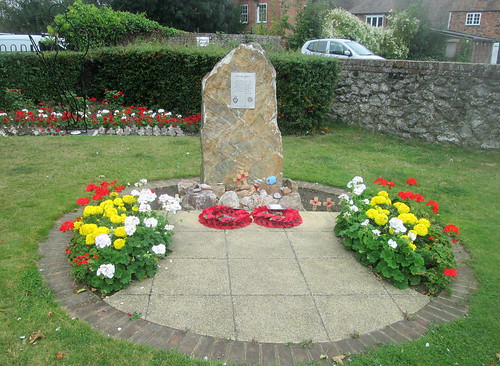
New Romney, War Memorials

The commemoration of the dead of New Romney in the two World Wars I subsequently discovered is on brass plaques within St Nicholas’s Church (see previous post.)

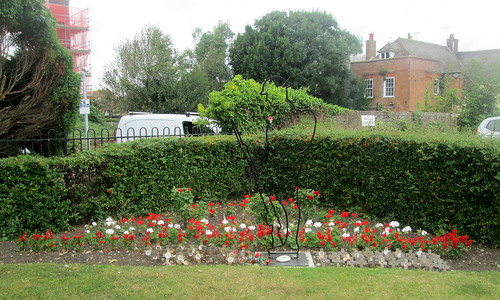
However what may be a recently laid memorial garden, probably for the 100<sup<th anniversary of the Great War, lies opposite the church.

This contains a stone slab with an attached metal panel inscribed with the familiar fourth verse of the poem “For the Fallen.”

War Memorial, New Romney, Kent

Another stone is dedicated to the Burma Star Association Romney Marsh Branch and is inscribed with the Kohima Epitaph, ‘When you go home, tell them of us and say, For your tomorrow, we gave our today.’

Burma Star Association Memorial, New Romney

There is also a “Ghost Soldier” seen here before a bed of poppies and remembrance crosses:-

"Ghost Soldier" War Memorial New Romney

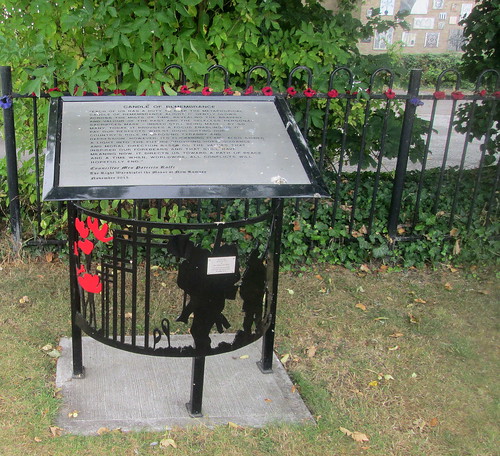
Another memorial bears a plaque saying, “Candle of Remembrance.” Click to enlarge and see inscription:-

Candle of Remembrance, New Romney

St Nicholas’s Church, New Romney

We scooted along ten miles or so from Rye into Kent and New Romney. The ground is very flat between the two towns. It was at one time under water before the sea retreated. It’s a smallish town but pleasant. We had lunch in a café there.

The Church of St Nicholas was the most prominent architectural feature:-

Church of St Nicholas, New Romney

Its doorway is intricately carved:-

Door of St Nicholas's Church, New Romney

Latest Interzone – Issue 289

 Hold Up the Sky cover
 Interzone 289 cover

It’s that time again. The latest issue of Interzone – 289 of that ilk – landed on my doormat this morning.

This one contains my review of Cixin Liu’s collection of short stories Hold Up the Sky which I mentioned receiving here.

Once again the cover is a wraparound. See below:-

Interzone 289 full cover</center

Rye War Memorial

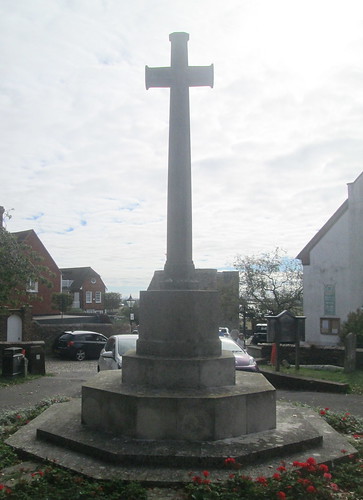
Rye’s War Memorial stands in the south-east corner of St Mary’s Churchyard. It was designed by Sir Reginald Blomfield in the form which was adopted as the Cross of Sacrifice. The cross surmounts a three-stage octagonal plinth, standing on a two-stage octagonal base.

There are in total 142 Great War Names, plus 42 for World War 2 and one each for the Gulf War and Iraq.

Inscribed on the first step of plinth below the names is, “In memory of the officers and men from Rye who gave their lives in the Great War MCMXIV – MCMXIX.” On the next step below, “Their name liveth forevermore,” and below again, “Also to those who fell in the 1939-1945 war.”

Rye War Memorial

War Memorial, Rye

Rye, War Memorial

War Memorial in Rye

St Mary’s Church, Rye

The most prominent architectural feature in Rye is St Mary’s Church.

The Church is rather hemmed in though – there’s not much room on the hill where it’s situated. This is a stitch of photos to show the whole church from the east:-

St Mary's Church, Rye, (Photo Stitch)

Clock Tower:-

Clock Tower, St Mary's Church, Rye

Clock tower from High Street:-

St Mary's Church, Rye, Clock Tower

Graveyard and Church:-

Rye, St Mary's Church and Graveyard

Church and War Memorial – note the upturned sword on the memorial turning it into a Cross of Sacrifice:-

Rye, St Mary's Church and War Memorial

Inside the church a memorial quilt was on display. The topography of the church made this difficult to photograph:-

Memorial Quilt in St Mary's Church, Rye

Also a memorial erected by their parents to the choristers of the church who fell in the Great War:-

Great War Memorial Plaque, St Mary's Church, Rye

The Sealwoman’s Gift by Sally Magnusson

Two Roads, 2018, 368 p, plus i p A Note about Icelandic, iv p List of Characters, i p Maps and i p Contents.

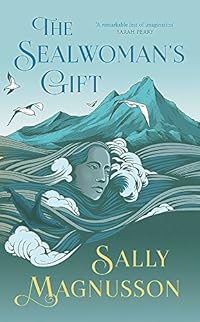
 The Sealwoman’s Gift  cover

The author is well-known (in Scotland) as a television newsreader and possibly more widely as a presenter of Songs of Praise. (Her father Magnus also made a career in television – he was the questioner on the original Mastermind – and translated various works from Icelandic to English; see The Fish Can Sing.) In this book Magnusson draws on her Icelandic heritage to tell the tale of a woman, Ásta Thorsteinsdóttir, caught up in a traumatic incident of Icelandic history, the abduction and enslavement of hundreds of Icelanders by Barbary corsairs in the mid-1600s.

The novel begins on the corsair ship taking the pregnant Ásta and the rest of her kidnapped family to Algiers. Despite her pregnancy, her defiance – in contrast to the more accommodating attitude of her husband Ólafur, a priest in the staunch Icelandic Protestant mould but who wishes to converse with his captors – fatefully takes the eye of the ship’s captain, Wahid Fleming, a man of Dutch origin. On board, and just before she gives birth she receives a cryptic piece of advice, the gift of the title, from the dying Oddrún, who had long claimed to be a sealwoman who once took off her skin to bask in the midnight sun but found it stolen when it was time to return to the sea so had to make a life for herself as an Icelander.

In Algiers Fleming sells Ásta and her family to Ali Pitterling Cilleby, with the suggestion of petitioning the King of Denmark (Iceland’s ruler at the time) for their ransom. Cilleby’s wife had hoped for a seamstress, in which regard Ásta is a disappointment. Cilleby sends Ólafur on the long journey to Copenhagen with the ransom demand, which the King refuses. Once back on Iceland, Ólafur, with the local bishop’s encouragement, sets about raising the money by community effort, via the selling of knitted socks etc.

The Icelanders in Algiers make their own accommodations with their new life. Some convert to Islam in order to make their way, others remain true to their own traditions. Even as she realises that this society, with its sights, sounds, smells, opulence and food abundance so in contrast to the harsh realities of life in Iceland, is in many ways much more civilised than her own, Ásta is anguished when her daughter, brought up among the strange foreign customs, becomes more at home with them than with her mother’s.

The ransom not forthcoming, Cilleby’s attention falls on Ásta. Inviting her to his chamber one night, he is astounded by her refusal to lie with him, which by the laws of his state he may. Her understanding, she tells him, was that she was not bought as a concubine. Moreover, she is married so cannot take another man for herself. This clash of customs and the building of the relationship between them forms the majority of the book’s largest section. Cilleby’s interest in her becomes intellectual as well as sexual as she relates the details of Icelandic sagas, in which he manages to find material to contradict her abomination of slavery. It is here that the book explicitly riffs on the tales of the Thousand and One Nights (not that Ásta is in any danger of execution, as Scheherazade was.) Yet there cannot be a meeting of minds. Both are too steeped in their respective values.

Via a Dutch intermediary, the ransom eventually arrives – for all the Icelanders, not all of whom wish to return. Cilleby offers Ásta the choice, he will turn down the money if she wishes to stay. Though torn between her children and her husband, duty wins out. Ásta’s equally long return to Iceland, via Denmark, allows Magnusson to explore other instances of human frailty and the conflict between religion and emotion. Back in Iceland Ásta fails to recognise the old man her husband has become and has to come to terms with how her experiences have changed her.

This novel is many-layered; it is among other things a story about stories, about love and loss, the ties that bind, and the barriers between cultures. Magnusson’s writing is assured and even her minor characters have depth. This novel is very good indeed.

Pedant’s corner:- span (x 2, spun,) focussed (focused,) maws (x 2, a maw is a stomach, not a mouth,) smoothes (smooths.)

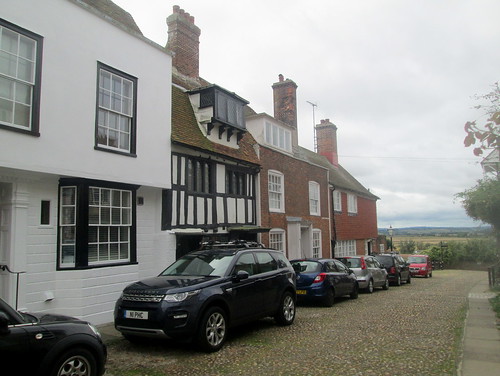
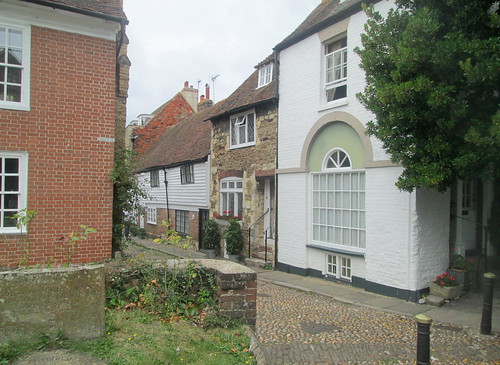
Streets in Rye, East Sussex

View from Landgate:-

View From Landgate, Rye

Timbered House, Bellwatch Street:-

Timbered House, Bellwatch Street, Rye

Another timbered house with unusual projecting window:-

Timbered house, Rye

This house also had a projecting window:-

triangular window, Rye

Hilly streets:-

hilly street, Rye

Hilly Street, Rye, East Sussex

Street corner:-

Street Corner, Rye

Town Hall with St Mary’s Church Tower behind:-

St Mary's Church Tower + Town Hall (maybe)

Old Street by St Mary’s Church:-

Old Street by St Mary's Church, Rye

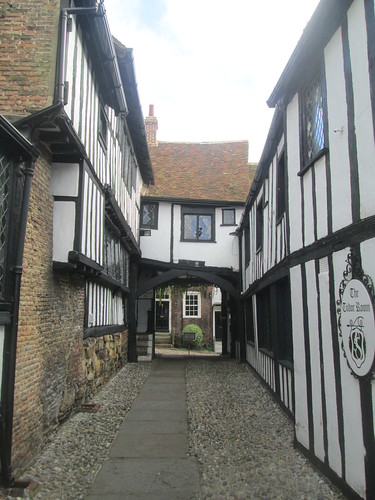
Mermaid Inn Arch:-

Mermaid Inn Arch, Rye

At the top of the hill is the High Street:-

High Street, Rye

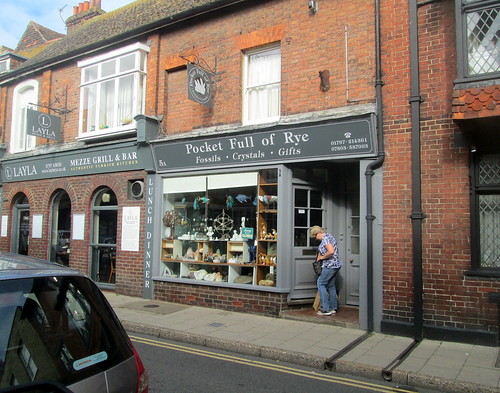
One shopkeeper could not resist the obvious pun:-

Pocket Full of Rye, Rye

Bookshelf Travelling for Insane Times – Alasdair Gray

This week’s books for Judith’s meme now overseen by Katrina are on my shelf of Scottish books.

Books by Alasdair Gray

This illustrates my idiosyncratic filing system. Within an author’s books, first come novels in order of publication,* then collections of short stories,** then anthologies edited (if any: in this case none,) then collaborations, finally non-fiction. But here we have two books of plays – one a verse comedy – before the non-fiction Independence.

Two further books, A Short Survey of Classic Scottish Writing and A Life in Pictures are of odd sizes and housed elsewhere as is the as-yet unread by me Old Negatives 4 verse sequences and The Book of Prefaces.

*See here for my review of Old Men in Love.

**I reviewed one of these here.

Kilmarnock 2-0 Dumbarton

Scottish League Cup*, Rugby Park, 14/11/20.

Not as bad as I’d feared, even if we were on for a hiding in the first half but Ryan McGeever got injured which we could have done without.

It’s a long time since this Cup has been a happy hunting ground for us. The group this year always looked a stiff test. Too stiff as it turned out.

The table makes for unhappy reading but I suppose this competition is never a priority for us.

Back to league business next Saturday.

*Betfred Cup

free hit counter script