Archives » 2020 » November

Art Deco in Coalville (i) Minor Building

In Coalville I found no fewer than four Art Deco style buildings. Two of them were glorious.

This one (to the left of the photo) however, barely makes the definition. It could be seen from the square containing the Clocktower War Memorial. It’s deco only in the stepped roofline and rule of three in (filled-in) windows:-

Art Deco Building, Coalville, Leicestershire

Coalville War Memorial (iv) plus Mining Memorial

Coalville Memorial Clock Tower with fence in foreground. The words inscribed on the fence are, “Memorial. For your tomorrow.”

Fence at Coalville War Memorial

Coalville War Memorial Fence

Post World War 2 commemorations – 2 general plaques one noting deaths in Korea, Cyprus and Iraq. (Mining memorial in near background.)

Coalville War Memorial, Names Since 1945

Mining Memorial, Coalville, Leicestershire

SF Bookshelf Travelling for Insane Times (xi)

A meme as started by Judith and now collated by Katrina.

Since these are SF paperbacks mostly published several decades ago they are on the shelves housed in my garage. The photos are zooms in on the ones of the whole bookcases and so are a bit fuzzy.

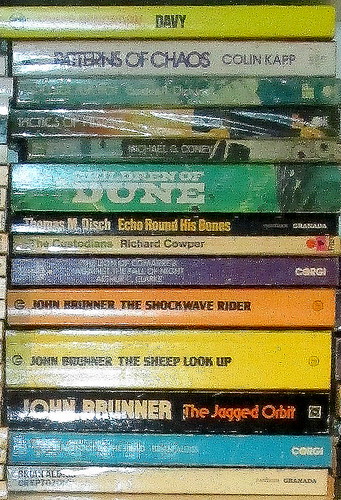
On view are books by the excellent Michael Bishop, several by my friend Eric Brown, three by Algis Budrys, five (or seven since one is an omnibus of a trilogy) by C J Cherryh, but most of the books shown here were written by John Brunner. I remember fondly Stand on Zanzibar, The Dramaturges of Yan, Telepathist and The Squares of the City, in which the characters are in effect avatars of chess pieces whose moves were taken from a real game.

SF Books by John Brunner

Brunner’s The Shockwave Rider (in which he more or less predicted computer viruses but due to the storage medium of computers at the time he called them tapeworms,) The Sheep Look Up and The Jagged Orbit are shelved in another bookcase in the garage for arcane reasons.

Science Fiction Books

His Timescoop is on my hardback shelves.

Coalville War Memorial (iii) World War 2 Names

R Adcock – H Davis:-

War Memorial, Coalville, World War 2 Names

W H Davis – G R Jacques:-

Second World War Names, Coalville War Memorial

D A James – G N Reason:-

Coalville War Memorial, Second World War Names

D A Richards – H Woodiwiss:-

Coalville War Memorial, World War 2 Names

Coalville War Memorial (ii) Great War Names

For wider views of Coalville’s War Memorial see previous post.

Dedication. “This tower was erected by the inhabitants of the district in memory of the men who went from the Coalville urban area.”:-

Dedication, Coalville War Memorial

Great War name plaques:-

F Adams – R Freeman

Coalville War Memorial, Great War Names

C T Gadsby – S W Palmer
Great War Names, Coalville  War Memorial 2

H Parish – W Young

War Memorial, Coalville, Great War Names

Coalville War Memorial (i)

On the way back up from Rye we stopped for a night at a hotel in Leicestershire near Ashby-de-la-Zouche as the name is so delightful we felt it was place we had to visit.

Between the hotel and Ashby, however, we passed through the town of Coalville, of which I confess before planning the trip I had never heard.

It’s well worth a visit though – not as far as shops are concerned but for some of the architecture and its War Memorial.

This takes the unusual form of a clock tower* which dominates the town centre. It was erected in 1925:-

War Memorial, Coalville, Leicestershire

War Memorial, Coalville

Clock tower with mining memorial in foreground. (As its name suggests Coalville has a mining heritage):-

War Memorial, Coalville

Coalville War Memorial

Close-up of tower from below:-

Coalville War Memorial From Below

*The only other clock tower I can remember seeing which also acted as a War Memorial is in the Dutch (or Friesian) town of Surhuisterveen. That commemorates the Second World War though and so will post-date Coalville’s.

Not Friday on my Mind 63: If I Were a Carpenter

A beautiful song written by the singer here. It wasn’t a hit for him in the UK but it was for the Four Tops (see here) and Bobby Darin.

I of course applaud the use of the conditional in the title and in each of the verses.

Tim Hardin: If I Were a Carpenter

Starsilk by Sydney J van Scyoc

Penguin, 1986, 251 p.

 Starsilk  cover

Reyna is a barohna’s daughter all set to make the trip into the hills to face the challenge which will make her into a barohna herself or die in the attempt. Her parents are Khira and Iahn from Bluesong who have fallen out over this tradition, with Iahn returning to the plains where Khira met him. On the day of the annual dance (when it seems the inhabitants of Brakrath choose mates) Reyna meets a hunter, Juaren, one of the last of his kind. That evening though it is her mother who picks out Juaren to dance and take to her bed. Some weeks later Khira tells Reyna she will not be the next barohna, her unborn sister will, and forbids her to take go on her challenge. The Arnimi, off-planet humans reliant on instruments to a very un-Brakrathi extent and who have been studying the people of Brakrath for many years, have discovered which part of the brain allows a palace daughter to become a barohna and Reyna has not inherited it. That her father is himself an off-planet Rauthimage is almost certainly a factor in this and Khira has therefore been forced to mate with a Brakrathi to fulfil her purpose of providing a daughter to replace her as barohna.

The communication from Birnam Rauth (of whom Iahn is a clone) via the bluesilk from the previous book in the sequence provides a new purpose for Reyna’s life though, as the Arnimi propose she travels to the likely planet where he is held captive to find and, if possible, rescue him. Her companions will be Verra, an Arnimi, and Juaren, whose dynastic purpose having been fulfilled is something of a spare at the palace.

Reyna’s tale is interspersed with details of the lives of some sithi, indigenous bear-like creatures of Birnam Rauth’s prison planet; in especial, Tsuuka, mother of several sithi one of whom, Dariim, is so enthralled by a red starsilk that he disobeys her strictures about penetrating deep into the nearby forest and falls into danger. There creatures called spinners produce the starsilks which sing to the sithi and also protect the eldest tree within which Rauth is trapped.

Through the third person text, Reyna keeps asking herself questions, as does Tsuuka. As a means of information provision (I hesitate to call it dumping) and illustration of Reyna’s lack of knowledge of the sithi’s planet, this is fine but there was perhaps too much of it.

As if to prove that Science Fiction is rarely about the future the Arnimi recording medium of choice in this book is tape. In Starsilk’s year of publication, 1984, of course, this would have seemed unremarkable and to have invented another a seemingly unnecessary extrapolation. How much has changed in the past 36 years.

The journey to find out where and how starsilks were produced and Birnam Rauth sequestered is where the trilogy has been headed all along. Though it takes us off Brakrath with its unusual culture and doesn’t really illuminate those of the Arnimi and the inimical Benderzic, it is not a disappointment. This is good, solid SF – even if it doesn’t quite reach the heights of the genre.

Pedant’s corner:- “picking up his work without word” (without a word,) “to show them that none of those supositions were true” (that none … was true,) “it had flirted away” (flitted makes more sense,) “a deep sound accompanying its ascent” (this was of a ship – or shuttle – coming down from orbit; descent, then,) “‘Danior described the night sky in just enough detail that our ship’s system was able to calculate the location of the forested atea he described’” (a knowledge of its night sky would be enough to locate a planet’s position, but not a specific area on its surface,) “‘to see if its drinkable’” (it’s,) “more briskly then before” (than before,) abosrbed (absorbed,) “‘maybe its nocturnal’” (it’s,) Komas’ (Komas’s,) thougts (thoughts.) “She saw what she hadn’t dare believe” (dared.)

Maradona

The one name suffices.

Like most superstars he is immediately identifiable.

Sadly one of the best two footballers ever to play the game today left the global pitch. Shockingly young it has to be said.

I suppose in that, his personal demons may have had something to do with it. But mercifully in the light of other recent deaths of former footballers it wasn’t dementia that took him.

His feats on the international stage are enough to put him on a pedestal, dragging Argentina to a World Cup win in 1986 almost (but not quite) on his own and to another final four years later, but it was his elevation of Napoli to the status of winners of Lo Scudetto in 1987 that is perhaps his greatest achievement. And then he did it with them again three years later. They haven’t touched those heights since.

In that 1986 World Cup there was the (in)famous Hand of God goal in the quarter-final against England – soon to be followed by the even more famous slalom through the whole England defence, one by one putting them on their backsides before planting the ball in the net. Even the English TV commentator Barry Davies was moved to remark, “You have to say that’s magnificent.”

But his performance in the semi-final against Belgium was better, a level of sustained excellence rarely seen before or since, perhaps even unequalled. I found this distillation of it (with a lot of repeat angles) on You Tube.

Diego Armando Maradona Franco: 30/10/1960 – 25/11/2020. So it goes.

Dumbarton 0-3 Falkirk

SPFL Tier 3, The Rock, 24/11/20.

My second experience of live-streaming. It was slightly less odd than before. The emotional engagement is diluted compared to actully being at the game.

We had more possession for the first ten minutes or so but never really threatened their goal. It’s always ominous when you know the opposition is likely to be good but don’t show anything. Sure enough once they came into it we were more or les on the back foot.

Their first was a good cross but the guy who scored it, coming in at the back post, was totally unmarked.

Their second – a great strike from a free-kick – I thought came from a foul that wasn’t a foul. Whether Kevin Dabrowski in goal might have done better is difficult to tell on a live stream. He is a bit susceptible to long-range hits it seems. He was also beaten by a shot from well outside the box which hit the bar.

In the second half things just went downhill. Ryan McGeever had had to be substituted at half-time, then Adam Frizell, then Rico Quitongo and finally Nat Wedderburn all for injuries it seemed. We’re lucky we’ve got ten days before our next game for the chance to recover.

Even so, sub Denny Johnstone managed to hit the post in an attack which the stream mostly missed, then a fine Robert Jones cross from the bye-line was headed wide by Jaime Wilson.

Their third was another defensive shocker from us, a long through ball from that Wilson chance wasn’t dealt with and their player managed (luckily?) to evade Dabrowski’s attempt to steal the ball as he went round him.

Very late on Johnstone again had a strike which the keeper tipped round the post at full stretch. Even later Wilson played in Robert Jones for a sitter but he took too long to hit it and allowed the defender to block it wide.

So in a game where Falkirk more or less strolled it we could have scored three times – and that with players shoe-horned into positions not their usual. But we didn’t score at all.

The good start to the league season feels like a long time ago now.

free hit counter script