Archives » 2020 » April

Nevsky Prospekt, St Petersburg (i)

Nevsky Prospekt, (or Nevsky Avenyue) is St Petersburg’s main street, running more or less east from the Admiralty Building near the Winter Palace at the River Neva end in the west to the Moscow Railway Station and, after veering slightly southwards at Vosstaniya Square, to the Alexander Nevsky Lavra Monastery. (We didn’t go that far.)

This poster/billboard of Vladimir Putin was on a road leading to the General Staff Building:-

Putin Billboard, St Petersburg

General Staff Building arch, Winter Palace behind:-

General Staff Building St Petersburg

The Prospekt itself has many fine buildings like this pinkish grey one with great detailing:-

Grey Building on Nevsky Prospekt, St Petersburg

And something calling itself Grand Palace:-

Grand Palace, Nevsky Prospekt, St Petersburg

And this church, set back from the street:-

A Church Building off Nevsky Prospekt, St Petersburg

Part of the way up the south side is this set of colonnades with shops:-

Colonnade, Nevsky Prospekt, St Petersburg

Then there’s the Kazan Cathedral:-

Kazan Cathedral, Nevsky Prospekt, St Petersburg

With its fountain:-

Fountain in Front of Kazan Cathedral

The fine building across the street and back a bit is almost hidden away:-

Through the Keyhole

Courtyard, The Winter Palace, St Petersburg

Winter Palace Gates. Famously “stormed” in the October Revolution of 1917. Except the film Eisenstein made of it rather overplayed things. There was very little resistance:-

Winter Palace Gates, St Petersburg

Behind the gates lies a courtyard where there is one of the entrances to the Hermitage Museum:-

Winter Palace from Courtyard, St Petersburg

Queue for entry to Hermitage Museum:-

Winter Palace Courtyard Trees, St Petersburg

Part of Winter Palace, St Petersburg

Winter Palace, St Petersburg, from Courtyard

Trees in courtyard:-

Ciurtyard, Winter Palace, St Petersburg

St Petersburg, Winter Palace

Looking back to gates:-

Trees in Courtyard, Winter Palace, St Petersburg

Summer Garden, St Petersburg

The Summer Garden, the oldest garden in St Petersburg, lies over the road from the Field of Mars, between the Palace Embankment of the River Neva and the Mihailovsky Castle.

Palace Embankment, St Petersburg:-

Boulevard by River Neva, St Petersburg

Garden:-

Summer Garden, St Petersburg, Russia

Walkway:-

Summer Gardens, St Petersburg, Russia

There are several fountains in the Summer Garden. This one is surrounded by statuary:-

Summer Garden, St Petersburg, Russia

Summer Garden, St Petersburg, Russia

Square Fountain:-
Summer Gardens, St Petersburg, Russia

Another Fountain, Summer Gardens, St Petersburg

This is the most ornate fountain:-

Summer Garden, St Petersburg, Russia

Fountain, Summer Gardens, St Petersburg

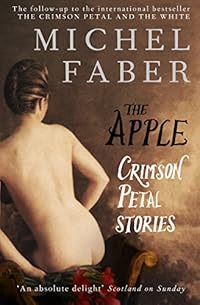
The Apple by Michel Faber

Crimson Petal Stories. Canongate, 2011, 206 p, plus xi p Foreword.

 The Apple cover

Faber’s foreword tells of the countless letters he was sent praising his novel The Crimson Petal and the White, or lamenting its inconclusive ending, the entreaties he received to let his readers know what happened next. This volume contains stories featuring characters who appeared in the earlier book (which I have not read, but did watch the television adaptation) but only those tales that demanded to exist. The rest he had to let slip away.

It has to be said that, here, Faber’s writing is masterful. In a few deft strokes he conjures up the times he is writing about and the characters he depicts.

Christmas in Silver Street sees sixteen year-old but nevertheless experienced prostitute Sugar give little Christopher, the brothel’s drudge of a linen-fetcher, a surprise Christmas gift of chicken and pastries.
In Clara and the Rat Man Clara has fairly recently been reduced to prostitution by an insensitive reference from a former employer. The Rat Man, a veteran of the Afghan War gives her a shilling a week to grow the nail of her middle finger and, once it has grown, ten more to insert it in a particular place while his dog is engaged in pit ratting.
Miss Emmeline Curlew’s father worries that if she doesn’t marry while young she never will, as she has inherited his aquiline nose, long face and strong jaw. Along with a photograph, Chocolate Hearts from the New World are an addition to the courteous reply upon which she muses after receiving it from a US slave owner (a contrast to the usual vitriol directed to her) to her entreaties to give up slavery.
The Fly, and its Effect upon Mr Bodley is the tale of the discomfiture of that gentleman who is unmanned by the memory of a fly landing on the buttock of a prostitute displaying herself as he decided which orifice he preferred to penetrate, a discomfiture two days later in the same house in Fitzrovia unallayed by the allures of a new girl, whose name is Ping or Pang but whom the establishment calls Lily, whom they are teaching English starting with the essentials (a four letter word of course.) Mr Bodley is prevailed on to sleep things off but is unprepared, “‘I can’t sleep without a nightgown. It’s not natural.’”
In The Apple, Sugar is awoken by an evangelist singing beneath her window. She observes the singer with a child and is enraged by the blow the child receives from her carer after she drops the apple she has been given. This prompts Sugar to rush out to remonstrate but the pair have gone. This along with Sugar’s perusal of the latest Trollope novels and penny dreadfuls makes her resolve to seize her chance of escape should it arise. It is counter-intuitive (brave?) for an author to include the thought that Sugar has about reading as “an admission of defeat …. it shows that you believe other lives are more interesting than yours. All of it is trickery, a Punch and Judy show for the gullible masses.”
William Rackham hopes his Medicine does not contain morphine or cocaine as he ingested other narcotics just an hour before. Sitting at his desk he recalls the way his life was turned upside down by Sugar.
A Mighty Horde of Women in Very Big Hats, Advancing is narrated by an old man in a care home in the nineteen nineties. He was born the day Queen Victoria died and brought to England from his home in Australia in early 1908. At his new school he falls foul of the unwritten codes of English life. “That’s Britain for you … how much unease can be generated out of bloody nothing.” He remembers the day of a huge suffragette march in June 1908. In what might be seen as Faber’s riposte to those who questioned Crimson Petal’s ending. “I do understand how maddening it is to get so far, and not know what happened next.” The narrator’s mother Sophie had once revealed to him she had been taken away from her home by her governess, a Miss Sugar, because she had felt unsafe there. “Life defies our intentions to be rational; it misleads and teases us until we are driven to do foolish things.” He also berates the reader’s tendency to bring sex into everything. Born one day earlier he’d have been a Victorian, “And you know what those Victorians were like.”

After reading the stories in The Apple we know exactly what those Victorians were like.

Pedant’s corner:- “the Virginias” (in 1850? Didn’t Virginia only split into two States once the US Civil War began in 1861?) “‘I had to go see my father’” (go to see,) “outside of” (outside, no ‘of.’) “Go play with” (go and play with,) “came to nought” (naught. The sense is ‘nothing,’ not ‘zero.’ There is a difference.) Some missing commas before direct speech, “prime minister” (Prime Minister.)

St Petersburg (vi)

The Mikhailovsky Castle, (known in English as St Michael’s Castle,) St Petersburg. The Tsar Paul I, Catherine the Great’s son, apparently didn’t like the Winter Palace so had this one built instead. It was built surrounded by water, for defensive purposes, to be entered only by drawbridges. Not that that did Paul much good. He was assassinated in the Palace 40 nights after moving in.

Note eagle finials on the gate posts of the Summer Gardens:-

Paul's Palace, St Petersburg

Moyka River. St Michael’s Castle in background. Field of Mars to left. This looked more like a canal to me:-

Moyka River, St Petersburg.

Crossing the river you head to the Griboyedov Embankment and towards the Church on Spilled Blood. We noticed how ornate the lampposts were:-

Ornate Lamppost, St Petersburg

The stunning and very Russian in style Church on the Spilled Blood and Griboyedov Canal:-

St Petersburg, Church on the Spilled Blood

From the canal:-

Church on the Spilled Blood 4

From Griboyedov Embankment:-

Church on the Spilled Blood 7

Church on the Spilled Blood

Upper portion. It’s a pity the top was swathed in scaffolding:-

Upper Portion, Church on the Spilled Blood, St Petersburg

From across the canal:-

Church on the Spilled Blood, St Petersburg

Message in a Poem

Also in the Guardian Review on Saturday was, under the heading “A Box of Delights” (though the website has “Reasons to be Cheerful,”) a small collection of new stories, poems and illustrations to lighten our mood in these times of plague and lockdown.

One that particularly caught my eye was a poem published under the rubric:-

Care of Exotic Pets
Number 1. The Axolotl at Bedtime
by Catherine Johnson.

It starts, “Never give your axolotl chocolatl in a botl.”

It goes on to use nine more – different – rhymes for axolotl. You know how I love an inventive, or a fitting, rhyme. I didn’t care a whit that every single one of them was misspelled. Those misspellings served to emphasise the Aztec origins of the word axolotl (not to mention chocolate. Sorry, chocolatl.)

It was a delightful jeu d’esprit and fair cheered me up.

The Persistence of the Rime

The Rime of course is that of the Ancient Mariner (a nickname bestowed on a 1980s full-time team’s part-time goalkeeper of my acquaintance – he taught in the same school as me – on the grounds that, “he stoppeth one of three”) by Samuel Taylor Coleridge.

In another piece in Saturday’s Guardian Review, Philip Hoare, remarks on the poem’s continuing relevance, from Mary Shelley’s Frankenstein and Herman Melville’s Moby Dick through to Fleetwood Mac’s Albatross and beyond.

(Aside; when I hear the word, “Albatross!” I nearly always think “Gannet on a stick.”)

The instant recognition of the lines, “Water, water, everywhere” and “all creatures great and small,” he says, have become part of the lexicon.

At which point my senses pricked up. All Creatures Great and Small is nowadays best known as a television adaptation of a James Herriot set of novels.

But surely, rather than from the Rime, that quote comes from the hymn All Things Bright and Beautiful of which it is the second line? To my mind that is a much more likely source for a collective awareness of the phrase than the poem.

The hymn’s writers may well themselves have been inspired by the poem and its almost identical line “All things great and small” (which is followed by “For the dear God who loveth us; He made and loveth all,”) itself very close to “The Lord God made them all.” However that is not quite what Philip Hoare claimed.

St Petersburg (v)

Green Onion Domes such as these are typically Russian:-

green domes ,St Petersburg

However, most of St Petersburg’s architecture is in the European style.

Senate and Synod building:-

Senate and Synod Building, St Petersburg

Portico:-

St Petersburg, Senate Building

Senate and Synod Building, Senate and Synod,St Petersburg, Frontage

Street to side:-

Street by Senate and Synod Building, St Petersburg

Central Exhibition Hall, St Petersburg:-

Central Exhibition Hall, St Petersburg

The Lion Palace is so-called because of the stone lions at its entrance. Corner (opposite St Isaac’s Cathedral):-

Corner of Lion Palace, St Petersburg,

Facade:-

Facade, Lion Palace, St Petersburg

Stone lions:-

Lion Palace, St Petersburg

Just across the road from the Lion Palace is this rather sumptuous in appearance public convenience. A bit more elaborate than the average British effort:-

Public Convenience, St Petersburg

Novel Misconceptions

In a piece in Saturday’s Guardian Review on how he wrote The Buddha of Suburbia, Hanif Kureishi echoes Tolstoy’s (in my opinion contentious) dictum about happy families. Kureishi claims that, “All first novels are letters to one’s parents, telling them how it was for you, an account of things they didn’t understand or didn’t want to hear.”

Speak for yourself, mate.

This sort of statement can only encourage the lazy view some readers have that everything in a novel – especially a novel written in the first person – is somehow autobiographical. It leaves no space for invention, nor for imagination; only craft. And it belittles that craft. The recent vogue for autofiction of the Karl Ove Knausgård type is for that reason an unwelcome development as far as I’m concerned.

Of course aspects of a writer’s life may seep into her or his work – perhaps even subconsciously – and autobiographical incidents may appear there, in altered form or otherwise, but that is not to say that everything in a work emanates from that source. Inspiration can strike from anywhere, not merely the author’s own life and experiences.

Your first novel may have been written as a letter to your parents, Mr Kureishi. However, that is not true of everyone’s.

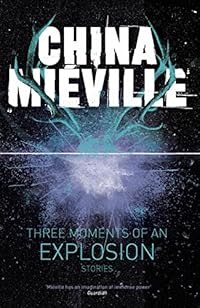
Three Moments of an Explosion by China Miéville

Macmillan, 2015, 443 p.

 Three Moments of an Explosion cover

This is Miéville’s latest collection of short stories. Like with all such collections the interest varies but the stories are all readable.

The very short Three Moments of an Explosion consists of three fragments all describing explosions, some of which are used for advertisemants.
In Polynia Cold Masses – icebergs – appear in the sky over London (while coral sprouts on the walls of buildings in Brussels.) There’s a Wellsian feel to it but the end result is still distinctly Miévillean.
The Condition of New Death is that all dead bodies orient with their feet pointing directly towards to any observer (including cameras) at all times. Apparently this is linked to a feature of early First-Person Shooters.
The Dowager of Bees is narrated by a card player, inducted one day into the phenomenon of Hidden Suits, where a card (such as the Dowager of Bees) will manifest during a game – and in the rule books – only for both to disappear again once the game ends, with forfeits to be fulfilled. The reader can guess which card the climax will involve but there is still a resolution beyond its appearance.
Narrated by an immigrant shopkeeper on the island where it is set In the Slopes is the story both of two rival archæological digs in the shadow of a volcano which are uncovering evidence of extraterrestrials living alongside humans and of a new resin for preserving the remains.
The Crawl is the text of a trailer for a zombie film.
Watching God is set on a peninsula cut off from its mainland by forest and a ravine. Ships appear from time to time but never come ashore, instead wrecking themselves just out to sea as if forming words with their arrangements.
The title of The 9th Technique refers to a form of torture but the story itself is about the uncanny manifestations attached to the techniques – the cloth from the first waterboarding now having unusual properties – and their value as objects of desire. The 9th technique is confinement with an insect. Viewpoint character Koning acquires it.
The Rope is the World is a history of the girdling of Earth – a thin-spoked wheel – by space elevators and their subsequent inhabitation and decay. Money for old ….
Containing some fables particular to its setting The Buzzard’s Egg is the address of an enslaved member of a defeated city, whose job it is to look after the captured gods of conquered peoples, to one of those gods.
Säcken is a tale of supernatural apparitions arising from an ancient punishment for parricide, the poena cullei, where the criminal was sewn into a bag with a dog, a cockerel, a viper and an ape and then thrown into water.
Syllabus is what it says, an outline for an academic course on the detritus left by time-travellers, the ramifications of the arrival of alien insects for global poilitics and the implications of the privatisation of sickness in the UK.
In Dreaded Outcome a therapist has an unusual proactive role in the restoration of her patients to well-being using what she calls traumatic vector therapy. She also has her own therapist.
After the Festival is a gruesome tale about a new entertainment – the public slaughter of animals and the subsequent wearing of their heads by people chosen from the crowd.
The Dusty Hat starts as a tale of political leftist factionalism but soon veers off into weirdness and a discussion of geological deep time (which gives Miéville the opportunity to make a neat pun with the description glass struggle. He also for some reason finds it necessary to italicise the word stramash.)
Escapee is another text of a film trailer, this time for a horror film.
The Bastard Prompt’s narrator’s girlfriend was a jobbing actor not getting many parts so took a post as a Standardised Patient – helping trainee doctors to recognise diseases from their ‘symptoms’. She’s very good at it but then starts to describe symptoms for diseases that don’t exist – yet.
Rules is a short list of, em, rules for as yet unknown games and also a reflection on imitating an aeroplane with spread arms and making that “now-familiar” noise.
The estate of Estate is a housing one which Dan Loch’s family had to leave one day. When he comes back there is an outbreak of incidents involving drugged deer staggering around with their antlers on fire.
Keep relates the evolution of a new epidemic where, if the afflicted remain too long immobile, trenches appear in a circle around them, and the scientific efforts to discover its origins and possible cure.
A Second Slice Manifesto is that of an art movement which constructs and displays slices through prior paintings; slices which reveal more of the originals than was apparent to the naked eye.
A father and daughter enter a militarily embargoed area around Covehithe. They have come to watch the emergence of a damaged and sunken oil-rig from the sea. It has come to drill down and deposit eggs from which new rigs will grow.
The Junket is narrated by a hard-boiled media journalist describing the controversy around a film (made by Jews) which displays every anti-Semitic trope in the book, and its aftermath.
Four Final Orpheuses gives us four different versions of why Orpheus might have made that turn and fateful look towards Eurydice.
A picture frame turns put to have unusual properties in The Rabbet.
Listen the Birds is another storyboard for a film trailer.
A Mount is a meditation on the ubiquity of porcelain animals and why some seemingly out-of-place people, not their owners, might be fascinated by them.
A sense of understated eeriness hangs over The Design in which a medical student between the wars discovers designs etched into the bones of the cadaver he is dissecting. He concludes that God is a scrimshander.

Pedant’s corner: vortexes (strictly the plural of vortex is vortices,) “a plethora of ceremonies are emerging” (a plethora is singular; a plethora …. is emerging,) indices (yes, it’s an acceptable plural but when it is for book contents it’s usually spelled indexes,) sodium pentothol, (sodium pentothal,) Cheevers’ wife (Cheevers’s,) crevace-spiders (crevice-spiders?) “There were a series of percussions” (there was a series.) “Most of the town were already gathered” (most of the town was gathered.) “None of them leave.” (None of them leaves,) snuck (sneaked.) Pangea (Pangaea, or, even better, Pangæa.) “A line of police block the road” (A line … blocks the road,) “wracks his brain” (racks,) “or that it be not shown” (or that it not be shown,) “Baron von Richtofen” (if it’s that baron, it’s Richthofen,) fit (fitted,) trash (rubbish.)

free hit counter script