Archives » 2018 » December

War Grave, Holy Trinity Church, Pitlochry

I must have passed this church building, of the Scottish Episcopal Church, twenty or so times at least. It wasn’t till October 2017 I noticed the Commonwealth War Graves sign on the gate.

Its grounds are lovely with a burn running through them.

Burn in Churchyard, Holy Trinity Church, Pitlochry

It contained one war grave quite near the entrance and close to the burn. Bombardier J Ward, Royal Garrison Artillery, 7/1/1915, aged 35:-

War Grave, Holy Trinity Church, Pitlochry

Here’s a video of the church and its grounds:-

Best Reading of 2018

Listed below in order of reading. 16 in total; 7 by Scottish writers, 4 SF or Fantasy (+ 1 non-fiction about SF,) 3 in translation, 10 by men, 6 by women:-

Living Nowhere by John Burnside
All Our Worldly Goods by Irène Némirovsky
Science Fiction: A Literary History Edited by Roger Luckhurst
The Fifth Season by N K Jemisin
The Black Book by Orhan Pamuk
The Gathering Night by Margaret Elphinstone
When They Lay Bare by Andrew Greig
The Great Chain of Unbeing by Andrew Crumey
Hame by Annalena McAfee
I Remember Pallahaxi by Michael G Coney
Not so Quiet …. stepdaughters of war by Helen Zenna Smith
Memories of My Melancholy Whores by Gabriel García Márquez
Time Was by Ian McDonald
The Shipbuilders by George Blake
Mr Alfred M.A. by George Friel
Moon Tiger by Penelope Lively

Stenhousemuir 2-2 Dumbarton

SPFL Tier 3, Ochilview, 29/12/18.

Well this was a mustn’t lose – and we almost lost. Thankfully we didn’t.

On our first half performance it would have been deserved – we created nothing and had only one shot on target, Ross Forbes’s free-kick right on half-time despatched with aplomb and hit so hard the keeper couldn’t keep it out. Their goal was a defensive travesty, a litany of mistakes strating with a poor Stuart Carswell ball out (I’m not blaming him, he’s making a fair fist of centre back duties despite being a midfielder, injury needs must) an atrocious Andy Dowie (lack of) challenge and Chris Smith in goal didn’t cover himself in glory with his effort at saving it.

The start was bizarre. We walked out in Stenny’s away kit – or a Stenny away kit an Argentina clone, blue and white stripes and back shorts. Seems the ref didn’t read our email asking if our red strip would be okay. It’s the second time I’ve seen us in the home team’s away kit. The first was at Bayview (the old Bayview) many, many moons ago.

Second half was a different game – after we let them waltz through our defence to retake the lead. We then totally dominated (apart from the odd break) and had a great chance from a Dom Thomas cross which Kyle Hutton put over. Ryan Thomson had an effort from a rebound blocked.

But the amazing thing was the series of corners from Ross Forbes, one hitting the bar and another the near post with a third flapped at by the keeper. If only we had somebody to attack the ball Forbes’s delivery could be decisive but we lack height just now.

Forbes stepped up again right at the death to fire an even better placed free-kick than his first in off the post. Cue celebrations.

The comments from some Sons fans when we were 2-1 down were less than helpful. I don’t seriously believe the players aren’t trying. The time that brought it to a head was a gamble on where the ball would break that didn’t come off. It might have looked like it but it wasn’t laziness on the player’s part – just a misjudgement. If we’d been going well it would never have raised its head as an issue. But we aren’t going well.

I doubt the January transfer/signing window will change much either.

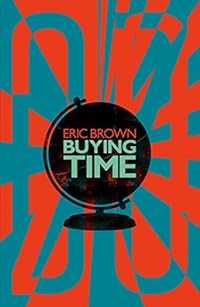
Buying Time by E M Brown

Solaris, 2018, 357 p.

 Buying Time cover

The designation of the author as E M Brown is a slight repositioning by the publisher of my old mate Eric Brown to highlight works of his that are more character based. (It’s a bit late and a bit odd. He has always produced these to go alongside his action adventure novels but even in those he did not neglect character.)

In 2017 Ed Richie, prodigious boozer, script-writer for Coromandel Cable’s Morgan’s Café and also with a few radio plays to his name, is a serial monogamist with a penchant for women of a certain type. His latest relationship with a woman called Anna blows up in his face after he has had some sort of medical emergency experiencing a blinding white light. The break-up is part of a pattern repeated throughout his life. He has a long standing, equally boozy, friend Digby Lincoln, a jobbing script-writer on the TV serial Henderson’s Farm, with whom he discusses his situation.

We then jump to 2030, where in an independent Scotland Ella Croft works as a journalist for ScotFreeMedia. England and the US are in the grip of right-wing authoritarian regimes and Scotland is accepting LGBT refugees from a US where gay marriage is banned and same sex relationships suspect. It seems Richie disappeared some time in 2025 after switching successfully to a career as a novelist. Croft, who knew Richie in her childhood, sets out to find out what happened to him.

When we return to Richie he has had another white light episode and discovers himself in April 2016, much to his confusion and others’ bafflement.

The Richie and Shaw strands alternate throughout the book, interspersed with interpolations from various journal extracts, some Richie’s own, others newspaper or media outlet pieces. Richie is tumbling backwards through time, from 2017 to 2016, then 2013, 2008, 2002, 1995, 1988, and finally 1983. At first Richie wonders if these are hypnagogic hallucinations but Brown later provides, via the 2030 Croft sections, a science-fictional explanation.

Brown draws some amusement from Richie’s knowledge of the future. To the revelation that Trump will be elected President of the US Digby responds, “What? The multiple-bankrupt TV celebrity shyster? Come on, even the Americans can’t be that stupid!” and when told Leicester will win the league in 2016 comments, “Now I know you’re crazy.”

A Trove of Stars, Digby’s SF piece, had caused a rift between them for a while as Richie told him he, “took needless time out to tell the reader about the characters’ states of mind.” Digby objects, “‘What I’m trying to do here is bring the concerns of the modern psychological novel to the hidebound format of hard SF.’ Richie had restrained himself from accusing his friend of talking pretentious bollocks.” In a later time-shift the book’s success signals we’re in a different timeline. All Richie’s touches down in the past must be in altered histories or else there would be time paradoxes.

Ed suffers further confusion when Finnish artist Emmi Takala, whom he met on a trip to Crete, seems to know about his condition but he time–jumps again before she can elucidate. Ella finds out Emmi also disappeared in the late 2020s when she went to England to meet a man called Ed. There is a connection too to scientist Ralph Dennison – mates at University with and Ed and Digby – an investigator into the theory behind faster-than-light travel but who, too, vanished in 2010. The scientists’ backer, tycoon Duncan Mackendrick, finally provides Ella (and us) with the puzzle’s solution.

Brown’s characterisation is excellent throughout. The Richie sections do not read like SF which is fine – good even – the Shaw ones do when necessary. Whether Buying Time brings “the concerns of the modern psychological novel to the hidebound format of hard SF” or is “pretentious bollocks” is for each reader to decide. I thought it was very well done indeed.

Pedant’s corner:- imposter (I prefer impostor.) “How many woman have you lived with over the years?” (women) “that all was not as it should be” (that not all was as it should be,) Diggers’ (Diggers’s – several other instances,) “her portrayal a grieving mother” (portrayal of a grieving mother,) Man U (earlier it had been Man U.,) humous (humous means ‘like a component of soil’, the food is houmous or hummus,) “He could curb the TV work, continued writing radio plays, and, to flex his creative muscles and ambition, tried his hand at stage plays.” (continue writing….try his hand,) recent British politics (given it’s 2030 here would that not be English politics?) Waterstones’ crowd (earlier, Waterstones staff and Waterstones crowd had had no apostrophe,) a double full stop at the end of a sentence (facing each other..) “‘You can bring yourself to love anyone’” (You can’t bring yourself to,) (and again later) -Tennant’s lager (Tennent’s,) “Pam took herself off the bed” (off to bed,) flag-stoned (flagstoned,) “she later said that that was what she initially liked about him was his ability” (she later said that what she initially liked about him was his ability.)

Reelin’ In the Years 155: Rose of Cimarron

A piece of soft country-rock from the mid-70s. Very USian, even all the way down to the harmonies.

Poco: Rose of Cimarron

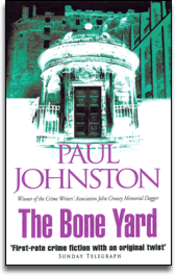
The Bone Yard by Paul Johnston

NEL, 2003, 316 p. First published 1998.

 The Bone Yard cover

Being the renewed adventures of Quintilian Dalrymple (after Body Politic) in an independent Edinburgh in 2020 where the inhabitants lead circumscribed lives ruled over by a Council and guardians while tourists to the year-round Festival are afforded every luxury.

Two people are found with their throats bitten out, tongues and genitals removed, and a cassette lodged in the wounds, in each case with a blues song (the Blues are banned in this Edinburgh) on the tape. When the first body is found Dalrymple is assigned the case due to his success in solving earlier murders. The usual conflicts with his nominal overseers ensue. Along the way we find out what the mysterious Bone Yard is, plus its connection to both the mothballed Torness Nuclear Power Station and pills dubbed Electric Blues – which are potentially fatal to those with weak hearts. We, Dalrymple, and his sidekick Davie, also make re-acquaintance with Quint’s love interest from Body Politic, Katharine Kirkwood. Her experiences outside Edinburgh in the interim, as recounted to Quint, have been grim (and a touch gratuitous) but provide a link to the killer.

The voice in which Johnston describes Quint and his attitudes is of the usual couldn’t-give-a-toss, rule-bending, I’ll-go-where-the-leads-take-me, would-be irreverent maverick type. While it seemed bright and almost fresh in Body Politic, here the similes and metaphors are either strained or overcooked.

Johnston has certainly hit on an unusual situation in which to set a crime novel. The speculative aspects are only trappings though. This is first and foremost a crime novel. A good enough one at that. But he’s since written five more Dalrymple books (plus eleven others.) This one didn’t much encourage me to look out the rest.

Pedant’s corner:- “the temperature swapped a minus for a plus reading” (the temperature went down, so a plus was swapped for a minus,) “didn’t use to turn up” (didn’t used to.) “Tonight was the only night of the year when the curfew isn’t enforced.” (conflict of tenses; wasn’t enforced is more natural,) had a accident (an accident,) bunsen burner (Bunsen burner,) e-string (E-string surely?) span (spun,) “a clear liquid” (colourless I think,) ouside (outside.) “Even though the numbers of Moslem tourists has fallen” (either ‘number of’ or else ‘have fallen’,) the Forth Rail Bridge (aka the Forth Bridge: since it’s the original only any others need a qualifying description,) a missing re-opening quote mark when a piece of dialogue resumed. Asshole, ass and smartass (this is Edinburgh; even there they put the “r” in. Arsehole, arse and smartarse,) “didn’t use to be like this” (used to be.)

Reading Scotland 2018

The ones in bold are in the 100 Best Scottish Books list.

I’ve read 33 Scottish (in the broadest sense) books in 2018, 7 SF or Fantasy (italicised,) 13 by women, 20 by men. E M Brown (aka Eric Brown) qualifies by having a small part of Buying Time set in Scotland and by living near Dunbar for the past few years.

I’ve not a good balance this year between men and women, mainly due to exhausting the women on the 100 Best list.

The Distant Echo by Val McDermid
Living Nowhere by John Burnside
The Hound of the Baskervilles by Arthur Conan Doyle
The Gathering Night by Margaret Elphinstone
When They Lay Bare by Andrew Greig
Autumn by Ali Smith
The Great Chain of Unbeing by Andrew Crumey
The Lie of the Land by Michael Russell
As Though We Were Flying by Andrew Geig
Madame Doubtfire by Anne Fine
Jericho Sleep Alone by Chaim I Bermant
Hame by Annalena McAfee
The Thirteenth Disciple by J Leslie Mitchell (Lewis Grassic Gibbon)
Memento Mori by Muriel Spark
Miss Marjoribanks by Margaret Oliphant
The No 1 Ladies’ Detective Agency by Alexander McCall Smith
The Gloaming by Kirsty Logan
The New Road by Neil Munro
Glitter of Mica by Jessie Kesson
From Russia with Love by Ian Fleming
The Abbess of Crewe by Muriel Spark
Supercute Futures by Martin Milllar
The Corn King and the Spring Queen by Naomi Mitchison
Places in the Darkness by Chris Brookmyre
Confessions of an English Opium Eater by Thomas de Quincey
Adam Blair by J G Lockhart
Naming the Bones by Louise Welsh
The Shipbuilders by George Blake
Mr Alfred M.A. by George Friel
Serious Sweet by A L Kennedy
Interrupted Journey by James Wilson
The Bone Yard by Paul Johnston
Buying Time by E M Brown

Tull at Christmas: Last Man at the Party

From The Jethro Tull Christmas Album. Though this one is more appropriate for New Year’s Day.

Jethro Tull: Last Man at the Party

Merry Christmas, everybody.

Earthrise: Reconstruction

From Astronomy Picture of the Day for 23/12/18. A video reconstruction of the famous Earthrise, photographed by Apollo 8’s astronauts, fifty years ago today.

My Real Children by Jo Walton

Corsair, 2014, 318 p.

My Real Children cover

Multiple lives have been having a bit of a vogue recently what with the likes of Life after Life and The First Fifteen Lives of Harry August. The trend may be waning now but this is one to add to the list – though its premise is more akin to that of the film Sliding Doors in that its protagonist, known variously as Patricia, Patsy, Patty, Pat, Tricia, Trish, has two lives here, the hinge being when she accepts or rejects her fiancé’s demand to marry her on the instant when he garners only a third class degree instead of the first they had both been expecting. The first chapter sees Patricia in a nursing home at the end of her life, remembering her past and confused as to whether she had four or three children. Up to the fifth chapter we follow the course of her early life until the (in)decisive moment. The two strands of her life alternate chapters with each other thereafter.

Both are altered histories. Depending on the strand, there are relatively small nuclear exchanges between the US and USSR over Cuba, others later in the Middle East and elsewhere, Bobby Kennedy becoming President in 1964, the UK joining the Coal and Steel Community at its inception in the 1950s, a rise in authoritarianism in Pat’s later life. Unfortunately all of this requires too much telling and not enough showing and this applies to the main thrust of the stories as well as the historical background.

It’s all shot through with how hard life is for women and the unfairnesses of discrimination against minorities, particularly same sex couples. Worthy, but done heavy-handedly.

I know we’re implicitly invited to do so ourselves but it is only in the final chapter, when Patricia’s lives seem to have re-coalesced, that Walton begins to make wider contrasts and connections by which time it is really too late.

Pedant’s corner:- Despite being a British edition this uses the USian text and spellings. Otherwise; post office (Post Office,) Finefare supermarket (it was Fine Fare,) “wracked with guilt” (racked.) “‘They will, however, will serve adequately’” (has one ‘will’ too many.) “The government were funding” (the government was funding,) grifters (is a USian term. A Brit wouldn’t use that but ‘conmen’ instead.) “Could she made it again, knowingly?” (Could she make it again.)

free hit counter script