Archives » 2015 » August

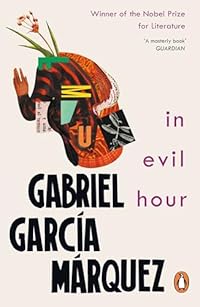
In Evil Hour by Gabriel García Márquez

Penguin, 2014, 186 p. Translated from the Spanish La Mala Hora by Gregory Rabassa. First published in Spain in 1968.

Borrowed from a threatened library.

 In Evil Hour cover

In Evil Hour is a very South American tale set in a town where the inhabitants keep expecting the bad old days of summary execution to return. In amongst descriptions of various relationships in the town there are vignettes such as the local telegrapher spending his free time sending poems and novels to the lady telegrapher in another town. The church is plagued by mice and the town by the clandestine posting of scurrilous notes on its walls while it sleeps. These notes, which the text calls lampoons, contain only gossip everybody knows but have created tension which spills over when César Montero kills the local troubadour Pastor for an alleged affair with his wife. The mayor at first tries to keep things low-key but later, as the tensions rise, imposes martial law and street patrols. There is a hint at the end that despite arrests being made these measures have been ineffective. Apart from the constant threat of governmental violence/coercion the book seems to deal with the more mundane aspects of life and is not as invested with magic realism as others of Márquez’s works. It is very readable though; a testament both to Márquez and his translator, Gregory Rabassa.

Pedant’s corner:- Father Ángel is rendered once as Angel.

In Between Reading

Amongst all the library books I’ve been borrowing recently in an attempt to delay or even abort the threatened closures I’ve also been reading stories from back issues of Interzone and two SF mags the good lady’s blog friend, Peggy, gave me as a present when she came over in May for her dream holiday in Scotland.

These will be popping up on my “currently reading” sidebar from time to time over the next couple of weeks (Iz 255 is there at time of writing.) I’ll be posting about them in due course.

Meanwhile all those books I have actually bought and are languishing on the tbr pile on my shelves are of necessity taking a backseat.

Shorter Scottish Fiction by Robert Louis Stevenson

Canongate Classics, 1995, 303 p, plus xvi p introduction by Roderick Watson.
Borrowed from a threatened library.

Shorter Scottish Fiction cover

This is a collection of shorter works by Stevenson each of which has either a Scottish setting or theme (perhaps both.)

In The Plague Cellar a minister is summoned by letter to a meeting with a seemingly slightly deranged Mr Ravenswood who tells him, “to save our Church from its present wretched state,” he must enter a cellar in which all who have trespassed contract the plague. Ravenswood breaks down the door and goes in. Thrawn Janet* is a typically Scottish tale of possession by the devil and of the minister who witnesses it. The thrawn Janet of the title is his disfigured housekeeper, the subject of the haunting. The Body Snatcher* is the tale of Fettes, employed to take in the grisly charges of the body-snatchers and hand over payment for them, and of Dr Wolfe McFarlane who encourages his complicity in the most illegal aspects of the work. The Misadventures of John Nicholson include being robbed of a considerable sum of his father’s company’s money, fleeing to the US, coming back and as a result being suspected of theft, then stumbling upon a dead body. Despite this his story has – for a Stevenson tale – an unusually happy ending. This story contains the phrase, “Stupider men than he are now sprawling in Parliament.” Some things never change. The Pavilion on the Links is the setting for a tale of a dishonest banker, his daughter, the two men who wish to marry her and the Italians who seek revenge for their financial losses. The landscape round the pavilion and the building itself are described in detail, as is the Scottish habit. The following story The Merry Men is atmospheric, and very Scottish, a gothic tale of madness and shipwrecks; again chock full of descriptions of land- and sea-scapes, the Merry Men of the title being the fifty feet high breakers that boom and dance together off the not-quite island of Aros between the forty-six reefs and the land. Of a negro our narrator says, “I had almost forgotten, and wholly forgiven him, his uncanny colour,” a sentiment somewhat jarring to the modern sensibility. Despite being set in London, Markheim features that most traditional of encounters in Scottish fiction a meeting with the devil. Here it causes Markheim to examine his conscience.

The last section of the book has its own title, “The Strange Case of Dr Jekyll and Mr Hyde,” (and its own epigram) and contains the story everyone thinks they know; on its own one of the 100 best Scottish Books. However, the story title page omits the definite article and the title is given as Strange Case of Dr Jekyll and Mr Hyde.* Once more the tale is set in London but as it uses the döppelganger trope could hardly be more Scottish. Except Hyde and Jekyll are not true döppelgangers, as they vary in appearance and stature. The story is seen through the eyes of Mr Utterson, lawyer to Dr Jekyll who has made a strange provision in his will in favour of Mr Hyde. I can’t make up my mind whether this remove heightens or dilutes the effect Stevenson tried to imbue. Strange Case is an examination of the dualities within us all and a timeless warning about inability to control desire as well as an illustration of the perennial attraction of the dark side of human nature to the Scottish writer.

In the stories marked * there is displayed what was once described to me as a tendency to the throat-clearing preamble.

The figure in the cover art – a detail from Lord Advocate Prestongrange by N C Wyeth – to my mind bears a resemblance to the actor Charles Dance.

Pedant’s corner:- Some such as carpetted, exhibitted, noctious are noted in the text. These occurred in The Plague Cellar which was apparently an apprentice work which Stevenson disowned. Everyone … were (was,) augery x2 (augury,) inflamable (inflammable,) conscience’ (conscience’s,) wth (with.) And, in the introduction:- or (of.)

Not Friday On My Mind 35: RIP Cilla Black

I know it’s not good form to speak ill of the dead but I’m afraid I can’t share the “National Treasure” stuff surrounding the passing of Cilla Black. She was undoubtedly a substantial entertainment figure of the 1960s though, with several big hits and many smaller ones. Yet to my mind her singing voice became too harsh when she upped the volume. In softer tones she could be quite effective though.

As to her later incarnation as a television presenter, I saw Blind Date once. It wasn’t for me. I never watched Surprise, Surprise.

I went off her completely when she was introducing some awards ceremony or other and mentioned Margaret Thatcher, at which the audience booed. Cilla then protested (against all reason) “But she’s put the great back in Great Britain.” Maybe for successful entertainers, but not for those left behind.

This was Cilla in her 1960s pomp, in a clip from Top of the Pops:-

Cilla Black: Surround Yourself With Sorrow

And here she is in her softer register. (Interesting that in the intervening almost forty years since I first heard her perform this song, to reflect our modern sensibilities the lyric has had to be changed from “ye’ll gerra belt from yer da’,” to “Ye’ll get told off by your da’.”)

Cilla Black: Liverpool Lullaby

Priscilla Maria Veronica White (Cilla Black): 27/5/1943-1/8/2015. So it goes.

East Fife 1-1 Dumbarton (aet 1-1, 4-3 pens)

Scottish League Cup, New Bayview, 1/8/15.

My first match watching the new look Sons….and we’re a work in progress. Not surprising considering that only two of last year’s squad started the game. Three finished it as one had come off but two later came on.

The match was preceded by an announcement to the owner of a Vauxhall Zafira to go back to the car – not an unusual thing to hear at a football ground but the following words were. I quote. “This is Methil and you’ve left your windows open.”

The first half was pretty uneventful. We had one close effort saved by their keeper, I think from Scott Taggart. Mark Brown didn’t have a save to make. We dominated the second half apart from a few breakaways on one of which they scored. The attacker was allowed too much room and Mark Brown had come too far off his line and was lobbed. They had the ball in the net a minute or so later but it was chalked off for a foul on the defender on the way through. For about two minutes East Fife threatened but then we got on top again.

The equaliser came from Kevin Cawley, neatly placed to head home after their keeper flapped at it a bit. We had a few more efforts on goal before the 90 minutes were up.

In extra time we carved them open several times but the ball just wouldn’t go in apart from one disallowed possibly for a foul on the keeper but who knows?

The statistics tell the story really.

So it was on to the lottery of penalty kicks. You have to say, 3-2 up with two kicks to one left we ought to have put it away. But we didn’t. Time to concentrate on the league, then. (The Challenge Cup can take care of itself. It usually does.)

The Expedition of Humphry Clinker by Tobias Smollett

Oxford World Classics, 1998, 353 p, plus 22 p notes, ix p introduction, 7 p bibliography of works by or about Smollett and 2 p chronology of his life. (Edited by Lewis M Knapp and revised by Paul-Gabriel Boucé.)

Another from the 100 best Scottish Books. Also, I borrowed it from a threatened library.

Smollet was born at Dalquhurn, in Renton, which is only two miles from Dumbarton. Since he was educated in the town that just about makes him a fellow Son of the Rock.

The Expedition of Humphry Clinker cover

I found this difficult to get into at first, perhaps because of its epistolary structure. In an innovation by Smollett (previous epistolary novels had consisted of letters “written” by one character) we are given the missives of several; Matthew Bramble, his sister Tabitha, his niece and nephew Lydia and Jery Melford and the lady’s maid Winifred Jenkins: but not, you will perhaps have noticed, any by the eponymous Humphry Clinker, a destitute who turns up around page 80, gets employed as a footman and thereafter performs the company various services. Coupled with the orotundities of 18th century language (the book was first published in 1771) this means the threads are slow to gel. Tabitha’s letters are full of misspellings as are Win Jenkins’s, with in her case the addition of multiple malapropisms.

The structure means that some incidents are rendered from more than one viewpoint – which is not in itself a problem but tends to impede the flow of narrative. It does though give Smollet ample scope to anatomise the society of the latter half of the 18th century and to poke fun at various aspects both of it and of human nature. Tabitha Bramble sets her sights on any available male, Lydia Melford’s sympathies are engaged with a man thought unsuitable by her family, Bramble dislikes the closeness of city life, decries the insanitary aspects of taking the waters at Bath and the adulteration of food.

Smollet does not forego the opportunity to guy his English readers. One character tells Mr Bramble that “the English language was spoken with more propriety at Edinburgh than in London,” that the Scots language was true, genuine old English since it had retained the guttural sounds, that the English render simple vowels as diphthongs and moreover they mumble and run their words together. (The same passage says that wright, write, right and rite were each pronounced differently by Scots in Smollet’s time. No longer – except perhaps for those who still say “a’ richt”.) On the understandings within the two countries we have, “What between want of curiosity, and traditional sarcasms, the people at the other end of the island know as little of Scotland as of Japan.” This is still largely true but the reverse never was and remains so. Later, Mr Bramble is informed in no uncertain terms that, far from Scotland benefitting from the Union, much the greater advantage was derived by England.

We also hear the authentic voice of the traditionalist in the sentiment, “Woe be to that nation where the multitude is at liberty to follow their own inclinations!”

Pedant’s corner:- the intentional misspellings, malapropisms and differences in the language over two and a half centuries make any such listing otiose.
free hit counter script