Archives » 2012 » December

Oscar Niemeyer

The architect of Brazil’s capital, Brasilia, a riot of modernist buildings, and much more besides – including the UN building in New York – Oscar Niemeyer, has died.

The civic buildings in Brasilia are stunning architectural statements, still futuristic in form, some of them even spaceship-like. Whether they succeed on a human scale is another matter and Brasilia has been criticised as being not easy to live in without a car but, nowadays, that stricture could equally be applied to cities and towns with more conventional architecture.

Images of Brasilia along with other designs by Niemeyer can be found here.

Oscar Niemeyer 15/12/1907 – 5/12/2012. So it goes.

Cragside, Northumberland

I’m still getting round to posting pictures of the places we visited in October!

This is Cragside, Northumberland, from the path leading from the car park.

Cragside, view from car park

Cragside was built for the Tyneside shipbuilding magnate William Armstrong. The house’s main claim to fame is that it was the first in the world to be powered by hydroelectricity (from a system specially constructed for the purpose.) Later – sometime in the 1930s I think – the house was connected to the National Grid.

This is a stitch of two photos taken from the terrace on the other side of the house from the photo above.

Cragside, Northumberland

This is the house from the rock garden. It’s a very impressive building.

Cragside from below

One of the delights of the site is the gardens with several bridges over the burn, the most striking of which is the metal bridge.

Cragside Gardens + Metal Bridge
Metal Bridge, Cragside

Two rustic bridges can be seen from the metal one and there is a smaller burn hard by the house.

Stream Beside Cragside

Inside, the most impressive feature is the massive marble fireplace in the main reception room. So big is this it had to be built directly onto the bedrock of the hillside to give it sufficient foundation.

Massive Marble Fireplace, Cragside, Northumberland

There is some nice tiling on the walls, here seen below an engraving/drawing of the house.

Wall Tiling, Cragside, Northumberland

We took a long walk down to the power house. The keeper of the power house used to sit down there waiting for a phone call from the main house to turn on the water. There is a brilliant model of the hydroelectric system – you pull up a lever to allow the water to flow onto the turbine blades (all contained behind glass) and you can see the increase in power with the flow, with lights on a panel coming on and getting brighter to simulate the lights in the house. If only my first year pupils could see that!

Joys of the Season

Happy St Nicholas Day to those of you who celebrate it.

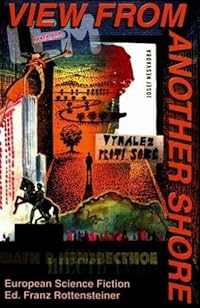
View From Another Shore – European Science Fiction. Edited by Franz Rottensteiner

European Science Fiction Liverpool University Press, 1999, 256p

 View From Another Shore cover

This is a 1999 reprint of a collection first published in 1973. Rottensteiner’s introduction for this volume bemoans the fate of SF in Eastern Europe since the Berlin Wall came down and the fact that non-Anglophone SF (even Australian SF) does not get much of a foothold in the world markets. It then goes on to discuss non-British European SF with respect to its main standard bearers, Stanisław Lem and the Strugatsky Brothers, heaping praise on the latter (comparing them to Philip K Dick) but tasking Lem for poor characterisation, misanthropy and misogyny. Yet the book fails to include a Strugatsky story and opens with one by Lem!

It is now almost 15 years since that introduction and Rottensteiner’s complaint still holds good. Very little SF written in other languages appears in English translation. For a genre which claims to operate over the whole of space and time that is a shocking indictment. But the fact remains that SF is primarily a US form and the US on the whole isn’t outward looking. Plus the costs involved may not return a publisher’s investment; certainly in Britain.

The content of View From Another Shore embodies a wide sweep of the continent. (I note, here though, that none of the contributors is female.) Rottensteiner argues that unique Europeanness cannot be attributed to these works of SF, no common characteristics that set them apart; arguing for only one literature since each writer is an individual. I don’t entirely agree with this view as it is possible to discern over a body of a national literature – even within SF – certain recurring themes and preoccupations (though some writers will of course transcend this.)

If there is such a thread in this book it is that the stories tend to didacticism, in general shy away from human interaction, are more interested in the situation than the people affected by it. Perhaps this distancing is an artefact of translation though.

A short comment on each story is below.

In Hot Pursuit of Happiness by Stanisław Lem. Translated from the Polish, Kobyscze, by Michael Kandel.
Yes, there is a dry quality to Lem’s writing. His fiction is more in the nature of thought experiment or philosophical tract than stories in the true sense. To expect rounded characters is to miss the point rather. A similar complaint can be made of Olaf Stapledon, after all. Yet has he been criticised for poor characterisation et al? Without the thread of empathy/sympathy it does make the reading harder, though.

The Valley of Echoes by Gérard Klein. Translated from the French, La Valleé des échos, by Frank Zero.
Explorers on Mars look for evidence of past alien life.

Observation of Quadragnes by J -P Andrevon Translated from the French, Observation des Quadragnes, by Frank Zero.
The Quadranges in question are humans, snatched from Earth by an “Extractor” to be studied by aliens. Cue much ado about sexual behaviour.

The Good Ring by Svend Åge Madsen. Translated from the Danish, Den gode ring, by Carl Mamberg.
A farmer picks up a ring which pulls him into a different reality where advanced creatures show him what his life would have been like on parallel Earths.

Slum by Herbert W Franke. Translated from the German, Un den Slums, by Chris Herriman.
Humans have taken to sub-ocean habitats. An expedition to the surface finds remnants of humanity scraping a living there.

The Land of Osiris by Wolfgang Jeschke. Translated from the German, Osiris Land, by Sally Schiller
Everything north of sub-Saharan Africa has been devastated by nuclear and biological war. In the Muslim dominated liveable regions of the continent mutants or the light-skinned are persecuted and killed. A foreigner (Master Jack) from southern Africa takes our main narrator, Beschir ibn Hassan el Sadun, as a companion to investigate strange occurrences in the dangerous reaches of the Nile. This setting is fascinating and well-handled but the story takes another tack as their journey unfolds and connections to ancient Egypt are made.

Captain Nemo’s Last Adventure by Josef Nesvadba. Translated from the Czech, Posledni dobroduství­ kapitána Nemo, by Iris Urwin.
A spaceman called Nemo (because his craft is named the Nautilus) is sent on a time-dilation journey to investigate what seems to be a systematic extinguishing of stars. In style this is very reminiscent of R A Lafferty’s Space Chantey.

The Altar of the Random Gods by Adrian Rogoz. Translated from the Romanian, Altarul zeilor stohastici, by Matthew J O’Connell.
The survivor of a once-in-the-lifetime-of-the-universe sequence of accidents limps into the presence of three cybernetic “gods.”

Good Night, Sophie by Lino Aldani. Translated from the Italian, Buonanotte Sofia, by L K Conrad.
A star of Oneirofilms – immersive dream experiences that are better than reality – tries in real life to interact with the customers for her performances.

The Proving Ground by Sever Gandosky. Translated from the Russian, Poligon, by Matthew J O’Connell.
This story features an ultimate weapon, a mind-reading tank, and shoots at an easy target, military commanders.

Sisyphus, the Son of Aeolus by Vsevolod Ivanov. Translated from the Russian, Sisif, syn eola, by Adele L Milch.
A warrior from Ancient Greece is on his way home when he encounters Sisyphus. This story is myth or fable rather than SF.

A Modest Genius by Vadim Shefner. Translated from the Russian, Skromnyi genii, by Matthew J O’Connell.
A prolific inventor diffident about promoting his inventions stumbles through life.

Starbucks, Amazon, Google and Tax

Sounds like a firm of lawyers doesn’t it?

The above three firms are under fire for not paying very much in the way of Corporation Tax despite apparently making large amounts of money in the UK. (That this situation is entirely within tax law surely means the law is askew. Profits made in the UK ought to be taxed here and not be allowed to be shifted elsewhere. Most employees in this country cannot esacpe PAYE so why ought companies be able to avoid Corporation Tax? But this isn’t my point.)

I have heard it suggested that such firms ought not to be pursued too vigorously for tax purposes as that might have an impact on the jobs they provide.

Really?

Seriously: will Amazon give up on the UK market place if they were to be taxed more fairly? Will Google? Will Starbucks? To ask this question is perhaps to provide an answer. If they do turn their backs on the UK then they can – they will – be replaced by firms with more socially responsible attitudes to the country they are taking money out of.

The least a company extracting profit from a jurisdiction in which they operate can do is to adequately recompense the polity which allowed them that opportunity.

Hyperemesis Gravidarum

I could not of course miss seeing today’s big news story, albeit on the TV news.

Fifteen seconds of utter drivel later I was feeling a bit of emesis myself. In a grown up country there would surely be no need for such gushing.

Kirkcaldy's Art Deco Heritage 3, Reprise: Burton's at Christmas

My original post on the Kirkcaldy Burton’s was one of my earliest to feature Art Deco.

This year, along with some other buildings in the town centre, Burton’s has been illuminated for Christmas by coloured uplighters. The subtlety and elegance of this stands in contrast to the poorer effort of the town’s main Christmas lights which are white and strung along the High Street and can be seen below.

Burton's, Kirkcaldy, at Night

Burton's, Kirkcaldy, Dec 2012

The colours change in sequence, gradually, and the blue/purple ones in particular show off the Art Deco detailings on the window surrounds to great effect.

Burton's, Kirkcaldy, Lit Up

Boris Strugatsky

I’ve just checked out Locusonline and noticed a link to Boris Strgatsky, who it turns out has died. This is a curious conicidence in that I am at the moment reading an anthology of Science Fiction by European writers hailing from beyond the Anglophone community.

Strugatsky was a Russian national (who co-wrote with his brother Arkady, who in turn died over 20 years ago) and one of the few non-Anglophone writers to achieve translation and gain some recognition in the “wider” SF world – a difficult feat due to its insular English-language-centred nature – particularly with the novel Roadside Picnic (filmed by Andrei Tarkovsky as Stalker.)

Boris Strugatsky: 14/4/1933 – 19/11/2012. So it goes.

free hit counter script