On our recent trip down south we stopped off at Morecambe again. This time we stayed the night so I was able to take quite a few photos.
The War Memorial there has an imposing position overlooking the sea. The lion surmounting the plinth is a good touch.
This is the west side, commemorating WW 1.
There are more names on the north and south sides.
The east side commemorates WW 2.
You can glimpse part of the Midland Hotel in the background in this angle.
Just to the east of the main memorial there is a small garden area containing a memorial of the Burma Star Association.
The other side of this shows a stone poppy encircling a star.
I assumed the local regiments had been posted to Burma and the Burma Star Association website confirms Lancashire regiments were indeed involved there.
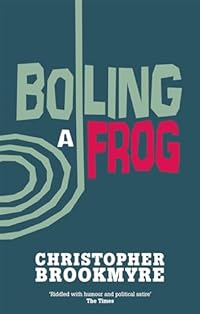
The usual Brookmyre shenanigans, this time involving the nexus between politicians in the then new Scottish Parliament, the tabloid press and religious organisations. Boiling A Frog is a third outing for Jack Parlabane; except outing is not quite le mot juste, as for most of the book Parlabane is in prison after breaking into the headquarters of the Catholic Church in Scotland.
The book is flawed by the fact that the plot mostly happens in flashback or offstage while Parlabane is in jail and concerns a conspiracy to restore the primacy of âfamily valuesâ to public life by framing various MSPs. It was as a by-product of the conspiracy and an unsettled state of mind due to problems in his private life that Parlabane was trapped into attempting the break-in.
If you stop to think for a minute the whole thing becomes unbelievable but believability has never really been the point with Brookmyre. You go along for the ride.
While not as amusing as other Brookmyre stories Boiling a Frog nevertheless has its moments.
Nowhere in the text is the strange title alluded to. An explanation is, however, given in the author’s note before the start.
*I read a reprint. The book was originally published in 2000.
I had mixed feelings about this one. I have a bit of a soft spot for the “Wee Rovers” and about half their team is composed of former Sons players.
Yet once the game started the atavism kicked in, I was as partisan as usual and I wanted us to win.
We had the better of the first part of the game but the bobbly pitch did us no favours and led to a few mistakes. Mark Gilhaney had a great chance to score – though Craig Dargo was actually offside in a previous phase and not given – but the keeper made a good save. A few minutes later Dargo was put through clearly onside but the flag went up. James Creaney also stung the keeper’s hands with a fierce shot.
An unstoppable drive from ex-Son Danny Ferry then put Rovers ahead. The ball was in the net from the moment it left his boot – I don’t remember him ever hitting a shot like that when he was with us.
A corner for us was wasted when it was taken short and on the next I was about to moan, “Don’t try that again,” but it was given quickly to Scott Agnew whose cross was turned into his own net by a defender.
I felt we lost a lot of our forward momentum when Ryan Finnie went off injured.
The second half was pretty scrappy. I think we only had two shots on target, one of them Gilhaney again. The keeper saved again. Craig Dargo couldn’t even let the ball bounce off him into the net, it skied over. He tried to place another but it was just wide. I can’t see what Dargo gives us that Pat Walker doesn’t. Yes, he’s a clever player, but he’s not a natural goal scorer. And I like Pat Walker’s industry.
James Creaney had a good game and saved the jerseys twice late on, putting off an attacker who looked likely to head in a cross and making an incredible block in the last minute.
Four points ahead of fifth with four to play and Airdrie Utd and East Fife still have to play each other the week after we have Airdrie Utd at home. There will be no easy games though. Everyone we still have to play has something to play for themselves.
As well as publishing his own book Adrift on the Sea of Rains, Ian Sales has been editing the anthology Rocket Science which is being launched this weekend under the imprint of Mutation Press.
Mutation Press’s previous venture, the anthology Music for Another World, was full of high quality content. I expect no less of Rocket Science.
Regular readers will know this means a slew of photographs of Art Deco buildings and design features plus various War Memorials will be appearing here soon.
*I actually typed away far before spotting it. Which was maybe appropriate as we were down in England again – or maybe not if you consider we only covered 960 miles in total.
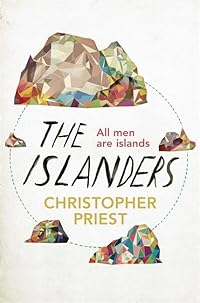
This one is odd. Normally a novel unfolds by the interactions of various characters and the intertwinings of their stories – however separate their narratives may seem to be from the outset – all set out in a standard narrative format, albeit with digressions or flashbacks or indeed flashes forward. This book strays far from such conventionality. It is set out as a gazetteer. Each “chapter” title is that of an island in the Dream Archipelago – a place of indeterminable geography due to “temporal gradients” and a “vortex” which distorts perception – which Priest has visited before. Different “chapters” take different forms: some are exactly like entries in a gazetteer (including tourist information relating to local laws, currencies used etc) others are more conventional first person narratives, there is even a police (Priest uses the description policier) interview transcript; but all drip information either about the world of the Dream Archipelago or its inhabitants. Indeed were I to be hypercritical I could describe the book as a giant info dump interspersed with (relatively few) short stories.
However, SF likes to think of itself as innovative. Where better to find altered ways to tell stories, to redefine what constitutes a novel? And this is on the BSFA Award short list (but not the Clarke, to whose choices this year Priest has objected.) I somehow doubt, though, that writing novels as if they were gazetteers is going to catch on.
Nevertheless in The Islanders a picture of the world and its complexities builds up over time. Early on, a confession to a murder in a theatre leads to an execution – later episodes cast doubt on whether the death was a murder at all, and if so who was really responsible. The narrative sections are mostly concerned with creative types, mainly writers and artists. Events are experienced through various eyes and are seen to be as mutable - or incapable of full comprehension - as the Archipelago’s geography.
Yet – to be hypercritical again – none of the stories really requires the off-Earth setting, each could take place in our here and now. Much of the discourse is familiar, we have cars, computers, the internet, email; the flora and fauna are unexceptional, we even have bananas. The world, set between two warring powers – one from each of the two polar continents which are separated by the ocean in which the Archipelago (more or less protected by the neutrality pact which is supposed to safeguard the islands’ sovereignties) sits, is almost humdrum in its similarities to our own. The islands’ polities appear akin to our own Channel Islands, being feudal and overseen by Seigniors some of whom are more benevolent than others. And warring powers behave as they will in any time or place.
The Islanders is novel, I would agree. But a novel? It’s ingenious and an impressive achievement; but in the end the structure does not fully satisfy; there are too many interconnections between the “chapters” for the book to convince as a gazetteer, and too few for a rounded novel. Nevertheless between the three candidates for the BSFA Award which I have read so far it is, I would say, the strongest contender.
This is probably the track which really switched me on to prog rock. I had been softened up by Procol Harum and had, I think, a few Moody Blues LPs by this time but this was something different.
I heard The Court Of The Crimson King for the first time on Pick of the Pops. Alan Freeman did not just play the top twenty but other more eclectic stuff. I particularly remember the name Rabbi Abraham Feinberg.
Anyway, one day this came on and I thought “Wow. What is that?”
King Crimson: In The Court Of The Crimson King (including “The Return of the Fire Witch” and “The Dance of the Puppets”)
They give with one hand and take away with the other….
Also in Saturday’s guardian review was the first part of the Guardian Book Club feature on Robert Harris’s Fatherland, wherein John Mullan says “Speculative fiction” might once have been synonymous with SF but now more strictly refers to an alternative, but plausible, historical scenario.
More strictly? There is a definition of speculative fiction which excludes SF?
This seems to me to be a dismissal of the more explicitly SF altered histories. Is Mullan attempting to distance his preferred examples from what he sees as less worthy; or am I too sensitive?
Nevertheless I had to laugh when Mullan immediately wrote that a modern classic of speculative fiction is Philip Roth’s The Plot Against America. That book not only failed as a novel, it failed as an Altered History (for my review see here). Can a story where history is restored swiftly to the “right” path really be considered speculative? Is it not then an author’s ill-thought out musings, onanistic even?
I’ve not read Fatherland but from the description it seems to invest more into its scenario than Roth ever did in his.
In that extent Fatherland is SF, and Roth’s book isn’t.
An article by Tom Holland in Saturday’s guardian review about the aftermath of the Roman Empire argued that there was no sudden change from classical to mediæval times, no instant forgetting, but rather a long interregnum in which the rise of Islam was an important feature.
Holland points out that the transition was all a messy business, triggering the evolution of legends of various sorts, which in Britain involved the King Arthur stories plus the evocation of elves and orcs to account for the gigantic ruins of Roman buildings. He sees Tolkien’s endeavours as an attempt to restore these myths to the culture.
The article surprisingly, to my mind, mentions Science Fiction favourably in that Asimov’s Foundation Trilogy and Herbert’s Dune sequence both recognised what Holland sees as the salient aspect of the transformation somewhat before it gained foothold in academe.
When I read the books it was easy to recognise that Asimov’s trilogy was modelled on the fall of the Roman Empire but it is the character of the Mule that Holland finds interesting – a Muhammad like figure with unusual powers. (That the Mule upset the apple cart of the Foundation’s “psychohistory” suggests to me a reflection of Asimov’s world-view.)
The parallels of the Dune sequence with Arab culture were of course unmistakeable even as a very young teenager. Paul Atreides (Muad’Dib) as Muhammad was at that time a step beyond me but is unmissable now. Herbert did seem to be in sympathy with Arab culture if not necessarily the religion it spawned. At the time I took his critique to be of the phenomenon of religion as a whole rather than Islam per se and I see no reason to alter it.
(The article further ponders the historical evidence surrounding the life of Muhammad, a matter on which I am not in a position to judge.)
Historically, the Roman Empire’s fall cannot be seen as anything other than significant. That authors still continue to see it as a template within which to set their stories – Holland mentions Star Wars and Battlestar Galactica as other not so rigorous examples – is testament to the endurance of its legacy.