Archives » Vietnam

Friday on my Mind 188: But You Know I Love You. RIP Kenny Rogers.

The usual output of Kenny Rogers who died last weekend, The Gambler, Coward of the County etc, isn’t really my cup of tea. It is undeniable however that he had a big following.

I had been toying with the idea of using this group’s second UK hit in this spot for some while and this would have been an ideal opportunity but I decided its title might be a little insensitive in connection with someone recently deceased. (It was also from 1970.)

Here’s one that wasn’t a UK hit at all but whose refrain has stuck in my mind for all those years – without me really remembering who had sung it.

The First Edition: But You Know I Love You

I note that Kenny’s Guardian obituary (see link above) says Ruby, Don’t Take Your Love to Town, the group’s first UK hit, was written from the viewpoint of a Vietnam veteran. At the time the story was that “the crazy Asian war” of the song’s lyric was actually the Korean War.

Kenneth Donald (Kenny) Rogers: 21/8/1938 – March 20/3/2020. So it goes.

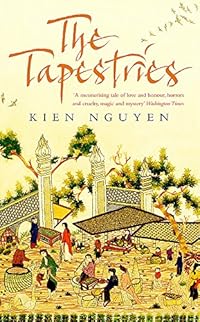
The Tapestries by Kien Nguyen

Abacus, 2004, 347 p.

 The Tapestries cover

This is a tale of Vietnam in the early to mid- years of the twentieth century when the old ways were beginning to crumble under the influence of the French. Peasant woman Ven is sold to the Nguyen family of Cam Le village as a bride for their seven year-old son, Dan. She protects him when the family’s fortunes are ruined by the local magistrate Toan and the elders of the family are killed or flee. As their faces are both unknown to the outside world they can for a while take refuge in the Toan household where he and Toan’s granddaughter, Tai May, fall in love. During a visitation from an official of the Emperor’s court to betrothe Tai May to Bui, the official’s son, they reveal their identities. In the outcome Ven is accused of the murders of the official and Bui actually carried out by Toan.

Thinking Ven dead, Dan leaves for the Imperial city and due to his skill at embroidery eventually becomes chief embroiderer to the court. (It is this ability and Dan’s handiwork, of course, which lend the book its title.) Meanwhile, the disgraced Tai May has been sent away to join a dance troupe. Their paths cross at the court but they cannot meet due to their respective obligations to the Emperor. On the deathbed of the Lady Chin, still grieving wife of the murdered official, Dan gives her food to revive her and accompanies her to Cam Le to confront the source of both their woes and achieve resolution.

Perhaps because English is not Nguyen’s first language the writing isn’t quite as fluent or crisp as in the very best fiction. There is often a resort to cliché (“with all her might”) and dialogue too frequently tips over into the melodramatic. I also found the love story supposed to be at the novel’s heart so barely outlined as to be almost invisible. We are told of it but rarely experience any of the relevant emotion. Rather, it is the relationship between Dan and Ven which dominates the book. Therein lies its tragedy and pathos. Yet even there the withholding by Ven of a nugget of information from Dan till very late on, twists the arc of the narrative.

Pedant’s corner:- “she said to the him” (she said to him,) “the plastic loop in her hand” (was a metal loop on the previous page and, in any case, plastic? In 1916?) “in the middle of night” (the night,) twenty-four karat (is karat USian? It’s carat over here,) organdy (organdie,) sprung (sprang,) “even her face seemed to have shed its usual plainness and glow with the sparkling mystical world” (glowed,) “the Indochinese Communist Party led by the socialist Ho Chi Minh” (in 1932? Ho did found the Indochinese Communist Party in 1930 but he was in jail in Hong Kong from 1931-33 and then moved to the Soviet Union, not returning to Vietnam till 1941. Would most Vietnamese have even heard of him in 1932?)

A New Iraq?

The lead story on the lunchtime BBC news today (18/2/12) concerned Iran’s pursuit of nuclear weapons. There followed some guy (from the Armed Services Institute?) talking about the ramifications of that on the likes of Saudi Arabia, Turkey, etc as regards proliferation.

The second story on the guardian‘s front page was headlined US believes strike on Iran is inevitable later this year.

Looks like Cowdenbeath are a banker for the Division 2 title this year, then. (With a side order of Armageddon.)

Seriously, though. What are these guys on? Remember Mr Irresponsible during the 2010 General Election campaign? It seems now like that was a prediction rather than an idle slip of the tongue.

How can I put this?

Iran poses no threat whatsoever to the UK. Still less does it pose a threat to the US. I’ll give you it may be a (possible) threat to Israel but its posture there may be rhetorical rather than real. However, there is no way it could invade either the UK or US; nor could it overthrow their governments.

And if it is in the process of acquiring nuclear weapons why might that be?

It has seen its neighbour, Iraq, attacked, on the flimsiest of pretexts, mainly by the US and the UK – and thereafter thoroughly destabilised. It does not want the same happening to it. It knows Israel has nuclear weapons almost certainly targeted on it; it also knows North Korea has such a “deterrent” and is treated more carefully as a result. In its mind developing nuclear weapons might be a rational response to its current circumstances. We (the UK, along with the US) have a history of interfering with the region that goes back a long way. If I were them I wouldn’t trust us either.

The ratcheting up of the Iranian situation reminds me of the run-up to the (second) Iraq war. Drip by drip of increasingly ludicrous assertions. (A much heightened version of this sort of thing was evident in the German press in the summer of 1939.)

I don’t much go for the idea that we could be the bad guys but, in the absence of any attack by Iran on us (or, at a push, Israel) that would be the case here; as it was in Iraq.

Moreover, and again as with Iraq, it would be thoroughly counterproductive.

The ramifications of an attack on Iran would only confirm the idea that the “West” sees Muslims as a whole as targets and though it would take time might make recent terrorist attacks seem like a garden party. Any occupation of Iran would make our involvement in Iraq seem like a picnic and Vietnam a cakewalk.

Do we really want that?
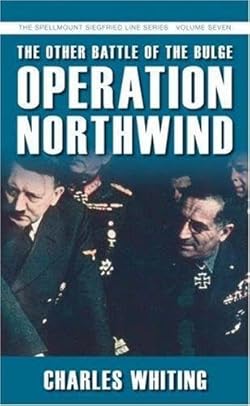
Operation Northwind by Charles Whiting

Grafton, 1987, 272 p including Source Notes and Index.

Operation Northwind cover*

To counteract the German surge during the famous Battle of the Bulge in the Belgian Ardennes, Allied Supreme Commander, Eisenhower, was forced to move General Patton’s troops away from a more southerly front in Alsace and along the Rhine on the border of France and Germany. This dangerously thinned the Allied forces in that area – so much so that Eisenhower ordered General Devers (in whom he apparently had little confidence) to withdraw to the Vosges in the event of being attacked. This was contrary to all US military convention which is against the giving up of ground hard won by US blood. Moreover it meant that Alsace would once more be under German control and that Alsatian city beloved by the French, Strasbourg, would for the third time in 70 years have fallen to Germany.

The Germans had foreseen most of this and, hoping to drive a wedge between the Allies, attacked here also in Unternehmen Nordwind, Operation Northwind. The resulting crisis caused a major rift between the French and US commands and poisoned French attitudes to the US for decades after. At the hint of withdrawal De Gaulle told Eisenhower that even if US troops would not defend Strasbourg French ones would. Eisenhower then threatened to withhold supplies from the French army and De Gaulle, de facto leader of France, then counter-threatened to deny the Allies transport rights across France! Partly as a result, but also because General Devers wanted to fight his ground, thousands of US troops -€“ not to mention the French and the Germans – became casualties, in atrocious winter conditions. One of the troops involved was the most decorated US soldier of WW2 and later Hollywood film star, Audie Murphy, who won the Medal of Honor in these actions.

The author occasionally displays an animus against the French. He lays at their door the lack of withdrawal and hence the responsibility for subsequent US casualties -€“ though the French attitude to Strasbourg in particular and Alsace in general is perfectly understandable, especially since their fall might have led to De Gaulle’€™s government being replaced by the communist elements of the Resistance. In the epilogue we find Whiting also blames General Leclerc’€™s determination to restore French military pride for the French attempt to retain their colonies in Indo-China hence the subsequent US embroilment in Vietnam, and thousands more US deaths.

As is usual with military history the text sometimes resembles an alphabet soup of Divisional nomenclature. A serious lack here is of maps. There is at the beginning of the book one map of the general area of operations but the place names are tiny. More detailed maps of parts of the overall battle would have aided comprehension of the ebb and flow.

In the end the Allied troops held out (but not without retreats, surrenders, self-€“inflicted wounds and even desertions along the way) and the Germans exhausted themselves against the defence, failed to hold off the counterattack and broke off, partly to send troops back to the Eastern Front.

*This is not the cover of the Grafton edition that I read. Neither was/is the cover shown on my Library Thing pages.

Friday On My Mind 60: I Feel Like I’m Fixin’ To Die Rag

For various reasons I was listening to “California Saga” from the Beach Boys’ Holland album this week, which, yes, is a 1970s recording. Referencing, among other things, John Steinbeck and his “travellin’s with Charley” it also mentions that at a festival, “Country Joe will do his show,” and I thought “Hmm.. I’ve not done that one.”

I don’t think Country Joe and the Fish are remembered for more than the one song but that song certainly caught a mood.

It is the quintessential musical protest against the war in Vietnam.

As this is a live version – Joe performing at a festival, Woodstock no less – it is not suitable for work.

Country Joe McDonald: Feel Like I’m Fixin’ To Die Rag

free hit counter script