The Tapestries by Kien Nguyen
Posted in Other fiction, Reading Reviewed at 12:00 on 6 May 2018
Abacus, 2004, 347 p.
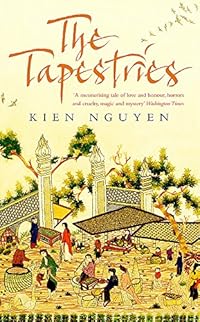
This is a tale of Vietnam in the early to mid- years of the twentieth century when the old ways were beginning to crumble under the influence of the French. Peasant woman Ven is sold to the Nguyen family of Cam Le village as a bride for their seven year-old son, Dan. She protects him when the family’s fortunes are ruined by the local magistrate Toan and the elders of the family are killed or flee. As their faces are both unknown to the outside world they can for a while take refuge in the Toan household where he and Toan’s granddaughter, Tai May, fall in love. During a visitation from an official of the Emperor’s court to betrothe Tai May to Bui, the official’s son, they reveal their identities. In the outcome Ven is accused of the murders of the official and Bui actually carried out by Toan.
Thinking Ven dead, Dan leaves for the Imperial city and due to his skill at embroidery eventually becomes chief embroiderer to the court. (It is this ability and Dan’s handiwork, of course, which lend the book its title.) Meanwhile, the disgraced Tai May has been sent away to join a dance troupe. Their paths cross at the court but they cannot meet due to their respective obligations to the Emperor. On the deathbed of the Lady Chin, still grieving wife of the murdered official, Dan gives her food to revive her and accompanies her to Cam Le to confront the source of both their woes and achieve resolution.
Perhaps because English is not Nguyen’s first language the writing isn’t quite as fluent or crisp as in the very best fiction. There is often a resort to cliché (“with all her might”) and dialogue too frequently tips over into the melodramatic. I also found the love story supposed to be at the novel’s heart so barely outlined as to be almost invisible. We are told of it but rarely experience any of the relevant emotion. Rather, it is the relationship between Dan and Ven which dominates the book. Therein lies its tragedy and pathos. Yet even there the withholding by Ven of a nugget of information from Dan till very late on, twists the arc of the narrative.
Pedant’s corner:- “she said to the him” (she said to him,) “the plastic loop in her hand” (was a metal loop on the previous page and, in any case, plastic? In 1916?) “in the middle of night” (the night,) twenty-four karat (is karat USian? It’s carat over here,) organdy (organdie,) sprung (sprang,) “even her face seemed to have shed its usual plainness and glow with the sparkling mystical world” (glowed,) “the Indochinese Communist Party led by the socialist Ho Chi Minh” (in 1932? Ho did found the Indochinese Communist Party in 1930 but he was in jail in Hong Kong from 1931-33 and then moved to the Soviet Union, not returning to Vietnam till 1941. Would most Vietnamese have even heard of him in 1932?)
Tags: Other fiction, US fiction, Vietnam
