Archives » The Guardian

Ursula Le Guin

I’ve just looked at the Locus website and discovered to my deep sadness that Ursula Le Guin has died.

She was one of the greats of Science Fiction and Fantasy and will be sorely missed.

Probably most famous for her “Earthsea” series of books she first came to my attention in the 1960s. I cannot now remember which book of hers I read first but I think it must have been the acclaimed The Left Hand of Darkness. I went on to scour bookshops for her work. I confess I wasn’t as impressed (in my relative youth) by the even more critically praised The Dispossessed – I probably hadn’t enough life experience then to appreciate it fully – but since those days her fiction has always been the background to my SF reading life, my anticipation of each new book never disappointed by its content.

Most recently I always enjoyed her book reviews for The Guardian, which showed a mind as sharp and incisive as ever.

Tonight the world – the universe – feels like a much smaller place.

Ursula Kroeber Le Guin: 21/10/1929 – 22/1/2018. So it goes.

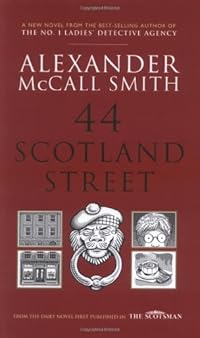
44 Scotland Street by Alexander McCall Smith

Polygon, 2005, 333 p including iv p Preface. One of the Scotsman’s 20 Scottish Books Everyone Should Read.

 44 Scotland Street cover

The narrative of this book covers the lives of various characters inhabiting the titular property and those with whom they come in contact. In the building live Pat, a young woman on her second gap year; her landlord flatmate Bruce, a narcissistic chancer; Irene, a pushy mother, with Bertie, her saxophone playing, Italian speaking five year-old who just wants to be a normal boy; and Domenica, an older woman more wise to the world. Pat takes up a job at an art gallery run by an incompetent set up by his father. Along the way we meet Bruce’s boss, a mainstay of the local Conservative Association, his wife and daughter; Big Lou, who runs a pub in the same street as the gallery; and Dr Fairbairn, Bertie’s psychiatrist – not to mention author Ian Rankin. There are occasional illustrations (by Iain McIntosh) at least one of which gave away an incident yet to occur on the page.

The problem with all this is its genesis as a periodic publication, appearing daily in The Scotsman. As a result none of the scenes is ever fully developed, they are sketched not drawn, and there is too much telling in place of showing. The characters are insufficiently fleshed out, types, not individuals.

What plot there is centres round the authenticity or otherwise, the disappearance and recovery, of a painting which might be a Peploe; but this is exiguous at best.

McCall Smith perhaps betrays his leanings when he puts these words about The Guardian into the mouth of five year-old Bertie, “Because it’s always telling you what you should think.” Then again it might just have been so he could add the rider, “Just like Mummy.” And don’t all newspapers in effect “tell their readers what to think”?

McCall Smith’s writing is easy on the eye but undemanding on the brain as the whole enterprise is very lightweight, admittedly suitable for quick, and perhaps not necessarily attentive reading. Quite why it appears on a list of 20 Scottish Books everyone should read is beyond me, though. That it is The Scotsman’s list is a bit too much like that newspaper blowing its own trumpet.

Pedant’s corner:- “Matthew’s father, despaired of his son ever amounting to much” (no comma,) a missing quote mark at the end of a chapter – the same speaker started the next so that’s fine – except the chapter number and title came in between, an extraneous quote mark between two paragraphs spoken by the same person, “and there was not reason to imagine” (no reason,) “aren’t I?” (Grrrr. The speaker was Scottish, the phrase is, ‘Amn’t I?’) “She realised sounded grudging” (realised she sounded,) an extraneous full stop at the end of a speech quote when the framing sentence continued, Descartes’ (Descartes’s,) “on the shore of their rivers” (shores.)
King Richards

Ever heard of him?

No. Me neither.

Yet he was the answer to one of the questions in the Guardian Weekend Section’s quiz on Saturday 24/6/17.

The question was, “What links Oxford, 1157; Bordeaux, 1367 and Fotheringhay Castle, 1452?”

The answer given was, “Birthplaces of King Richards.”

I emailed them, “I believe the answer to question 15 in Thomas Eaton’s Quiz in the Weekend, 24/6/17, contains (i) a logical impossibility and (ii) an inaccuracy.

To take them in order:-
(i) How can a King have been born in more than one place?
(ii) There has never been a King Richards of England. (Nor one of France.)

I do note, however, that England has had three Kings Richard.”

They seem to have ignored this.

Creating a Fictional World

Two articles caught my eye in Saturday’s Guardian Review.

The cover piece was by Naomi Alderman and discussed feminist Science Fiction with reference to its warning nature and the threat recent political events present to the potential of women being treated on an equal basis with men. Of particular interest here was the revelation to me of part of the background to Ursula Le Guin’s childhood where her parents had taken in the last survivor of the Native American Yani people about whom Le Guin’s mother wrote a book. The implication is that exposure to other ways of thinking than what otherwise surrounded her opened up perspectives which Le Guin was able to transform into her fiction. Margaret Atwood too spent parts of her childhood outside the comforts of civilisation, while Alice Sheldon (James Tiptree Jr) travelled in Africa as a child coming into contact with various groups. Alderman uses the example of her own novel The Power to illustrate that the nature of a utopia/dystopia is dependent on viewpoint.

Further on there was an odd piece by Scarlett Thomas on her conversion to the delights and magic of children’s fiction.

What got me here was the sentence, “But it turns out that creating a fictional world is a very complex act” in a “who knew?” context.

Well, duh. Only every Science Fiction or fantasy writer who ever tried it.

Behind the sentence’s remarkable blindness presumably stood Thomas’s previous implicit view that such creators are not real writers and anything fantastical does not warrant serious attention.

Still, it seems she’s got over that now.

Chuck Berry

Reading his obituary and a piece in the Guardian’s G2 brought home to me how important Chuck Berry was to the development of rock and roll and the music that followed it.

His heyday was in the 50s so I had kind of missed all that by being too young. I must have been aware of him somewhere in the background via the paltry amount of rock music on the radio in those times but I didn’t really come into contact with his music till the mid to late 60s when some of his singles were in the pile beside the record player at a youth club I went to. It’s therefore No Particular Place to Go and Memphis Tenessee I remember most particularly. It wasn’t actually till years later that I discovered No Particular Place to Go was a reworking of a 1957 song, School Day (Ring! Ring! Goes the Bell).

Not the least of his accomplishments was to irritate Mary Whitehouse with his ding-a-ling. (Well, it seems it was Dave Bartholomew’s ding-a-ling, but it was Chuck who annoyed Whitehouse.)

His personal life may not have been unblemished but he certainly has an impressive musical back catalogue, and that’s only the singles.

So here are those two Berry singles the second in a later live version.

Chuck Berry: No Particular Place to Go

Chuck Berry: Memphis Tenessee

Go Johnny go! Tell Tchaikovsky the news.

Charles Edward Anderson “Chuck” Berry: 18/10/1926 – 18/3/2017. So it goes.

Time Travel, Reviews, Hame and Rebellions

In an article in Saturday’s Guardian review, James Gleick examined the history of the time travel story since H G Wells more or less invented the form in The Time Machine. It was a skate over the subject really and veered into the territory of so-called Alternative History which of course I prefer to name Altered History but worth reading all the same.

In the same section of the paper was a review of Annalena McAfee’s new novel Hame. Many reviews are interesting, some make you think “definitely not”. Very few inspire you to go out and read the book concerned. Stuart Kelly’s did just that, as indeed did his review of Kevin MacNeil’s The Brilliant and Forever which I read a few months ago after also reading the same author’s A Method Actor’s Guide to Jekyll and Hyde due to the same review. McAfee’s Hame sounds intriguing and possibly funny. Definitely one I’ll look for.

I recalled McAfee’s name. She had an article in the Guardian Review some weeks ago which I wished to post about then but at the time could not find on the Guardian website but which now pops up fourth when you search her name there. The article was about the relative importance of Robert Burns and the possible balefulness of his mythologising (Aside. Why does no-one ever question this about Shakespeare?) and the continuing battle over whether Scots is a suitable medium of expression for literature.

My take is if the author wishes to use Scots it is entirely up to her or him. It may reduce the psossible readership but that is a question for author and publisher, not reader. Myself, though not very well versed in it, my mother being the daughter of two English parents, thus hardly a native speaker and unable to expose me to its richness, I do not consider Scots – as some do – as necessarily inferior form to English. It is at times much more pithy.

I have a quibble with McAfee over a detail in that piece, though. She stated that Burns was born “two decades after the failed rebellion against the Union.” While Prince Charles Edward Stuart’s Rebellion of 1745-6 was many things, not least the last flailing gasp of a failed dynasty, and the Battle of Culloden can even be considered as in some way (if you ignore its continuation into Ireland even into the twentieth century and possibly beyond,) the last of the Thirty Years War – though admittedly that was mostly fought out in German territories – it was not primarily against the Union. It was less general then that, more personal.

Core Values?

In yesterday’s Guardian G2 there was a wonderful scathing article written by the US born comedian Rich Hall dealing with recent events in his home country.

In it he satirises the US penchant for owning, and using on each other, firearms.

A striking sentence concerns the number of terrorist-related deaths carried out by people from the seven countries subject to the, now legally suspended at least till appeal, ban on entry to the US.

That number?

Zero.

(Though Hall does balance this by saying there have been three – thwarted – attacks using knives.)

I don’t suppose such satirising of what Hall characterises as the US core value of gun crime will change anyone’s mind, though.

William McIlvanney Again

I noticed that Radio 2’s news on Saturday evening referred to William McIlvanney as a crime writer. That is a gross over-simplification. Laidlaw, The Papers of Tony Veitch and Strange Loyalties may have featured a detective but they were primarily novels. And there were seven more novels to add the account, as well as his poetry and journalism.

This link is to his obituary in the Guardian.

Making and Keeping the Peace

I hadn’t meant to return to this subject but today’s G2 in The Guardian had an article by Paul Mason which more or less articulated my views. Except he put it better than I could.

Any action that does not take account of what the world – and especially the Middle East – will look like after the resolution of the conflict (and it is undoubtedly a conflict) is worse than useless, may in fact only stir up more trouble.

More Referendum Reflections

No. Not the one on the EU. Last year’s on Scottish Independence. (For my immediate thoughts on its result see here.)

The subject of the consequences of the “no” vote were referred to once again in The Guardian, on Thursday, this time by Alan Bissett in which he mentions Alan Warner’s view that a “no” vote represented a schism between the voters and the writers, which I also mused on.

As followers of this blog will know I have been reading a lot of Scottish literature recently, both modern and otherwise. It is safe to say that there is such a beast as Scottish writing and its recurring concerns and themes do tend to differ – at least in emphasis and psychology – from literature emanating from elsewhere in the UK. Is this insular? The wider community certainly does not afford it the status of a national (or even regional) literature; perhaps because it is liable to be misunderstood or seen as parochial even where it’s not neglected.

Yet how parochial are the sentiments expressed in Rupert Brooke’s poem The Soldier – a poem widely considered as being serious in purpose (if nowadays also seen as just a touch wrong-headed, though not as wrong-headed as those in the same poet’s Death) and included in many an anthology of First World War poetry? To my mind it is impossible to conceive of a Scottish poet of those times writing such words about his land in such a way. And if he had (it would have been a “he” the times being what they were) he would most likely have been ridiculed, certainly not still being reprinted one hundred years later.

Bissett mentions the view that the 2015 General Election result in Scotland was politics catching up with Scottish culture. An alternative take is that the Scottish Labour Party failed to recognise that after devolution the centre of gravity of Scottish politics had shifted decisively to Holyrood (which it saw as a sideshow – and probably still does) and as a consequence neglected to pay it enough attention or put up for election to it sufficient numbers of its best politicians. That Labour in the UK has consistently failed to “protect” Scotland from Tory policies – even as New Labour which often felt like a mildly diluted Thatcherism – only compounded this mistake. It is possible that, for Labour, Scotland is gone, and is unrecoverable in the short term. Whether Corbynmania is enough to overturn that perception remains to be seen. Some Labour voters may return to the fold but once political trust is lost it is usually hard to regain.

Yet in many ways it is as if the Scottish people feel that the country did become kind of independent on devolution; or at least that the Scottish Parliament was an adequate reflection of their political desires. Yes they do know that Westminster holds sway on many of the most important aspects of political life but they feel it’s at arm’s length, divorced from them almost.

Bissett concludes that there can be no “schism” between Scotland and its artists. My reading of Scottish literature and its history suggests that, even if some may transcend such labelling, while the idea of Scotland and a distinct Scottishness persists writers will continue to reflect those origins in their stories and the characters they describe. As Scottish writers that is arguably what they are for.

free hit counter script