Archives » Star Trek

Winged Nebula

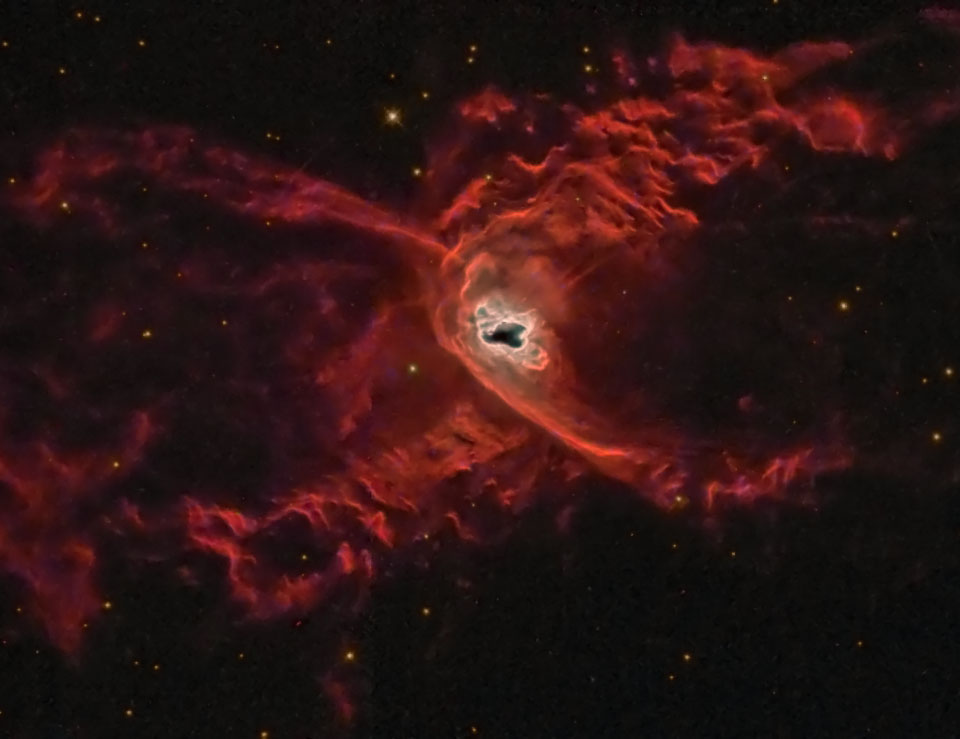
This is the Red Spider Planetary Nebula from Astronomy Picture of the Day for 29/10/12. What a weird apparition. I don’t think it looks much like a spider, though, more some sort of weird jellyfish or flying creature or maybe an alien spacecraft like those in Star Trek, not a Klingon Bird of Prey but close.

Red Spider Nebula

Magic as Technology (Technology as Magic)

One of the famous SF writer Arthur C Clarke‘s well known sayings was, “Any sufficiently advanced technology is indistinguishable from magic.”

Demonstrate, for instance, a Star Trek communicator (or, better, a modern day mobile phone; because effectively that’s what those communicators were, minus the photo and internet functions) to a hitherto isolated tribe in the deep remote somewhere and its working principles would be impossible for them to comprehend. The same would be true of us confronted with some really advanced piece of hardware.

But it’s always seemed to me that the reverse of Clarke’s saying could equally be true and that any sufficiently effective magic would be indistinguishable from advanced technology. Certainly it could be explicable as such. “I do this with this and that happens.”

Long Ago and Far Away

Two 60s memories are now no more.

Scott McKenzie – a one hit wonder with San Francisco (Be Sure To Wear Flowers In Your Hair)has died.

So too has the actor William Windom whom I remember very fondly as the star of the US TV series My World and Welcome To It, inspired by the works of cartoonist James Thurber, a role for which Windom won an Emmy Award. Though I hadn’t quite remembered it he also played Commodore Decker in Star Trek – for evidence of which see this:-

Commodore Decker

More latterly Windom has appeared in Murder She Wrote.

Here is a You Tube clip of a part of a My World and Welcome To It episode. It follows the usual pattern of Windom giving a spiel outside his (cartoon) house before the opening credits – which appear at about 1:30 and are a joy in themselves. The clip retains the original US adverts. (I must say they would drive me crazy coming in so early in a programme.)

.

Scott McKenzie (Philip Wallach Blondheim): 10/1/1939-18/8/2012
William Windom: 28/9/1923-16/8/2012

So it goes.

Embassy Cinema, Braintree, Essex

Why Braintree?

Well: the good lady and myself used to live there when I worked as a Research Chemist. We thought we’d see how it had changed in thirty years so made it one of the last stops on our recent trip down south.

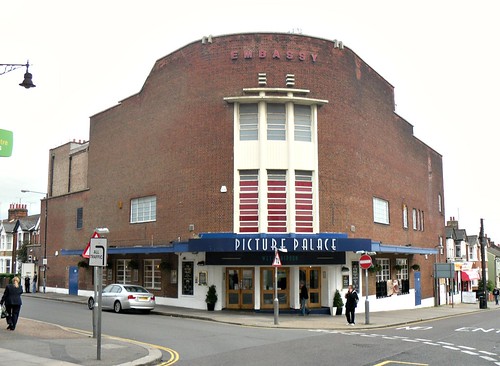
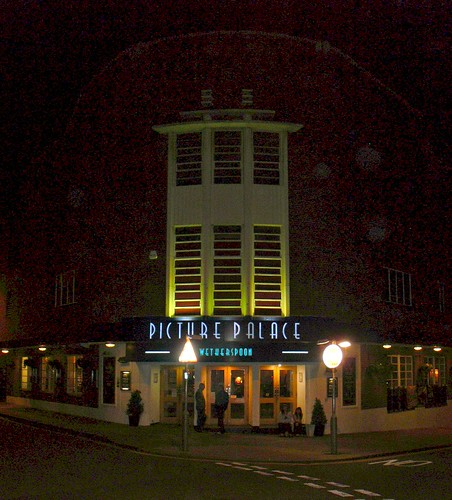
I well remembered the cinema. The Embassy as was. The building is very deco indeed but is now a Wetherspoons pub called the Picture Palace.

Former Braintree Cinema by day

Former Braintree Cinema by Night

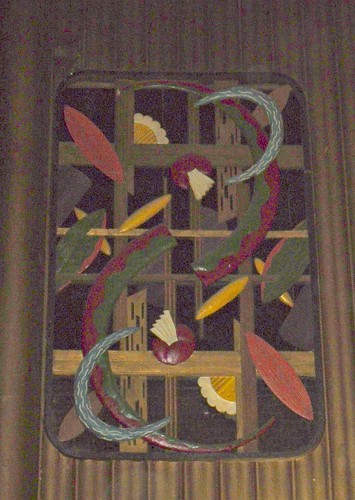
Former Braintree Cinema Interior Panel
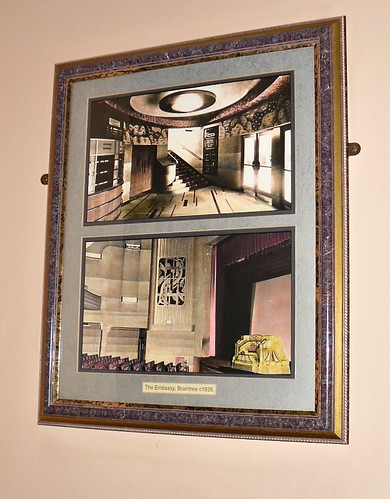
Former Braintree Cinema Photo Panel

Surprisingly the inside has not been mucked about with much. On either side of where the screen was situated – the screen itself appears still to be present behind the bar area – are some original panels one of which I tried to photograph (see left above) but the light level was very low so the result is grainy. Two photographs of the original interior are in a frame on the wall of the foyer (right, above.) The windows are not original but have been replaced very sympathetically. You can just about make them out here.

We astonished the waiter by saying we had actually seen films in it. (By the way, a true life incident – not to do with the film itself – from watching the first Star Trek movie there made it into my novel A Son Of The Rock in somewhat disguised form. It was too good not to use.)

Can You Change The Laws of Physics, Captain?

Italian scientists have reported a finding that implies that neutrinos can travel faster than light. So much for Einstein, then. (And perhaps Lieutenant Montgomery Scott of Star Trek fame – to be born in Linlithgow in 2222.)

I can’t deny it’s quite exciting and may mean we have to throw over everything we thought we knew about the the way the universe works.

And perhaps all those space operas where starships cleave the paper light years with ease might be reasonable after all.

Well, maybe.

The result is only that the neutrinos seem to arrive 60 billionths of a second earlier than they should have, with a plus or minus margin of 10 billionths of a second. It awaits checking.

Caution may be in order. Remember cold fusion?

In any case light is already known to travel at slightly different speeds depending on the medium it is moving through. It is slower in glass and air than in a vacuum, so maybe this is a similar effect.

Anyway, the reported difference between neutrinos and light isn’t much – 299,798,454 metres per second compared to the 299,792,458 metres per second of light in a vacuum and according to the first link above it’s already been postulated that neutrinos might be faster than light, if only by a fraction.

I think there’s sufficient accumulated evidence to suggest that Einstein’s famous E = mc2 equation is reliable that we won’t have to junk it just yet. Newton’s F = ma and F = Gm1m2/r2 are still going strong after 400 years.

Rocket Science?

There are two interesting posts over at Ian Sales’s blog.

The first is an attempt to (re)define “hard” SF. As far as he sees it – and I largely agree – this is SF that is bound, more or less, by known physical laws, by the restraints inherent in, for example, Physics and Chemistry.

In this regard any use of the trope of, for example, faster than light travel is – despite decades of convention and use in what might otherwise be considered hard SF stories – not hard SF in the strictest sense, as, to our best knowledge, the speed of light is an insurmountable barrier.

This is not to decry other types of SF (which are perfectly legitimate) merely to say that they go beyond the bounds of the known and, in the case of Space Opera in particular, which cleaves the paper light years with carefree abandon, actually tend towards wish-fulfillment. Though of course there is the necessity of getting characters from here to there in a reasonably efficient, non-boring manner.

It is amusing to recall here what is perhaps the most famous phrase in Science Fiction – certainly in its dramatic form, “Ye cannae change the laws of Physics, Captain.” This from a TV programme which made a habit, nay a virtue, of portraying just that.

Ian makes a distinction between hard sciences (Cosmology, Physics, Chemistry) and softer ones such as Psychology, Archaeology and Anthropology. While agreeing that the term is most often interpreted this way I wouldn’t myself say that stories featuring these could not be hard SF.

The second of his posts is an announcment that he will be editing an anthology of… hard SF; to be called Rocket Science.

No need to rush. Submissions will not be accepted till 1st August.

Rocket Science is itself a term that has often irritated me as it is most often heard in the phrase, “It’s not rocket science, is it?” as if rocket science was at the cutting edge, inherently incomprehensible. As Ian points out in his post, the science of rocketry – as opposed perhaps to some of its technological aspects – has, due to its basis in chemical reactions whose energetic outcomes are limited and, moreover, fixed – not evolved much in a century.

I know it’s use is as much metaphorical as anything else but I’ve always felt tempted to respond to anyone who trots out the, “It’s not rocket science,” line, that rocket science isn’t rocket science.

Rocket Science, however, may be.
free hit counter script