Archives » SF

Brain Plague by Joan Slonczewski

Tor, 2000, 382 p.

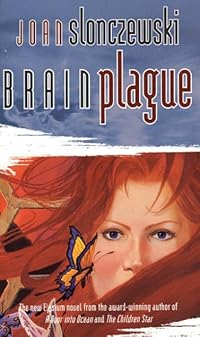
 Brain Plague  cover

Since the events of The Children Star – the third in Slonczewski’s tales of The Fold – the people of Valedon have come to terms with the microzoöids found on the planet Prokaryon spreading through their population. With some hosts the tiny creatures are under control (usually by means of restricting access to the arsenic necessary for their survival but also via rewards of the chemical azetidine,) in others their proliferation runs rampant resulting in a disease (the Brain Plague of the title,) whose victims become zombie-like. A rogue human element known as slavers promotes fear in the population by abducting citizens to their concealed planet.

The book’s protagonist is Chrys (Chrysoberyl,) an artist who can see infrared. Initially she is struggling to pay her rent and keep painting and when she is introduced to her colony of microbes, which reveal themselves and communicate with their host by flashing colours in the host’s eyes, some of her former friends and associates withdraw from her. Since the hosts have power of life and death over them the microscopic creatures refer to their hosts as gods. They also have only a limited understanding of their hosts’ lifestyles.

Chrys’s colony, known as Eleutheria and to whose leaders she gives names corresponding to the colours with which they “speak” to her, inspires her work and her paintings become collectable. Her microbes are also mathematicians and allow her to gain a contract to refurbish a failing piece of architecture known as the Comb, whose ever expanding structure has become unstable. The colony members’ lifespans are short and they have their internal politics for Chrys to contend with.

There is plenty of Valedon politicking to occupy Chrys outside all this and some intrigue involving the slavers whose secret planet she is the first to be abducted to and return to tell the tale.

Brain Plague is 392 pages of fairly small font size print and continues Slonczewski’s trait of incorporating biological and chemical ideas into her SF. It is rewarding enough reading and deals with a common SF concern (alien invasion of the body) with an unusual slant.

Pedant’s corner:- shrunk (shrank,) “the stress must have wreaked its program” (wrecked, I think, [and I spell it ‘programme’,]) “the shear newness” (sheer,) “laying low” (lying low,) a missing quote mark at the end pof a piece of direct speech. “The sphere cut in, it’s the plane of section…” (The sphere cut in, it’s plane of section.) “She shined her light inside” (shone.) “‘Such an distinctive cut’” (Such a distinctive cut,’) “Chrys grasp his back” (grasped.)

SF Bookshelf Travelling for Insane Times (ix)

Again, for this week’s contribution to Judith‘s meme now hosted by Katrina, it’s a crop of a previous photo (hence the blurriness.)

This is the shelf which contains books by my third favourite SF writer (after Ursula Le Guin and Roebert Silverberg,) Roger Zelazny.

ZelaznySF Books

So here you will find Lord of Light, Creatures of Light and Darkness, Isle of the Dead – starring the unforgettable Shimbo of Darktree, Shrugger of Thunders – and Doorways in the Sand. (The Dream Master, expanded from He Who Shapes, and This Immortal, ditto from …. And Call Me Conrad, must be just out of shot.)

SF Bookshelf Travelling for Insane Times (viii)

This week contribution to Bookshelf Travelling for Insane Times started by Judith and taken up by Katrina.

This shelf is full of SF books by Robert Silverberg.

He is my second favourite SF writer. (Ursula le Guin is my favourite but due to the way my books are shelved hers are not to the fore.)

The photo is a crop of the one I featured on 16/8/20. As a result it’s a bit blurry.

Science Fiction Books, Robert Silverberg

There’s stuff here from Silverberg’s glory days; Thorns, Nightwings, The Man in the Maze – the one that persuaded me to persevere with SF when I was on the point of stopping reading in the genre – Tower of Glass, A Time of Changes – “My Name is Kinnall Darrival and I mean to tell you all about myself. Obscene! Obscene!” – Dying Inside. Then there’s the much later Kingdoms of the Wall (see my take on its first paragraph here.)

Looking at the photo I see the books aren’t quite shelved im my usual order system, probably due to them getting mixed up a bit in the house move – six and a half years ago now. Time flies.

A Socialist Utopia?

The keener eyed among you will have seen from my side bar that I have just finished reading Chinese SF author Cixin Liu’s collection entitled Hold up the Sky.

In it there were two separate references to characters requiring medical procedures that were too expensive for them to afford.

I also heard on the TV news recently that those receiving a test dose of a vaccine newly produced in China against the Covid-19 causing coronavirus also needed to pay the equivalent of £45 pounds for the privilege.

China is reviled in certain quarters as being a Communist country.

I must say that on the evidence above China must be far from being even a socialist utopia, the minimum requirement for which I would have considered to be medical treatment free at the point of use.

Another Review Book

Hold Up the Sky By Cixin Liu

Hold Up the Sky by Cixin Liu is a collection of the Hugo Award winning author’s short stories. It’s my latest review book for Interzone and arrived this afternoon. It’s not usual for my mail to be so late in the day but I was pleased it came all the same.

Spy Fiction Bookshelf Travelling for Insane Times

This meme, originating with Judith, Reader in the Wilderness, has now been taken over by Katrina at Pining for the West.

Spy Fiction Books

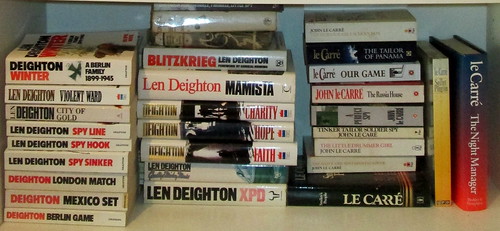
Back in the days of the Cold War spy fiction was a big thing. The two main purveyors of the form – in the UK anyway – were my (sur)namesake Len Deighton (although he pronounces the “Deigh” part to rhyme with “day” rather than “die”) and John le Carré. I also have a le Carré omnibus of his early works shelved elsewhere.

These, too, are housed in the garage, below the last of my SF paperbacks (see last week’s post.)

I have read all the books by Deighton here. His book Fighter is not on these shelves because it’s a history of the Battle of Britain but then Blitzkrieg is also a history book and it is here. Winter is not a spy novel but reflects Deighton’s knowledge of Germany (specifically Berlin) in the first half of the twentieth century. Goodbye Mickey Mouse is a novel featuring members of the US Air Force which took part in the campaign in World War 2 in the lead up to the invasion of Normandy. SS-GB is an altered history set in a Britain where a German invasion of the UK in 1940 succeeded.

I’ve not read all the le Carrés. Spy fiction lost a lot of its resonance when the Cold War ended whereupon he moved on to other things. I always meant to get round to his later stuff but life (and other books) got in the way.

House of Books, St Petersburg

Or the Singer Building. It’s the corner building with the cupola and sphere. Also known as Dom Knigi. Note Victory Day banners.

House of Books, Nevsky Prospekt, St Petersburg

The bookshop lies just by the Griboyedov Canal on the corner of Nevsky Prospekt and the Griboyedov Channel Embankment road.

St Petersburg, House of Books, Nevsky Prospekt

We went in. It has loads of lovely books. The good lady was most taken by the illustrated children’s ones. She bought a copy of Гуси лебеди (Gusi-lebedi or Geese-swans) and (in English) Pushkin’s Fairy Tales and also The Monarchs of Russia. The shop had a large stock of SF. Unfortunately it was all in Russian!

The light fittings on the Griboyedov Channel Embankment road are something else:-

Lampposts, House of Books, off Nevsky Prospekt, St Petersburg

HHhH by Laurent Binet

Vintage, 2013, unpaginated. Translated from the French HHhH (© Éditions Grasset et Fasquelle 2009) by Sam Taylor.
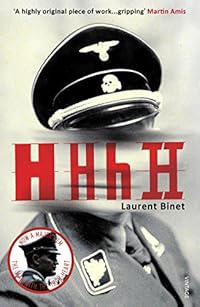
 HHhH cover

HHhH is a strange book, claiming to be a novel, but which is also a historical account of Operation Anthropoid, the British-backed mission to assassinate the head of both the Gestapo and the SD and architect of the Nazis “Final Solution” to what they called “the Jewish Problem,” Reinhard(t) Heydrich, (he removed the final “t” of his forename to make it sound harder) in Prague in 1942. The narrator makes much of his attempts to be true to his characters’ actual lives, saying he will eschew invention of dialogue where possible, commenting on occasions where he does so. He asserts his heroes are the assassins, Jozef Gabčík and Jan Kubiš (one Czech, one Slovak at the insistence of President-in-exile Beneš) and other members of the resistance, yet they and the assassination itself take up only a small portion of the novel which is really the story of Heydrich’s life and an examination of the insanities of the Nazi belief system and organisation. Along the way we delve deep into the roots of the Czech-German dispute – in mediæval times a Bohemian king invited miners from Germany to exploit the silver deposits found in his kingdom – we digress into the origins of the Reformation in the Hussite heresy and, solely because Heydrich visited Ukraine, the heroism of the Ukrainian footballers who took on the previously undefeated Luftwaffe team with ten men and despite being warned to lose at half-time, triumphed 5-1. A few days later they also won the return against a team bolstered by “professional” players from Berlin. [I put that “professional” in quotes because I’m sure I read somewhere else – probably in Inverting the Pyramid – that the pre-war German game was amateur and the Nazis believed only amateur sport was true sport. Professional football only developed in Germany after the war.] The Ukrainians also won the hastily arranged return match and all but three players, who escaped in the confusion of a pitch invasion at the end, were executed.

The narrator mentions the many books and films featuring Heydrich and/or the assassination which he has sought out or encountered – mainly to emphasise their historical inaccuracies – and puts in a good word for Conspiracy where Kenneth Branagh portrayed Heydrich at the Wannsee Conference but scorns most other representations. Despite his apparently encyclopædic knowledge of Heydrich’s afterlife in book and film he makes no mention of the only other I have seen bar Conspiracy, a film called Operation: Daybreak starring Anthony Andrews as Gabčík, but he does dwell on the novel on which the film was based, Seven Men at Daybreak by Alan Burgess.

The first person narration is a piece of authorial trickery. We are invited to believe it is by Binet himself but the narrator does his military service teaching French at an academy in Slovakia, Prague is the city he loves most in the world, yet the author is French – HHhH won the first-novel Prix Goncourt in 2010 – and the constant references to his attempts to establish facts (for example he dithers over whether Heydrich’s Mercedes was black or green; his memory has it as black but the museum exhibit he saw may have been a substitute, an otherwise reliable book has it as green) subtly undermine reliability. In a sly aside he mentions that – contrary to the perennial defence trotted out by ex-Nazis to defray blame for their actions – Heydrich was not averse to disobeying orders when the opportunity to be lenient was available. Heydrich was never lenient.

It seems Heydrich was also supremely arrogant, usually travelling round Prague with no escort, a fact which troubled Albert Speer on his visit to the city and to whom Heydrich says in the novel, “Why should my Czechs shoot me?” Heydrich had previously been shot down on the Eastern Front after a reckless chase of a Soviet plane in an attempt to make himself a war hero, causing great apprehension in Berlin till he got himself back to German lines. Hitler banned any further such adventures. Yet Heydrich didn’t learn. His only companion on the day of the assassination was his driver. After his death the book has Hitler berating his carelessness, saying, “Men as important as Heydrich should always know that they are like targets at a fairground.”

Except for those parts dealing with the narrator’s research and primary readers’ comments the book is for the most part written in the historic present. (John Humphrys would not like it, then.) Its unusual title is from the German Himmlers Hirn heisst Heydrich (Himmler’s brain is called Heydrich.) The original title Operation Anthropoid was apparently “too SF” – !!!! – “too Robert Ludlum.”

The climax of the German hunt for the assassins and their comrades, fruitless until they were betrayed by a fellow parachutist for the reward of twenty thousand crowns, is dealt with in a few pages. Of course, there are no eye witness accounts of the final moments in the crypt at the church of Saints Cyril and Methodius, as the group held out till their ammunition was about to be exhausted and killed themselves with their last bullets.

The narrator quotes George Sand – “Struggle against those who tell you: ‘Work hard to live badly’” – which he says is “not an invitation to digress – it’s a demand.” One of the Nazis is stated as thinking, “Scapegoats at all costs – that could be the Reich’s motto.”

Notwithstanding the lack of tension – surely any interested reader will already know the outcome – and the digressive nature of the treatment the book is immensely readable. It’s easy to see why it won the praise it has received.

The translation was excellent (except for its unfortunate forays into USian – ass for arse, jerked off.)
This Year’s Hugo Awards

These were announced at the SF Worldcon in London.

(I know I really ought to have gone but it was in Docklands rather than London proper and I don’t even like London much. Perhaps I’m tired of life.)

The winners for fiction were:-

Best novel: Ancillary Justice by Ann Leckie

Best novella: Equoid by Charles Stross

Best novelette: The Lady Astronaut of Mars by Mary Robinette Kowal

Best short story: The Water That Falls on You from Nowhere by John Chu

Of these I’ve read only the novel winner but congratulations to all.

Robin Williams

I was so sad to hear of the death of Robin Williams.

I first remember him from, of course, the US TV series Mork and Mindy where Williams played Mork, an alien sent to Earth from the planet Ork in order to observe its customs. He reported back to his superior, Orson, at the end of each episode which allowed fun to be poked at our human peculiarities. The programme wasn’t SF, it just borrowed one of the tropes for comedy purposes. His manicness was apparent even then. He blazed through that show like a meteor.

The first film I saw him in was The World According to Garp, where his serious acting talents were displayed. In Good Morning Vietnam and Mrs Doubtfire he showed a talent for acting in all its variety. By the mid nineties though I had pretty much stopped going to see films nor did I have time to watch them on TV so I haven’t seen much else of his.

He brought a lot of joy with his comedic abilities. It’s regrettable that gifts such as his so often come with a downside. A downside that seems to have cost him his life. So it goes.

Mork signs off.

Robin McLaurin Williams: 21/7/1951 – 11/8/2014. Na-Nu Na-Nu.

free hit counter script